Trust

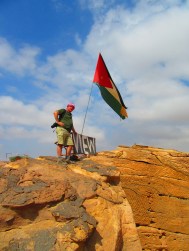
Passport, wallet, even my shoes were safely stored in the back of the jeep whose tailgate receded down the sand dunes and was buried from sight. We were alone in the desert. A man whose last name we didn’t know, whom we had met last night, pointed out a narrowing canyon and said, “Walk that way. I’ll meet you on the other side.”

We took refuge in the cool shadows of the red rock, followed it down the ancient and fading memory of a waterfall, stepped with rubbling boulders, to fresh sand, undisturbed. Birdsong, spare and echoing, lit our way past the trees, green and astonishing, growing in the heart of the desert.

Posted in spiritual autobiography, story | Tagged , , , | Leave a comment

Dead Sea Prayer

Floating in brine designed

not for propagating

but for pickling;

Suspended between peace

and petrification, love

and devotion.

When will your waters break

afresh, bringing a new creation

to its first astonished breath?

Posted in poetry, prayer | Tagged , , , | Leave a comment

Morning prayer

This morning, I fed the cat,
bagged the trash, wiped the kitchen
counter of crumbs, relics really;
raked the leaves, mowed the grass.

A rabbit, startled by the
gas-powered scythe scuttered,
white tail exposed,
exiting garden right.

I lit a fire. It smouldered
only, breathing smoke,
heaving ashes into air,
unspeakable particles of prayer.

Posted in prayer, story | Tagged , , , | Leave a comment

Salt and sabbatical

This Sunday’s readings include James’ admonition to pray for one another, and Jesus’ cryptic blessing of salt.


Pray for one another. Have salt in yourselves – that is, be true, and steadfast – and be at peace with one another.

One of the greatest gifts, arguably, that Jesus gave his disciples was the creation of a community of faith, of confession, of forgiveness, of the mutual covenant of prayer. They had been arguing about greatness. They had been worried about conformity. They had been concerned, gravely, by Jesus’ predictions of his own death, and confused by his hints of resurrection.

Jesus exhorted them to be at peace with one another, and to stay true to the mutual covenant between themselves and their God which continues to be the basis of our life together: the salt of the covenant, the seasoning of faith, the peace which passes understanding and allows strangers to become members of one body with one another.

Pray for one another. Have salt in yourselves, and be at peace with one another.

As almost all of you know, after today I will be on sabbatical for two months, until December, taking time to retreat and pray, to write and to listen for God’s Spirit in the silence of solitude.

I am hyper-aware that I am leaving at the end of a week which has been hard for many women and not a few men, because of the way that personal trauma has been visited upon our public life. For those whose background memories of private pain have been called forward, there has been little respite. For those who struggle to understand how such trauma can live in the base of the skull, and the pit of the stomach, and the lead weights that lodge in the bottoms of the feet, hidden and mute for days or for decades, there has been bewilderment. The two categories are not mutually exclusive, either, leaving almost no one unaffected by the mood of the news of the week. If your trauma needs more help than you manage with prayer, I encourage you to seek professional solace.

For while righteous anger is a fire that burns like salt, clean and hot, rage can wreak havoc like a wildfire. While godly grief cries out to heaven, despair can drown us with its tears. While the stubborn love of the cross stands firm, the obstinacy of oppression is blind to resurrection.

So pray for one another. Pray ardently for one another. Have salt in yourselves, for salt cleanses wounds and promotes healing.

I promise to continue to pray for you while I am away, and I confess my need for your prayers. But James advises the church not only to pray for one another, to sing for one another, but also to confess to one another, to convert one another. So here is my pre-sabbatical confession:

When God set aside the seventh day for rest and renewal, and the seventh year for the remission of debts and the restoration of liberty, the setting free of souls and the refreshment of spirits, God did so knowing that we have a tendency, left to our own devices, to become so involved in the workings of the world that without a reminder every now and again, we are inclined to think that we make the world work, and that it revolves around us. Taking a step back from that illusion feels dangerous, even irresponsible; but that in itself is a symptom of the delusion that makes us idols instead of images of God. Sabbath rest is a radical recognition of all of the ways in which we are not God, and in which God depends less upon us than we do upon our Creator, Redeemer, and Sustainer. The Sabbath reluctance to do anything productive is a profound act of faith.

I am not very good at it. Like most of you, I was raised implicitly or explicitly to believe that my worth is wrapped up in my usefulness to other people, and my value is measured by my work product, whether as a woman, as a mother, as a priest, as a writer, as a worker in the economic ant farm that surrounds us.

But that is the theology of Thomas the Tank Engine, who longs only to hear the Fat Controller call him “a useful little engine.” It is not the theology found in the Bible nor in the Word of God, Jesus the Christ, who celebrates the meek and the helpless, the poor in spirit and the hopeless, the errant and the outcast, the ungodlike.

I confess my need to abandon the illusion of omnipotence. Only with God are all things possible, and even so, not everything is probable. I am not God, who neither slumbers nor sleeps, and I confess my need for rest.

Be gentle with yourselves. Discern what is necessary and needed of you, and where you might simply be striving for the approval of the Fat Controller, who is not God; for God’s love is not dependent upon our usefulness.

I confess my need to give up the fantasy of God-like omniscience – of the knowledge of all things, in all places and at all times. This is not an invitation to ignorance nor a retreat from information – but it is a retreat from information overload. I do not need to take the pulse of the planet minute by minute. I am not its surgeon, nor its saviour. I need to listen more closely for the pulse of prayer, the voice of God calling in the wilderness. I plan to mute my social media feeds, and to disarm my phone; to balance my thirst for up-to-the-moment information and analysis with the long, slow quest for wisdom, and unchangeable truth.

I invite you, if it is helpful to your blood pressure and brain space, to consider rededicating a portion of the time you spend listening to the opinions of pundits and redirecting your attention to God: through scripture, through prayer, through the simplicity of silence; whether it’s replacing the morning news channel with sacred music, or turning off Twitter notifications and installing a daily office app instead. For what does it benefit a person to see the whole picture if they lose sight of God?

I confess my need to curb my desire for God-like omnipresence – for the ability to be in more places at once than is truly humanly possible. When I am away, I will be away. I will try not to bridge the ocean between here and there. That will be hard, because I will miss you. But part of my sabbatical journey is pilgrimage, and to walk in the footsteps of Jesus and hear them echo, I will need to try to be fully present to the places where his heartbeat still echoes, through the dust of the desert and the waters of the River Jordan.

I invite you to be fully present here: to be alert and awake to the community and its call, to the opportunities to hear the voice of Jesus speaking through his creature, the church, this community of faith.

I thank you for the gift of this sabbatical. I ask for your prayers that I will use it wisely and to the glory of God, and I covenant to pray for you. I pray that our mutual acts of Sabbath – the rededication of time back toward God, who is the only true Creator; our Provider, and our Rest – we might find some balance in a world whose equilibrium is often doubtful, and whose spin is frequently erratic.

Have salt in yourselves, the seasoning of God; rest in peace with one another; and may the God who only is good and great bless you and keep you until we meet again.

Amen.

Posted in current events, lectionary reflection, prayer, sermon | Tagged , , , , , | Leave a comment

Conjuring Esther

The readings for the nineteenth Sunday after Pentecost tell just a little of the story of Esther. They leave a whole lot out.


Esther has become difficult to read. Her story makes me angry and afraid. We read it like a fairytale. But like so many fairytales, it teems with themes of horror dressed up in royal satin and silk.

Esther was an orphan, given into the mercy of her uncle Mordecai. When the soldiers came to town, he failed to protect her, failed to hide her in the cellar, defend her with his body. He let them take her, take her to the harem of the king, where the eunuch took a liking to her. He gave her cosmetics. He taught her the tricks that would make the king like her. He groomed her for the royal bed.

Mordecai followed her. He saw that she could become his protector, and she was willing. Esther always did the right thing: obedient to her uncle, obedient to the eunuch, obedient to God, obedient to the king, her eyes downcast and her body compliant. She saved the people, no doubt of that. She was Haman’s downfall.

But none of the blood – none of their blood could wash away the stain on the sheets from a young girl, trafficked.

If she were alive today, and able to get away, Esther might sit outside the United Nations, holding a placard with a picture of her and the king smiling at a party, the wine flowing, her own face laughing, with the legend, #MeToo. She would watch the world leaders passing by, challenging them to censure one of their own.

She would stand outside the Capitol, piercing the consciences of congressmen and senators with her penetrating gaze.

She would darken the doorways of churches, interrupting sermons with her story: “Where was your God?” she would cry.

I will not tackle Esther from the pulpit this Sunday, for fear that my words might conjure her to appear in the aisle, to call me out.


Image: Queen Esther, by Edwin Long [Public domain], via Wikimedia Commons

Posted in current events, lectionary reflection, sermon preparation, story | Tagged , , , | 2 Comments

Fear of God

A slight detour on my countdown to sabbatical. In three weeks, I will return to Jerusalem for the first time in over thirty years; God willing.


It was a dangerously hot summer in Jerusalem. I got food poisoning from a falafel stand; but that is not why I am afraid to return.

I remember the bazaar, burrowing through narrow alleyways, accosted on all sides by street vendors offering tourist trinkets at inflated prices. “I’m not American,” I would tell them, and the price would instantly halve. “Fish and chips!” they would cry. These days, I am an American. No doubt the prices will be steeper.

A local boy assaulted me mildly, casually, on my way back to the youth hostel at sundown. I can still see him silhouetted against the pale yellow sandstone, his curls sharpened into stone themselves by the setting sun. But he is not the reason I am afraid to return.

I climbed the Mount of Olives, traced Jesus’ journey through Holy Week to the cross, and the tomb. I was not afraid of resurrection.

Thirty years older, and not much the wiser, I spend my days praying under the Presence of Christ, over the bread and wine, the simple stuff. I am a professional at proclaiming the promises of God.

I make excuses not to put God to the test. What I am really afraid to put on trial is the absence of innocence, after the long decay of youth. World-wearier, and decades more cynical than the first time around, I wonder if I could survive the solar plexus punch of raw religious experience, or whether I have armour-plated myself against it.

They say that when you get an electric shock, you can’t pull your hands away. At the remaining Wall of the Temple, a reckless teenager, I placed my palms flat against the stones. The current running through the living stones, the centuries of prayer and lament, the outpouring of blood, sweat, and tears gripped my hands and held them tight against the house of God, as though They would never let me go; as though I could never leave.

Posted in spiritual autobiography, story | Tagged , , , | Leave a comment

The great and the good

The readings for Year B Proper 20 include the disciples’ argument about who is the greatest, and Jesus’ child-assisted response.


“Look,” said Jesus, scooping up a spare small child as it scurried by; “Look. This is what greatness looks like.”

He sat on the floor with the little one and its grubby little feet kicking at him. The child peered into the ears of the Son of Man, and pulled the beard of the Son of God. The child rubbed its snotty nose on Jesus’ shoulder. It wriggled and began to snivel a little.

The disciples waited for Jesus to elaborate, to draw some great lesson, some marvellous metaphor out of this admittedly very physical spiritual encounter with the child. There must be something special about it, they thought.

But Jesus continued to sit on the floor, cradling the little one, wincing whenever it caught its chubby little fingers in his hair and pulled; making soothing, sighing, songful noises whenever it became fretful; like a woman, like a nursemaid, like a mother.

The child’s own mother, a woman of no consequence, one of the servants of the household, hung around the edges of the room a little bashfully, watching as the most honoured guest of all time whispered a lullaby to her drooling child. As the little one’s eyelids drooped, Jesus murmured quietly to his disciples, who had to lean in to hear him,

“Whoever can welcome such a child as this in my name embraces me. And whoever can embrace and welcome me has opened his heart and mind and body and soul to God.”

The disciples, still a little out of sorts from their argument about greatness, could not find it in themselves to dispute or question Jesus’ teaching, since no one wanted to waken the now-sleeping infant who still rested on the knees of the Messiah, who still sat on the floor, and whose right foot had now quite definitely fallen asleep along with the baby.

And now Jesus was stuck on the floor with a sleeping baby, his hands full, his feet with no feeling left in them, and the child’s mother had gone back to work. There was nothing for it but to continue to wait on the baby, serving it with patience and with love.


Another time, talking about greatness, Jesus told his disciples, “Greater love has no one than this: to lay down one’s life for one’s friends” (John 15:13).

This was more their pace, they thought. This was a lesson more suited to a man. Heroism. Good stuff. But the image of the infant still haunted their dreams of greatness. They were infected by the suspicion that Jesus really was talking less about grand gestures and more about great love.

Great love doesn’t have to wait for a great gesture. We can practice great love in small matters. We can practice on small children (or even small animals). They have a way of drawing us into the discernment of service: what do you need? What do you want? Why won’t you stop crying? Why won’t you stop laughing? Help me to understand you! How can I best and most lovingly serve you?

Each time we put our own life on hold – our desire, our need, our timetable – for the sake of someone else: letting them take the first or the last piece of pie; letting them go before us in line; giving up our place, our time, our pride and importance: then we are practicing, in our small, everyday ways, giving up our lives for those around us, our friends and our neighbours.

Jesus practiced it when he washed the feet of his disciples, his friends; he was demonstrating and foreshadowing and practicing the service that he preached, and the self-sacrifice that he lived out to the end, and beyond.

Greatness abounds in humility.

Power and pomp cannot feed the people: the hummus, the earth, the small seed, the dirty fingernails, the mud and the rain are more essential, more useful, than parades and penants. A loving arm, and a breast full of milk, is more useful to a child than all the tea in China. Such things are not the seeds of greatness. Small acts of great love, practiced with abandon, with more than occasional regularity; habitual humility and service is not the key to greatness: it is greatness.


We are good at discerning the lessons from this gospel as individuals. We have all taken a couple of mental notes already about how we can practice great love in small ways in the next day or week, and that is marvellous.

But what does a great church look like? What is the institutional image that is akin to Jesus sitting on the floor with the child of a serving girl? The Son of Man, whose dignity cannot be diminished, sitting on his pride and serving the needs of the one who needed him least in the whole household? If that is the measure of greatness, what is the greatest achievement or action of this church that you can remember or imagine?

Given a little time and a few pieces of paper, my loving and generous congregation came up with the following, among others, and in no particular order:

img_7774

A great church

reads the Bible
loves Jesus (they mentioned him a few times!)
welcomes all people to the table (this got said a lot, too)
opens its arms to children (as did this)
sings to God
reaches out into the community
plays well with others
serves its neighbours
has people willing to give of themselves
has people who care for one another
engages with social justice and gun violence prevention
is kind
prays
is willing to share the good news of God


A great church is built upon the greatness of our God; and the greatness of our God is that God so loves the world, that God sent Jesus to sit in the dust, so that all who needed it might find life in him, and dream of the divine, and be cradled by the great love, the amazing graciousness, of God.

Amen.

Posted in lectionary reflection, sermon | Tagged , , , , , , | Leave a comment

Sabbatical: steady

The logistical preparations for sabbatical are their own spiritual discipline. Last week I wrote about the creative stewardship of finances and professional resources – sharing priests across parishes and raising up lay leaders to facilitate one another’s time away.

The stewardship of attention and anxiety has also come to the fore as an important dimension of the discipline of preparing for Sabbath. Preparing to let go of the ability and the need to do – things, details – reminds me of how closely I hold on to the illusion of control, much of the time, without seeming to or meaning to; not out of (I hope) an inflated sense of authority or competency, but quite the opposite, out of my anxiety that if I don’t do what is expected of me, or needed of me, or do it right, that I will fall apart, things will fall apart, and my inward hollows will be exposed.

It’s not good theology: the idea that I can cover up the cracks in my own creation with artifice. It’s not good theology: that I hold the world together, and send it spinning on its axis. It’s not good theology, that it’s all on me; but it’s an old fear, and one with which I have learned to regard with some sympathy. It’s not good theology, and I know that it is not a true story: that my body and mind tell me superstitious tales born of childhood terrors and that magical thinking that protects the powerless and the very small and young.

It has its uses. The upside of being neurotic about leaving every question answered and every drawer tidy in my desk is that I finally have a tidy desk, and hopefully the endless lists and charts of information will be helpful to those taking care of business while I am gone. It’s knowing where to stop that’s key. Things will happen which I have not foreseen – and they will be taken care of. I will have got some things wrong, and my friends and colleagues will sigh and roll their eyes, and roll with it – and they will still welcome me back with good will. I may occasionally feel needed here, but I am not in control, and I am not in charge. I am not essential. I am not (spoiler alert) God.

That which God has created will not be destroyed nor undone; especially that which is formed in the very image of God. I think of ripples in a pond, diminishing over time and distance, further separating and sinking until no trace of them remains. But the changes they have made, as subtle as they may be, to the surface and to the depths and all that dwell therein; those changes are not undone when the memory of the ripple has gone.

What we do now matters beyond our reach and our imagination, then; which is good and terrifying to know. But in time, as memory fades, our impact, the good and the bad, will be become first anonymous, and finally infinitesimally indistinguishable from the layers of creation, of time, that surround us.

That interplay of significance and anonymity; of responsibility and mortality; of duty and humility: I think that is the balance that is trying to strike its loving note, like a singing bowl or a bell, insisting its echo into this scurry of self-fulfilling sabbatical preparation.

Posted in other words | Tagged , | 1 Comment

Love, lies, and blessing

The readings for Year B Proper 19 include James’ indictment of the tongue as a “world of iniquity,” Peter’s confession, and Jesus’ rebuke.

The tongue is a fire. … With it we bless the Lord and Father, and with it we curse those who are made in the likeness of God. From the same mouth come blessing and cursing. My brothers and sisters [and siblings], this ought not to be so, writes James.

Get thee behind me, Satan! replies Jesus.

We have heard many tongues speaking of the descent of civil discourse in our country lately. We have read column inches and books are printing straight out of the presses and off the shelves with page after page of critical analysis, conspiracy theory, and plain old gossip. Our heads snap from left to right as words are lobbed across our screens and our scenes like balls at a tennis match. If, as James says, the tongue and its little movements are like a rudder, then we are in danger of being lost at sea.

Get thee behind me, Satan! nods Jesus.

Peter had just made the statement of his life; the defining claim of his career: that this Jesus was, in very fact, the true Son of God, the long-awaited Messiah, the Christ, anointed, appointed by God to redeem the world out of its suffering and sin, out of its oppressive economy of war and one-upmanship, out of death into the life that God had intended for it, for all of God’s creation, from the beginning.

In the very next breath (or at least the next paragraph, the next scene), Peter is telling Jesus that he knows better than the Son of God, the Son of Man, how to do the work of a Messiah; how to do God’s work in the world. From one tongue in Peter’s mouth came the confession that Jesus is Lord, and the proud and preposterous claim that Peter, in fact, held the true keys to the kingdom of God.

Jesus said, You’re not listening, to yourself or to me. If you say that Jesus is Lord, then the next thing out of your mouth had better be consistent with that statement. Otherwise, get behind me, Satan.

Well, we all make mistakes, as James points out. Still, the idea that if we say that Jesus is our Messiah, then whatever else we say or do should make sense in the context of that foundational, ground-breaking, fundamental statement – that seems to be a good principle for working through some of the difficulties and dilemmas we find ourselves facing today, in whatever conversations we find ourselves having.

You can’t bless God out of one side of your mouth and then curse God’s image made flesh out of the other, says James. Experience would suggest otherwise: that we are capable within a minute, within a mile, within one family, one congregation, within one person to bless God and curse ourselves or another within one breath. But what James is saying is that when we fail to love our neighbour as ourselves (or perhaps ourselves as our neighbour), then we fall short of loving God with all our heart and all our mind and all our strength, as we are commanded to do, since we have failed to love God’s image wherever it is to be found.

This is where I find Jesus’ example of anger against Peter to be helpful.

Jesus did not love everything that Peter said, or did. In fact, when Jesus went on to tell the crowd, in front of Peter, that he would be ashamed of those who were ashamed of him and his ministry, his Messiahship – we can’t help but read that as a criticism of Peter’s words and a foreshadowing of Peter’s denial of Jesus, his shame at being associated with Jesus, outside the high priest’s house.

Jesus was hurt, he was frustrated, and for a moment he found it better, wiser even to turn his back on Peter: Get behind me. Get out of my sight, for the sake of my own soul.

Because Jesus is perfect in love, in the next breath he is back on track with Peter, and even after the betrayal before his trial and the desertion, Jesus welcomes Peter back into his resurrected embrace with words of peace. Jesus will not corrupt his own soul, or speech, with bitterness or enduring anger.

James’ advice without Jesus’ humanity is an impossible hurdle. James recognizes that himself: “No one can tame the tongue.” But with Jesus’ humanity, we recognize that there are steps that we can take to feel the anger, the hurt, the outrage, the incredulity, the pessimism, the disgust, the barbs that assault and prick us every day, without cursing the image of God.

A few weeks ago, after putting out invitations to our 90th anniversary picnic, I picked up an angry and anonymous message on our church voicemail. It wasn’t threatening, but the vitriolic, corrosive anger in the caller’s voice upset me. The good thing about a voicemail, though, is there is a separation of time and space between the message, the anger, and its arrival. I wasn’t called upon to respond on the spot, nor to read the features of a rageful person. I was given the gift of time and space to sit and ponder what would make someone so mad that receiving an invitation to a party incited their anger. The more I wondered that, the more I found myself praying for the person who had called, and the people who would cross their path without the insulation of an answering machine. I wondered whether we had, in fact, all unknowing done the work of God that day by absorbing this anger into our own body, safely and harmlessly, turning it into digital nonsense and a memory soon deleted.

The gift of time, to breathe, to pray, is a blessing.

There’s a Graham Greene story in which the characters like to say that we bless what we cannot love.

“I do a lot of blessing myself,” the old man said. “It’s when you want to love and you can’t manage it. You stretch out your hands and say God forgive me that I can’t love but bless this thing anyway.” …

The old man repeated … “We have to bless what we hate. … It would be better to love, but that’s not always possible.”

I think that it’s the Graham Greene version of “bless his heart.”

No one has tamed the tongue, James says, and it is a fire burning our own souls.

Get thee behind me, Satan, agrees Jesus.

When we temper the teaching of James with the humanity of Jesus, we can find a way to live with the tongues in our heads and the secret words of our souls. We do not have to deny the evidence of our senses; we can name what is wrong with the world. We can call out lies and counter them with truth. We take a breath, take a break, even turn away for a time if we need to. We can bless; we can always pray.

We can proclaim that Jesus is Lord, that God is love, and that come what may, the way of the cross is the way of eternal life. We can let it go at that.

We can protect our tongues from bitterness and our souls from shame by keeping to the truth, and holding fast to the hope that Christ has set before us, and following him, step by step, word by word, in the way of the cross, the way of God’s unimaginable love, for all whom God has made in the image of the living God.

Amen.

_________________________________________________________________________

“The Blessing” in Graham Greene, Collected Stories (Viking Press, 1973)

Posted in blessings, current events, lectionary reflection, sermon | Tagged , , , | Leave a comment

Holy Cross Day

Ach!

A splinter draws a bead of blood,

as the sting of a dead wasp exacts its revenge,

like a plaited crown of thorns twisted beyond play

the tree protests its perversion;

lungs of the world, breath of life

suffocating under the weight of salvation.

Posted in holy days, poetry | Tagged | Leave a comment