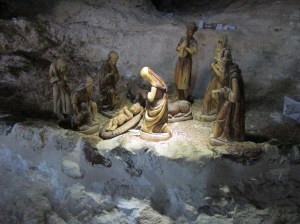
Mary’s first Christmas

The first Christmas after he had died, Mary wasn’t even sure how to feel. Her heart had never completely healed from that afternoon watching him on the hillside, on a Roman cross, muttering and crying, praying and raving. He had seen her, standing near. He told her to go home with someone else’s son. She didn’t know if he said it out of love, or out of bitterness, for the times she had tried to drag him home, out of danger, out of sight, out of his mind. She had not dared to ask him, afterwards.

Since that day, her heart had a habit of missing a beat, making her catch her breath painfully, as though the spear with which they had pierced him were jabbing at her ribs.

He had returned. It was a miracle; she should have seen it coming. They had already entombed him, but he walked out without his grave clothes, shrugging off his new swaddling bands.

She had always been a little afraid of his body. He was her first-born, and she was young, and far from home, and the midwives were strangers, and Joseph was kind but distant; they didn’t know one another so intimately, yet. She thought that he would tear her apart, as small and helpless as he was. She was afraid of his naked hunger, his eagerness to feed on her, on the stories she told him (how could she not?) of angels and God’s favour. And then, that naked ambition, returning from the grave, trouncing death, renouncing the execution of Rome; dangerous hunger, perilous power, risky resurrection. Her heart trembled again, its spear-point peaks threatening her.

She remembered the soothing sighs of the midwives, tried to match her breathing to their words, to calm her body and spirit. He had left again, after forty days, during which time she had seen as little of him as in his former life, which he spent on everyone who had need of him, his friends and strangers. She tried not to mind, that he had outgrown her womb, her breasts, her bosom, but ever since the cord was cut, it was hard to let him go.

The first Christmas after he died, she spent the dawn remembering that night in Bethlehem, and the stars, and the straw. Her sobs rehearsed those frantic convulsions of her body, his first cries; the first time she heard his voice, it was as though angels were singing. She would not touch his head again, nor cradle his feet, although they had hardened long since from their baby fatness into something more suitable for the journey of life. She missed the baby scent of him, and the sound of his laughter, disappearing around the corner of his childhood. If she tried hard enough, she could make herself see him coming through the door, as though he had never left home, and her whole being strained with the effort of recognizing reality: that the shadow in the corner was simply a broom, illuminated by the gray morning light; that he was not asleep upstairs, but sitting at God’s right hand in the heavens, wherever that might be.

Her heart was heavy, so that it was an effort to stand, when she found herself lying on the floor in front of the fire, warm on one side, and cold on the other, but she did stand up, and pick up the kettle to make the morning tea, before the rest of the household would awaken, his friends, her family, and wonder anew, as they did every day, if those were the clouds of glory that they was rolling down from the hills to the east, with the sun rising behind them.

Posted in advent meditations, story | Tagged , , , , , | 1 Comment

Good news, you brood of vipers!

A sermon for the third Sunday of Advent, Year C, at the Church of the Epiphany, Euclid, Ohio


John was quite a preacher. He could call people snakes, and threaten them with fire, and they called it good news!

At another time, in another place, Jesus said of John that no prophet greater than him had ever arisen – and that even so, John was but a speck of a man in the kingdom of God (Matthew 11:11). Why would Jesus say that? People were thrilled with John’s message. They were convicted by his preaching. They were filled with expectation, wondering whether he might even be the Messiah.

But John said, “No; I am water, he is fire. I am wheat, he is the sickle and the scythe. I am prophetic, he is powerful.”

The encompassing message of this story is that while John is good, and his message is sound, and his heart is on fire for God, nevertheless, the repentance that he preaches and the instruction that he gives is merely a baseline for living. It is not revolutionary. It is not messianic. It is enduring, but it is not eternal.

Take his advice to the tax collectors and soldiers: don’t exploit people. Don’t extort money. Do the right thing, even if others around you seem to be profiting from doing wrong. It might be counter-cultural, now as then, to promote honesty over gain, fairness over profit, humility over success; it may be counter-cultural, but it is hardly ground-breaking. It’s how we know the world should work, how we know we should act, if we could only keep our heads, our consciences, God’s commandments, even in a cultural context that has a tendency to excuse a sliding scale of corruption. It’s as though a border patrol agent asked him, “What should we do?”, and he told them to treat asylum seekers as children of God, or a drug company CEO, and he told them to put healthy people ahead of inflated profits. What would he say to a police officer today, or to a parent, or to a parishioner at Epiphany? Do the right thing. It is pretty basic stuff.

Or take his invitation to share our abundance with those experiencing scarcity. “If you have two coats, give one to someone who has been left out in the cold,” offers John. “If you have enough to eat, show your gratitude by sharing with someone who doesn’t have enough (instead of complaining about how they spend their food stamps, for example, or whether they deserve them).” It is good and sound policy, based on God’s law of loving our neighbours as ourself, and showing kindness and mercy to the orphan and the alien. But let’s face it, it’s pretty basic. It is almost literally the least we could do.

John’s message, the need for his words, the impact that they have on the people around him – “He said to do good, to share, to be fair and merciful! Could he be the Messiah?” – the fact that such basic tenets of human cooperation are received as astonishing and revolutionary should be shocking, to us, and to his original brood of vipers. If it isn’t, then it’s time for us to wake up and smell the wickedness that has seduced us into accepting an environment of tawdry and banal selfishness, casual corruption. Have we fallen so far that simply not doing evil sounds like salvation?

We will not save ourselves by the baptism of John, but God has more in store for us. We will not save ourselves by the baptism of John, but to get our own house in order, to deal with our own sin, to clean up our own station, to share what overflows from our bucket of blessing: that is almost literally the least we can do. Because God wills so much more for us than to be concerned with counting tokens. We will not get into the Good Place because we earn enough points.

The good news, John prophesies, is that there is more to the story than trying not to do wrong and fighting to do good. It would be so depressing if the pinnacle of human achievement, the redemption of humanity, the restoration within us of the image of God were so pedestrian, so basic. But the gospel was not designed to be depressing. The gospel was designed for our rejoicing, for the revelation of the overwhelming, unimaginable, indescribably, beyond reasoning goodness of God, revealed to us ultimately not by the prophecies of John, but by the presence among us of Jesus Christ.

Of course, you know that two months ago we travelled to the places where John was preaching, to the cave of Elijah where he made his wilderness home, on the banks of the Jordan River, still militarized, still full of soldiers. We went to the hilltop palace where Herod Antipas imprisoned John and had him killed, and it was empty, and razed to the ground, stripped of its glory and abandoned. Such is the fate of tyrants, and the end of egotism.

But the glory of God endures for ever, and the grace of God cannot be destroyed. Even in death, Christ became alive. Nothing can burn down the kingdom of God.

And what does that look like? I’m sure you all know the story of Silent Night during WWI. Last month, we celebrated the one-hundredth anniversary of the armistice that ended the Great War, which was supposed to end all wars. We know that it didn’t. But even in the midst of that turmoil and great suffering, there was a glimpse of what life could be like in the kingdom of God. You remember that at Christmas, the carol Silent Night served as a sign of truce that produced a pause in the fighting. But more than that, the troops came out of their trenches and played football together. But more than that, they shared the gifts they had received from home. Those of you who have served away from home and family know what a sacrifice that was. These people, these men, not only ceased from fighting, but more than that, as a sign of the coming of Christ they shared their mothers’ home cooking with the enemies they had been paid to kill. That is what the kingdom of God looks like. That is what we are looking for.

We follow the preaching of John as a prelude to the coming of Christ, not as an end in itself, as though if we could only keep our heads down and our hands clean while the world swirls around us in systems of sin, we could earn our own salvation. We know that’s not how it works. We’re in this world together, and we do the best we can, not for our own sakes but for the sake of the gospel that is breaking through with good news for all people, for the poor and the neglected, for those in pain and the forgotten, for the lost and the last in line for benefits and blessings. We do it, not for our own salvation, but because we know that it is the will of God that all should know the coming of Christ, the love of God born into the world, and rejoice.

Christ is coming, with his winnowing fork and his fire, with his infant cry and his table-turning rage, with his death-defying life and the blazing love of God. That’s the good news.

Amen. Come, Lord Jesus.

Posted in sermon | Tagged , , , , , | 1 Comment

Invested

It’s the sixth anniversary of the mass murder of children and adults at Sandy Hook Elementary School in Newtown, CT, and I have been invited to comment on the topic of shareholder advocacy in gun manufacturing, and it’s about breaking my heart.

Even as naïve as I am, I recognize that we are in the marketplace, and that we cannot pretend, like Pontius Pilate, to wash our hands and be clean of the whole shooting match. We walk the Via Dolorosa. We live under the shadow of Golgotha, and of Sandy Hook, and of Stoneman Douglas, and of Pulse, and of Aurora, and of Chardon, and of Columbine. In life, we are in the midst of death, and there is something to be said for managing the morbidity the best we can.

But the idea of actively investing in the manufacture of guns does not sit well with me. At best, I read it as a mixed message. Gun manufacturers exist to fabricate, market, and profit from the proliferation of these weapons, of which we already have too many, circulating too freely, wreaking too much harm.

We may say that it is impossible to do any better than to invest in these weapons and try by our votes and voices, our purchased influence, to turn their fire away from our schools and offices and yoga studios. But it feels like as though we are making a dangerous deal.

This Sunday, I will be preaching about how John the Baptizer’s message of repentance was about doing the best you can to live right within a system that is all wrong, and the people were so impressed that they thought he might be the Messiah. But the gospel is more revolutionary than that. Jesus asks more of us than to make do within systems of sin and do our best to keep our hands clean.

I admit, I don’t know that much about investing. I didn’t come from a portfolio family. I think that the guidelines established by Do Not Stand Idly By and cited by Resolution B007, passed by this summer’s General Convention of the Episcopal Church, do help investors to consider and evaluate their effect on the gun industry.

But the gospel convinces me that we can do so much better than to fund the manufacture of weapons that cause chronic and devastating death in this country day by day, year in, year out.

It may seem impossible, but so is resurrection, and in the face of death, we believe it anyway.

Posted in gun violence, story | Tagged , , , | 1 Comment

Advent obligations and indulgences

A version of this piece was first posted at the Episcopal Cafe under the title “Speaking to the Soul: Look up and raise your heads”


On the first Sunday of Advent, my church distributed calendars with suggested activities for each day between now and Christmas. They included things like:

“Support a charity”
“Look for something positive to say to everyone you meet today”
“Invite someone over who would otherwise be alone”
“Turn off digital devices and really listen to people”

I didn’t take a copy of the calendar, not because I don’t think that its suggestions are good, nor that kindness shouldn’t be scheduled (why not?), but because these daily things feed my anxiety and fear of failure. What if I miss a day? What if I’m having an incurable introvert day when I’m supposed to invite someone over? What if I am just not a very good person?

So I didn’t take the calendar, but kindness followed me home anyway. It happened this way:

That Monday morning I woke up grumpy (reading the above, you might not be surprised). It had been a beautiful weekend, with temperatures in the 60s, and everyone else on the street had raked their leaves while I was at church sunrise till sunset. I had just finished Morning Prayer with the cat when we heard the leaf-sucky-truck turn onto our cul de sac. I wondered if there was any chance I could at least clear a few leaves off the driveway before they got to our house.

Outside, the weather had turned its switchback bend and an icy rain was struggling to fall. I battled the wind for control of the leaves while the sucky-truck driver and I eyed one another across the circle. Halfway through my neighbour’s mammoth pile, they had filled the truck, and had to go and unload. In a rash rush of enthusiasm, I not only cleared the driveway but decided, as long as they were gone, that I might as well get started on the lawn.

About halfway through, they came back. About three-quarters way through, they started on my own leaf pile, began to suck it up – then stopped. Apparently, they decided that they’d better go and empty the truck again. Now, no way was that truck full.

I finished the leaves in time to shower and change for work, but I would need to wait until the leaf people came back and cleared a pathway off my drive, which was now blocked by a trench of leaves a couple of feet high all the way across. From behind my blinds I soon saw them return, pick up a “thank you” card from the top of the leaf pile, and carry on with their sucky work.

On Sunday morning, before the calendars and the climbing temperatures, I had preached on Jesus’ words to his disciples in the Gospel of Luke:

“Now when these things begin to take place, look up and raise your heads, because your redemption is drawing near.”

It occurred to me that the leaf collectors had given me a demonstration of exactly that: looking up, raising their heads, noticing the stressed-out, slightly frantic woman with the flying leaves, they decided that it was in their power to make her task a little bit easier, to give her a small break, to redeem her day, by emptying their truck a pile or two early. Looking up, taking notice, seeing where help could be extended, without even a word; just kindness.

I did feel better after my encounter with the leaf collectors. The physical exercise no doubt helped, and the fresh air, but also it reminded me that it is almost impossible to calculate or to know what the smallest notice, the most minor kindness, done deliberately and without ceremony, can do to lift the spirits of one who might need it more than we imagine.

I am still eschewing the calendar, in case it’s a guilt-trap; but I grateful for the example of the good people on the sucky truck, of how to look up, raise my head, and try to notice where redemption may be within my reach.

Posted in advent meditations, story | Leave a comment

TLK W GOD

A sermon for the second Sunday of Advent in Year C at the Church of the Epiphany, Euclid, Ohio


See, I am sending my messenger before me to prepare the way …” (Malachi 3:1)

Last Sunday, driving between this church and the Church of the Good Shepherd for our Advent Lessons and Carols, I found myself surrounded by cars proclaiming prophetic messages. I still find that surprising. I grew up in a much more secular country than this one. It’s also a lot more expensive to customize a license plate there, so it would be almost unheard of to find the prophets of God driving their messages down the highway on the bumper of their cars.

The ones that frustrate me are the ones with random bible verse references. I feel as though I am supposed to know the words to which they refer, but I don’t memorize chapter and verse numbers easily, so instead I have to remember to look them up when I get home, and sometimes they are so obscure that I can’t for the life of me work out why someone would take the trouble to display them in heavy traffic.

But the messages that surrounded me last Sunday were pretty clear.

In front of me, the number plate spelt out TLK W GOD. Next to me, a lady in a real church hat was driving a car with a Jesus fish; and not just the fish, but one that spelt out JESUS inside the fish shape. On the other side of me, a big SUV had a big poster message plastered across its flat back: JESUS IS SO AMAZING! (Not just amazing, but SO amazing.) PRAY FOR THE POLICE, it continued, MORE GOOD COPS (pray for more good cops, or pray because there are more good cops than the ones we see on the bad news stories? You decide); IF YOU NEED A LAWYER, CALL 216 …

Now, I don’t know the story behind the decal, so I will try to reserve judgement, but I couldn’t help feeling just a little as though they were beginning to drift off-message towards the end there. What’s worse, they started out using their space, their presence, everything at their disposal to proclaim that Jesus is so awesome, but they ended up using Jesus, using the gospel, to advertise themselves instead.

But then, the SUV-driving lawyer decided they needed a change of scenery, and shifted over to pull in behind me, and I thought of my own bumper sticker: God Loves You. No Exceptions. And I wondered what the lawyer read into that. After all, people do read, and decipher, and evaluate, or judge, the signs and messages we put out about ourselves, about God, about Jesus and the gospel. My own little sticker has provoked a few casual, brief conversations. It’s even provoked the occasional mild outburst of road-rage – at least I don’t think it was my driving.

Last Sunday’s brief encounter with the messengers of God at a stop light made me think about the messages that we send out to those around us, in every encounter, whether we mean to or not. Are they clear? Are they internally consistent? Are they faithful? Do they proclaim the gospel of Jesus Christ, not of Rosalind Hughes? Do they prepare the way of the Lord?

“See, I am sending my messenger before me to prepare the way…”

We are messengers going before Christmas during Advent. I am not suggesting, like Micah, that we all need to act like refiners’ fires, purifying the metal of the people to make of it acceptable ornaments for the household of God, although if you know that you are carrying some dross and sin, there has never been a better time to repent, come clean, sweep out your own soul ready to receive Christ.

But I’m thinking more about that voice crying in the wilderness, “Make straight the paths. Smooth the rough ways.” We who live in what can often feel like a wilderness; we are the ones invited to clear the ground, to manage our eternal infrastructure, to build a highway to God, to remove all obstacles to the gospel, so that the most weary and furthest removed and least likely to look up will see and know the coming of Christ, and have a chance to rejoice.

It is our calling to be straightforward about the faith we have received: to be honest, that we don’t own the glory of God; that we don’t have all the answers; but that we trust in the gospel of Christ, clinging to it like a life preserver at times; trusting that God is with us.

It is our calling to smooth the way for people to come to Christ, offering our company, a ride, a shoulder, a seat at the table, a translator, an ally: whatever is needed to remove the obstacles and ease the passageway for weary feet.

It is our calling to cry out the goodness of God in Christ; not as a way of advertising our own services, but for the sake of the gospel itself, because we know that life is better with God, that we are comforted by the Sacraments of Christ, and the communion of saints.

At coffee hour today we’ll have the opportunity to create and post a message from God: of hope, of love, of mercy, for those who use this building to find. Some of them come with no hope or expectation of finding Jesus here. Let’s let them know that God loves them, no exceptions; that God is here for them.

Just as my little bumper-stickered car found itself surrounded last Sunday by signs and indications that God was at work all around this city, so we are not only the messengers, but we are the people in need of a good word ourselves. And God has us covered.

“See, I am sending my messenger before me …”

This is not an idle promise. Throughout the ages, God has raised up prophets to prepare the people for the coming of God’s glory. Throughout the generations, God has sent messengers to announce good news, to declare that God is with us. We should expect God to show up, especially now, in Advent, when we are supposed to be looking for the signs all around us that God is with us, born as one of us, as close as the palms of our own hands.

Expect God. I think that should be my next bumper sticker. Expect God to show up in the first cry of a child, in the last gasp of hope. Expect God to be with us on the journey.

Amen. Come, Lord Jesus.

Posted in advent meditations, lectionary reflection, sermon | Tagged , , , , , , | Leave a comment

Be still and know: meditation on a breathing meditation

It’s been sixteen days since I published my advance review of J. Dana Trent’s #OneBreathBook (One Breath at a Time: A Skeptic’s Guide to Christian Meditation, available for pre-order from Upper Room Books). Sixteen days later, I’ve just finished my first eight-day cycle of Breath meditations. Fortunately, Dana is generous with both permission and forgiveness, so I will continue at my own erratic pace into the next octave, Centering; but I will be reluctant to leave breathing behind, as it were.

In the maturing days of the breathing meditations, I found myself drawn to that space which opens up between slow breaths. After each breath is complete, there is a pause, in which nothing at all happens. My body is sated with breath, for now; in a moment, it will open up for more, reach out of its own accord, but in that present pause, there is stillness, silence, a full and sufficient absence.

For the space of a day or two, it reminded me of giving birth to my son. Between the contractions of second stage labour, when push came to rest, while all about me were carrying on with encouragement and activity, my child and I knew a secret internal stillness, in which we contemplated the transition from one level of living to another, and enjoyed together the final moments of peace before a new beginning would crash upon us.

Another day, it made me think of gills, and of wings, of metamorphosis, as though the moment of breathless life could last forever, as though there were the possibility, in that pause, that instead of an automatic response my body would decide that it no longer needed lungs, that a whole new way of being was open to it, that we would rise together as something new, and unheard of.

Then, of course, unbreathing carries intimations of mortality.

Centred 
in the pit dimension,
opening up unseen between
inane thoughts of profundity,
the beat of blood dancing
seedily, sliding down 
untidily; every
ten seconds,

after every
exhalation,
everything

stops

… between each breath,
a little death,
still as the grave
face of God

“Be still, and know that I am God.” I revel in that moment of un/being: the stillness of eternity.

Posted in book review, meditation, poetry, prayer | Tagged , , , , , , | Leave a comment

Stand up for Advent

A post-sabbatical sermon preached at the Church of the Epiphany, Euclid, Ohio, December 2 2018. The readings are for the First Sunday of Advent, Year C. The text may be more or less as delivered.


It’s good to be back and I have a lot to tell you about and I want to hear about the many things you’ve been doing while I was away, and I hope that we will have time for that over the coming weeks in coffee hours and conversations …

For now, here we are together again, appropriately enough at the start of Advent, a time of new beginnings, the first day of a church year.

Bethlehem grotto

A grotto at the Shepherds’ Field outside Bethlehem

During Advent, we will remember that the birth of our Saviour, Jesus Christ, while it is our gateway to God, our touchstone, our own birthday as Christians; that it is not the only time that God was with us. God is not locked away in history nor in mystery, although God is present in both. God is not limited to time and place, nor contained by the competing grottos of different denominations scattered about. God is with us at all times and in all places. God is with us in times of plenty and of celebration. God is with us in unity and in isolation. Tonight our friends and neighbours in the Jewish community will begin their celebration of Hannukah, the festival of lights that celebrates the miracle of God’s divine intervention in a time of great danger, need, and fear. God is with us in such times. God is with us when we cannot see a way through the very present dilemmas of life. God is with us.

We hold fast to that faith even as we pray throughout Advent, Come, Lord Jesus, hoping for some new sign, some new and undisputed intervention, some miracle to rescue us from whatever it is we think we need rescuing from.

IMG_3705

Washington National Cathedral

I spent this past, last week of sabbatical on retreat, trying to finish my book before I returned. Spoiler alert: I didn’t get it done yet. Nearly. Anyway, I spent part of the week in a hermitage in Washington, DC, and on Tuesday, I went to the Episcopal cathedral church of Saints Peter and Paul, otherwise known as our National Cathedral. During a noonday Eucharist, the presiding priest addressed the signs and portents of Jesus’ apocalyptic sayings, the wars and rumours of wars. He, from the heart of DC, spoke of a war on our common values. When we see such signs, he said, it is time for us to raise our heads, take notice, and stand for what we believe in.

As he suggested, we see such signs all around us. As we draw near to Bethlehem, and the holy family knocks on the doors of houses full and unwilling to become any fuller, the political and religious cartoons of the southern border write themselves, don’t they? No room. Go away. A pregnant Mary choking on tear gas, an infant saviour born into respiratory distress. When we see such attacks on what we hold dear, those whom we hold dear, our neighbours, it is time for us to stand up.

[Find an interfaith statement from northeast Ohio religious leaders on immigration here.]

Jesus said, “There will be signs in the sun, the moon, and the stars, and on the earth distress among nations confused by the roaring of the sea and the waves.”

IMG_3680

Red Rock Canyon, Nevada

Hiking in the southwest of this country earlier last month, stopping for lunch at the top of a small mountain in Nevada, we met a couple from the Bay area. They had come to escape the smoke of California’s wildfires; to find free air to breathe for a time, before plunging back into the valley, the shadow of that terrifying inferno. The signs are all around us, and the scientific data and reports, of devastating climate change and the damaging effect unchecked human exploitation is having upon our environment. It is time, it is almost too late, some say, to stand up, raise our heads, take notice, and take action.

The time of your redemption is drawing near, Jesus tells us, and I don’t think that he is talking about a divine miracle that will rapture us out of a burning world, but our redemption, the one we organize and energize and mobilize in the name of the kingdom of God, in the name of the coming of Christ, in the name of compassion for the people and the earth that God has made.

God is with us. Are we with God on this?

IMG_3249

Olive trees at the Garden of Gethsemane

And then, the weekend after we returned from the Holy Land – and trust me, you are going to hear so much more about that journey, more than you ever wanted to know – but I have to talk about this: the Saturday, the Sabbath after we returned home, a man entered a synagogue in Pittsburgh and killed a number of people at prayer. They were martyred, reporters concluded, partly because of their tendency to stand up for what they believed in: to stand up for migrants, immigrants, the desperate and the dispossessed; and partly because of their tendency to stand up in prayer and praise and worship of God. They were killed because of anti-Semitism, because of xenophobia, and because it is all too easy, in this time and place, to find the means and machines with which to carry out mass murder.

Every Sabbath since I have thought of my friend, Beth, whose husband is a rabbi to one of the three congregations who met at Tree of Life, whose family remains whole, thank God, but shattered by the work of grief and of shepherding their community through the funerals that followed and the work of holding out hope, standing strong, raising their heads, continuing firm in the faith they have claimed, their common values. Tonight, they will begin their celebration of Hannukah, the memory of the enduring and unfailing fuel of God’s faithfulness towards God’s people.

IMG_2956

Graffiti on the border wall at Bethlehem

After the shooting, I saw calls from the president on down to a local columnist advising that our response to such evil should be to compromise our own values, take up arms against our neighbours, rely on the power of death to counter death, of violence to stem hatred. It is up to each community to assess its risk and its response, of course; but for the state to tell the church that in order to pray in peace to the Prince of Peace, the Giver of Life, the God of Love, we should practice those values only behind locked and guarded doors; I’m not going to stand for that.

Because that, my friends, is a trap. “Be on guard so that your hearts are not weighed down with … the worries of this life, and that day catch you unexpectedly, like a trap,” warns Jesus. Do not become consumed by signs of turmoil. Stand up. Raise your heads. Give voice to the gospel. Expect God. Pray that you may have the strength to stand before the Son of Man at his coming.

[God Before Guns offers opportunities to take action against gun violence through prayer and advocacy.]

IMG_2349

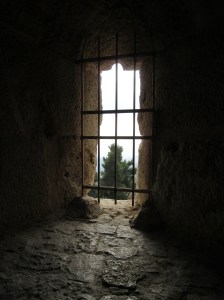
Barred window at Aljoun Castle, Jordan

This morning, we are, among other observances, celebrating St Nicolas, Bishop of Myra, patron saint of children and sailors. We remember him mostly in children’s stories of secret miracles, gold coins found in stockings to save some girls from certain human trafficking; maybe not quite as child-friendly a story as we might have hoped after all.

The good Bishop Nicolas considered that all that he had was a gift from God for him to share, to use for the good of those around him, not only for himself. This was his value, that he knew his place not as a guardian but as a selfless sharer, avenue, giver-out of God’s grace and mercy. Nicolas was imprisoned and tortured for his defence and fearless practice of Christianity under the persecutions of Emperor Diocletian, and we remember him as a saint, one of those washed in red and clothed in white, standing before the throne of God, because he did not waver in standing for the gospel that he understood.

We often talk about Advent as a time of waiting, but Jesus directs his disciples to stand, to raise their heads, to look hopefully for their redemption, to search actively for the coming of God’s kingdom, which has indeed drawn near.

Our neighbours at Trinity Cathedral this morning are welcoming a new worshipper, Ansly Damus, a Haitian asylum seeker who has been released on bail after two years in prison waiting, still waiting, for his case for asylum even to be heard. The people who stood for their values of Christian love, mercy, and welcome, who raised up a busload of supporters to travel to Michigan to court this week, finally had their prayers answered in Ansly’s albeit conditional release.

IMG_2426

Olive trees at Mount Nebo, Jordan

The signs of God’s kingdom are all around us, but they require us to stand up, raise our heads, take notice in order for us to see them over the turmoil and trappings of the world. They require our hopeful persistence, though heaven and earth pass away, holding fast to the promises of God: I am with you, till the end of it all.

May we journey together this Advent, a caravan of pilgrims bent on reaching the kingdom of God, revealed and realized and unmistakably relevant in this time and place, as much as in Bethlehem, as much as ever:

Come, Lord Jesus. Amen.

Posted in lectionary reflection, sermon | Tagged , , , , , , , , , | 2 Comments

Book Review: We Pray With Her

We Pray With Her: Encouragement for All Women Who Lead
Emily Peck-McClain, Danyelle Trexler, Jen Tyler, J. Paige Boyer, Shannon Sullivan (Abingdon Press, 2018)

(This review is based on an advance review copy supplied by the publisher. For a chance to receive your own free copy, see below.)


This collection of essays, reflections, and prayers is gathered from over 70 Methodist clergy women under the age of 40, compiled by the five editors named above. The result is a gifted resource that is as varied as seventy women can be, while holding the thread of that particular time of life, and that particular place in which women find themselves over and again in our society, of sometimes grumpy,* sometimes celebratory, oft-times put-upon, regularly resisting and persisting sisterhood.

Being at least ten years older than any of the writers, I cannot fail occasionally to recognize the generation gap between us. Still, the specificity and universality of their message to the women with whom they pray is that God is with us all.

The book itself is small enough to carry, and to read in a sitting if one had a whole afternoon stretched out ahead of oneself and needed some company during a cross-country flight to find a new job, or a long, slow chemo treatment, or the first day alone after the children start school.

More likely, it will be used as a resource for those moments when a certain prayer is needed, a voice of comfort or of challenge while you count to ten. Each essay is a page or so, followed by a prayer which might be a sentence or two, organized into sections of Call, Struggle, Courage, Resistance, Persistence, so that one can always find what is needed quickly and easily. Longer prayers are added in between the essays, for general themes: “A Prayer for Discernment;” “A Prayer for Transformation Through Struggle;” and for very specific needs: “A Prayer for the Unplanned End of Breastfeeding;” “A Prayer When Experiencing a Panic Attack,” for example. They are listed in the contents, for a quick-dip look-up.

There is also plenty of extra material to follow up on, should you feel so inclined. Each essay is headed by a quote from the Bible or from some other source, some familiar, others (to me) brand new. I want to learn more now about Sor Juana Ines de la Cruz, with a view to adopting her as my patron saint of sarcasm (see next paragraph). In the meantime, the regular return to scripture is a faithful anchor, and the variety of voices is such that you can choose your prayer companion: whether you need a comforter or a swift kick in the pants, they have you covered.

The hidden treasure of this book for me, though, is the wealth of imagery, pairing narwhals and Brussels sprouts (Rev. Elizabeth Ingram Schindler); smashing patriarchy and printers (Rev. Shannon E. Sullivan); describing courage as a pirouette (Rev. Sarah Karber); celebrating the secret virtue of sarcasm (Rev. Angela M. Flanagan). I enjoy these women’s wordplay, and their invitation to play along.

I can readily imagine giving this book as a gift to a woman embarking on a new call, a new career, a new phase of family life, or one who, in the middle of it all, is crying silently or aloud for some encouragement.


For your chance to receive a free copy of We Pray With Her, leave a comment on this blog before December 1, and make sure that you enter your email address. A random responder will receive an email asking where I can send the book during the first week in December. This deadline has now passed.

To order a copy for yourself or a friend, visit the publisher’s website or your favourite book retailer.

9781501869709_CVR_FinalLayout.indd


*(This is a good thing.)

Posted in book review, prayer | Tagged , , , | 8 Comments

Book Review: One Breath at a Time, by J. Dana Trent

I like the subtitle of J. Dana Trent’s new book, One Breath at a Time: A Skeptic’s Guide to Christian Meditation. I know that I am not the only person in the universe who does not enjoy being told what’s good for her. I am also suspicious of other people’s enthusiasm for new and exciting activities that will change your life, deepen your spirituality, and improve your skin. The fact that the author of this introduction to meditation as a thoroughly Christian and very useful practice is on board with such scepticism is the first plus, in my book (pun intended).

I might still have resisted, but I love the author, and I really enjoy receiving Advance Reader Copies of books, which Upper Room Books kindly provided electronically for the purposes of this review.

It helped that I had read an advance chapter several weeks ago, and recognized that Dana Trent is a genuine fellow traveler on the “yeah, right” train. She has had her own share of false starts on spiritual and meditative practices, including one infamous meditation app voiced by a relaxation tormentor known ever after as “Mr Villain Narrator.” Trent is not offering us this meditation guide as the answer to all woes, but because in the midst of grief, chaos, migraines, and joy, she is searching as hard as any of us for some connection, some anchor, some God that can hold us when we can sometimes barely hang on.

This is meditation for real life.

Trent is not asking for much. In fact, she insists that we begin with no more than three minutes of meditation at a time – less if necessary. In a typically reassuring passage, she writes

Meditation practice is not another to-do to add to our daily lists but a way of life. … This new way of life doesn’t require a total upheaval, remodel, or demolition. It simply starts with a beginner’s mind and a longing to connect with God, one breath at a time.

“A longing to connect with God, one breath at a time.” As I commented on first reading, there are those moments when you don’t know how hungry you are for something before it is set in front of you on a plate.

Beyond personal experience, Trent offers some solid history from ancient traditions, the life of Jesus, the desert fathers and mothers, and beyond. She explores the proven physiological effects of deep breathing and physical centering, especially as an antidote to our increasingly-proven and less than healthy addictions to smart personal devices (which are also useful, ironically, for setting timers for bursts of meditation). She debunks some of the Christian myths about the dangers of meditation (including empty minds as the devil’s playground – she doesn’t advocate empty-headedness, anyway). But she is always present, in her research, practice, and sympathetic companionship on the road to “Ok, let’s give it a try. What have we got to lose?”

Those chapters of set-up are not just preamble. They are not only making a sound and solid case for meditation, but they become part of the process of readying body and mind by opening up avenues for curiosity and a questing spirit that, by the time we reach the practice, is eager to stop and get going.

The structure feels familiar. In five sets of eight days, Trent moves us slowly and intentionally through breathing, opening up, reading scripture, allowing ourselves to be changed (conversion), to devotion. It is easy to see why she recommends, at least in these first forty days, taking the practices in order, and only after we have worked through them to choose the one that hooks our bodies and souls most firmly, recognizing that each will have its season.

I only read the book yesterday, so I haven’t worked through the forty days of practice yet. Maybe I’ll check back with you when I’m a few weeks in, but for now, this sceptic is going to take three minutes to start meditating, one breath at a time. See you on the other side.

J. Dana Trent’s One Breath at a Time: A Skeptic’s Guide to Christian Meditation is available for preorder from Upper Room Books (30% preorder discount with the code PRESALE 30), or through Amazon

Posted in book review, meditation | Tagged , , , , , | 1 Comment

The widow’s might

what if the widow’s

mite was hope, and she spent all

she had to live on

Posted in haiku, lectionary reflection, poetry, prayer | Tagged , , | 1 Comment