By halves

I cycle the scant half-mile to the boat launch.

It takes me nearly half an hour to swim

half a mile across the choppy, floppy lake.

I make it halfway back up the hill before

I have to stand up on the pedals to pump to the top,

trailing half the weed of the Great Lakes in my wake.

I am half a century old, which in cat years

is practically Methusaleh. Even so

my mother’s mantra haunts me:

Never do things by halves;

when I get home, I eat the whole cookie.

Posted in poetry, story | Leave a comment

Be angry, but do not sin

The readings for Year B Proper 14 are available here and include this from Ephesians 4-5:

Putting away falsehood, let all of us speak the truth to our neighbors, for we are members of one another. Be angry but do not sin; do not let the sun go down on your anger, and do not make room for the devil. Thieves must give up stealing; rather let them labor and work honestly with their own hands, so as to have something to share with the needy. … Put away from you all bitterness and wrath and anger and wrangling and slander, together with all malice, and be kind to one another, tenderhearted, forgiving one another, as God in Christ has forgiven you. Therefore be imitators of God, as beloved children, and live in love, as Christ loved us and gave himself up for us, a fragrant offering and sacrifice to God.


There is plenty going on just in this tightly-packed passage of Ephesians: tell the truth; be careful with your anger; consider how you gain and how you spend your worldly goods, not out of plain self-interest, but for the good of those who need your goodness; be imitators of Christ in your dealings with one another. Live in love, as Christ has loved us.

Walk in love, because Christ has loved us.

For me, it is always striking to read that the letter of the Bible says, go ahead, get angry; just do not sin. Many of you will have grown up like me in households where we were discouraged from getting angry, to say the least; where anger was the privilege of a powerful few, and the rest were expected to keep meek and stay mild; where we were taught that, for us, anger is the sin. There is something freeing, for us, in being instructed by scripture to be angry, and to be expected to be angry without it becoming a sin.

Anger is dangerous. That much seems evident. From the days of Cain who killed Abel out of jealousy, simple self-interest that gave birth to murderous anger; to last year’s horrific events in Charlottesville, Va, when Heather Heyer was killed by someone whose unrighteous, self-interested, jealous anger again spilled over into deadly violence; we know that anger that is born out of envy, greed, corruption, selfishness, hatred; anger that is born out of enmity leads most directly to deadly sin.

But there is an anger, born of love, that leads towards life. William Barclay, in his commentary on the epistle, notes that

There must be anger in the Christian life, but it must be the right kind of anger. Bad temper and irritability are without defence; but there is an anger without which the world would be a poorer place. The world would have lost much without the blazing anger of Wilberforce against the slave trade …
The anger which is selfish and uncontrolled is a sinful and hurtful thing, which must be banished from the Christian life. But the selfless anger which is disciplined into the service of Christ and of our fellow men is one of the great dynamic forces of the world.”[i]

Selfless anger which is disciplined into the service of Christ and of our fellow folk is one of the great dynamic forces of the world.

Look at the times when Jesus became angry: when people would try to deny another the chance for healing, for forgiveness, for a blessing, because of the Sabbath, because of their status, because of their stature. When people used corruption, greed, self-righteousness to turn others away from the temple of the living God. Whatever would get in the way of loving God and loving one’s neighbour; that is what made Christ angry. Whatever would get in the way of walking in love, as Christ loved us.

When we tame Christ’s anger out of the story, we lose a dynamic force. Barclay again says, “There is a place for the tiger in life; and when the tiger becomes a tabby cat, something is lost.”[ii]

The instruction to anger without sin is related to the instruction to tell one another the truth. Christ was not one to leave too many things unsaid, one might think. One who is righteous in anger and does not sin will not leave evil to go uncontested.

When evil is abroad, promoting its lies in subtle or in strident fashion, undermining the foundations of love on which the kingdom of God is constructed; when it ranks people by their skin, by their status; when it ranks people by their similarity to the one doing the ranking, then unless that one is God’s own self, it is a lie.

Avoiding sin is not the same thing as burying truthful, rightful, roaring anger at such lies. When that tiger is caged, something is lost. Righteous anger is the integrity of the tiger as a free, whole creature of God, raging to be set free.

Here’s a really small and quiet and totally manageable real-life example. I once had a conversation about the kind of bike lines that we now have outside the church. They were not a fan, labelling them a liberal conspiracy. Then, the person said, “They’re just gay, really.”

It was, I promise you, just as easy to tell that person, “Using ‘gay’ as a slur is offensive and I don’t appreciate it,” as it would have been to let it go.

The menace of casual slurs, which pile up like trash stinking up the lives of people we love; these careless lies and injuries are compounded by the things that go unsaid by those of us who know better, and say nothing. I have done that, raised to stay meek and mild, conflict-avoidant; I have stayed silent enough times to know that it is harder on my conscience, in the long run, than speaking out is on my confidence.

Whatever gets in the way of loving God, loving our neighbours, walking in love as Christ loves us; these things should make us angry.

“Do not make room for the devil,” the letter warns. Do not allow the Father of Lies to make you doubt the righteousness of Christ’s anger wherever false prophets set up roadblocks to the love of God and the true love of one’s neighbour.

Even so, anger is dangerous. Hence, the letter-writer advises “do not let the sun go down on your anger;” rather, “Put away from you all bitterness and wrath and anger and wrangling and slander, together with all malice, and be kind to one another, tenderhearted, forgiving one another, as God in Christ has forgiven you.”

Do not let the sun go down on your anger, because you do not want it to infect your dreams, over which you have no control. Righteous anger can be used to the advantage of the kingdom of God; championing the abolition of slavery; fighting the Nazi holocaust; marching to make sure that everyone has heard and understood that Black Lives Matter; defending the defenceless and the endangered. But anger is only useful as a tool in the hands of one who has control of it, and who is not controlled by it. It must always be servant only to the purposes of love, of kindness, of a tender heart, promoting the love of God and the true love of neighbour, if it is not to become sin.

Walk in love, as Christ loves us, and gave himself up for us, a fragrant offering and sacrifice to God.

Walk in love. Let truth-telling, let anger, let our words, our work, even let forgiveness serve only the purposes and pathways of love.

Walk in love. Walk like a tiger, wildly, freely, loudly, dangerously. Love like Christ, selflessly, completely, without reservation, without exception, without end. There is no sin in that.


[i] William Barclay, The Letters to the Galatians and Ephesians, The Daily Study Bible, Revised Edition (The Westminster Press, 1976), 155-156

[ii] Barclay, 156

This post has been edited.

Posted in story | Leave a comment

Bread and miracles

Readings for the eleventh Sunday after Pentecost in Year B

These middle weeks of summer, when the theme of bread circles through the readings and the readings themselves overlap, beginning and ending in the same place over and over; it’s as though the disciples are still circulating through the crowd gathering up baskets of crumbs from the loaves and fishes, as though the miracle is still feeding our souls.

We are not altogether comfortable with miracles, in this day and age, except when we need one. We like to explain the loaves and the fishes away as one little boy shared his lunch with another little boy, who shared his lunch with a family who had packed and stashed a stuffed but secret hamper with food enough for an army … We point and say, “You see!” If we would only share, we could take care of ourselves and everyone else, no miracle needed. And perhaps that’s true. It’s certainly an idea worth exploring, worth sharing. But the gospels were written so that we might know not only what we can do for ourselves, even for one another, as important as that is; but so that we might know what God has done for us.

The feeding of the five thousand is reported in every gospel because the memory of Jesus giving thanks, breaking bread, sharing it out, enough for the whole crowd, enough for the whole world; that story of Jesus taking bread, and giving thanks, and breaking it open should remind us of the love that God has for us, which is poured out for us as often as we seek it, as much as we need it, as long as we are hungry for it; and not only for us alone but for every stranger on the hillside who holds out her hands for a crumb of comfort. The miracle, the thing which is beyond our understanding, the extent and reach, the abundance of God’s love for us; that is what the gospels are trying to describe in the story of the loaves and the fishes.

But then what comes next?

The people in the crowd were so blissed out by their unexpected picnic that they fell asleep on the hillside. They literally missed the boat that the disciples took back to Tiberius. They missed the awesome and fearfully wonderful sight of Jesus walking across the water, over the Sea of Galilee, his very footsteps calming the storm beneath his feet; his very incarnation trampling the chaos and treading down the waves that threatened to swamp his followers. The people who remained on the hillside, full to a food coma of bread and fish, did not notice Jesus slipping away from them, and they had no idea what they had missed.

That might account for this conversation in Capernaum, in which the crowd and Jesus might as well still be talking from opposite sides of the lake. The people, who sought Jesus out because of the healing in his hands and his prophetic preaching, that the kingdom of God is at hand – these same people, who were healed, and fed, and satisfied, now seek him out and say, “What else can you do? What more have you got?”

They remind me of those lines in our Book of Common Prayer, in Eucharistic Prayer C:

Deliver us from the presumption of coming to this Table for solace only, and not for strength;
for pardon only, and not for renewal.
Let the grace of this Holy Communion make us one body, one spirit in Christ,
that we may worthily serve the world in his name.

We are fed because God loves us, and because God loves us, God wants us to share that love with those around us, with those among us, with those we have yet to encounter. If we are Jesus’ disciples, the witnesses not only to the breaking of the bread, but witnesses also to his faithfulness in the storm that followed, his calm in the chaos, his presence in the darkness – if we are Jesus’ witnesses, what will we tell the crowd who come asking, “What more will you do for us? What else have you got?”

Assuming, for a moment, that we are still travelling with Jesus, that we haven’t fallen asleep on the hillside having had our fill; what is the hope that we will offer those still trying to come to terms with the irrational and unreasonable love of God?

Long ago, before I was a priest, I met a woman who was sure that God could not love her any longer, because of things that she had done, situations she had undergone. I asked her, what would it take for you to know that it is safe to pray again? She said, I would need a sign. I said – and I could hardly hear myself say it for the beating of my heart, because it is scary to think of oneself as a sacrament, but I said – what if the sign is that you got into a conversation with a stranger who told you that she knows, categorically, for sure and certain, that God loves you, and is waiting for a word from you; that God forgives you? And she looked at me, a little strangely, and she said, “That could work.”

What if you are the sign? What if you are the miracle? For

each of us was given grace according to the measure of Christ’s gift.

and just as God spread manna in the wilderness, and just as Christ broke bread on the hillside,

… he gave gifts to his people,

Not for solace only, but for strength; not for pardon only, but for renewal; not for the moment only, but for eternity, that we might be one with Christ, and serve the world worthily in his name.

What if you are the miracle? What stories would you tell of the footsteps in the storm, Christ’s power over the chaos, coming to be with us in the boat even as it is sinking? What tales of abundance, of enduring providence, of selfless grace, of the power of sacrament?

Perhaps the lesson of the little boy with the loaves and fish is less what we can do for ourselves, and more what God can do with even the little that we have, if we are willing to put it in Jesus’ hands to be transformed from something temporary to something of eternity; if we are willing to follow him, not only to ask what God will do for us next, but to follow out of genuine curiosity about what Jesus will do next, about the mysterious movements of God in the world, watching for those moments of miracle, of power, of intimacy with creation and with us, God’s creatures.

Amen.

Posted in lectionary reflection, sermon | Tagged , | Leave a comment

Heron

Heron: hunched, gray,
no plumage to waste on a kingfisher display;

patient as a vulture,
impassive as a judge,
dangling the business end of its beak
like a sword until an itch
hits its wing-pit;
it contorts it like a silly goose.

Even the most cynical of men
cannot let a tickle go unteased.

Posted in poetry | Leave a comment

Bathsheba goes to General Convention

The readings for the tenth Sunday after Pentecost (Year B) include the story of David, Bathsheba, and Uriah; the “breadth and length and height and depth” of the love of Christ described to the Ephesians; and the feeding of the five thousand according to John.

Now to him who by the power at work within us is able to accomplish abundantly far more than all we can ask or imagine, to him be glory in the church and in Christ Jesus to all generations, forever and ever. Amen. (Ephesians 3:20-21)

At Tuesday night’s bible study, it was suggested that we skip this morning’s reading from the Hebrew testament altogether. In fact, I once served in a church where the reader resigned as lector directly after delivering the lesson, rather than risk being called upon to read anything like that aloud in public, in church, again. It is painful, maddening to hear the story of David’s sin, and still call him king. But the story is there for us to wrestle with, and the power of God is such that even while trauma remains, the possibility of healing is offered by the presence of Christ among us, and the love of Jesus poured upon us. This is not to simplify anything; but it is our gospel hope.

At the very beginning of our recent General Convention, before formal business began, the bishops held what was called a Listening Session. It was a worship service, during which anonymous accounts of sexual harassment and abuse committed by the church against (mostly?) women, and the ways in which they were covered up, dismissed, or worse were read aloud by the bishops whom we expect to keep the flock safe from wolves in sheep’s clothing.

Reading this morning’s lesson, I have to wonder what Bathsheba might have submitted as her story. How she would have told this sorry tale. Who would have read her account aloud from the altar. Would anyone have believed her?

Well, yes. There were plenty of people who knew exactly what was going on – the servants of both households, for a start, and they would have been quite a crowd. But David was the king, and no one, not even his dedicated and dignified general Joab, was willing to call him to account. Joab’s misplaced loyalty led him to murder. David, the great king David, ruddy handsome shepherd boy, giant slayer, anointed by Samuel to be the father of his people: one might think that David could sink no lower.

And still no one said anything, to anyone, and given what David did to Uriah, who could blame them?

There is a fine question as to what comes after the Listening Session at General Convention. The stories that were read – we knew them. They had been told, in whispers, in private pastoral meetings, in heated discussions with senior clergy and leaders of the church. Convention did take some of definitive steps. As usual, there is a task force, to study and report, and to develop training to reduce the risk of further clergy abuse in the future. There is some suspension of the statute of limitations of reporting old instances of abuse, to encourage truth-telling, to help the church finally to hear and believe Bathsheba after all this time, as a first step towards repentance and reconciliation. If you need to talk, I will hear you.

This is difficult stuff. We are tempted to skip it; but sin blossoms in silence, and abuse depends upon closed mouths and blind minds, bent on protecting the king rather than the innocent bodies and souls whom he uses and disposes.

David’s downfall is tied up with the first sentence of this whole sorry story: in the springtime, when kings go out to battle, David sent his men away, but he stayed at home, in Jerusalem, drinking wine on the rooftop, and looking for entertainment from his subjects below. He had forgotten the duties of king, to lead and to serve and to give himself to his people, instead being seduced by the luxuries of a soft palace and a pliable public.

Whereas Jesus didn’t even want to be king. No soft palaces for him. Instead, a picnic on the hillside, a few good friends, a few thousand hungry mouths to be fed, and he was in his element. The miracle described by all of the evangelists, one way or another, begins with a simple act of blessing and breaking; giving thanks and sharing. As Jesus begins to share the bread and the fish, to give them away, piece by piece, holding nothing back, the miracle blossoms, like the flour and oil of Elijah and the widow, refusing to give out or give up until everyone has their fill.

Jesus gives thanks, and he starts sharing, and with nothing held back, without reservation, without keeping a kingly portion for himself, he finds that he has enough for everyone, and the people see in the gathered leftovers the abundance of God’s grace and providence for those whom God has called together in Christ: “the breadth and length and height and depth,” the knowledge of the love of Christ that surpasses knowledge (Ephesians 3:18-19).

They had followed him because of the healing that they found at his hands, and at the hem of his garment. They found in him a source of life, of sustenance, beyond their imagination. No wonder they thought to make him king.

Jesus was not interested in a palace coup, and he slipped away.

But Jesus was descended from a line of kings, from David. There’s no avoiding it. We hear him called the son of David, we know that he is of the house of David, and if we look back at the genealogies in Matthew and in Luke, whether they name him through the line of Solomon or of Nathan, David’s sons, they both seem to agree that when Jesus’ line descended from David, his fore-mother was Bathsheba.

To be clear, the redemption of Bathsheba’s story, if that is what we find in these genealogies; the redemption of her story does not excuse David, nor save him from judgement. Only his repentance has a chance of redeeming his story.

And as the Revd Dr Wil Gafney, womanist biblical scholar, recently tweeted, the God who created out of nothing does not need such stuff in order to work God’s good purpose in the world:

“God can and does use the things that happened to us to transform us. But God who creates from nothing does not require trauma to make us who we will be.”

And so there is no reason to glorify nor sublimate the suffering of Bathsheba, nor any of the women or people of God whose bodies and souls have been sacrificed to the causes of kings, of religion, of power, of the church.

But God can help to bring healing out of the most desperate circumstances. Whether our trouble is like Bathsheba’s, or comes from another source, that is a reasonable hope for Bathsheba and all her siblings.

And there is good reason to restore her dignity, to allow her story to resonate with the strength with which she survived, and the new life she brought out of the ashes of her home, her husband, the betrayal of her king.

There is reason to believe that God, “who by the power at work within us is able to accomplish abundantly far more than all we can ask or imagine.”

There is good reason to believe that Jesus, who healed the woman of blood, who shared water with the woman at the well, Jesus who was born of a woman, has an abiding interest in the dignity and integrity of his foremother, Bathsheba.

There is every reason to believe that God, working within us, as flawed and as injured and as trying as we might be, is able to accomplish far more than we can ask or imagine. The proof is right here with us: the incarnation of Jesus, broken, shared, never holding back, never giving out, never giving up; the height, and depth, and breadth, and length of a love that is immeasurable, unquenchable. Incorruptible.


Featured image: Bathsheba, by Francesco de’ Rossi – The Yorck Project (2002), Public Domain, via Wikimedia 

Posted in lectionary reflection, sermon | Tagged , , , , , , , , | 2 Comments

Falling star

The sun does not set;
it becomes moot.
The security light clicks on instead,
sensing danger as water falls like silver,
holds its form uncontained

I do not expect anyone at prayer
on a night such as this
but something is rising
to meet the storm
called like light into life

Posted in poetry, prayer | Tagged , | Leave a comment

Nevertheless, she preached

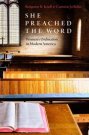
9780190882365

I admit I haven’t read the book (yet), but it seems from the press as though She Preached the Word: Women’s Ordination in Modern America, by Benjamin R. Knoll and Cammie Jo Bolin (Oxford University Press, 2018) 
is pretty clear in its conclusion that ordaining women is good for women and girls, whether they themselves are called to the collar or no.
(Here’s what I posted at the Episcopal Café about the conversation going around online.)

I remember Margaret. At least, that might have been her name. I was maybe twelve or thirteen; my memory might have shifted a few details over the decades.

As I remember it, she was robed in blue and grey, marked as a Lay Reader. I had never heard the title before – I read the Lesson myself from time to time, but I knew that was not what the Vicar meant when he intoned the term in a low and serious voice, as though it were something slightly dangerous, underground, almost dubious. I wonder what he really thought about it all.

IMG_0395

Now that Margaret was a Lay Reader, the Vicar told us, she would preach. As I remember it, he led her to a lectern set up below the pulpit, on the opposite side from the big Bible where I would occasionally read, but set down on the floor, below the chancel steps. I do not remember what she said, although I remember paying attention. Her feminine voice piqued my curiosity in an unfamiliar and exciting way.

I remember noticing at the Offertory how Margaret did not join the men, the priests, on their journey back to the high altar.

The first conversation that I had with a clergyman about my own vocation was informed by Margaret’s voice, and by her position, caught in the crossing. The way that I remember describing it to myself, I wanted to do what she did, and I wanted to do it as completely and as closely as the men.

Seeing and hearing a woman preach, for the first time in my life, opened windows in my soul that I did not know had been barred shut. Seeing her left before the altar, I was grieved and indignant on behalf of us both. Her presence in the crossing was enough to make me imagine a destination I had not known how to dream of before.

I don’t know what Margaret thought about it all. I was a shy child. I never asked her.

I was never brave enough to be first past the breach, for all my bolder thoughts.

20130124-184029.jpgBut when it came to my own ordination to the priesthood, my preacher was a woman who had broken through barriers on behalf of herself and others to claim her priestly vocation. I once heard another woman thank her for allowing women to discern a vocation as lay person as freely as a priest, bishop, or deacon.

I do not know what Margaret’s choice would have been, had other avenues been open to her. I do know that, standing in the crossing, she opened my heart to the word of God for my life in a register I had never heard before.


Read Knoll & Bolin’s own articles on their book’s conclusions at the Religion News Service

Posted in spiritual autobiography, story | Tagged , , , , | Leave a comment

A house of cedar

The readings for the ninth Sunday after Pentecost include David’s desire to build a house for the Ark of the Covenant; the glorious description of the household God is building on the cornerstone of Christ in the letter to the Ephesians; and Jesus’ short-lived attempt to escape the crowds for a quick retreat with his disciples

Nathan the prophet got a little carried away in his initial endorsement of David’s half-spoken thought to build a temple. The next morning, he was forced to walk it back. That happens sometimes when we try to speak or act on behalf of God without asking first; without praying first … but I do not hear anger in God’s redirection of Nathan, and of David. This does not read to me as a rebuke, but as a reminder of God’s tenderness, God’s faithfulness, God’s generosity.

“Wherever you have gone,” God says, “I have gone with you. Whatever trials you have faced, I have faced beside you. Whatever dangers befell you, I stood before you. What makes you think that in order to keep me by your side, you have to build me a cedar box, store me like cloth in mothballs? No: it is I who would build you a house. It is I who sustains you. I am your Father. I am your Mother. I am your God.”

Do you remember the story from the Garden of Eden, when Adam and Eve found out that they were naked, and they tried to make clothes out of fig leaves, and to hide themselves from God in the cool of the evening? And God’s own self made for them clothing out of animal hides; which was such a sacrifice from one who had only just called those animals to life. God’s mercy, God’s tenderness, God’s faithfulness to the people whom God has called to be God’s children is almost beyond belief.

“Wherever you have gone,” God says, “I have gone with you. Whatever trials you have faced, I have faced beside you. Whatever dangers befell you, I stood before you. I am your Mother. I am your Father. I am your God.”

At this afternoon’s community meal, we will hand out invitations to next month’s 90th anniversary picnic and celebration. In the next couple of weeks, we are going to be asking you to distribute some door-to-door, if you are willing and able, to let our neighbours know that this house is open to them, that after 90 years in the neighbourhood, we are pretty committed to loving them as ourselves. We are pretty determined to share the love of God that we have encountered, which redeems and sustains and informs our life together. We have good news to share, and we shouldn’t, we can’t keep it to ourselves.

Ninety years ago, a group of people gathered in Euclid and decided to build a church. The bishop said, “Go, do all that you have in mind; for the Lord is with you.” Fortunately, they had all prayed first. And of course, they knew that the church is not a cedar box in which to mothball God, only to be taken out on Sundays and special occasions, or worn as an amulet in case of emergency. This church does not need any walking back. Many of you know better than I the trials we have faced, that God has faced beside us; the dangers that befell, when God stood before us. Wherever we are, God is with us. This church does not need walking back. We do need to pay attention to God’s leading questions and sharp-elbowed nudges and tender whispers of encouragement about where we are called to follow Christ next.

Who is seeking Christ? Who is rushing ahead to find a good word? Who is desperate for good news? Who are the ones like sheep without a shepherd? Who needs healing, restoring, sustaining? Who needs grace, mercy, the love of God, the tenderness of a God who would sew clothes for sinners, and build a house for the over-emboldened king, only to show that God’s love is inexhaustible, and indescribable?

Who are we called to be a church for, a haven for, a crucible for in these days? We are not a cedar box for God, but God has built us into a house where the seeker can find solace in the Sacrament, and the weary can find good news to rest in for a while, and the eager can find work to do to further the reign of God recognized among us.

Of course, there is so much still to do; so many needs to address. Some of it is personal: the need for healing, for forgiveness, for strength, for a respite from sorrow, for solidarity in joy. We need a place to hear God say, “Whatever trials you face, I face beside you. Whatever dangers befall you, I stand before you. I am with you. I am your God.”

Some of the needs are societal. We are still, millennia after David’s era and nearly a century in the city, we are still struggling to place love before the law; to set mercy at a higher value than material, to prefer justice to judgement. Millennia after Hannah and Mary sang the Magnificat, with decades of prayer ringing in our own ears, we still require a revolution of kindness, of hospitality, that keeps families together for the sake of love rather than sacrificing them to our own divisions; a revolution of gentleness, which prefers to lay down weapons of war for the sake of peace on the streets. We need a revolution of dignity, to live without prejudice. We need a revolution of truth, to live and pray and love without deceit.

Those for whom God would build a house: these are our neighbours to love, and to serve, and to live with.

There are agenda items involved: like continuing to increase access to our building and its benefits to all sorts and conditions of people; like opening up our restrooms to all kinds and expressions and abilities and identities of bodies in need of relief. Next month, at our picnic, we will install a bench outside by the bus stop, inviting all who are weary to find rest, to be still for a moment, and know that God, God is with you. God has not left you behind, nor have you outrun mercy.

There are agenda items; and there are life goals, living into that glorious vision of the household of God which is described in the letter to the Ephesians, in which

you are no longer strangers and aliens, but you are citizens with the saints and also members of the household of God, built upon the foundation of the apostles and prophets, with Christ Jesus himself as the cornerstone, [through whom] the whole structure is joined together and grows into a holy temple in the Lord; in whom you also are built together spiritually into a dwelling place for God. (Ephesians 2:19-22);

letting the Spirit move among us and between us, in our families, between strangers, among one another.

Some of the needs appear almost eternal. The knowledge of good and evil informs our engagement with the world that God has given us to tend.

Some of the needs are the same ninety years on as ninety years ago, which could be disheartening. Others present in new and interesting ways. If we can’t quite keep up with it all, God tells David that there will be a whole new generation coming up behind him to complete the work he has not yet even begun.

There is freedom in that, not to having to save the whole world, or even ourselves, all at once (which is, after all, God’s prerogative, not ours). It also takes some humility, to accept that we have our limitations, that there is only so much we can do, in ninety years, or ninety more.

Most of all, we need to set God free to be the God that we need, rather than the God in a box that we too often want. That takes prayer, waiting sometimes even in the wilderness, in the desert places, rather than rushing ahead with our own plans, only to have to walk them back. We will find those whom God sends to meet us there, in prayer, in the wilderness, to share God’s healing mercies. Through it all, we remember that we are not kings by right, sovereigns of our own souls, but totally and utterly dependent on the providence of God. We do our own work, knowing that everything we have, everything we do, everything we are comes only from our Creator.

“Wherever you have gone,” God says, “I have gone with you. Whatever trials you have faced, I have faced beside you. Whatever dangers befall you, I will stand before you. What makes you think that in order to keep me by your side, you have to build me a cedar box, store me like cloth in mothballs? No: it is I who would build you a house. It is I who will clothe you with grace, with mercy, with righteousness. I love you. I am your God.”

Posted in lectionary reflection, sermon | Tagged , , , , , , , , , | Leave a comment

Swimming in prayer

my might is little;
my limbs weary quickly;
I am a child by the tides of eternity.

the womb of God is wide
with the fluid of life.
I will not drown

Posted in poetry, prayer | Leave a comment

Why pray

This morning’s Speaking to the Soul offering at the Episcopal Café


Does God need our prayers?
It is foolishness to Greeks, with their ideal sufficiency.
It is a stumbling block to our proud humility, and yet
isn’t it the nature of Love to desire some response,
some relationship, if only with a memory, if only
in another life?

Lord, you are in the midst of us, and we are called
by your Name.*
And if it is true that we learned this love from you,
what longing must abide in the heart of God?
How can we turn away, when love pursues us
with such glorious desire?

What is the point of prayer, if God has no need of it?
What its possibility, unless God desire us into speaking?


* From Jeremiah 14:9; Daily Devotion At the Close of Day, BCP 140

“The trouble with being a god is that you’ve got no one to pray to.” Terry Pratchett, Small Gods

Posted in poetry, prayer | Tagged | Leave a comment