
Snow has fallen, slurring my footsteps,
skewing my pathway to prayer.
Only become as a child, you say:
trade caution for the headlong hurtle;
build snowmen, not as idols but monument to
the meeting of flesh and raw air.
Snow has fallen, slurring my footsteps,
skewing my pathway to prayer.
Only become as a child, you say:
trade caution for the headlong hurtle;
build snowmen, not as idols but monument to
the meeting of flesh and raw air.
A sermon for the second Sunday after the Epiphany, and Martin Luther King, Jr weekend, 2019. The gospel reading describes Jesus turning water into wine at the wedding in Cana (John 2:1-11)
Have you ever done the maths on the jars of water that Jesus turned into wine at the wedding in Cana? It’s a massive amount. William Barclay’s commentary notes that the capacity of those jars represents the breadth and depth and reach of God’s mercy:
“No need on earth can exhaust the grace of Christ.”[i]
One of the places I visited while I was on sabbatical, apart from the Holy Lands, was the National Museum of African American History and Culture. The Museum is a remarkable place. I don’t know anything about architecture, but even I could read the parable that this building writes on the National Mall.[ii]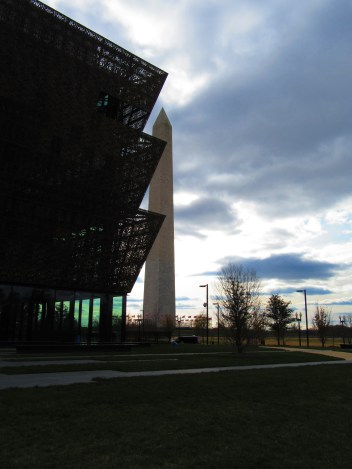
Aside from the immediate and visible experience of African influence and African American labour on the structure and culture of this country, the journey through the museum’s interior made me think of Dante’s Divine Comedy. Above ground, reaching to the sky, with views from Washington’s monument to the White House, the culture exhibits on the upper levels reminded me of the Rock and Roll Hall of Fame – full of colour and celebration, hard work and inspiration, controversy, community, and creativity. But to tour the history floors, you have to head underground, six stories deep. The elevator opens on the past, and the only way out, the only way back up to ground level and the present day is through the history of this country’s relationship with its own people, through the lens of the African American experience.
I can’t begin to describe to you briefly the impact of walking that history of inhumanity and human dignity, the weight of those ceilings, each one a century, and the heaviness of your footsteps as you climb closer to our own day of reckoning: Which side are you on, boys, which side are you on?
Praying before the casket in which Emmett Till was buried – the casket exhumed when his case was reopened, and preserved as a memorial when he was returned to God’s ground – I can’t begin to describe it to you (and unfortunately you’ll have to wait until the government shutdown ends to attempt to experience it for yourselves if you haven’t already been).
When you emerge finally from the halls of history, there is a reflection gallery, a place of peace and quiet, light and water, in which to sit and recover your breath, and replenish the defences which you wear in order to go about daily life pretending that all is well.
(Although the experience of Native Americans this weekend on the same National Mall argues otherwise).
[Updated to note that some differing accounts of the incident described at the link have now also been reported.]
On the walls, a quotation from the Revd Dr Martin Luther King, Jr, echoes the falling water: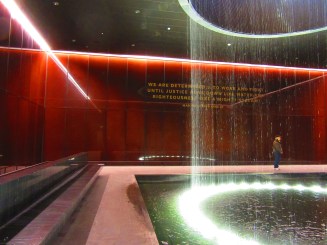
We are determined to work and fight … until justice runs down like water, and righteousness like a mighty stream.
Of course, Dr King was himself quoting the promise of the prophets of the radical and refreshing and overwhelming quality of God’s justice, that judgement which brings with it mercy, and the steadfast loving kindness of God:
But let justice roll down like waters, and righteousness like an ever-flowing stream. (Amos 5:24 )
In today’s gospel, that outpouring of love and justice is illustrated by what Jesus does with the water.
I wondered all last week why it was that in John’s gospel this water into wine wedding sign is the first public manifestation of Jesus’ miraculous power. All four gospels begin to describe his ministry broadly speaking with his baptism, with his proclamation of the coming gospel, with his calling disciples to follow him, and with his preaching from the prophets the good news of God’s kingdom, the justice that is to roll down and the waters of life which will buoy up God’s people.
But in the other three gospels, the first individual miracle, the first breakthrough sign is one of healing; of making a leper clean and whole, or of casting out an unclean spirit. It occurred to me that this sign at the wedding of Cana most probably, for John, also represents healing, wholeness, and restoration.
John’s story begins, “On the third day,” and it ends, “he revealed his glory; and his disciples believed in him.” For John, Jesus is the healing miracle. He is the restoration, the refreshment, the fulfillment of the prophets.
And now I notice that at the start of the story, it is not only the wine that has run dry. The stone jars that hold fresh water themselves need filling up before anything else can happen. Even the water has run dry. It is a theme repeated through the gospel of John, when Jesus encounters a woman beside a well in Samaria, and asks her for a drink, because he is thirsty, and when he cries out from the cross with his dying breath, “I thirst!” Jesus is the living water that runs with justice and righteousness and slakes the thirst for life; and he is the first to point out how thirsty the world is for such relief.
Emmet Till’s body was found in the river, a river now polluted by injustice. From the empty jars of Cana to Flint, Michigan, not all water runs clean. Sometimes, the thirst for justice threatens almost to drown us.
In John’s story, the jars designed to hold water have been used up. In practical terms, the guests used them to wash up for dinner. They used the water to wash their feet before the feast, just as later Jesus would tie a towel around his waist and wash the feet of his disciples before he fed them with bread and wine.
So where does that leave us? What do we do?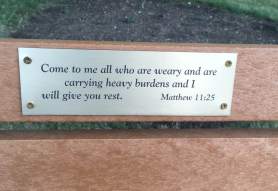
“Do whatever he tells you,” Jesus’ mother says in the story.
I read another story this week, in a book that was published a matter of months before Dr King’s assassination in 1968.[iii] It carries a young girl’s account of attempting to go to school in a legally integrated but lethally segregated southern city in 1957. Elizabeth Eckford, whom history knows as one of the “Little Rock Nine,” described the nightmarish morning in which she tried to go to school, and was damn near lynched for her trouble. She said:
“I turned back to the guards but their faces told me I wouldn’t get help from them. Then I looked down the block and saw a bench at the bus stop. I thought, ‘If I can only get there I will be safe.’ I don’t know why the bench seemed a safe place to me, but I started walking toward it. I tried to close my mind to what they were shouting, and kept saying to myself, ‘If I can only make it to the bench I will be safe.’
“When I finally got there, I don’t think I could have gone another step.”
A bench at a bus stop became a beacon of safety to that young girl, and I couldn’t help but picture in my mind’s eye our own, new bus stop bench, and wonder how we are living into our call as a haven of safety, a place of redemption and rescue, and a harbour against the storms of racism and other oppressions that continue to swirl around and within us.
We have a ministry of place, to be a safe space, a bench at a bus stop ready to receive the weary and the fearful and to offer a defence against the violence of this world. We have a call to provide refreshment to those seeking resurrection, those who are thirsty for justice, and hungry for grace.
“Do whatever he tells you,” Jesus’ mother told the servants. We servants of Christ are instructed to fill the jars with water, to fill our own lives with justice, to fill our world with the gospel of righteousness that frees the prisoners from oppression, lifts up the faces of the poor, sustains the orphan and the lonely, and provides a place of safety for every child of God. We servants of Christ are instructed to fill the jars with water, for the world is thirsty still for the justice that runs down like water, and righteousness like a mighty stream. We are called to do whatever he tells us, and let Jesus do the rest, turning water into wine, humility into glory, justice into victory, and the kingdom of God into a present and living reality. He is the living water that runs with righteousness, and he brings the wine of justice, the wine that tastes so good, when the kingdom of God is realized and all of God’s children are gathered in: no exceptions.
[i] William Barclay, The Gospel According to John, Volume I, The Daily Study Bible, 2nd edition (Westminster Press, 1956) 89
[ii] You can read more about the work of lead designer David Adjaye and lead architect Philip Freelon here.
[iii] Black Protest: History, Documents, and Analyses 1619 to the present, edited by Joanne Grant (Fawcett Publications, 1968), 276
Featured image: glass recovered from the 16th Baptist Street Church, Birmingham, Alabama, after four young girls were killed at Sunday School by a racist bombing attack in 1963
First published at the Episcopal Cafe
The other day, I opened the front door of the church and a cat I had never met before walked in. I bid her welcome. She meowed.
 For the next hour, she was my shadow. I had to tread carefully to avoid tripping over her, she stayed so close to me. Having small company lightened my footsteps.
I had, I confess, been having a dreadful afternoon, by which I don’t mean that anything horrifying had happened, but that I was buckling under that dull burden of dread which accompanies winter in the northern hemisphere: the lack of brightness, the dismal disbelief that sows doubt about the eventual return of spring.
We finished up the work I had to do in my office, then set off for the sacristy to set up for evening service. We ended up for a little while on the chapel floor, beneath the benevolent eye of Jesus, purring, and I reflected that when our saviour was humanity incarnate, there must have been moments when he was unable to move, or shout, or sneeze for fear of waking a cat that had taken up residence in his lap. These things happen.
 When the first person arrived for service, the cat greeted him with a polite leg rub, then showed herself out. I saw her once more as I drove out of the parking lot later, sitting under the porch light, watching me leave.
Now, I know that I have a weakness for whimsy, but there was something about that cat. She had a flash on her forehead that was the exact colour of the sand in the Jordan desert. She arrived as though in answer to prayer, and stayed until she left. She watched over my going out, and for all I know my coming back in.
If it is possible for the Holy Spirit to inhabit a dove’s form, or to inspire the formation of a flock of geese, why not send a small cat as a messenger of hope, comfort, warmth on a cold midwinter’s afternoon, her desert colours proof against the dying of the light?
The silence of prayer, not
the absence of sound but
footprints on the ceiling and
the waltz of a three-legged cat,
a hungering woodpecker picking
the lock on a worm-weary tree,
the hum of heat and refrigeration,
competing elements of fire, water, air,
breath and beat.
The Word populates
time with meaning:
Let there be
[Most of] this morning’s sermon at the Church of the Epiphany, on the festival of the Baptism of Jesus
Many years ago – more than three decades ago now – I found myself in the middle of summer, in the middle of Galilee, in the middle of a river (I think it was the River Dan), caught in a strong current that threatened, in that moment, to drown me.
Rarely, maybe never before or since, have I needed more that promise which God offers via Isaiah:
When you pass through the waters, I will be with you;
and through the rivers, they shall not overwhelm you;
nor, as my lungs burned with the effort of resisting the river, the second part of that promise:
when you walk through fire you shall not be burned,
and the flame shall not consume you.
Nevertheless, if my fellow travelers had stayed on the bank where they had safely come to rest, and tried to buoy me up with those promises, words of comfort and peace, I would almost certainly have drowned, aged nineteen, and a long way from home.
Instead, realizing my predicament, a couple of them came back into the river and held me up, supporting me against the current while I freed my foot from the tangle of tree roots that had trapped me in place, even catching my shoe when it popped like a cork to the foaming surface, helping me back to dry land to catch my breath.
I have no doubt that God was with me in that river, whose banks Jesus knew, whose rapids perhaps he had played in. I have no doubt that God would have stayed with me, whether I lived or died that day. But in order to remain alive, in that moment, I also needed my people, the little community of foreigners with whom I had set out that morning in a black tyre inner tube to float down the river towards the Sea of Galilee.
And I was grateful to them, particularly because I had made a promise of my own, when leaving home. We had visited my mother in the hospital, and I knew that my father found it hard to put me on the train alone to a destination he had barely imagined, and of which he was, frankly, afraid. So when he said, “Just come home safely,” I promised him, “I will.” I didn’t say, “with God’s help,” but it was to God that I prayed in that moment underwater when I realized, “A person could drown this way.” I prayed that God would help me to keep my promise to my father. And to do that, to keep my promise, I needed more than a promise of God’s presence. I needed the literal and physical support of God’s people.
There is a moment in the baptism of any infant or adult who comes to the font for that sacrament when the people of God, the people in the pews, are invited to affirm their involvement and support for the promises that are made to grow in faith, to live in Christ, to love God and neighbour as no one else can. The bishop or priest asks the congregation, “Will you who witness these vows [these promises] do all in your power to support these persons in their life in Christ?” And the people answer together, as a body, “We will.”
Not, as elsewhere, “I will, with God’s help,” but, “We will.”
The promise of baptism, as profound as it is, is not only the reassurance that even when the waters of chaos overwhelm us, even when we enter the arms of death, even when we are gasping for breath underwater God is with us.
It is not only, as astonishing as it is, the symbol of a resurrected life, a life in Christ that cannot be destroyed even by death, a life with God that is unbreakable.
It is not only, as comforting as it is, the contract of adoption in which God tells each of us, “You are my child, my beloved. You are mine.”
The promise of baptism is all of these things and more, and it is the promise that there is a community of the people of God who have promised, faithfully, to do all in their power to support and sustain a person’s life and salvation. It is the promise of lifesavers. Baptism is not an individual act. No one can baptize themselves. Even Jesus did not baptize himself. Each person needs the witness, the prayers, the water, the wave of community to buoy them up and bring them ashore.
Even the promises that we make using “I” statements during our baptismal covenant, if we look at them closely, can’t possibly be kept without the company of a community.
How will we continue in the footsteps of the apostles, in their fellowship, in the breaking of bread and in their prayers without the gathering of a community of Holy Communion?
To whom will we confess, who will assure us of our safe return when we repent of the evil that we fall into time and again; and who will help us resist the current of casual corruption and systems of sin; who will call us to account if not those closest to us?
To whom will we proclaim the word and example of the gospel, if we are determined to go it alone?
How will we seek and serve all persons unless we are in relationship with them?
How will we respect the dignity of all people unless we are prepared to witness the indignities other people suffer, or strive for justice unless we know, unless we see, unless we are prepared to enter the places and spaces where injustice is visited upon our neighbours, where they are in danger of drowning; unless we are willing to risk getting wet with the same water that threatens to overwhelm them?
We cannot keep these promises on our own. “I will, with God’s help,” we promise, “I will;” but we need one another to make it true. The promise of God to be with us whether we live or whether we die, to be with us through hell and high water, that is the ultimate promise of our salvation; but in this life, along the way, if we are to keep our own promises, if we are to fulfill the promise of the life that God has given us, then we need one another. …
… So I encourage you to be brave, even reckless, and risk entering the waters of another person’s baptism, knowing that God is with you, come hell or high water, and that the promises of God to you, God’s beloved child, endure forever.
This is not the river from thirty years ago, but one of its neighbours, last October
A true story, and a reflection ahead of this Sunday’s commemoration of the Baptism of Jesus
In Galilee, a root gripped my foot,
the tree of life inverted, submerged;
the river filled my lungs with fire,
a strange baptism, the Spirit of God
hovering helpless above the chaos:
“My child, my child,” breathing
underwater as it was in the beginning,
dredging sludge from the riverbed
into the rarefied air.
When you pass through the waters, I will be with you;
and through the rivers, they shall not overwhelm you;
when you walk through fire you shall not be burned,
and the flame shall not consume you. – Isaiah 43:2
A sermon for the feast of the Epiphany at the Church of the Epiphany, Euclid, Ohio
The message of the Epiphany might be (among other things) that the grace and glory of God, the steadfast love of God for God’s creation, the mercy and faithfulness of God towards us is not a secret.
Angels proclaimed it out loud from the heavens, rank upon rank breaking the lines, the borders between heaven and invading the earth to make sure that the news was heard on the hillside.
The very arrangement of the astronomical omens led astrologers from far afield to the place where Christ was born.
And on their way, they consulted with wise men and scribes who had inherited generations of prophecy and promise, that God’s anointed, the Messiah, the saviour of the people of God would be born in Bethlehem.
It was no secret. It had been foretold. It had been witnessed. It had been written across the sky for all to see.
We are the Church of the Epiphany. If ever we have wondered what that means, we might reflect on the boldness of God’s boast, broadcasting the birth of Jesus, the Incarnation of God, the bridging of human and divine, mortal and eternal life, at the first festival of the Epiphany.
Where do we see ourselves in the story?
We hope that we are not Herod.
We are not necessarily the wise strangers, either. We mostly don’t travel too far to get here, Sunday by Sunday. We know whom we are seeking, and we know where he is to be found; ubi caritas: wherever love is, there God is. Wherever faith, hope, and love labour together, there Christ is born.
Sometimes we gather with the shepherds. In our better moments, we rank with the angels. In our more contemplative moods, we might side with Joseph, standing witness, wonderer, even helper to the Holy Family. But we should fear becoming like the people of Jerusalem.
The people of Jerusalem, the populace were shaken by Herod’s upset. They feared that his unpredictability would be more present to them, in the short run, than God’s implacable mercy. They silently cursed the magi for stirring up trouble in the palace and the Temple, for daring to suggest that the promise of God was more than just a promise, that it was nearing fulfillment, if only one would look up, and see the signs, and follow the star.
The people of Jerusalem, the people in the pews thought that a saviour would be nice, but really wished that everything would just get back to normal, allow Herod to calm down, move on to the next piece of news, without too much damage being done.
But that is not how the inbreaking of the Incarnation works. There is no pretending that anything can be undone, that pretending ignorance of the coming of the Christ, the kingdom of God drawn near, would make it go away.
The people of Jerusalem, the everyday folk may have thought that the sufferings in Bethlehem, tragic and reprehensible as they were reported, were a heavy but necessary price to pay to regain their status quo. Of course, the people Jerusalem didn’t pay the price. The children and parents of Bethlehem paid it for them. And the people of Jerusalem were wrong. They didn’t mean to be. They didn’t want to be. They just wanted things to stay the same as they were used to.
Last year, at Epiphany, we celebrated our ninetieth anniversary by looking back to what our ancestors had founded and tended, and looking forward to the new roads that God might be calling us into, leading us along. As we heed the lessons of our forerunners both here and in Jerusalem, we might wonder, and check, whether we are still open to new ideas, new ways of interpreting our own traditions, newcomers and their strange wisdom.
When the wise men came to Herod with the news of a saviour, the establishment replied, “Yes, but that is not how we do things here. We know that God has promised something new, but we are happy with the old ways.” One doesn’t have to be as mad and as murderous as Herod in order to shoot down initiatives and new ideas that might, in fact, have been inspired by the heavens.
The wise men were warned not to return to Herod, but to take a different road. If they had gone back the way that they had come, they would have risked revealing the identity and whereabouts of the Holy Family to Herod before they had a chance to flee, seeking asylum in Egypt, waiting out the threat of violence and death. When we are not open to new ways of travelling together, with friends, with strangers, with Christ, might we even be endangering the gospel? When we allow the powers that be to interpret God’s promises for us, without examining the evidence for ourselves, reading the heavens, reading the Bible, reading our prayers, are we playing into Herod’s hands?
But it is no secret that God’s grace continues to break into our lives, and that God’s promises will not be thwarted by Herod or his ilk. Even among the people of Jerusalem, there must have been some who were intrigued rather than intimidated, and eager to follow the star along with the wise men to seek this saviour whom God had sent. There must have been people, who out of their own prayers, or out of despair, who out of curiosity and hope and longing for God’s love were prepared for an epiphany, the revelation of God in Christ, and ready to take a new road.
We are the Church of the Epiphany. If nothing else, that name must mean that we cannot keep the gospel a secret, that we cannot keep it buried, or still, that we are constantly breaking open, being broken open in new ways, by the revelation that God has given us in the birth of Jesus, in the coming of Christ, the bridging of heaven and earth.
Arise, shine; for your light has come, and the glory of the Lord has risen upon you.
For darkness shall cover the earth, and thick darkness the peoples;
but the Lord will arise upon you, and his glory will appear over you.
Nations shall come to your light, and kings to the brightness of your dawn.
Lift up your eyes and look around; they all gather together, they come to you.
So says the prophet Isaiah, because God’s mercy is not a secret, and God’s promises are not kept under wraps, nor long contained in swaddling clothes.
As we celebrate a new year together, are we prepared for a new epiphany, the always strange and surprising revelation of God’s love among us? It is our part in the story, the part of those who witness the wonder, always anew, and whisper to our neighbours, “Come, see the child who has been born for us. See the love of God that has dawned on us. For we have seen his star rising, and we have found him, and have come to worship him.
Come and see.”
What I didn’t write in the parish newsletter
This Sunday, we celebrate the arrival of the Wise Men at the manger; the completion of many a Christmas tableau.
On Christmas Eve, we pondered a moment how the birth of a child is always revolutionary. Whether it changes the succession of the royal throne or simply the direction of its parent’s affection, it always wreaks havoc on the settled order of those surrounding it.
In the biblical story, Herod was unsettled, and wrought havoc on those within his reach in order to shore up his own throne and exercise his own rage. Still, we borrow the story of the Holy Innocents to describe the tragedies and atrocities of our own time: the children separated from their families, the children imprisoned, the children dying at our southern border. Authorities more concerned with their own security and rage, more intent on funding walls than finding help, exacerbate the situation, we are told [1]. A world away from the desert, families spent Christmas stranded at sea, denied a safe harbour by a continent unsettled at their advent [2]. In our streets, in our houses, children are maimed and murdered by the incurious, impassive, inanimate availability of guns [3]. The madness of King Herod has not yet found its cure, nor learned submission to the kingdom of God.
Christmas is not a holiday from these realities. The Incarnation is not an excuse to look away. The coming and going of the Magi at Epiphany reminds us that after we have spent our moments lost in wonder at the Christmas Incarnation, the time comes to recognize the havoc that Herod still wreaks in the world and in the lives of the children of God and humanity.
When the wise men left the manger, they were warned not to return to their country by the same road. The birth of Jesus had changed everything between here and home, and they needed to find a new way. If we are wise, we will follow their example, for the sake of the Holy Innocents; for the sake of Christ’s infant innocence.
[1] “Border Patrol has come under heavy criticism over the deaths of two Guatemalan children. In the wake of the second death, Nielsen ordered that all children be given a medical screening after they are apprehended. McAleenan acknowledged the capability to provide medical support will be hampered if the government shutdown becomes lengthy.” – More children arriving very sick at the US border, by Carol Morello, for the Washington Post
[2] “Already on Saturday, the crew of the Sea-Watch 3 has saved 32 people from drowning, including four women, three unaccompanied minors, two young children and a baby. Five countries (Italy, Malta, Spain, Netherlands, Germany) refused to take responsibility and grant the rescued a port of safety for Christmas.” – Sea-Watch.org
[3] Watch this telling video from the End Family Fire campaign
A sermon for the First Sunday after Christmas Day, 2018, at the Church of the Epiphany, Euclid, Ohio
In the beginning was the Word … and the Word became flesh and dwelt among us, and we have seen his glory …
It may seem strange, but we hear this more times than the story of the manger and the angels, the shepherds and the star, across the Christmas season.
I first heard it, this year, on Christmas Eve, listening to the service of Lessons and Carols from King’s College, Cambridge on the radio. The Provost of the College announces the ninth and final Lesson,
St John unfolds the great mystery of the Incarnation.
I always wonder what they mean by “unfold,” when John’s words fold in the glory of God like a piece of origami, glorious in its intricacy and effect, but not exactly straightforward.
We read this gospel again on Christmas morning, after a night of angels and sheep, the manger and the glory of the heavens breaking through. In the morning light, we were left with poetry, the glory of the Word made flesh, God’s timely and timeless presence among us.
We talked about that timeliness and timelessness on Christmas morning; how John’s gospel, reaching back beyond creation and deep into the mystery of Christ’s birth reminds us that, while no one has seen the glory of God face to face, God’s grace and mercy have never left us, which leaves us the promise that they never will.
No one has seen God, John says, and he name-checks Moses. We remember how Moses longed for a closer revelation of God – closer than the burning bush, and the Red Sea, the pillars of cloud and of fire, the personal conversations. God told Moses that a man could not handle such naked glory. Moses hid himself in the crevice of a rock, and God guarded Moses from the glory with God’s hand, letting him peek out only as God disappeared around a corner, like a familiar friend passing just out of reach, out of earshot, beloved, but lost.
Still, when Moses met with God on the mountaintop, his face shone with the reflection of God’s glory, and the people were afraid even of his afterglow.
God’s grace and mercy have never left us, passing over us and shielding us from more than we can imagine; but how much glory can we handle, human as we are?
When Elijah hid in the cave, fleeing for his life and resenting rather how much of it he had dedicated to God, God showed him a different lesson. All of the power of creation passed by as Elijah, like Moses, hid in the cleft of the rock; and after it was done, he veiled his face to come to the cave entrance, drawn by the quietness that followed the storm, the back end of God’s power, the quiet insistence that God is faithful, God’s presence persistent, even in the stillness, God’s mercy endures forever.
If the sky were full of angels and noise tonight, I wonder who would be the first, and how long it would take to launch missiles to disperse them. We, no more than Moses and Elijah, are not equipped to deal with too much of God’s unfiltered, powerful glory.
In the end, Elijah was taken up by chariots of fire, directly immolated by the nearer presence of God, consumed by glory.
When John speaks of the timelessness, the eternity of God’s Word, and of the glory of God veiled and revealed by the flesh of his Incarnation, John reminds us that while the birth of Jesus is unique, and ultimate, and unrepeatable, and shines with the glory of the only Son of the Father; still, the mercy of God has endured forever.
When we wish that God would do more, and more dramatically, in our own lives, in our own time, it might be that God is protecting us from too much glory, so as not to overwhelm our humanity. If the Word of God that spoke light into being, caused the land to rise and the seas to shift, if that Word were to break loose upon us, how would we respond? Instead, God covers us with God’s hand, shielding us from the full weight of glory, veiling divine power in the miracle of a birth, muting the clamour of glory with the cry of a child, presenting God’s mercy and grace to us as one born of a woman, in need of love, care, tenderness.
And will we receive God’s glory this way?
He was in the world, and the world came into being through him; yet the world did not know him. He came to what was his own, and his own people did not accept him.
Will we recognize the glory of God when it passes before us, covered by God’s hand to shield us from its divine force, clothed instead in flesh and mercy?
While we demand divinity, glory unleashed, God appeals to our humanity, teaching us by God’s own example to exercise the image of God within us, whose graciousness is revealed by acts of mercy and protection, whose power is found in faithfulness, whose glory is borne by love.
For God so loved the world that he gave his only Son, so that everyone who believes in him may not perish, but may have eternal life. …
No one has ever seen God. It is God’s only Son, who is close to the Father’s heart, who has made him known.
Even in the ultimate revelation of glory, God is shielding us, protecting and directing us, preferring for us mercy to might, grace to glory. God’s mercy endures forever.
And what even is this thing called glory? As the gospel tells it, it is no less than the birth of new life, the wonder of love revealed.
No wonder the shepherds and angels sing, Glory to God in the highest. Glory, and peace, goodwill towards the people, whom God loves.
Amen
And so here we are, drawn to the manger once more by the promise of the angels:
Peace on earth, goodwill to all people whom God loves;
for to us has been born a saviour, who is Christ, the Lord.
And because the promises of God will not fail, and the faithfulness of God endures forever, our hope is born anew for that peace that passes understanding, and the love of God that prevails over all ills, even in the face of the evidence all around us that life still has its ups and downs, to say the least.
Bethlehem has always been a hotbed of political as well as religious activity. The actions of God in the world are not without consequence for the powers and principalities that we erect, our Babel congregations.
Centuries ago, David was born in Bethlehem, and anointed king while there was somebody else already and still wearing the crown. And Luke’s gospel is clear about setting the Christmas story within a clear historical and geopolitical landscape, in the reign of the emperor Tiberius, when Quirinius was governor in Syria, and Herod was the king in Judea.
The birth of a child itself has often been political. It changes the line of succession, whether the succession of power, or wealth, or of affection. The birth of a child wreaks havoc on the settled order of the world, as any parent or relatively close observer knows.
And what more political, and welcome, declaration can there be than the announcement of peace to a people under occupation and oppression; or the anointing of a new king from among a poor and politically helpless people shuffled like pawns on a board by the empire that rules over them.
Two months ago, I visited Bethlehem for the first time. To get there, we passed through militarized zones and the security wall, erected to keep the people of the West Bank in their place. On the wall, amongst the other graffiti, we saw the familiar emblem of the dove that announces peace between God and the world, carrying an olive branch. But this dove, rendered by Banksy, wore a flak jacket, against which the laser sights of a rifle were reflected.
In Manger Square, people thronged. We slipped through the back of a church and down into the grotto, the cave where Jesus was said to have been born. Most pilgrims were lined up in the church next door, more ornate and older, to enter the same shrine, but on the other side of a wall which the Christian denominations had built between them, dividing the site of the birth of Christ as though defining their shares in him.
When we had had our fill of the manger, we headed out to the Shepherds’ Field, where the angels sang their Gloria, and announced peace to the weary and waiting world. Wandering into a chapel, we stumbled into a choir of pilgrims from another far-off land, singing the angels’ song, but slowly, as though it were a prayer, awaiting an answer.
The answer, God tells us at Christmas, the answer does not come from pomp, power, or the proliferation of the potential for violence, the weaponry of war, the mechanisms of might. It does not come from defending our piece of the pie, nor even our piece of Jesus, at the expense of others.The peace of the world is not the Pax Romana of emperor Augustus, nor the capitulation of Herod and Quirinius to its principalities. The hope of the world, God tells us, is found in the love of its creator, shown forth at Christmas in the birth of Jesus, the love of God breaking into the world, demolishing walls between heaven and earth, so that shepherds hear the angels sing; demolishing the divisions between inside and out, Christ the saviour sharing space with the homeless and the helpless; demolishing the thrones of the mighty, by anointing a new king; demolishing our hearts, breaking them open with the cry of a child; committing revolution, not with the blood of battle but with the blood of the birthing room, the complete surrender of love.
With the utter dependence of a newborn infant upon its mother’s blood, its mother’s breast, God wails out, “See how much I have loved you?”
And outside the stable, the politics of Bethlehem and Judea continued to swirl. Pontius Pilate’s wife had her first dream about the stranger who would ruin her husband’s reputation. Herod began his spiralling descent into madness. Augustus wondered whether he had felt some kind of an earthquake, a tremor disturbing his sleep.
Even now, we rebuild walls that God would demolish, and wonder why our prayers for peace were so slow to grow into fruition; but for the shepherds, who heard the angels sing and came quickly to find Jesus for themselves; for Mary, and Joseph, and for their child there was no doubt that God had broken through their defenses, and changed their lives for ever, for good, and for a moment, in the fullness of their hearts, it was enough.
May the coming of Christ this Christmas be enough to break our hearts open to God’s goodness, to demolish the walls of sin that divide us from Christ and from one another, and the love of God bring us once more to our knees, astonished anew at the love that God has for us all, without exception; the good news that the angels bring.
Amen.