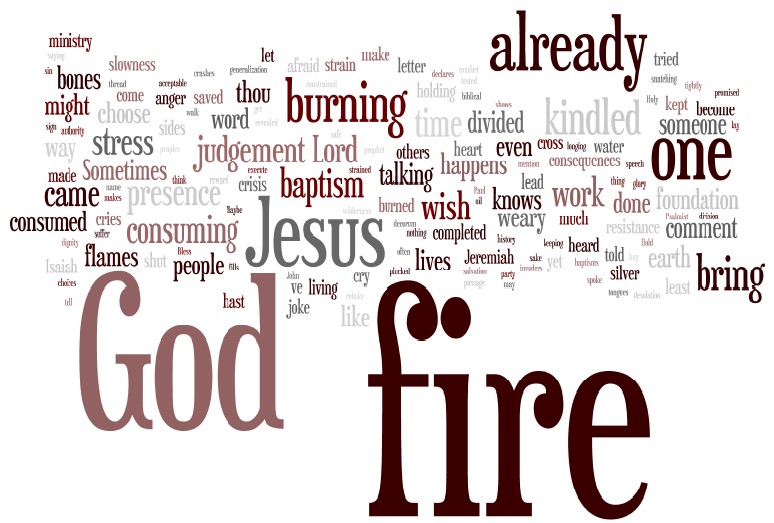
Tomorrow’s sermon: extract

“In today’s Gospel reading, Jesus goes into a synagogue, to take part in the prayer of his community. He is faithful in his observance, and he is obedient to his tradition. He sees a woman in need of healing, and he reaches out and touches her, and she is made strong. The leader of the synagogue berates her – notice, he berates the woman, not Jesus – for coming to worship on the Sabbath and getting healed! He is not angry because Jesus has done work on the Sabbath, because he has done something beautiful and wonderful. You can tell it from the story, because he doesn’t yell at Jesus, and anyway, Jesus shields the woman from his words and shrugs off his diatribe with disdain, and no one argues back; and besides, how would that even make sense? No, the leader of the synagogue is lashing out at the weakest one there because he is afraid. He is afraid that he has just seen God at work, and heaven knows what trouble that will bring, God knows what God will ask of him, if God truly is at work in the world, in his little world, in his small corner of the world. The leader of the synagogue doesn’t really think the woman should suffer. He is simply afraid of the burden that her freedom has just placed upon him. He has read Jeremiah and the prophets, and he knows that God is not shy of calling God’s people to account. His frightened but loud dissenting voice is hardly evidence that Jesus was wrong.”

… To be continued, Sunday August 25th, at Church of the Epiphany, Euclid, Ohio

Posted in lectionary reflection, sermon preparation | Tagged , , , , , , , , | Leave a comment

Year C Proper 15: “I came to bring fire”

Jesus said, “I came to bring fire to the earth, and how I wish it were already kindled! I have a baptism with which to be baptized, and what stress I am under, how I am strained, and constrained, and consumed until it is completed!”

How I wish it were already kindled. I am consumed until it is completed.

Jesus seems to be feeling the strain of his ministry from at least two sides: he knows that he has the most important work to do, but he feels so much resistance around him. He knows, too, that it will lead him into conflict and chaos. The tension between forging forward and knowing what he is to face is unbearable. It is consuming. No wonder he cries out from time to time. There is so much packed into these few words, so tightly pressed that they are bursting at the seams, that it is difficult to know where to begin to pick up a thread that might lead us into our own lives of ministry, our own stress, our own living baptisms.

I came to bring fire to the earth; how I wish it were already kindled.

It could be a cry of frustration, at the slowness of God’s judgement upon the Roman invaders, at the slowness of God’s action against the persecutors that had killed John, Jesus’ baptizer, who were already plotting against Jesus and his followers. It could be a cry of desolation, longing for the comfort of God’s company, a sign of God’s presence, a baptism of healing oil and cooling water.

A brief survey of biblical fire shows both sides of the same coin.

In the Torah, the presence of God is found in the fire which cut the covenant with Abraham; the fire which spoke to Moses out of the burning bush and led the children of Israel by night in a pillar of flame. God speaks to the wilderness people out of fire in the covenant of the commandments, and accepts their sacrifice by burning it from their altars. Our God, the people are told, is a consuming fire.

Chariots and horses of fire swoop down from heaven to catch up Elijah to the eternal presence of God. God’s fire visits the temple of Solomon at its dedication, and the glory of the Lord fills it up. The word of God sets fire to Jeremiah the prophet; “If I say, “I will not mention him, or speak any more in his name”, there is in my heart as it were a burning fire shut up in my bones, and I am weary with holding it in, and I cannot.”

Our God, the people are told, is a consuming fire, a jealous God. “Is not my word like fire, declares the Lord [again to Jeremiah], and like a hammer that breaks the rock in pieces?” And in Isaiah, “For behold, the Lord will come in fire, and his chariots like the stormwind, to render his anger in fury, and his rebuke with flames of fire. For by fire will the Lord execute judgement.” Isaiah and later Mark agree about a worm that shall not die and a fire that shall not be quenched.

So when Jesus says, I came to bring fire to the earth; how I wish it were already kindled, he is speaking in divided tongues of fire. Is he talking about judgement, or salvation? Is he talking about God’s loving kindness and enduring mercy, or about God’s anger? Will God’s kingdom come with the flaming sword or will we be the brand that is plucked from the fire and rescued from the flames (Zechariah 3:2)?

Maybe the choice is ours. Jesus is talking out of the midst of a crisis: what stress I am under, he cries! And he goes on to warn us that the crisis will continue in our own lives. We have choices to make, and decisions bring division. If we choose to walk the way of the cross, we may be called upon from time to time to deny ourselves, to choose the path of most, not of least resistance.

How often have you heard someone tell a joke, or make an offhand comment, or give a speech, or even a sermon that made fire burn in your bones, yet you said nothing, kept quiet for the sake of decorum and keeping the peace? I’ve done it; God knows I’ve done it more than once. Sometimes it happens by accident – a comment slips by and only in retrospect do we realize what was meant. Sometimes it happens that a sexist joke or a racist comment or a disparaging generalization is made by someone we love, or by someone who happens to have authority, or economic influence, over us, and we are afraid of the consequences of saying, “Hold on, do you mean that? Do you think that is an acceptable thing to say?” We are afraid of creating divisions. Jesus says, sorry, but that is not the way of the cross. If you are going to be a disciple, sometimes you will find yourself divided from the crowd, divided even amongst yourselves. Sometimes respecting the dignity of every human being means calling one of them to account.

Either way, we might get burned; either by a burning conscience – “there is in my heart as it were a burning fire shut up in my bones, and I am weary with holding it in” – or by the social consequences, a dinner party that crashes and burns; or worse, burning our bridges with someone we hold dear, or who holds opportunities for our advancement over us. It is not always a simple decision, to divide ourselves from that which burns other, from that which burns our own souls, too. And yet the letter of Jude encourages us to save others, “by snatching them out of the fire.” By separating ourselves from sin where we are able, we might even help others to do the same.

None of this is easy. Jesus makes it quite clear the strain that he is under, and we say that we follow, as we can, in his footsteps. But we are promised safe passage through the fire, and God will never abandon us to the flames. In the first letter to the Corinthians, Paul writes, “No other foundation can any one lay than that which is laid, which is Jesus Christ. Now if any one builds on the foundation with gold, silver, precious stones, wood, hay, straw – each one’s work will become manifest; for the Day will disclose it, because it will be revealed with fire, and the fire will test what sort of work each one has done. If the work which any one has built on the foundation survives, that one will receive a reward. If any one’s work is burned up, that one will suffer loss, though they will be saved, but only as through fire.” If we follow Jesus, we will come through fire and water and tests and trials maybe not unscathed, but saved, kept safe in God’s bosom.

The fire which Jesus came to bring has already been kindled, and we are under stress until we are fully consumed by it. But do not become weary in your bones. We have already passed through the waters of baptism and the anointing with fire and the Holy Spirit. We have already been rescued from the fires of judgement for the burning passion of God’s presence. Here is what the Psalmist has to say to us, about our baptism, about God’s consuming fire, about our compressed, stress-filled lives (from Psalm 66):

Bless our God, O peoples, let the sound of God’s praise be heard,
who has kept us among the living, and has not let our feet slip.
For thou, O God, has tested us; thou hast tried us as silver is tried…
Thou didst let men ride over our heads;
we went through fire and through water;
yet thou hast brought us forth to a spacious place. (RSV)

we went through fire and water;
but you brought us out into a place of refreshment. (BCP)

Amen.

Posted in sermon | Tagged , , , , , , , , , , , , , | Leave a comment

Tomorrow’s sermon: Fire

Image courtesy of wordle.net

Image courtesy of wordle.net

Posted in image, lectionary reflection, sermon, sermon preparation | Tagged , , , , , , , , , , , , | Leave a comment

Assumption

She spent a lot of time running away from reality.

When she was young, she ran to the hill country.

She sang revolutionary songs that she couldn’t hope to realize.

She ran to Egypt, where the fires burn and courage trembles.

She tried to leave Jerusalem without him, only to be drawn back, unable to find her son but seeking, searching.

Maybe that was the turning point.

She sought him out and he turned away, finding his family among the outcasts and the sinners, the singers and the women who lavished their resources upon him.

He met her once more on the road out of the city, and they both wept, face to face and separated by the bitter way that life sometimes has of shredding bodies and souls.

He cried out, “Blessed are the barren, and the wombs that never bore, and the breasts that never nursed,” and a sword pierced her own soul, also.

Dying, his last bequest, mother to son and son to mother, an ironic reconciliation.

And she said, “Here I am, the servant of the Lord; let it be with me according to your word.”

Posted in holy days, lectionary reflection, poetry | Tagged , , , , , , , , , , , , , , , | Leave a comment

Heart of darkness

I’ll readily (although not happily) admit that I am pretty naive about race. I grew up in the dark about my own white privilege, my own native prejudice and naive misconceptions. I moved to another country, with its own complicated racial history and culture, and I was more lost than ever in the fog.

I am also often a little slow of understanding. So when a person I had never met before commented on leaving the suburb that I serve because of how dark it had become, I was at a loss for what he meant. He tipped his head to one side and said with a wry, twisted grin, “Know what I mean?”

I gave him a blank look, baffled, then relieved to be rescued by the opening up of the line and the opportunity to do what I had come to do: to offer the prayers and condolences of my parish to a bereaved family, in the name of the Light that overcomes the darkness of death.

That wry grin, that odd tilt of the head stuck in my craw, though. I was puzzled. “Know what I mean?” Light dawned, and I was thunderstruck. I left under an ominous black cloud, furious that I had been unwittingly co-opted into someone else’s vision of a community I am growing to love, full of the children of God; furious that I had let it happen.

But that’s the thing about being me, isn’t it? I get to be naive, and slow on the uptake, and thus to escape the embarrassment of responding to a stranger’s throwaway line at a funeral home visitation full of flowers and family secrets and sighs.

“He said to them, ‘If any want to become my followers, let them deny themselves and take up their crosses daily and follow me. For those who want to save their life will lose it, and those who lose their life for the sake of the gospel will save it. For what will it profit them to gain the whole world but lose or forfeit themselves? Those who are ashamed of me and of my words in this unfaithful and sinful generation, of them the Son of Man will be ashamed when he comes in the glory of his Father with the holy angels’.” (Mark 8:34-38/Luke 9:23-26, combined)

I’m so sorry I let you down. God willing, one day I’ll do it right.

Posted in other words | Tagged , , , , , , , , | Leave a comment

The anniversary of a Transfiguration, a mushroom cloud and a drone strike

 Now about eight days after these sayings Jesus took with him Peter and John and James, and went up on the mountain to pray. And while he was praying, the appearance of his face changed, and his clothes became dazzling white. Suddenly they saw two men, Moses and Elijah, talking to him. They appeared in glory and were speaking of his departure, which he was about to accomplish at Jerusalem. Now Peter and his companions were weighed down with sleep; but since they had stayed awake, they saw his glory and the two men who stood with him.Just as they were leaving him, Peter said to Jesus, ‘Master, it is good for us to be here; let us make three dwellings, one for you, one for Moses, and one for Elijah’—not knowing what he said. While he was saying this, a cloud came and overshadowed them; and they were terrified as they entered the cloud. Then from the cloud came a voice that said, ‘This is my Son, my Chosen; listen to him!’ When the voice had spoken, Jesus was found alone. And they kept silent and in those days told no one any of the things they had seen. (Luke 9:28-36)

Have you been on the mountain when the cloud has come down to embrace it? It is like a moist mist, creeping around you and into your bones. The bright views of the valley are gone in a moment, replaced by a swirling grey-white nothingness as far as the eye can see. The path is lost. The only place to be is where you are, still and patient, until the cloud either lifts or falls, and the light breaks through once more.

It is like being in the womb of the world, where the universe shrinks to the touch of water on your fingertips and the wall of damp air that extends forever and into your essence, so that time and space and history and all that is known are hidden from view, until the light breaks through once more.

In the cloud, the precipices present themselves far too late; safest to stay away, stay still, wait it out.

But we who have been born, once or twice, we do not belong in the womb, and if we stay too long our fingers will wrinkle and our skin sag and we will begin to chill and sweat and hunger; we do not belong in the womb any longer; we have to make our way in the world,

we cannot hide from our history, the strange-shaped clouds and their terrible particles of water and dead air;

we cannot hide from our future; we know that even blind drones are seeking their way through the cloud;

ever more urgent, then, that we try to find our way

with compass and map and a gps and Jesus

until the light breaks through once more.


With prayers for those who have no safe space to stay today, and those who fear for their safety, and for those who would help them out of harm’s way, for a peaceful passage through the clouds.

Posted in current events, holy days, homily | Tagged , , , , , , , | Leave a comment

Remembering Rachel

A few months ago, my teenaged daughter asked if she coud go urban exploring. Of course, I said no. Acknowledging that it sounded intriguing and exciting and that I could certainly see the artistic possibilities, I pointed out that it is still my duty as a parent to protect my baby girl. I proffered such perils as:
Disintegrating floorboards and structurally suspect staircases;
Rabid bats and feral rats (she has a tame one who is cute; doesn’t need to meet the cousins);
Trespassing code violations and their consequences;
Dangerously discarded hypodermic needles, broken glass and tetanus-laden rusty nails.
What I didn’t tell her is that while her dad and I were both still living in our separate student-style houses in our college town, a young man killed his girlfriend and hid her body under the floorboards of her own quiet home, right around the corner from my baby’s father’s digs. It left us with a certain suspicion of empty buildings, not to mention over-possessive partners.
In the months that have followed, she has learnt the horrors that can be found not only in abandoned buildings but in abandoned lives. She hasn’t asked again to go urban exploring. She has expressed her outrage at a culture that winks at the abuse of women under the cover of “domestic disputes.” She has wondered at the evil that can hide in the long grass. She has learned to feel more vulnerable than she did when she made that first request, and that breaks my heart.
I wish that I could tell her that the rats are the worst she has to fear. I hope she will live her life as though they are; there is much more joy in believing the best of people.
Unfortunately, as I have never forgotten Rachel found under the floorboards, I know that the stories she has lived through will not fade without any trace.
That is why, although I do not know the women who were found, those dead and those living, in those infamous events of the past few months, I have some work to do to forgive those deeds. They affect many more than those at arm’s length. They pique the conscience and convictions and they have consequences for us all.
I was impressed, as were many, by the courage of the survivor who spoke at the sentencing of her abuser last week in Cleveland. I wish it was not needed.
I was shocked, with many, at her abuser’s self-pity and self-justification. I hope that he will come to repentance.
I was relieved that he will be kept from perpetrating further harm, without the need for more death and destruction of life. There has been enough of that.
To call it justice, though, misses the point. While we treat one another unjustly, the best we can do is damage control.
I will continue to hope for better, for the sake of my daughter’s future.

Posted in other words, story | Tagged , , , , , , , , , , | Leave a comment

Year C Proper 13: the divine economy

There are some doors that money doesn’t open; there are some palms that cannot be greased. When Jesus is asked to interfere in a family financial dispute, he declines. Sort it out between yourselves, he tells them. Deal rightly with one another, that’s what counts. Riches will not buy you heaven. There is nothing on earth that God does not already own, and God’s free gift to us is our lives, and all that is in them. God’s free gift to us is eternity.

There is nothing wrong, we might argue, with planning for the future. There is nothing wrong, we might insist, in enjoying the fruits of our labours. There is nothing wrong, we might be right in saying, with being a rich man.

So why the harsh judgement of the man in the parable Jesus tells, who also builds bigger barns and stores up as much of his wealth as he can in them? And how does that relate to Jesus’ refusal to arbitrate the inheritance case between two brothers?

To start with, Jesus’ summation at the end of the parable states clearly that this rich man is rich only towards himself, and much less generous in his attitude towards God.

This is borne out by the man’s apparent desire to store up riches only so that he could then take his ease and live off of the fat that he had gathered, believing that this would take care of any future concerns that might arise.

Hidden deep in this mindset is the fallacy that this is a self-made man, that this rich man created all of the wealth that he enjoys, and that he owns and deserves it in full. Hidden from his recognition are the many labourers who have built his barns and worked his fields; he forgets the very valets who are dressing him in his fine silks even while they touch up his pleats and refill his wine goblet. His tunnel vision has blinded him to his dependence upon the poor people upon whose labour he stands, and he is light years away from a simple word of thanks, let alone an attitude of gratitude.

The man’s possessions have come eventually to consume him. There is an ambiguity in the Greek towards the end of the parable; our translation opts out of defining just who is demanding the life of the rich man, but it is quite possible and even probable that it is, in fact, his goods, his riches, his hoards which are whispering in his ear and demanding to take possession of his soul this very night.

Actually, you might say that the biblical story of wealth and its right use is the basic story of faithfulness versus idolatry. In his letter to the Colossians, Paul defines greed as idolatry: wanting and worshiping that which is not God (Col. 3:5). When we set our faith in that which we have stored up instead of in God’s providence, that is idolatry. When we work only to achieve more money, instead of to make a better life here on earth for all that we can, that is idolatry. When we ignore the working conditions of those making cheap clothes – child labour, the overcrowded, under-protected working conditions in that garment factory in Bangladesh – when we overlook or turn a blind eye to these matters of life and death just so that we can save a buck, that is idolatry. When we make the “invisible hand” of market forces out to be some sort of hand of God, that is idolatry. One of the most egregious mistakes that we have made in modern times is, I think, to equate riches with health: we have made it in this country and on a global scale too that we buy healthcare in proportion to our wealth, as though our very wellness, soundness, wholeness ought to be bound up in how much we earn and how much insurance we can acquire; the rich deserve ease, the poor suffer proportionately greater pain. That is immoral; that is idolatry.

To put it another way, to place our hope, our faith, our investment in our salvation in our own resources and finances is idolatry. We are not able to buy our way into heaven, either in this life or the next. We’ve all read the crash and burn stories of huge lottery winners – so why do we still want to win? We are not able to win or to work our way into heaven, to barter or to beg. God’s gift in Jesus is to welcome us already, and any payment we make is an offering of gratitude and love. It doesn’t affect God’s bottom line.

There is a line in the rubrics of the Book of Common Prayer that directs the Minister of the Congregation “to instruct the people, from time to time, about the duty of Christian parents to make prudent provision for the well-being of their families, and of all persons to make wills, while they are in health, arranging for the disposal of their temporal goods, not neglecting, if they are able, to leave bequests for religious and charitable uses.” (BCP, 445)

It is not unbiblical nor irreligious to provide prudently for the future of one’s family and to arrange for the right and judicious use of resources acquired during a life of work and leisure. (If you want a positive biblical story about building barns and storing up crops, read the story of Joseph in Egypt in Genesis 41 and following chapters.) It isn’t wrong to possess nice things or to enjoy them. It isn’t that God doesn’t want us to eat, drink, be merry – to enjoy the blessings with which we are bestowed – but God also wants us to look around and see who needs to be invited to our table, who would welcome a morsel of food, a cup of cold water, a song and an invitation to sit awhile.

William Stringfellow, in an essay about money, argues that the only way to avoid idolatry of money is to use it sacramentally. He says that

“That includes not simply freedom from an undue affection for money but, … It means the freedom to have money, to use money, to spend money without worshiping money, and thus it means the freedom to do without money, if need be, or having some, to give it away to anyone who seems to need money to maintain life a while longer.
The charity of Christians, in other words, in the use of money sacramentally – in both the liturgy and in the world – has no serious similarity to conventional charity but is always a specific dramatization of the member of the Body of Christ losing their life in order that the world be given life. For members of the church, therefore, it always implies a particular confession that their money is not their own because their lives are not their own but, by the example of God’s own love, belong to the world.”[1]

By the example of God’s own love, our lives and all that is in them belong not to ourselves but to God’s love and to the world. That is what the rich man, what the disputing brothers, what most of us outside of the most hallowed saints tend to forget. When we hoard things to ourselves, we tend to destroy their value for ourselves as well as for others. But when we allow them to open us up to our brothers and sisters in God, then we are acting in unison with God, who gave even the life of Jesus to be spilled out and shared out among us.

There is a prayer in the back of the BCP entitled, “For the Right Use of God’s Gifts.” The rich man could have used it. I offer it now for all of us:

 “Almighty God, whose loving hand hath given us all that we possess: Grant us grace that we may honour thee with our substance, and, remembering the account which we must one day give, may be faithful stewards of thy bounty, through Jesus Christ our Lord. Amen.” (BCP, 827)


[1] “Money,” by William Stringfellow, in Simpler Living, Compassionate Life: a Christian perspective, edited and compiled by Michael Schut (Morehouse Publishing, 1999), 70-71

Posted in sermon | Tagged , , , , , , , , , , , , , | Leave a comment

Strange gifts

For the feast of Joseph of Arimathea:

The gift of a place to rest in peace. A quiet tomb. A hillside full of life and new growth. A garden; paradise on earth.

The tenderness of a cradling arm, swaddling clothes.
Joseph borrowed sufficient grace to welcome you belatedly into his family’s final home.

I cannot help but think of those garbage bags hidden in the long grass and the abandoned basement rooms, those blessed daughters of God deprived of tenderness and loving care in their final moments.

Then I think of those whose work it is to caress the dead, brush their hair, soap their skin, dress them like a child, with compassion and whispered godspeed.

Joseph understood that it was not too late to show you a little love, to touch you with his heart; we pray for those whose earthly resting place is unquiet, confident that they will find the comfort that they need in God’s loving arms.

Posted in holy days | Tagged , , , , , , , | Leave a comment

Perfect storm

God, singing in the
shower, echoing slate grey
tesselating clouds.

Posted in poetry | Tagged , , , , | Leave a comment