Magnificat

My imagination is scattered,
but my heart still hungers for something good;
my soul magnifies God the great and merciful,
but mine eyes look to the Golan hills;
from where is help to come?
We are fortunate that God does not forget us,
for if we all fell out of grace, all at once,
all hell would break loose.

Posted in poetry | Tagged , | Leave a comment

The doves of democracy

It sounded on my radio this morning as though the world was repeating to its leaders the lessons it learned at its mothers’ knee: Two wrongs don’t make a right. NPR reported that Angela Merkel was likely to be wary of joining military action against Syria, since she is facing an election in a Germany that has little stomach for a new war; and David Cameron has retreated from a once bitten, twice shy, post-Iraq Parliament in order to fight another day. Perhaps the population is reminding its politicians that aggression all too often brings tends to bring its shame paradoxically back to the violator rather than the victim.
The difficulty for these democratic doves, though, is letting the people of Syria know that they are not alone, that the rejection of revenge or vengeance violence, that the distaste for further death is not because their loved ones go unmourned or unmissed; quite the opposite. In fact, such inaction can only be justified by a fierce love for peace and for the people who long for it.
In the Gospel of Luke, James and John are eager to emulate Elijah in calling down fire on the people of Samaria who reject them. Jesus rebukes their zeal for revenge; it is not their task to fight Elijah’s forgotten battles; and they are not to take lightly the lives of those whom God loves, whose lives are precious in the sight of God. Theirs may be in some ways a harder road to follow, yet its yoke is easier, unburdened by the blood, grief and tears of the opposition.

Posted in other words | Tagged , , , , , , , , , , , , | Leave a comment

Music to weep by

A simple psalm, honest vibrato supplied
by the singer’s fear of the Lord;
a half-forgotten nursery rhyme
from a half-forgotten time;
a song whose intervals trip down memory lane;
a show tune belted over the kitchen sink;
notes rise on soap bubbles, floating
out of the window on a breezy day.

Posted in poetry | Tagged , , , , | Leave a comment

Year C Proper 16: Jeremiah and Jesus

The Book of Jeremiah is a complicated document, and there are many scholarly debates about its history and its voices, its purpose and its people. What we read at its beginning, though, is a classic call story.

“Here,” says God, touching Jeremiah, “I am giving you my words, my Spirit, my authority.”

My goodness!

So Jeremiah begins his career as a prophet, and like most prophets, he is loved and he is hated, and he is hated the most by those nations and kingdoms (and their kings) over whom he has been appointed “to pluck and to pull down, to destroy and to overthrow, to build and to plant.” For his pains, Jeremiah is placed in the stocks, imprisoned, rejected and despised. In fact, at one point in the story, one of those kings over whom Jeremiah has been given authority by God takes his prophetic scroll and deliberately and defiantly destroys it, having it read to him by a voice dripping with irony, and after each section is done cutting it away and throwing it into the fire (ch 36). One commentary notes drily that “Jeremiah has the reputation of unremitting doom.”[1]

But Jeremiah never gives up the faith that he has been given. He cannot keep from the call that he has heeded. God’s words have been placed within him and they burn to be set free. He calls the people to account, to recognize that they, too, are known to God, their actions and the imaginations of their hearts are open books. He urges them to do what is right and return to God, because when they do, God will always receive them with joy, and with mercy, and with love.

Jeremiah’s is not a happy story. Jeremiah is one of those characters that gives the lie to the popular reassurances: if it is God’s will, all will go well; if you are truly inspired, no one will be able to oppose you.

It gives the lie to the popular assurances that if God is for us, no one can stand against us. That lie is too often used as an excuse, or a rationale for backing off, backing down, when a prophetic voice is needed, stronger words, the telling of hard truth to power.

Think of the modern martyrs, of Mahatma Gandhi, assassinated for attempting to bring peace between warring factions of his own country; of Martin Luther King, Jr, killed for calling out the injustices of racism in this country. Or, getting back to basics, think of Jesus, plotted against from the early days of his ministry by political and religious leaders whose authority he undermined by daring to highlight the plight of the helpless and the hypocrisy of the high and mighty.

What do you think? Sixty-five years after Gandhi was killed, the ideal of non-violence is still embattled in this country by wrangling over stand-your-ground laws and fights about just where the right to own lethal weaponry begins and ends; internationally by the apparently tortured diplomatic difficulty of controlling and calling out chemical weapons attacks and cruelty among the nations. Does that mean that Gandhi’s inspiration was wrong?

Fifty years after the March on Washington, the media is reporting on a Pew Research finding that a majority of white folks, who look like me, think that enough has been done, that the war on racial inequality has been won, while more black folks seem to believe otherwise and insist that there is more work to be done.[2] Who owns the truth?

At the very least, Jeremiah teaches us that we cannot base our judgement of what is good and true and necessary simply on polite or popular opinion. Nelson Mandela’s first arrest, coming under the “Suppression of Communism Act,” would have been considered quite legal and reasonable back in 1952; it took some while for his prophetic voice to be heard above the chatter.[3] When Gene Robinson accepted the call of God and of his diocese to serve as a bishop in the Episcopal Church, he received hate mail and death threats, and some predicted the demise of the church and of civilization; but have you heard him preach the Gospel?

In today’s Gospel reading, Jesus goes into a synagogue, to take part in the prayer of his community. He is faithful in his observance, and he is obedient to his tradition. He sees a woman in need of healing, and he reaches out and touches her, and she is made strong. The leader of the synagogue berates her – notice, he berates the woman, not Jesus – for coming to worship on the Sabbath and getting healed! He is not angry because Jesus has done work on the Sabbath, because he has done something beautiful and wonderful. You can tell it from the story, because he doesn’t yell at Jesus, and besides, how would that even make sense? And anyway, Jesus shields the woman from his words and shrugs off his diatribe with disdain, and no one argues back.

No, the leader of the synagogue is lashing out at the weakest one there because he is afraid. He is afraid that he has just seen God at work, and heaven knows what trouble that will bring, God knows what God will ask of him, if God truly is at work in the world, in his little world, in his small corner of the world. The leader of the synagogue doesn’t really think the woman should continue to suffer. He is simply afraid of the burden that her freedom has just placed upon him. He has read Jeremiah and the prophets, and he knows that God is not shy of calling God’s people to account. His frightened but loud dissenting voice is hardly evidence that Jesus was wrong.

For most of us, following God’s call to love God, and to love our neighbours, will not lead to imprisonment, rejection, public humiliation, assassination, much less crucifixion, thank God. It does take continual attention to what is right, and good, and true. It does take discernment, prayer, listening to the call of God upon our hearts. It might quite often be necessary to filter out the background noise of popular dissent, or polite disapproval, or powerful politicking. It might take courage to do the next right thing, to take the next positive step towards loving God, loving our neighbours as ourselves.

Fifty years from Washington, two thousand years from the cross, more than three thousand years from the Exodus out of Egypt, we still have a long way to go, and part of that is because, for most of us, it’s all done by baby steps. Just occasionally, someone comes along who is ready to take a running jump; but for most of us, most of time, it’s baby steps: learning simply to notice the next crooked woman to walk through the door needing a touch of compassion; learning to speak the next true word with love; building our courage to take the next step towards loving our neighbour as ourselves. 

Here’s what Jeremiah’s call story and its aftermath leaves us: knowing and doing the will of God isn’t always easy. It might sometimes be scary. But God has known us, has known you, from eternity. God says, “Before I formed you in the womb, I knew you, and before you were born, I consecrated you … Do not be afraid of them, for I am with you to deliver you.” And Jesus says, “You are set free.” The Lord reached out and touched Jeremiah’s mouth, and placed words in it, and Jeremiah proclaimed the word of the Lord to the people of God. And Jesus reached out and laid hands on the woman and she was healed and lifted up her voice, praising God; free at last.

The king who burnt the scroll, the leader who lashed out in anger, they were afraid of the evidence of God’s power in their lives. They were afraid that loving God and their neighbour too much would leave too little love left over for themselves.

But as Jeremiah says later, “Thus says the Lord, ‘Keep your voice from weeping, and your eyes from tears; for your work shall be rewarded… There is hope for your future,’ says the Lord” (Jer. 31:16-17). So anger is answered with mercy, and the flow of fear is stopped up with faithfulness, and Jesus stands among the congregation, and has compassion upon the people that he finds there.

Amen.


[1] The Oxford Bible Commentary, John Barton and John Muddiman, eds (Oxford University Press, 2001), 490

Posted in sermon | Tagged , , , , , , , , , , , , | 1 Comment

Tomorrow’s sermon: extract

“In today’s Gospel reading, Jesus goes into a synagogue, to take part in the prayer of his community. He is faithful in his observance, and he is obedient to his tradition. He sees a woman in need of healing, and he reaches out and touches her, and she is made strong. The leader of the synagogue berates her – notice, he berates the woman, not Jesus – for coming to worship on the Sabbath and getting healed! He is not angry because Jesus has done work on the Sabbath, because he has done something beautiful and wonderful. You can tell it from the story, because he doesn’t yell at Jesus, and anyway, Jesus shields the woman from his words and shrugs off his diatribe with disdain, and no one argues back; and besides, how would that even make sense? No, the leader of the synagogue is lashing out at the weakest one there because he is afraid. He is afraid that he has just seen God at work, and heaven knows what trouble that will bring, God knows what God will ask of him, if God truly is at work in the world, in his little world, in his small corner of the world. The leader of the synagogue doesn’t really think the woman should suffer. He is simply afraid of the burden that her freedom has just placed upon him. He has read Jeremiah and the prophets, and he knows that God is not shy of calling God’s people to account. His frightened but loud dissenting voice is hardly evidence that Jesus was wrong.”

… To be continued, Sunday August 25th, at Church of the Epiphany, Euclid, Ohio

Posted in lectionary reflection, sermon preparation | Tagged , , , , , , , , | Leave a comment

Year C Proper 15: “I came to bring fire”

Jesus said, “I came to bring fire to the earth, and how I wish it were already kindled! I have a baptism with which to be baptized, and what stress I am under, how I am strained, and constrained, and consumed until it is completed!”

How I wish it were already kindled. I am consumed until it is completed.

Jesus seems to be feeling the strain of his ministry from at least two sides: he knows that he has the most important work to do, but he feels so much resistance around him. He knows, too, that it will lead him into conflict and chaos. The tension between forging forward and knowing what he is to face is unbearable. It is consuming. No wonder he cries out from time to time. There is so much packed into these few words, so tightly pressed that they are bursting at the seams, that it is difficult to know where to begin to pick up a thread that might lead us into our own lives of ministry, our own stress, our own living baptisms.

I came to bring fire to the earth; how I wish it were already kindled.

It could be a cry of frustration, at the slowness of God’s judgement upon the Roman invaders, at the slowness of God’s action against the persecutors that had killed John, Jesus’ baptizer, who were already plotting against Jesus and his followers. It could be a cry of desolation, longing for the comfort of God’s company, a sign of God’s presence, a baptism of healing oil and cooling water.

A brief survey of biblical fire shows both sides of the same coin.

In the Torah, the presence of God is found in the fire which cut the covenant with Abraham; the fire which spoke to Moses out of the burning bush and led the children of Israel by night in a pillar of flame. God speaks to the wilderness people out of fire in the covenant of the commandments, and accepts their sacrifice by burning it from their altars. Our God, the people are told, is a consuming fire.

Chariots and horses of fire swoop down from heaven to catch up Elijah to the eternal presence of God. God’s fire visits the temple of Solomon at its dedication, and the glory of the Lord fills it up. The word of God sets fire to Jeremiah the prophet; “If I say, “I will not mention him, or speak any more in his name”, there is in my heart as it were a burning fire shut up in my bones, and I am weary with holding it in, and I cannot.”

Our God, the people are told, is a consuming fire, a jealous God. “Is not my word like fire, declares the Lord [again to Jeremiah], and like a hammer that breaks the rock in pieces?” And in Isaiah, “For behold, the Lord will come in fire, and his chariots like the stormwind, to render his anger in fury, and his rebuke with flames of fire. For by fire will the Lord execute judgement.” Isaiah and later Mark agree about a worm that shall not die and a fire that shall not be quenched.

So when Jesus says, I came to bring fire to the earth; how I wish it were already kindled, he is speaking in divided tongues of fire. Is he talking about judgement, or salvation? Is he talking about God’s loving kindness and enduring mercy, or about God’s anger? Will God’s kingdom come with the flaming sword or will we be the brand that is plucked from the fire and rescued from the flames (Zechariah 3:2)?

Maybe the choice is ours. Jesus is talking out of the midst of a crisis: what stress I am under, he cries! And he goes on to warn us that the crisis will continue in our own lives. We have choices to make, and decisions bring division. If we choose to walk the way of the cross, we may be called upon from time to time to deny ourselves, to choose the path of most, not of least resistance.

How often have you heard someone tell a joke, or make an offhand comment, or give a speech, or even a sermon that made fire burn in your bones, yet you said nothing, kept quiet for the sake of decorum and keeping the peace? I’ve done it; God knows I’ve done it more than once. Sometimes it happens by accident – a comment slips by and only in retrospect do we realize what was meant. Sometimes it happens that a sexist joke or a racist comment or a disparaging generalization is made by someone we love, or by someone who happens to have authority, or economic influence, over us, and we are afraid of the consequences of saying, “Hold on, do you mean that? Do you think that is an acceptable thing to say?” We are afraid of creating divisions. Jesus says, sorry, but that is not the way of the cross. If you are going to be a disciple, sometimes you will find yourself divided from the crowd, divided even amongst yourselves. Sometimes respecting the dignity of every human being means calling one of them to account.

Either way, we might get burned; either by a burning conscience – “there is in my heart as it were a burning fire shut up in my bones, and I am weary with holding it in” – or by the social consequences, a dinner party that crashes and burns; or worse, burning our bridges with someone we hold dear, or who holds opportunities for our advancement over us. It is not always a simple decision, to divide ourselves from that which burns other, from that which burns our own souls, too. And yet the letter of Jude encourages us to save others, “by snatching them out of the fire.” By separating ourselves from sin where we are able, we might even help others to do the same.

None of this is easy. Jesus makes it quite clear the strain that he is under, and we say that we follow, as we can, in his footsteps. But we are promised safe passage through the fire, and God will never abandon us to the flames. In the first letter to the Corinthians, Paul writes, “No other foundation can any one lay than that which is laid, which is Jesus Christ. Now if any one builds on the foundation with gold, silver, precious stones, wood, hay, straw – each one’s work will become manifest; for the Day will disclose it, because it will be revealed with fire, and the fire will test what sort of work each one has done. If the work which any one has built on the foundation survives, that one will receive a reward. If any one’s work is burned up, that one will suffer loss, though they will be saved, but only as through fire.” If we follow Jesus, we will come through fire and water and tests and trials maybe not unscathed, but saved, kept safe in God’s bosom.

The fire which Jesus came to bring has already been kindled, and we are under stress until we are fully consumed by it. But do not become weary in your bones. We have already passed through the waters of baptism and the anointing with fire and the Holy Spirit. We have already been rescued from the fires of judgement for the burning passion of God’s presence. Here is what the Psalmist has to say to us, about our baptism, about God’s consuming fire, about our compressed, stress-filled lives (from Psalm 66):

Bless our God, O peoples, let the sound of God’s praise be heard,
who has kept us among the living, and has not let our feet slip.
For thou, O God, has tested us; thou hast tried us as silver is tried…
Thou didst let men ride over our heads;
we went through fire and through water;
yet thou hast brought us forth to a spacious place. (RSV)

we went through fire and water;
but you brought us out into a place of refreshment. (BCP)

Amen.

Posted in sermon | Tagged , , , , , , , , , , , , , | Leave a comment

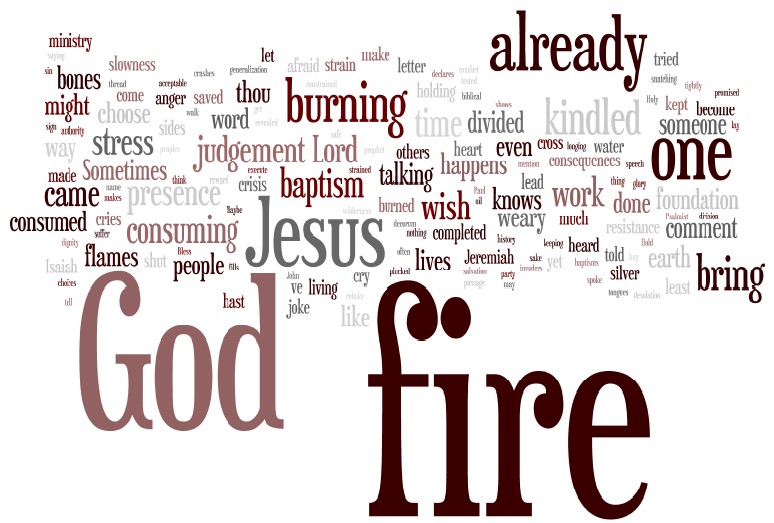
Tomorrow’s sermon: Fire

Image courtesy of wordle.net

Image courtesy of wordle.net

Posted in image, lectionary reflection, sermon, sermon preparation | Tagged , , , , , , , , , , , , | Leave a comment

Assumption

She spent a lot of time running away from reality.

When she was young, she ran to the hill country.

She sang revolutionary songs that she couldn’t hope to realize.

She ran to Egypt, where the fires burn and courage trembles.

She tried to leave Jerusalem without him, only to be drawn back, unable to find her son but seeking, searching.

Maybe that was the turning point.

She sought him out and he turned away, finding his family among the outcasts and the sinners, the singers and the women who lavished their resources upon him.

He met her once more on the road out of the city, and they both wept, face to face and separated by the bitter way that life sometimes has of shredding bodies and souls.

He cried out, “Blessed are the barren, and the wombs that never bore, and the breasts that never nursed,” and a sword pierced her own soul, also.

Dying, his last bequest, mother to son and son to mother, an ironic reconciliation.

And she said, “Here I am, the servant of the Lord; let it be with me according to your word.”

Posted in holy days, lectionary reflection, poetry | Tagged , , , , , , , , , , , , , , , | Leave a comment

Heart of darkness

I’ll readily (although not happily) admit that I am pretty naive about race. I grew up in the dark about my own white privilege, my own native prejudice and naive misconceptions. I moved to another country, with its own complicated racial history and culture, and I was more lost than ever in the fog.

I am also often a little slow of understanding. So when a person I had never met before commented on leaving the suburb that I serve because of how dark it had become, I was at a loss for what he meant. He tipped his head to one side and said with a wry, twisted grin, “Know what I mean?”

I gave him a blank look, baffled, then relieved to be rescued by the opening up of the line and the opportunity to do what I had come to do: to offer the prayers and condolences of my parish to a bereaved family, in the name of the Light that overcomes the darkness of death.

That wry grin, that odd tilt of the head stuck in my craw, though. I was puzzled. “Know what I mean?” Light dawned, and I was thunderstruck. I left under an ominous black cloud, furious that I had been unwittingly co-opted into someone else’s vision of a community I am growing to love, full of the children of God; furious that I had let it happen.

But that’s the thing about being me, isn’t it? I get to be naive, and slow on the uptake, and thus to escape the embarrassment of responding to a stranger’s throwaway line at a funeral home visitation full of flowers and family secrets and sighs.

“He said to them, ‘If any want to become my followers, let them deny themselves and take up their crosses daily and follow me. For those who want to save their life will lose it, and those who lose their life for the sake of the gospel will save it. For what will it profit them to gain the whole world but lose or forfeit themselves? Those who are ashamed of me and of my words in this unfaithful and sinful generation, of them the Son of Man will be ashamed when he comes in the glory of his Father with the holy angels’.” (Mark 8:34-38/Luke 9:23-26, combined)

I’m so sorry I let you down. God willing, one day I’ll do it right.

Posted in other words | Tagged , , , , , , , , | Leave a comment

The anniversary of a Transfiguration, a mushroom cloud and a drone strike

 Now about eight days after these sayings Jesus took with him Peter and John and James, and went up on the mountain to pray. And while he was praying, the appearance of his face changed, and his clothes became dazzling white. Suddenly they saw two men, Moses and Elijah, talking to him. They appeared in glory and were speaking of his departure, which he was about to accomplish at Jerusalem. Now Peter and his companions were weighed down with sleep; but since they had stayed awake, they saw his glory and the two men who stood with him.Just as they were leaving him, Peter said to Jesus, ‘Master, it is good for us to be here; let us make three dwellings, one for you, one for Moses, and one for Elijah’—not knowing what he said. While he was saying this, a cloud came and overshadowed them; and they were terrified as they entered the cloud. Then from the cloud came a voice that said, ‘This is my Son, my Chosen; listen to him!’ When the voice had spoken, Jesus was found alone. And they kept silent and in those days told no one any of the things they had seen. (Luke 9:28-36)

Have you been on the mountain when the cloud has come down to embrace it? It is like a moist mist, creeping around you and into your bones. The bright views of the valley are gone in a moment, replaced by a swirling grey-white nothingness as far as the eye can see. The path is lost. The only place to be is where you are, still and patient, until the cloud either lifts or falls, and the light breaks through once more.

It is like being in the womb of the world, where the universe shrinks to the touch of water on your fingertips and the wall of damp air that extends forever and into your essence, so that time and space and history and all that is known are hidden from view, until the light breaks through once more.

In the cloud, the precipices present themselves far too late; safest to stay away, stay still, wait it out.

But we who have been born, once or twice, we do not belong in the womb, and if we stay too long our fingers will wrinkle and our skin sag and we will begin to chill and sweat and hunger; we do not belong in the womb any longer; we have to make our way in the world,

we cannot hide from our history, the strange-shaped clouds and their terrible particles of water and dead air;

we cannot hide from our future; we know that even blind drones are seeking their way through the cloud;

ever more urgent, then, that we try to find our way

with compass and map and a gps and Jesus

until the light breaks through once more.


With prayers for those who have no safe space to stay today, and those who fear for their safety, and for those who would help them out of harm’s way, for a peaceful passage through the clouds.

Posted in current events, holy days, homily | Tagged , , , , , , , | Leave a comment