She’s leaving home

My eldest child left home this week. It was a lot less dramatic than you might think.

Just as the act of birthing her was fraught with all of the emotion under the sun, but revolved in the moment around the contracting of muscles and the monitoring of heartbeats, so on Monday we moved furniture and boxes, panted, ached, and ate lunch.

She had some things to finish up, so she said she would follow me home.

By the time she was ready, I had been called to attend to the next child’s travelling needs, and while I was gone, her new life came and swept her away to Buffalo.

Of course, she hasn’t really lived at home, as such, for a while; but I felt a difference entering that empty room yesterday, with boxes to stack and store, to wait for her call. There was a falling away; the room had dropped its guard. I no longer needed to pause for permission to enter. She had moved on.

She was born for this: to find new love, seek out adventure and meaningful work, to forge for herself a life she can embody.

She said that she would like a new crockpot, one big enough to cook meals for the two of them. I hope I get the right one. It is my small offering to lay at her feet, of peace, of love, of faith in her future, because what more, now, can I do?

Posted in story | Tagged , | Leave a comment

Ruined – a memoir by Ruth Everhart: Review

Let’s get the disclaimers out of the way first: yes, I have met the author. We are both members of an online group of (mostly) female clergy-types called the RevGalBlogPals. We both contributed to a book edited by the RevGals director, Martha Spong, called There’s A Woman in the Pulpit. And that’s how I came to be in possession of an Advanced Reader Copy of Ruth Everhart’s memoir, Ruined, provided by Tyndale House Publishers.

I met Ruth irl at the Festival of Faith & Writing this spring. We were at Calvin College in Grand Rapids, Michigan. To tell the truth, I was a little intimidated. The seats she had reserved for our online group of connected strangers were in the middle of the front row. She seemed to be surrounded by people she knew. She was confident and competent and firm on her feet, seemingly on home ground.

The college scene of Grand Rapids is a fairly major character in the book; reading the background, it becomes remarkable that this woman has found such (apparent) peace in her “homecoming” here. But her memoir is, in the end, more about redemption than rape, after all.

A difficult thing to narrate, such an intrusion, invasion, injury as rape. The level of detail which Ruth provides is objectively astonishing. As an aid to reading the story of that pivotal event, it is perversely comforting. It reduces evil to its banality. It slows the pace enough for this reader, at least, somewhat to catch her breath.

The stories of Ruth’s struggle to reconcile her rape with her faith in a providential God, and the paths and rabbit holes down which her head and heart lead her, are told with little retrospect, so that at the end, we find ourselves blinking a little in the unexpected light of a life that is good after all, if imperfect; certainly not ruined. Perhaps that is the author’s way of conveying miracle, or grace.

I am one of those horrid readers who, at a certain point, has to flick to a few pages short of the end, just to be sure of her destination. Here I found Ruth’s letter to her daughters, explaining some of her purpose in writing this book. This was the retrospect, the hindsight which, for me, tidied the narrative into a comfortable structure for an uncomfortable content. The decision not to begin the book with this perspective, though, allows the reader to walk more closely, more fully with Ruth through her journey past the spectre of ruin to the spirit of redemption, and to appreciate more thoroughly her fortitude, and forthrightness as she “continues to work out [her] own salvation with fear and trembling,” as she herself quotes from Philippians 2:12.

I am still a little awed by the author, but I think for good reason. Telling this kind of truth is a feat of remarkable faith and courage. I hope that by reading this book, a little of that might rub off on me.

Ruined, by Ruth Everhart, is published by Tyndale House Publishers this coming Tuesday, August 1. It can be ordered from the publisher, from Amazon, or from your favourite book seller today. This review refers to an advance copy that may differ from the final product.

Posted in book review | Tagged , , , , , , | Leave a comment

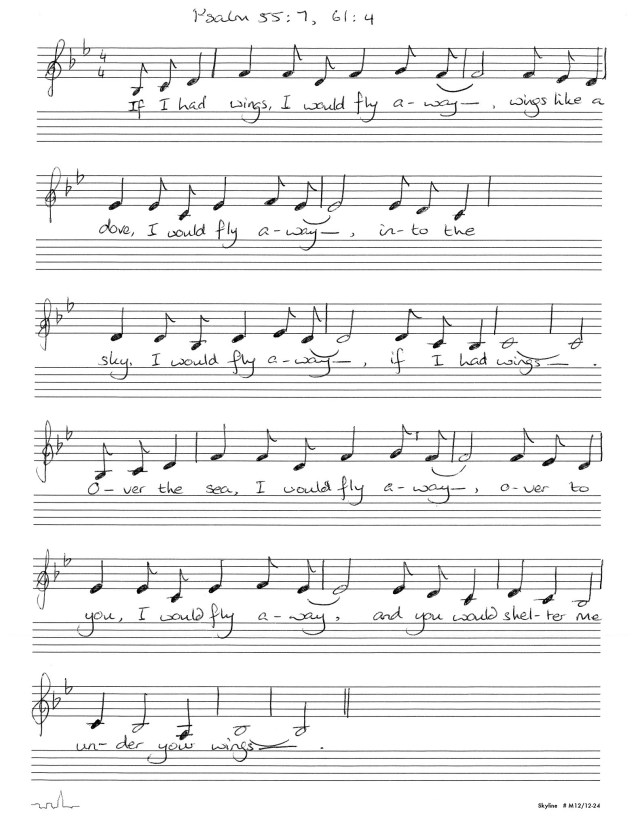
Psalmbird

At last week’s Summer Music Camp, we learned all about David the songwriter (the one from the Bible, as we had constantly to disambiguate).

We learned to sing Psalm 23 in childlike form. We listened to Kiri te Kanawa singing “O for the wings of a dove,” Mendelssohn’s beautiful response to Psalm 55.

Today’s Morning Prayer included the verse, “I will dwell in your house for ever; I will take refuge under the cover of your wings” (Psalm 61:4), which reminded me of the second verse of our own little Psalmbird refrain that we learned on dovewing day last Wednesday.

In case you need a little ditty to hum while you watch the seagulls circle and the eagles disappear over the horizon, here is the Epiphany Summer Music Camp version of David’s psalmbirds.psalmbird

psalmbird04913320160726141102

Posted in prayer | Tagged , , , , , | Leave a comment

Year C Proper 12: Teach us to pray

Jesus gave a couple of different words of advice to his disciples about prayer. In one, he tells his disciples to lock themselves behind closed doors in secret, to pray privately to God, and there is a place for that in each of our hearts. But here, too, he speaks aloud, invites his disciples to “us” and “we,” to share their prayer, to share his prayer, together. That is what we do on Sunday mornings.

It is not the silent prayer of our locked hearts, but it is not, either, the loud, showy prayer of the Pharisee. It is a tuning of our hearts and voices to one another, as the Body of Christ working in harmony, to lift our prayers to God with angels and archangels, with all the company of heaven, with the person standing next to us.

We don’t use the exact words that we read in this morning’s Gospel. Over time, we have become used to traditional forms, renderings of the prayer that Jesus taught us, which we can recite together anywhere, almost without thinking. Almost without thinking.

Sometimes, a change of translation: ancient to modern, musical to spoken, choral to plainsong, trips us up, and we are tempted to fall away.

It can be difficult to adjust the habits of a lifetime to the gathered community in the moment; but we are called by Jesus not only to pray in the privacy of our locked hearts, but to open our prayers to one another, “us” and “we.”

There are many ways to pray as Jesus taught his disciples, and each community has its own tradition, and if we visit one another, we may find ourselves straining to match our tone, our pace, the habits of our heart; but it is worth it to experience the Body of Christ in unity, in harmony, praying together.

So some of us have found it a stretch, this summer, to speak in contemporary language instead of borrowing the language of our ancestors to pray to God; but we are in good company, and we will find ourselves on familiar ground if we visit another church where this is the tradition.

The habits of our hearts will spring back into place as soon as we are behind locked doors, or as soon as the season changes and a new, or old setting presents itself as the prayer of the gathered community before God; we have lost nothing.

Jesus taught his disciples to pray, not in rhythmic lines, but in stark petitions to the God whom we trust to hear us.

Father, hallowed be your name.

In God we trust, and there is no other name that we dare elevate to the place of saviour, sustainer. We belong to God, every tribe and nation; we are called by the same name, creatures made in the image of God. IN the excitement and fear, in the rhetoric and threat, in the promises and the pageantry that flood our news feeds, let us remember whose name it is that we hallow, hold sacred, alone, and temper our hearts accordingly.

Your kingdom come.

Come to Kabul, to Munich, to Nice, to Baton Rouge, St Paul, Dallas, Orlando, Cleveland, and Euclid. Your kingdom come; the kingdom in which no weapon is raised, no death remains, but the light of your life leads us in paths of righteousness. Before any more grief, any more graphic fear grips us, let your kingdom come.

Give us each day our daily bread.

And let it be enough for us.

And forgive us our sins, for we ourselves forgive everyone indebted to us.

Or at least, we try. And if we cannot forgive other, how will we forgive ourselves? And if we will not forgive anyone, what do we say, that we know better than Jesus who is deserving of his blood, and sweat, and tears? No; but forgiveness sets us free, in the giving and in the receiving, and reminds us of our humility, and our own need for God’s grace and mercy, which is given ungrudgingly.

And do not bring us to the time of trial.

Last Sunday night, 200-300 young people gathered on Sims Park Beach for a party that they labelled, Stop the Violence. The Violence visited them. One young man is dead, a child is in the hospital. A juvenile is charged with aggravated murder before he has reached adulthood.

“Which of you, if your child asks for an egg, gives him a scorpion?” asks Jesus. And I’m afraid that we do, with our excess of guns and our tendency to play God with one another’s lives.

Do not bring us to the time of trial, because we just might fail. Instead, deliver us from evil.

Jesus does not add a doxology, but it is the cry of our unlocked, unleashed hearts. We know that in God alone our prayers are answered, and that there is power beyond ourselves that we can borrow, lean on. Those young people last weekend knew that they were strong together in their love, strong enough to bring a message to Stop the Violence. Earlier in the day, on a bridge in Cleveland, thousands gathered in silent prayer to hold our city in hope, in faith, in peace, drawing on something much larger than ourselves, something beyond our closed-door hearts.

Jesus does not add a doxology, but we do, to remind ourselves when it is hard to pray that there is power that we can borrow, lean on, to bring ourselves closer to that kingdom come, in which no evil is done. It is our hope, our faith, and our promise:

For thine is the kingdom, and the power, and the glory, for ever and ever. Amen.

Posted in prayer, sermon | Tagged | Leave a comment

About prayer

Father, Mother, source of life, all being;
your very name fills us with awe.

We long to know you, ruler of all; unelected,
you elect us to do your will, here, now, forever.

You who nursed creation as it grew,
fill us now with solid food;
leave no room for envy,
release resentment,
that our lives may be made whole.

Catch us when we are falling;
save us from harm,

for without you, we perish,
we are bereft; you only have
the power to raise us up to glory.

Posted in lectionary reflection, prayer, sermon preparation | Tagged , | Leave a comment

Martha & Mary

There is so much to be done:
the sweeping of the streets,
the hanging of bags full of plasma,
saline, the careful placement of Kleenex.
There are so many distractions:
tanks and trucks, bullets and bombs,
the cleaning of windows shattered,
the salvage of strangers’ belongings,
urgent attention to medical alarms,
news alerts, hatches to batten; there is
one thing that is needed more than all,
that is, to stop. Sweet Jesus, to stop.

Posted in current events, lectionary reflection, poetry, prayer, sermon preparation | Tagged , , , , , | Leave a comment

“Do not be overcome by evil”

… “but overcome evil with good.” Romans 12:21

If I were asked, I suppose I would say,
“Continue to do good.
Teach kindness to children,
in hope that we might learn it from them.
Tell them to be unafraid,
that we will stay close by,
that there is more to love in this life than to fear.
Teach them to pray for our enemies,
as a bulwark against bitterness.
If only to hear ourselves say it aloud,
remind them to praise God in all things;
God who made hearts to be broken,
and hearts to soar before the dawn,
when in the turning they see for a moment
the face of the beloved once more.”

Written on a morning when the radio tube.JPGdescribes terror, a body in the street, a child’s stroller, run over. On a morning when the Daily Office advises, nonetheless,

Let love be genuine; hate what is evil, hold fast to what is good; love one another with mutual affection; outdo one another in showing honor. Do not lag in zeal, be ardent in spirit, serve the Lord. Rejoice in hope, be patient in suffering, persevere in prayer. Contribute to the needs of the saints; extend hospitality to strangers. Bless those who persecute you; bless and do not curse them. Rejoice with those who rejoice, weep with those who weep. Live in harmony with one another; do not be haughty, but associate with the lowly; do not claim to be wiser than you are. Do not repay anyone evil for evil, but take thought for what is noble in the sight of all. If it is possible, so far as it depends on you, live peaceably with all. Beloved, never avenge yourselves, but leave room for the wrath of God; for it is written, “Vengeance is mine, I will repay, says the Lord.” No, “if your enemies are hungry, feed them; if they are thirsty, give them something to drink; for by doing this you will heap burning coals on their heads.” Do not be overcome by evil, but overcome evil with good. Romans 12:9-21

Posted in current events, lectionary reflection, meditation, poetry, prayer | Tagged , , , | Leave a comment

PokemonGO to the RNC

The signs on the highways into Cleveland have changed from their regular warnings against distracted driving to vague warnings to report odd distractions to the FBI RNC tip line. But have authorities taken into consideration the prevalence of odd sightings around and even within the security perimeter in recent days?

At least two of these odd characters were spotted sneaking into a sold-out final performance of The Phantom of the Opera last Sunday at Playhouse Square. Fortunately, theatre-goers were able swiftly and quietly to put them in their place.

ratata

They are no respecters of personal space

But their sheer ubiquity is frightening. “There are wild Pidgey everywhere,” remarked Edward H, of Bay Village, Ohio.

And they are not always as easy to dispense with as the Phantom interlopers. “Zubats are hard to catch,” confirmed Freya H, currently of Columbus, Ohio.

How will the security forces police these potential gatecrashers of the RNC?

Are Pokeballs on the list of restricted items within the secure zone?

How are the police planning for the inevitable battles breaking out in Public Square?

At Trinity Episcopal Cathedral, notorious for its radically inclusive welcome of all, a peaceful but unusual guest sat in on a recent staff meeting.

Does the RNC Rules Committee, meeting today, need to consider providing space for the presence of such uninvited observers?

Idle minds want to know: Will PokemonGo to the RNC?


Seriously, though: Please pray for the peace of our city in the coming week. Trinity Cathedral in downtown Cleveland will host noonday prayer Monday through Wednesday and Friday, with a Healing Eucharist on Thursday. Church of the Epiphany in Euclid hosts healing services tonight and next Thursday at 6pm. Circle the City will see thousands standing in silent prayer on the Hope Memorial Bridge this Sunday afternoon.

Posted in current events | Tagged , , , , | Leave a comment

Year C Proper 10: who is my neighbour? (read: which lives matter?)

It’s not a pretty story about being kind to people. Put it back into its context, in which Jesus is asked the question, not by a devoted disciple seeking enlightenment, but by a cynic trying to trip him up, looking for a gotcha moment to discredit the Messiah.

“Who is my neighbour?” he asks, and Jesus launches into a rant, told in the form of the traditional three-part folktale. He tells the man, in so many words, “Even the Samaritans know how to treat people like human beings. Even they would not be so crass and arrogant as to ask, ‘Who do I have to bother to care about?’”

There is a strong, stale odour of ethnic division, inequality, and tension behind the choice of a Samaritan as the hero of the story; all the better to demonstrate that quality of keeping his humanity that the third man works out of. He is a human being to the man laying by the side of the road, because he sees that man’s full humanity, laid out and bleeding out before him, and he is moved with compassion, fellow suffering, because he recognizes their kinship, fellow humans, made in the image of one God. Despite their history, humanity saves the day.

But it is not a pretty story. Do you remember, a few years ago, a woman’s body was left on the side of the highway a few miles from here? A motorist called it in. When the police rolled by, they thought they were seeing a deer carcass, and went to take their lunch break. They failed to see her humanity. A second caller reported the body almost an hour later, leaving us to wonder how many more passed by without seeing, without heeding her. When ODOT arrived to clean up, they found a third motorist, waiting with her body, the third caller. Finally, someone who saw her clearly in all of her humanity, and stayed with her, through the end of the story.

It’s not a pretty story. Jesus is on the offensive, angry. It is as offensive a story, in fact, as his whole, “Love your enemies,” piece.

“You have heard that it was said, ‘Love your neighbour and hate your enemy.’ But I tell you: Love your enemies, and pray for those who persecute you, that you may be sons of your Father in heaven.” (Mt 5:43-35a) Love your enemies, because the old ways of dividing ourselves into those whom we claim and those whom we kill, those ways are not working. They do not bring us to life. They bring death daily to our doorstep.

We have not covered ourselves with glory this week in America. We are not even the heroes of our own stories today. Instead, three separate instances of gun violence have shown how deeply divided we are from one another’s humanity.

In the first two, in separate incidents on consecutive nights, men were shot to death by police officers, and disturbing camera footage brought home, literally into our homes, the faces of those numbers we see but do not read, or read but do not recognize: that our criminal justice system from top to bottom, from the sterile death chamber to the very streets we walk and drive upon, the system is failing African Americans, and especially young black men. There is a strong, stale odour of ethnic division, inequality, and tension behind these videos. And too many of us have passed by too often, failing to see humanity falling by the side of the road.

That was two. Then on Thursday, a military veteran took his knowledge of weaponry and his easy access to it onto the streets of Dallas. While a thousand people peacefully demonstrated their right to be seen, their right to have their humanity recognized, their lives to matter, and while officers protected and policed and served that right, stood guard over their bodies and their voices and their lives, that’s when one man chose to shoot and kill five public servants right there, wounding several others.

When we divide ourselves into those whom we claim and those whom we kill, we bring death daily to our own doorstep.

In the story that Jesus told, the Samaritan man recognized the humanity of the man lying in the road, left for dead by bandits. That same Samaritan man knew that his own humanity demanded something of him. To love his neighbour as himself, he had to treat them both as human beings made in the image of God. He had to recognize the need of his neighbour, and he had to recognize the nobility of his own soul. He had to call upon his human ability for humility before an enemy, love before a stranger, sacrifice for the sake of justice and of mercy.

In a story stale with the odour of ethnic violence and division, Jesus poured out oil and wine, his own blood, for the sake of our humanity, because somehow he saw himself in us, in his humanity.

“Go,” he told the lawyer, “and do likewise.”

The story of the Samaritan, of the Levite and the priest and the man left for dead, by bandits hiding in the shadows; that story is told for one purpose: to answer the one who asks, “With whom should I be bothered? Who is deserving of my care?” Which lives matter?

And into a story stale with the odour of violence, Jesus pours out oil and wine, his own blood, for the sake of his humanity, for the sake of our humanity, made in the image of God, saying “Go, and do likewise.”

Amen.

Posted in current events, sermon | Tagged , | 3 Comments

Morning Prayer for July 7, 2016: Psalm 18, Part I

Last time, I came back cold;
colder than any living thing was meant to feel.
Your burning coals, flung from your flaming tongue,
extinguished themselves against the skin of my unclaimed body,
and I didn’t feel a thing, except cold;
colder than a living thing was even meant to feel.

You harnessed the storm clouds,
you rode the winds like winged horses;
the beds of the seas were uncovered and laid bare,
because many waters cannot quench love,
nor can the floodwaters drown it* – ah!
but the cold carries it deeper than any living thing can suffer.

You drew me out of great waters, and the cold coated me
with its thick, numb covering, impervious; impermeable.


  • Song of Solomon 8:7
Posted in lectionary reflection, poetry, prayer | Tagged , , | Leave a comment