A sermon for the 24th Sunday after Pentecost, October 30, 2016
Habakkuk 1:1-4; 2:1-4, Psalm 119:137-144 or Isaiah 1:10-18, Psalm 32:1-8, 2 Thessalonians 1:1-4, 11-12, Luke 19:1-10
On Friday morning, I went to the new Old Fort steps at the Rocky River Metropark. They carry visitors (not magically; you have to use your legs) from river level to the top of the steep cliffs overlooking the canyon as it winds its way to the Great Lake. Formed over millennia, the landscape is still moving and changing, which is why new steps had to be built.
“Change takes time,” reads a sign part way up the steps. “Change begins with a single step.”
There are signs from MetroHealth all around, giving a stair count, and an encouraging little message halfway up. I noticed the one urging visitors to make this new staircase part of their daily routine.
At the top, a greeting, and an encouragement to take a moment, take a breath, take in the view.
Of course, I thought of Zacchaeus. How could I not, up there among the tree tops? You get a different view of it all from on high, a different perspective, lifted free of the trunks and trails and the busy fall of leaves all around. Up in the clear air, the distractions are more thinly spread, the view is cleaner.
Zacchaeus climbed a tree, in order to see Jesus.
Back on the ground, Zacchaeus is inundated with negativity and grumbling, with distractions and distress. Maybe he deserves some of what is coming his way; he is a tax collector, after all. Still, it was easier up there in the tree, with no one to come between him and Jesus, their eyes meeting in empty air.
We tend to read this story as though the crowd intercedes for judgement; Zacchaeus pleads his case; Jesus decides; and everyone goes home for dinner. But the crowd is not muttering 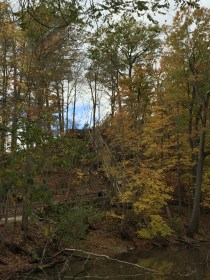 and grumbling to Jesus but at Zacchaeus. He is familiar with the charges and he is well-versed in his response, used to justifying his living. He appeals to the Law: give to the poor, and repay with interest anyone one may have wronged. That, he claims, is the Zacchaeus way. Did you know that his name means “righteous”?
And Jesus addresses neither the grumbling nor the excuses. Jesus’ reply is oblique. He does not call Zacchaeus to repentance, nor does he commend him for his righteous dealings in his despised tax collecting office. He does not trouble himself to anger or to appease the crowd. He states, simply, that “this man, too, is a son of Abraham.” And he’s the one that Jesus just happened to see, sitting up a tree, waiting for Jesus to pass by. [1]
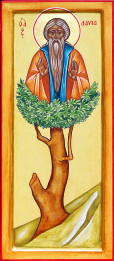
There is in the ancient world a tradition of tree-dwelling monastics, seeking Jesus from the confines of a hollow tree, or the branches of a tall one.
David the Dendrite (dendrite was the term used for these tree hermits) is the patron saint of Thessalonika. He spent three years living in an almond tree next to his monastic home, waiting upon guidance from God. After three years of exposure to the seasons, presumably some ridicule, and other hardships, he received a message from an angel that the time had come for him to leave his tree and return to his monastic cell. From there, he offered healing miracles and hope to those who visited him from the outside.
There are issues on the ground that are pressing. Jericho itself, the city of Zacchaeus, has been transformed from a centre for trade and abundance to a besieged settlement within the Palestinian territories of the new Israel. The issues on the ground, of political allegiance and occupation, have never been more real since the days of the Roman tax collectors and their collaborators. The city is a symptom of a broken world system debased by sin, and grounded by the weight of its own greed.
On the ground in Dakota, sacred sites, water sources are up for grabs, while the crowd grumbles.
On the ground in Calais, children are dispersed from the one safe zone they have known, while the crowd grumbles.
On the ground in Aleppo, what crowd is left to grumble about the walking wounded  taking over the town?
And we, on the ground grumbling, we are not innocent. We are complicit in the occupation of the lives of the poor, the disenfranchised, the unfortunate, the immigrant, the despised, no matter how many laws we cite to justify ourselves.
There is plenty of work, grumbling, and justifying to be done on the ground; but how do we get a clear view of what to do, how to help?
Jesus himself did not spend all of his time sitting down to dinner with sinners. He covered a lot of ground in his ministry, seeking and saving the lost. Still, there was that time, that moment when he and Zacchaeus connected through the tree tops, took a breath, sat down, and he said, “Today, salvation has come to this house.”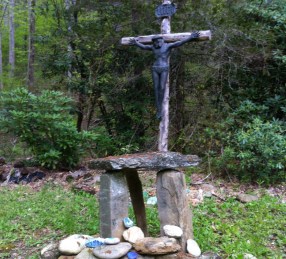
Salvation has come, not because a man climbed a tree, or obeyed the law, or because the crowd grumbled, but simply because this one, too, is a child of Abraham, and because Jesus came to seek and to save the lost. Salvation has come because Jesus has passed by this way, and left in his wake an evangelical tax collector, an astonished crowd. Salvation has been delivered in a moment of grace, an encounter with Jesus, even as he continues on his way toward Jerusalem, where he will be raised on the branches of another tree, on the hilltop, into the empty air.
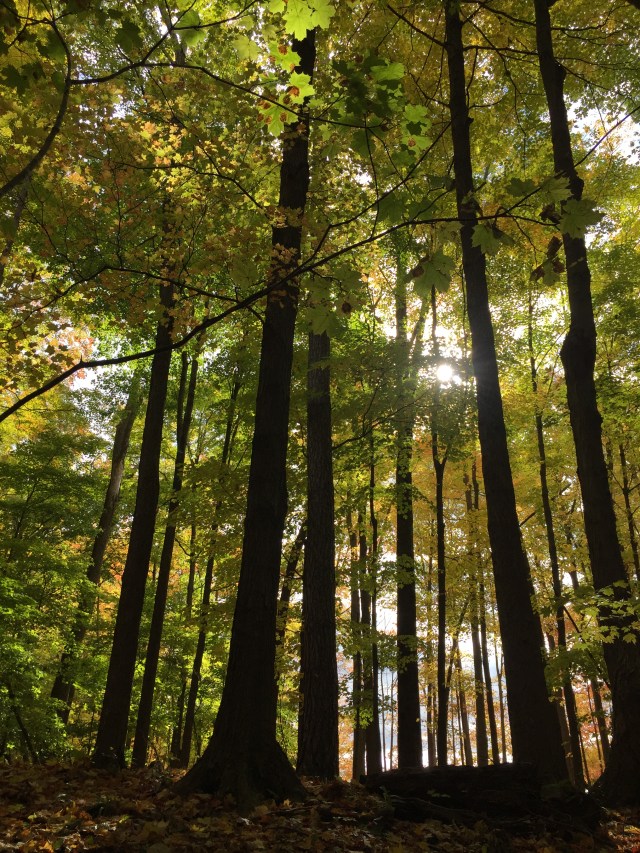
There is always work to be done on the ground. There is Wisdom, too, in taking time out, in taking a vantage point, clear and unobstructed by distractions, from whence one can see the wood for the trees, hear the Word of God unfiltered by the grumblings of the crowd, the noise of life on the ground in a still sinful world.  There is grace in finding a place where salvation can find us; where salvation can be at home within us, and among us.
According to the experts, Dendrites tended to use their tree dwelling not as a long-term living situation, but as an introduction to their life of prayer; a discernment process. [3] In fact, when David the Dendrite died, he was back out in the world on a political mission on behalf of the people of Thessalonika, grumbling to the emperor.
The signs in the Metropark from MetroHealth suggest incorporating a daily activity of climbing the stairs into the treetops, for the health of our bodies and our lives. I am not necessarily advocating for climbing trees, unless that is safe for your body as well as your soul. But to find a space where there is nothing between you and the sight of Jesus but empty air – that is a space worth expending a little effort to find.
A daily practice of setting aside distractions and disturbances, a practice of placing ourselves in the plain sight of God, with nothing but empty air between us, so that Jesus can find us at home.
For the Dendrites, the tree dwellers who practice prayer in the empty air, their biographer Susan Harvey writes,[4]
Here … is our healing and our hope: salvation is a life we will live. And because we know this now in our limited, temporary, mortal body, we will know it there in a fullness that defies our rational understanding but brings to completion the nature of our embodiment. We will be at home, and we will know it.
[1] For more, see David Lose, http://www.davidlose.net/2016/10/pen-24-c-reformation-the-unexpected-god/
[2] https://orthodoxwiki.org/David_of_Thessalonica
[3] “Whereas stylitism was often an enduring ascetic and public vocation, dendritism was typically the precursor to other forms of asceticism.” Kyle Smith, “DENDRITES AND OTHER STANDERS IN THE HISTORY OF THE EXPLOITS OF BISHOP PAUL OF QANETOS AND PRIEST JOHN OF EDESSA,” Hugoye: Journal of Syriac Studies, Vol. 12.1, 117-134 (© 2009 by Beth Mardutho: The Syriac Institute and Gorgias Press), 119
[4] Susan A. Harvey, “Embodiment in Time and Eternity: A Syriac Perspective,” St. Vladimir’s Theological Quarterly 43(1999) 105-30. Repr. Theology and Sexuality: Classic and Contemporary Readings, ed. Eugene F. Rogers, Jr. (Oxford: Blackwell Publishers, 2002), 3-22