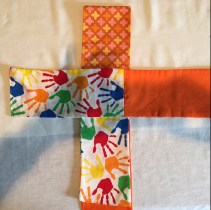
Spirit and flesh

Such contortions of the flesh,
bearing down in humility before
the Spirit, pregnant with the weight
of glory, groaning as a child
sighs in the dark, sideways, furled
in on itself, dreaming the impossible

Posted in lectionary reflection, poetry, prayer | Tagged , | Leave a comment

Godsplaining

Godsplaining is what Rebekah gets in answer to her prayer in the midst of a difficult pregnancy in this morning’s reading from Genesis …

So little did Esau think of his birthright, his advantages, his destiny that he would sell it for a pot of beans. It’s a story that cries out for one of those alternative history treatments: the names of Abraham, Isaac, and Esau would replace the familiar formula of blessing. Jacob had yet to be renamed: might Esau, instead of his twin, have been adopted as Israel, the father of God’s chosen people, if he had not been so hungry that day after hunting, for nothing?

We never know what might have been, if a different path had been taken. We cannot see into those putative parallel universes where all of the possibilities play out, according to the science fiction writers, and some of the scientists. We are left with the here and the now, our lives as we have lived them, and the choices that we make today, as best and as faithfully as we are able.

Rebekah wanted to become a mother. Her husband interceded for her, because it was difficult for her to conceive. When she did, and the twins inside her uterus fought and squirmed and pressed upon her bladder and her gullet, and wrenched her back, stretched out her breasts and made her life wretched for the better part of nine long months – as these little creatures will do – then she prayed to God, “If this is how it’s going to be, just kill me now!”

And God did answer Rebekah, although not, perhaps, as she might have expected. Instead of removing her discomfort, God explained it (thus inventing “Godsplaining”), telling her that her destiny was to be the mother of strife, of nations, of an important turning point in history.

God did not remove her discomfort, but offered an explanation. And it was just enough to keep her going, apparently, until her deliverance. I do notice, though, that unlike most of her biblical sisters, Rebekah did not go down that same path again. The twins were her and Isaac’s only children.

The oracle that Rebekah had received in place of any relief of her distressing pregnancy symptoms dictated her later course of action with regard to her sons: aiding and abetting the replacement of the elder by his barely-younger brother. In setting up the trickery that stole Isaac’s deathbed blessing for Jacob, she was simply fulfilling the destiny declared to her when the boys were still in her womb.

Isaac was oblivious to the whole thing: to his wife’s distress, no longer interceding on her behalf; to his son and heir’s sale of his birthright to his younger brother; to his wife’s scheming to get his blessing on the whole switched-at-birth motif. If Isaac had paid more attention, would he have had a say in the succession plan? Again, what might have been is not ours to know.

So what, apart from providing the script for a stunning telenovela, does this story offer us in the way of biblical wisdom and guidance?

I think that it is something about how we interact with God’s intentions for us, and how God interacts with our best and blighted intentions.

For Rebekah, the desire to bear a child is part of her call to be a part of this founding nation, ordained by God through the covenant with Abraham. She assented to this call – her relatives asked her explicitly whether she wanted to go and become Isaac’s wife, and she agreed that she did. Now, some way down the road, she is finding it heavy going, with the twins pressing on her bladder and her diaphragm and putting out her back and making her burp, as they do, and she is miserable. She turns back to God and asks if all the trouble is even worth it.

But this is the trouble that she chose, that she asked for. So God does not take it away. God does not undo Rebekah’s choice to become part of this foundational biblical story. Instead, God reminds her of what is at stake: not only a few months of pregnancy problems, but a family saga – an international saga of epic proportions.

Sometimes, when the going gets tough, we need to be reminded that we chose to become Christians, to follow the way of the cross. We are innocent of wanting to be crucified; but we have chosen to participate in an epic drama of the goodness of God – grace, mercy, and justice – set up against the evil that lurks in the corners of creation that have yet to embrace God’s love. Whether it is the call to ordination, or to lay preaching, or whether it is simply (simply) the call to love God and one’s neighbour as oneself: we are part of an epic story, and our labour is worth its salt.

And God does not remove the symptoms of the way of the cross, nor undo our choice to follow Christ; but God does remind us of the grace that we are pursuing, and why it is all worthwhile.

So it may mean the awkwardness of calling out an off-colour or racist comment at work, risking ridicule or family fallout by standing up for the dignity of every human being, as our baptismal covenant promises. It may require the inconvenience of going the extra mile for someone when we really can’t be bothered; or even the danger of telling truth to power, balancing the scales of justice when we see oppression in action. It may call out the risk of rejection involved in offering unsolicited love and mercy, expecting nothing, not even gratitude, in return. The symptoms of Christianity in our everyday lives may occasionally bring us beyond our comfort zones. But our labour is worth it, because the seeds that we plant bear fruit beyond our reckoning. And this is the labour that we asked for, when we entered the covenant of God that was cut by Jesus.

We do not know what would have happened had Esau not sold his birthright, or Rebekah and Jacob not tricked old Isaac, or if Isaac had paid more attention to his sons. It is not ours to know what shape our lives would have taken if we were not Christians, because this, the Christian story, the Gospel story, is the story within which we live, and move, and have our being. This is our story.

It is a story of struggle, of drama, of the unexpected. Always, it is the story of God’s grace and loving interest in our lives, guiding, explaining, encouraging us along the way to stay faithful, to stay the course; to follow the way of the cross, no matter which turning we choose. And no matter where we find ourselves along the way, we will find God there, reminding us that we have the privilege of participating in God’s epic script to love the whole world, and each of us, God’s beloved and troublesome children, within it.

Posted in lectionary reflection, sermon | Tagged , , , , , , , , | Leave a comment

Fishing

Poised on the deck, line in hand, she
casts her bread upon the waters
and waits. Under the bridge,
birds echo and argue. The river
runs fast, but time has slowed
down, still water running deep.

I match my morning prayer
to hers, drawing out the psalms,
eking out the slow invitation;
waiting for a tug on the line,
some sign of life
on the other end.

Posted in poetry, prayer | Tagged , , , | Leave a comment

Wrestling and rest

The readings are for the fifth Sunday after Pentecost. Paul says, “I do not understand my own actions. For I do not do what I want, but I do the very thing I hate.” (Romans 7:15) Jesus says, “Come to me, all you that are weary and are carrying heavy burdens, and I will give you rest. Take my yoke upon you, and learn from me; for I am gentle and humble in heart, and you will find rest for your souls. For my yoke is easy, and my burden is light.” (Matthew 11:28-30). Will we choose to wrestle with Paul, or rest with Jesus?

Poor Paul had a problem. He did not live easily in his body. He found it difficult to live harmoniously with himself. Thank God, he concluded, for Jesus Christ, who says in the Gospel, “Come to me, all who are burdened; for my yoke is easy, and my burden is light.”

Poor Paul; although he was thankful for the opportunity, he never did seem to find much rest.

Although actually, some of the commentaries[i] suggest that Paul did not mean, in this passage, what we think he meant; even that Paul was not speaking for himself, but for a humanity, born from the sin of Adam, which has yet to find its way into the grace of God. It is inconceivable, they say, that Paul, who knows the grace of God, who knows the love of Jesus, who knows his way to salvation should continue to condemn his body to death! The man who met his Lord on the road to Damascus knows that in that moment, his life changed course, and that he was diverted from death – that death he would visit upon his fellow men – that he was diverted from death into life.

And yet, we recognize for ourselves the dilemma described in Paul’s angsty arguments against his own will and actions. We know we shouldn’t check our phones while we are driving – but how many of our hands stray towards that siren screen, as though they had minds of their own, apart from our sensible will? We know we shouldn’t take one more drink, place one more bet, but our bodies seem to have other ideas than our sensible minds. We know that the spiral of negative thoughts, revisiting the same scenes over and over again will not change the past, nor help the future; and yet we find ourselves slaves to the voices in our heads that shout down the sensible voice of reason.

Come to me, says Jesus, all you who are weary and burdened; for I am gentle, and humble, and my yoke is easy, and my burden is light.

So why are we still in that place, wrestling like Paul, or Adam, wanting to do the right thing when we have been made saints by our baptism, made holy by the holiness of God, sanctified and sent to share that grace with the world? Why isn’t it easier to live as a saint?

When Paul was taken aside from the road to Damascus, led blindly into the city and set down for three days to recover his sight, his journey was not over. It was diverted, his destination transformed from one of destruction – he was pursuing Christians to kill them at the time – to one of salvation. He ended up as the greatest evangelist to the Gentile world, spreading good news wherever he went.

His journey was not over. “Wherever he went” covered the Mediterranean world, which was a long way in those days. It included shipwrecks, arrest, trials and tribulations. It included in-church arguments, friendships and fallings-out. His journey, at the time of his conversion and diversion, was just beginning. And he was still human, prone to all of the failings and foulness, good intentions and bad choices that afflict us all.

Come to me, says Jesus, all you who are weary, for my yoke is easy, and my burden is light.

This, that Jesus offers, is not the image of the end of a journey. The yoke which joins us together, to share our burdens between us, between us and Jesus is used for walking together, not for standing still. The burden is light because of the way that it is carried, not because it has been laid down. Jesus is not speaking, this time, of a destination, but he is offering a way of walking the rest of the journey together.

It is a gentle and humble way of proceeding. It does not depend on punishment, or pain, but on encouragement and mutual assistance. It is gentle, dealing not in threats and beratements but in loving kindness, grace and mercy.
It is humble, seeking not to impose itself upon us, but courting us with its love, seeking not power but justice.

So what are we to do with those things that we do that we hate? If it is true (and I think that it is) that Jesus has already defeated the evil that besets us, then how do we live into his victory?

The greatest commandments that we have been given are to love God with all of our heart and mind, body, soul, and strength; and our neighbours as ourselves. It begins and ends in love. For those things that drive us crazy, drive us to drink, drive us to destruction – there is love. Perhaps it is the support of family and friends, perhaps of a more formal support group: AA, or a hospital-sponsored health program. It may be the community of the church; the small group comfort of a Thursday evening healing service, or the silent support of Centering Prayer. Is there more that we should be doing together, to ease the burdens, and lighten the yoke? Are there ways that we can support one another in this community, that we have not yet thought of or tried? Don’t be afraid to suggest them, for the yoke is easy and light when we carry our burdens in tandem, between us. The way of Jesus is not the way of singular struggle, nor of self-crucifixion. It is the way of gentleness and humility. It is the way of love; and love does not exist alone.

It is that assurance, of love, of gentleness, that we find at the altar, week after week. We say our confession – because the journey still involves sin – and we are assured of God’s forgiveness, week by week, day by day. We come in humility to find the most humble of offerings already set before us: the Body and Blood of Jesus broken open for us, for our salvation.

Come to me, all you who are weary and burdened, and I will give you rest. For my yoke is easy, and my burden is light, says the Lord.

Come to me.
_________________________

[i] The New Oxford Annotated Bible, third edition (OUP, 2001); The Oxford Bible Commentary (OUP, 2001)


 

Posted in lectionary reflection, sermon | Tagged , , , , , , , , | Leave a comment

Clouded out

Morning storm awakening shelved my plans
to swim; I traded in my impression of
an independent woman riding the waves
for one of a devoted wife and mother, cleaning house.

Clouded out, that other woman,
drowned out by thunder,
white-washed by lightning,
saving face.

Posted in poetry | Leave a comment

A prayer for the next day

This was published July 5th on the Episcopal Cafe.

The previous day, I had visited with my new friends: a refugee family from the Congo living in Cleveland. “There will be fireworks,” I told them. “Oh no!” The parents exchanged looks brimming over with buried memories. “We don’t like fireworks. In the war, they mean death.” That’s why I wanted them to be prepared, I told them. They would hear many explosions. It would be important to know that they are safe.

As the gunpowder smoke settles, and the stink of its breath is erased from the nostrils, Lamb of God, have mercy on those whose dreams are disturbed by the memory of death.

Read the rest of the prayer here.

Posted in current events, prayer | Leave a comment

Sunday at Collegeville

Sunday morning, starting slowly;
Abbey bells blocked by insomniac dreams.
After three days of rising –
psalms at dawn in the abbey church-
this morning is for the tomb, 
wrapped in winding sheets,
the womb of sleep.

But the breath of God paints
the surface of the water with music;
light playing loud rhythms,
riffing heart beats echoed
by the voices of the young,
sing dissonance into harmony
at the altar of resurrection.

Posted in poetry, prayer | Tagged , , , | Leave a comment

An open letter to the NRA, after *that* recruitment video

A reminder that the views expressed in this blog are my own.

Dear NRA,

You do not have to arm yourselves against me. I am honestly bewildered as to why you are afraid of me, a middle-aged, moderate-radical Episcopal priest, mother, and cat-lover.

nrahttps://www.facebook.com/plugins/video.php?href=https%3A%2F%2Fwww.facebook.com%2FNRA%2Fvideos%2F1605896562755373%2F&show_text=0&width=560

Even though I did attend the Women’s March in my city, and one in support of refugees and immigrants, 18814176_10213171784195062_4068859492634336195_n and one to raise awareness of the horrific toll that gun violence takes on our children, our communities, our neighbors; even though I do my best to bother my elected representatives by phone, mail, email, or office visits whenever their decisions bother me; still, I am not sure why your recruitment video casts people like me as a threat, and seems so deeply to fear me. I am unarmed. I am peaceful. I am really quite harmless.

I have resisted the rhetoric of Nazi propaganda and Hitler, partly because I teach our children consistently not to call people names that are not their own; but also because, while I appreciate the lessons of history, our time is unique to us.

16406914_10211946372840544_6933204408108076546_n (1)

Broad-brush comparisons gloss over the dangers that lie, like the devil, in the details. Details like keeping the media in the dark about important decisions, and making idle threats in hopes of cowing independent and critical action; like promoting Islamophobia as public policy, or restricting women’s access to important medical provisions.

I don’t watch award shows, so I can’t comment on that part of your recruitment video. I have, as I mentioned above, attended a couple of demonstrations. As I recall, the Women’s March, which attracted numbers dwarfing the previous day’s Inauguration celebrations, was remarkably peaceful and positive. In fact, one of the most powerful demonstrations that I have attended in the past year was completely silent: non-partisan and hope-filled, it was the opposite of fear-mongering , and the antithesis of violent. I did not notice any guns on the nuns who hosted the demonstration of the power of love over fear.

image1.jpg

I am not sure what the “clinched fist of truth” of your subtitles looks like, but I am willing to offer, in its stead, the open hand of blessing. One of the most-spoken phrases in the Bible, one often offered by the angels, is, “Do not be afraid.” I may be no angel, but you do not need to be afraid of me.

Sincerely,

Rosalind +

Posted in current events | Tagged , | 1 Comment

Jesus’ health insurance policy

Jesus didn’t believe in universal health coverage. Not until a bold woman of native descent called him to account (Matthew 15:21-28).

Jesus was ready to stand on the strong and stable principles of citizens first, in-groups and out-of-pocket expenses. He had his speech locked and loaded, teleprompted told her that she must make way for those more deserving than her own sick child; that resources are scarce and must be rationed according to rank, relationship, and level of in-network coverage.

Do you know this story? Have you heard this biblical argument for ignoring the least able to afford to live – literally to live – in America today?

This, mind you, was not the woman, bereft of contraceptive coverage, who crept up to touch the hem of his robe to stem her incessant, intolerable bleeding (Matthew 9:20-22). That’s a whole other story. This is the one, the mother of a tormented child, demented to distraction by her pain, who called him out face to face at a town hall meeting.

“Even the dogs get to eat up the crumbs that fall from the children’s table.” She spat Jesus’ own prejudice back at him, turned her poverty into a privilege, proud of her disinherited heritage.

He tried ignoring her. Then, she was warned. She was given an explanation. Nevertheless, she persisted.

I am an immigrant. I am a mother. I am a follower of Christ, and I am in awe of this woman with more chutzpah than Yeshua, more juice than Jesus, who converted Christ to compassion by confronting his prejudice and pricking his privilege into action.

I am not a politician, policy expert, or economist; but I have visited patients in my brief stint as a hospital chaplain who, in extremis, lost their extremities – toes, feet, and further –  because they could not afford to keep up with their diabetic treatment and control. I have encountered too much despair, unmitigated by adequate mental health coverage until the crisis comes, and the 72-hour watch, if it is not already too late. I have sat in the underwear of the woman venting blood before contraceptive coverage became preventive care and saved her sanity.

I am an immigrant, and a woman, and a Christian. I have decent health insurance and I can access good care for my family whenever we fall sick. In this great country, God knows, I know of no one who deserves less.

Posted in current events, lectionary reflection | Tagged , , , , , , , | 8 Comments

The Sparrow

For the sparrows that feature in this week’s gospel reading. This poem was first published by the Collegeville Institute’s Bearings. Coincidentally, today I fly to Collegeville.


I

Sparrow is packing heat.
He has taken up residence
atop a propane burner on the deck,
building his family into their nest;
an outrageously flammable construct.

We hold our fire,
keep our distance,
while sparrow, careless, kicks back.
Is this bald-faced contingency a design flaw, or
the conceit of a bird-brained genius?

II

Sparrow’s out foraging.
Tiny unseen beaks sing
improbably loudly
their repetitious repertoire
of faith, hope, and hunger
to the father.

III

Sparrow stakes his claim to the feeder
which I had bought, and filled, and hung;
beneath his scolding, I beat a retreat.
Unabashed, he faces down the scarlet cardinal;
unchastened by the chattering squirrel,
careless of the black-wigged crow,
the bold, brown ragamuffin knows his place,
beautiful in the eye of the Beholder.

IV

… and then he was gone,
without a word of thanks,
regret, or good riddance;
only the quiet absence
of a watchfulness I had grown
used to turning aside.

Posted in lectionary reflection, poetry, prayer | Tagged , | 1 Comment