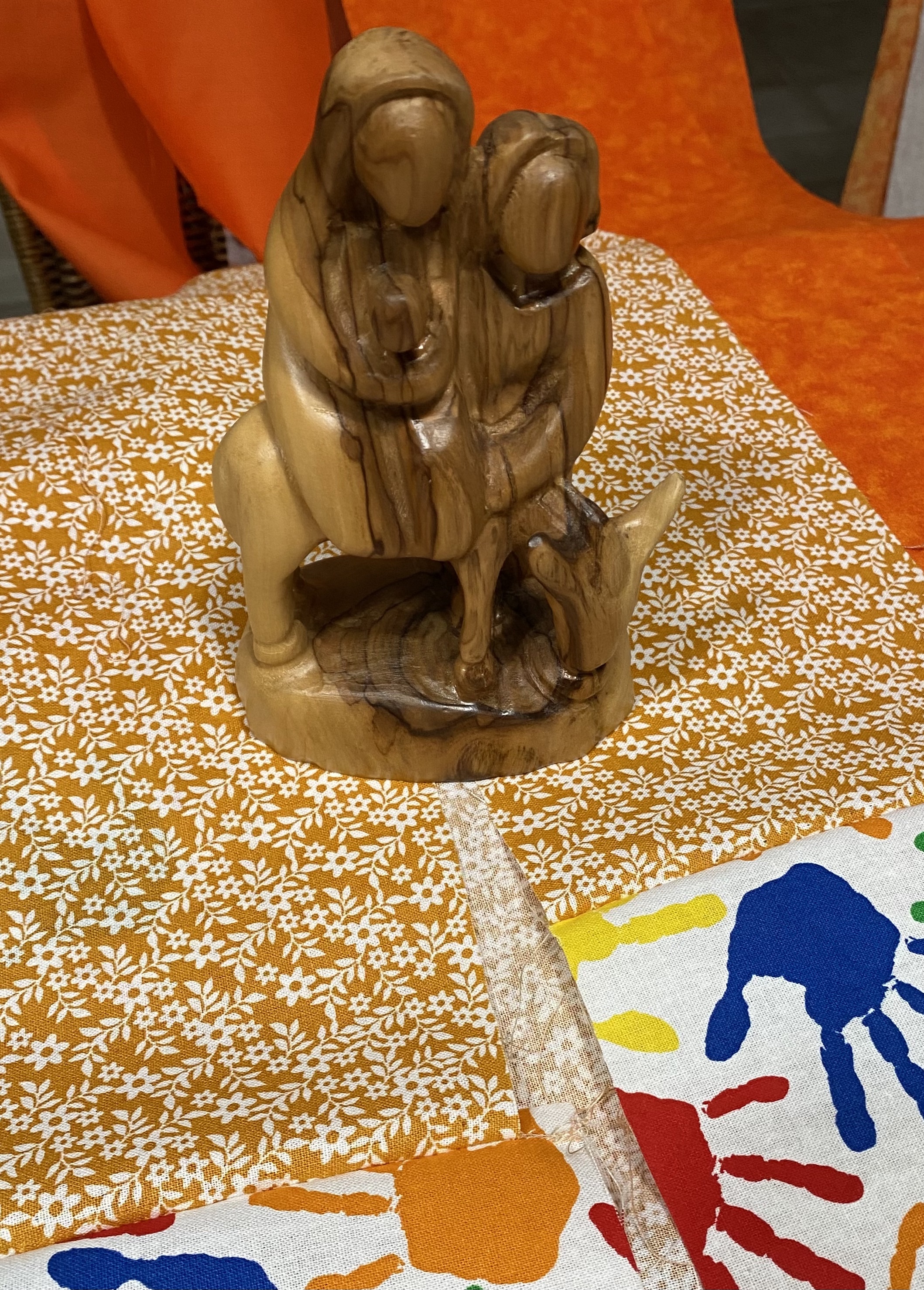
The longest night

Morning after the longest night,
like the first day of creation
when evening fell before the dawn;
as the dream goes before awakening,
the linened tomb before resurrection,
the twilight womb before the birth
of the Christ, all part
and particular to his Incarnation,
this nurturing dark that precedes
the light of the first new day.

This poem first appeared at the Episcopal Cafe

Posted in advent meditations, poetry, prayer | Tagged , , | Leave a comment

Mary’s song, our song

A sermon for the Fourth Sunday of Advent, 2021

I think that I’ve mentioned it from this pulpit before, but Mary was not the only Mary in her town. At the time that Jesus was born, around one in four or five Jewish girls were named one form of Mary or another.[i] Their naming may go back to Miriam, the clever and resourceful sister of Moses, who helped arranged his adoption into Pharaoh’s household and his exodus, along with all of the enslaved Hebrew people, their liberation from an empire of oppression. More recently, the descendant of the Maccabees, the Hasmonean queen Mariamme herself bore the name that once sang of God’s deliverance at the Red Sea. Whether the inspiration were ancient or modern, naming Mary could be seen an act of bravado, of rebellion, of faith in the promises of God that delivered God’s people from Pharaoh, and could be relied upon, so the hope went, to deliver God’s people now from the Romans and their puppet-potentates.

The name Mary cried havoc and announced the day of the Lord’s deliverance from the bonds of oppression. Mary’s word to the angel, “Here am I, the servant of the Lord,” was the acceptance of a mantle, the mantle of Miriam, the sister and peer of Moses. Mary’s, “Let it be with me” was saying, in effect, “Bring it on.”

Mary knew the dangers of raising an eyebrow in a buttoned-down society, one under the chastening rod of the empire. She knew the dangers of childbirth in a pre-medical society. She knew the danger of singing a Magnificat that glorified the God of promise and prophesied the scattering of the proud and the unseating of the powerful. 

The Incarnation of Christ, the entering of God into human flesh, is an act that defies our expectations and shatters our exact rules about where God belongs and how God is allowed to interact with human nature. Mary knew it in her body: that God was not living down to our ideas of how these things were supposed to happen. In all sorts of ways, barriers and boundaries, barricades were being breached that had sought to keep the sacred and the fleshy apart, separate, sacrosanct.

And she was Mary, named for Mariamme, named for Miriam, who sang of God’s victory over Pharaoh at the Red Sea, who followed the pillars of cloud and fire, and while she may well have been afraid, she was not going to let that stop her living up to her reputation.

Just as God defied the imaginations of the Egyptians at the borders of the Red Sea, so now God was about to make a new way out of no way, and Mary wanted every part of it.

We are still a way from realizing the grand conclusions of the Magnificat. The powerful are not yet cast down, the fall of the Roman empire notwithstanding; we still suffer natural disaster and unnatural, violent division. 

A civil rights case here, a murder conviction there; justice trickles past us, but where is the torrent that Amos prophesied, that Mary sang?

Last weekend, deadly tornadoes blew through Kentucky, Illinois, Tennessee. We have witnessed the devastation and the aftermath of a natural disaster that was exacerbated, allegedly, by unnatural greed and inhuman interactions, by bosses who refused to let workers leave the shop floor to take shelter; by the perennial survival gap between the wealthy and the struggling. This is not the levelling that Mary imagined.

And there is this pandemic that seemingly will not let us go. Where is the healing of the nations?

Perhaps it is not enough to sing of it. Perhaps, like Mary, we need to embody the incarnation of God’s mercy, the growing of God’s justice, the birth of God’s new way in order to find our way out of no way.

In Mary’s town, one in every four or five girls born was named Mary. In our country, nearly two out of every three people calls themselves Christian. Just as Mary’s name meant something, called her into something, prophesied something, so the name of Christian should mean something for us who bear it in the world, should tell out something about God’s promise to us and through us.

Mary was named after a queen and a rebel slave and we are named after a radical religious type who preached counter-intuitive peace and love for enemies and friends alike and who died as a criminal, condemned by religious and state authorities, and who would not let even death deter him from bringing God’s mercy to the world and living God’s love in the world.

What Mary believed and proclaimed and laboured to reveal began deep in her own body, in the quiet mystery of her hidden organs, and it grew. How can we, from the small beginnings of our own embodiment of Christ, our faith in the goodness and mercy of God, labour and deliver good news to the poor, healing to the sick, justice to the oppressed, freedom to the prisoners, life to the dying? It is not beyond us; it is within us to do what God has called us into.

It seems as though the kingdom of God, the second revelation of Christ, is a long time coming, and there is much that we are afraid of, and much that we despair of, and too much that we have already left undone; yet, Mary’s song reminds us, God is already at work in the world. God has cast down the mighty, repeatedly; God has scattered the proud, perennially. God feeds the hungry with mercy, and pays attention to the prayers of the lowly. God is with us.

God is with us when we defy the injustices and entitlements of the world and respond instead with counter-intuitive kindness, counter-cultural mercy, radical devotion to the principles of peace, hope beyond measure, faith in God’s ability to break down barriers, to cross boundaries, to do whatever it takes to be with us, Emmanuel.

We are named, we Christians, for that first note of Mary’s song, the one who inspired in her courage and the imagination to live into her name, the name that launched a freedom movement onto the Nile in a Moses basket; the name that can do great things out of small beginnings, with strategic and rebellious mercy, with the insistence that God is with us, yesterday, today, tomorrow, and then some; and Christ’s new revelation is coming.

Amen: Come, Lord Jesus.


[i] Tal Ilan, “Notes on the Distribution of Jewish Women’s Names in Palestine in the Second Temple and Mishnaic Periods”, in Journal of Jewish Studies, Vol. XL, 1989

Posted in advent meditations, current events, sermon | Tagged , , , , , , | 1 Comment

Suffer the little children

Rumours of rumours; and the rub is that in this country, in this time, we cannot dismiss them as rubbish until the day is done and the sun has set over the farthest gate. It should not be this way.

My heart goes out; my heart remembers one day when two of the three were still in high school and there were rumours. One decided to stay at home, and I wept for the anxiety that we have bred and our children bear. One decided to go to school and I wept, watching love walk away from me, the closing doors illuminated by blue and red lights, a mockery of the Christmas lights dancing up and down the neighbourhood. It should not be this way.

When my child was very young, I was tucking her into bed one night, and she was distressed. I asked why, and the reply was that at any moment, an asteroid might smash into the earth and destroy it, ending all life and all knowledge of life in an instant. Rational arguments about probabilities, space stations, forecasts, warnings, and probabilities again did nothing to soothe the young soul. “But you can’t tell me it can’t happen,” she insisted. …
Children already know that the world is dangerous. They do not need their fears magnified; their imaginations will take care of that without encouragement. They see dragons in their sleep.

Whom Shall I Fear? Urgent Questions for Christians in an Age of Violence (Upper Room Books), 89, 91

In Isaiah’s vision of peace, “a little child shall lead them” (Isaiah 11:6); but we are not casting the vision before our children of peace but of lockdown drills and guns secreted in backpacks. The guns belong in lockdown, not the children.

In Children Under Fire: An American Crisis, John Woodrow Cox finds that, “If children did not have access to guns, well more than half the school shootings over the past twenty years would never have happened” (p. 291). The guns belong in lockdown, not our children.

About halfway through our march in Cleveland, I found myself on East Ninth Street directly behind a woman with a young child in a backpack carrier like the one I had used when my children were younger. Too small to walk so far, the little one’s legs and feet hung from the carrier, bouncing and dancing with her mother’s stride. A sign attached to the out fabric of the child’s traveling nest said, “My preschool class does lockdown drills.”
I wanted to fall to my knees on the spot and repent of my dismal stewardship of her world, but the crowd swept me on.

Whom Shall I Fear, 95

It is past time to repent. It is no time to be simply swept along. The guns belong in lockdown, not our children.

Posted in current events, gun violence | Tagged , , , | Leave a comment

Because love is the miracle

For Megan and Jacob

One says
that your first miracle
was at a wedding:
celebrating love,
astonishing, intoxicating –
the kind of stuff
to leave you 
walking on air.

Love is what it takes
to make the other
miracles true:
to calm the storm,
soothe the sick,
to keep the dead alive,
to forgive and not to forget,
with heart and soul and body.

At the wedding, 
at first
you said that this
was not what you
were called to do,
then, looking on
you saw the bride
and groom, love 
shimmering between
and you remembered
what love is for 
and that you are for 
love, that
you have been for eternity;

You raised your hand
in blessing and
toasted them with wine.

Posted in blessings, homily, poetry, prayer | Tagged , , , | Leave a comment

Karl Barth, St Paul, and the stickiness of sin

A homily for Evensong at Trinity Cathedral, Cleveland


It is said that Karl Barth once commented upon the Anglican style of liturgy:

“If the Anglo-Saxons would not make their phylacteries so broad and so long! I went to an Evening Prayer at which the Lord’s Prayer was said twice and the Gloria five or six times. I said to them afterwards, ‘If I were the good God, I would reply to you in a voice of thunder, ‘All right, that will do. I’ve heard you!’”[i]

Which is to say that I feel a little shy about bringing Barth to church with me this evening. But Barth was not one to shy away from the conflicts and ambiguities and frank paradoxes of religion and theology and our strange and wonderful relationship with God, our Creator, Christ, our Redeemer, or the Holy Spirit, who defies definition.

Take this passage from the Epistle to the Romans, in which Paul, converted and convinced of his salvation nevertheless wrestles with the stickiness of sin and its ability to contort his every effort of will into something less than righteousness, so that he cries out for deliverance.

Barth, in his commentary on this passage, is almost as sunny and gay as St Paul himself.

“Religion,” he writes, “spells disruption, discord, and the absence of peace.”[ii]

“Conflict and distress, sin and death, the devil and hell, make up the reality of religion. … Religion possesses no solution of the problem of life; rather it makes of the problem a wholly insoluble enigma.”[iii]

So that’s helpful.

Perhaps putting Barth into some biographical context might shed light on his frightening insights. He wrote his commentary on Romans relatively early in a career that would sink him deep into the mire of systematic theology and draw out of him the utter and devoted dependence upon God’s grace that looking into the vortex of our incomprehension will evoke.

He lived through two world wars. In the shadow of the first he was accused of pacifism; in the gathering clouds of the second he was criticized for militarism.[iv] Yet he was consistent in his strong belief that the justice and mercy of God do not authorize the kind of bullying might that characterizes nationalism, and he was appalled at the capitulation of too many churches to those dangerous forces. One might say that any compromising of the gospel in order to achieve greater power to proclaim it is at least misguided, self-defeating, perverse. 

There is a reason that Barth still resonates in our public theology amphitheatres.

While Barth knew clearly on which side he stood when it came to the sin of anti-Semitism, the siren song of nationalism, not to mention the seductive destructive power of the atom bomb, and while he was not shy of his duty as a political man to, as he once put it, “make it clear with whom I would like to be imprisoned and hanged,”[v] yet he knew just as clearly that salvation comes from somewhere very different.

“The kingdom of God is a foreign country, so foreign that even the saints must pray …” he wrote in his commentary on this passage from the Epistle to the Romans.[vi]

And here is the key to the hope, even joy, that both Paul and Karl embody even as they decry their own sinfulness, their own helplessness in the vice of sin that grips them.There is no political program nor self-justification that can free us from the consciousness that we fall short of the good that we feel so strongly should be available to us. But there is Jesus.

The good that I want to do I cannot, and the evil that I would avoid, I cannot. “Now,” says Paul eagerly, “if I do what I do not want, is it no longer I that do it?” That is, can I separate my actions from my will, my impact from my intention, my life from my imagination?

But these, Barth writes, “are perilous opinions.”[vii] They offer false comfort, when the only true consolation is Christ. They are perilous, too, I might add, ethically, offering a kind of acquiescence with the messiness and mercilessness of the world: “I hate that this is the way that the world works (I will good and not evil), but I am helpless to change it, so it is enough to despair of it.” Even Barth fell prey to it. As he has said, “There is no sinless Christian.”[viii]

This, too, is not the gospel of repentance that Christ calls us into. It is the hymn of the compromised conscience, the power-hungry church, the secular creed of false unity.

No, says Barth, the fact that my conscience is piqued at every turn is correct, and should not be denied. It reminds me daily that as often as I pray, “Thy will be done,” (which is too often in our liturgies for Karl, you might recall); as often as I pray it, I am reminded how far I am from doing God’s will, and how great the gulf is between Creator and this creature made dimly in Their image.

But the corollary is glorious. For, “Who … is aware of man’s real wretchedness, save he who is aware of God’s mercy?” Barth lectured his students in Bonn.[ix] We know our sin, we are convicted of it, Paul discovered his error in persecuting the followers of Jesus only when he was confronted by the living Christ himself, the revelation and reality of God’s saving mercy.

“The kingdom of heaven does exist already; from God’s side action has been already taken for our good. To pronounce the name of Jesus Christ means to acknowledge that we are cared for, that we are not lost. Jesus Christ is man’s salvation in all circumstances and in face of all that darkens his life, including the evil that proceeds from himself.”[x]

So it is that Paul can proclaim in one breath: “Wretched man that I am! Who will rescue me from this body of death? Thanks be to God through Jesus Christ our Lord!”

In this season of Advent, when we are advised by the prophets and the preachers to prepare ourselves for the coming of the kingdom, the second coming of the Christ, while our consciences are chilled by apocalyptic fires and the dumpster fire of the world around us, when we despair of doing the good that we will and denying access to evil even in our own jealous hearts, it is the Incarnation of Jesus that reminds us that all is not lost; that nothing, in fact, is lost, since God, the originator of all things, abides in mercy and sustains us. 

Therein lies our freedom, this is our hope, our way, our truth, our life: not a reconciled conscience but a reconciling Christ, God with us, God for us, and a grateful sinner, weeping at his feet, drying his soft body with her hair.

Amen. 


[i] Mark Galli , Karl Barth: An Introductory Biography for Evangelicals (Eerdmans, 2017), accessed via Scribd: https://www.scribd.com/book/482210637, p. 164. A footnote attributes the source of the quote to Eberhard Busch’s Karl Barth: His Life from Letters and Autobiographical Texts, trans. John Bowden (Philadelphia: Fortress, 1976), 1–32

[ii] Karl Barth, The Epistle to the Romans, translated from the sixth edition by Edwyn C. Hoskyns (Oxford University Press, 1933), 266

[iii] Barth, Romans, 258

[iv] Galli, 127, via Scribd

[v] Galli, 98, via Scribd

[vi] Barth, Romans, 263

[vii] Barth, Romans, 262

[viii] Barth, Romans, 263

[ix] Karl Barth, Dogmatics in Outline (Harper Torchbooks, 1959), 71

[x] Barth, Dogmatics in Outline, 71

Posted in homily | Tagged , , , , , , | 2 Comments

It’s (not too) complicated

A sermon for the Second Sunday of Advent, the Sunday after yet another school shooting, during a continuing global pandemic, and other concerns … Readings may be found here (we read Baruch for our first lesson).


On this, the Second Sunday of Advent, we pray, 

Merciful God, who sent your messengers the prophets to preach repentance and prepare the way for our salvation: Give us grace to heed their warnings and forsake our sins… (BCP, 211)

In the third season of The Good Place, the ethical complications of life are explored. It is not so easy, we find, to forsake our sins and walk in the ways of righteousness when even choosing a tomato to buy at the grocery store has implications for fair labour, the environmental impacts of pesticides and long-distance transport, and so much more, even before we get to any question of whether it tastes good! 

Even so, repenting of our sins, paying heed to the prophets, may not be as hard as we sometimes make it. Sometimes, it is simply a question of kindness, of doing the most merciful, the most loving, the most human (as Christ embodied and exemplified humanity for us) thing.

The prophets promise that God, in due course and good time, will level the mountains and raise the valleys out of their shadows and make straight the pathways before God’s people, that everyone might make their way toward Jerusalem, cast as refuge and the resting place of the children of God.

To do the work of righteousness, then – to love God, and follow in the footsteps of Christ, to love our neighbours as ourselves – means nothing less than to remove the obstacles from before the feet of those stumbling towards justice, towards equity, towards salvation, towards peace.

On a communal level, it means heeding the prophets’ warnings that chasing after wealth at the expense of the poor is plain wrong. 

It means following the example of Christ who did not care who was in or out of network, whether they were Jews, Gentiles, madmen, women, nor even what day of the week it was, when it came to offering works of healing mercy. His healing was available even to the woman who dared only creep under the crowd and touch his cloak.

It means clearing any obstacles that litter the paths of people made in the image of God, obscuring their dignity.

It means removing the plank of racism from the foundations of all of our functions and replacing it with real and radical justice rather than whitewashing over the cracks.

It means beating swords into ploughshares, guns into shovels, removing them from the hands and the lives and the deaths of our children. There is no deeper shadow cast than the deaths of children, and the enormity of the problem before us is our mountain to climb.

But Jesus once told his disciples, if you have but a mustard seed of faith you may move mountains (Matthew 17:20-21).

Better still, the prophets have told us that God is with us in the work, that God will level the ground that God has created, and bring righteousness and justice, which is mercy, to the earth.

On the personal plane, heeding the prophets and repenting of sin often means simply to do the most merciful, most loving, most humble thing available in any given situation, any God-given opportunity.

If you have ever had to fill in the ground where an old, old tree once stood, then you know that the work is not done in one day. There is filling and raking, seeding and growing and mowing of grass, and where do all of those mushrooms come from? And in a year or two the ground will have settled and sunk once more, and you will have to start over again, and again. Just as when we learn better we do better, the work of repentance is repetitive, and cumulative, and it does build toward righteousness, if it is a labour of love: Love for God, love for our neighbour, love for our enemies, as well as for one another.

I am confident, with St Paul, that you who have begun a good work will bring it to completion with the help of Jesus Christ. It is my prayer, with St Paul, that our love for God, neighbour, enemy, and one another may overflow more and more with knowledge and full insight to help us to determine what is best, and to do it (Philippians 1:6, 9-10).

John came, eating wild honey and locusts, a simple life, preaching a baptism of repentance from sin, so that the crooked should be made straight and the rough ways made smooth, and so that all flesh might see the salvation of God (Luke 3:1-6; Isaiah 40:3-5).

It is not too complicated for us. The mountain is not too high and the valley not too cold, since God is going before us to pave the way; since Christ has gone before us to give us knowledge of salvation by the forgiveness of sins.

In this way,

“In the tender compassion of our God the dawn from on high shall break upon us,
To shine on those who dwell in … the shadow of death, and to guide our feet into the way of peace” (Canticle 16, BCP).

Amen.

Posted in advent meditations, lectionary reflection, sermon | Tagged , , , | Leave a comment

Advent (the second coming)

There is no cloud of glory can define, 
no gates of heaven can confine; there is
no dogma, doggerel, or doctrine can describe,
no earnest imitation reinscribe him. 

Christ’s coming cannot be constrained or restrained 
by our rituals of mortality.
Our candles are dimmed, our illuminated 
manuscripts burned by the living Word… 

This is Omega and Alpha, ending 
and beginning, humbled only by love, 
by love, by love 
to enter this world and its contracting womb. 

Posted in advent meditations, holy days, poetry, prayer | Tagged , , , | Leave a comment

Christ, the King, the way, the truth, the life

Splendor and honor and kingly power
are yours by right, O Lord our God. (A Song to the Lamb, Canticle 18, BCP, 93)

‘Pilate asked him, “So you are a king?” Jesus answered, “You say that I am a king. For this I was born, and for this I came into the world, to testify to the truth. Everyone who belongs to the truth listens to my voice.”’ (John 18:37)

And Pilate infamously responded, “What is truth?” (John 18:38)

Because Pilate knew that truth was whatever he decided. The law was whatever he imposed. Justice, in Pilate’s estimation, was whatever he exacted. And truth? The truth could go hang from a cross for all he cared.

The visions of Daniel and of John of Patmos describe the kingship of Christ as one of glory, of dominion. But it is by his own blood sacrifice, says John, that he has freed us from our sins; it is by his love that he has made us a kingdom, priests to serve our God.

Standing before Pilate, Jesus conjures a vision of a kingdom in which the truth is not decided by the preferences of the powerful, nor is justice exacted by violence, nor does the law of the nations have the last word over it. The kingdom that Jesus brings is one in which the love of God stands resolute before the principalities that would lord it over him, and undermines them by refusing to accept the finality of their penalty of death.

As another biblical poet wrote, “Many waters cannot quench love, neither can floods drown it.” (Song of Songs 8:7) For love is stronger than death.

We have not yet achieved that kingdom among ourselves. We still live in a world where justice is decided by division and argument, where there is no consensus on the truth. Where a youth can take a gun he is too young legally to buy for himself and go out looking for the trouble. When he finds the trouble and becomes afraid for his safety, he successfully pleads self-defence for the deadly consequences of his decisions. Deadly for others, that is, not for him. And some see him, the survivor, as a martyr and a hero, and others see a travesty, an abortion of justice. We live where those who know the open secrets of our system see his young white skin as armour against the judgements of the world, while others still deny that such privilege exists.

We find ourselves in the place of Pilate asking, “What is the truth?”

Standing before Pilate, Jesus refuses to be drawn into his world of claim and counter-claim, power-brokerage and politicking. “I came to testify to the truth,” he asserts, even under the greatest imaginable pressure, for he knows what is to follow. He, Jesus, will not back down from the truth of God’s love, God’s justice which is mercy, which is the forgiveness of sins, which heals instead of harming, which is the reconciliation of the penitent and the hope of the sinner. He will not raise an army, of people or of angels, to save his own skin, because his reign, he tells Pilate, he tells us, does not depend upon unimaginative might or oppression, but rests in the enduring and creative power of God.

Daniel and John of Patmos each write their revelations, their visions of the kingdom come, from a position of persecution. Daniel has been captured by a foreign court and forced into exile and service to a foreign king who tried to eliminate the culture and language and religion of the Jews, who gave them new names. Daniel, whose name means “God is my judge”, was called by his captors Belteshazzar, after the Babylonian’s gods. John, in turn, has been exiled by the imperial persecution of the earliest Christians to the island of Patmos, where he awaits the judgement of God over the nations.

Daniel refused to submit to the attempted assimilation of his faith into the Babylonian ways. He held fast to the covenantal promises of God, and he looked with steadfast hope for the coming of God’s kingdom. In his vision, as in John’s he found his hope coming in the person of the Christ, the anointed and appointed embodiment of God’s mercy, justice, and reign. It was enough, even in those days of persecution, exile, and compromise with the powers that be to sustain both visionaries through long years of suffering. It did not eliminate the suffering, nor did it undo the injustices against them, but it allowed them to remain faithful, to remain true themselves to the faith that God had set within them, knowing that God is faithful and will prevail.

“Thy kingdom come,” we pray each and every time we gather, as Christians, as followers of Christ the King, whose reign comes with glory and dominion and with unending righteousness and justice, with truth. 

It is so difficult, in days like these, to imagine a universe in which truth is known and shared an accepted and agreed upon: but Jesus tells Pilate that he is bringing it, and Daniel and John, in their times of greatest trial, see it coming on the clouds.

Of course, there is the risk for any of us that we will discover that we were wrong in some of the so-called truths we espoused along the way; but God is just and merciful, and if we hold fast to the promises of mercy and forbearance, of the creative ways of love to conquer the dull blade of oppression, if we will follow the example of our King, loving our neighbours instead of taking up arms against them, seeking and serving the image of God in all people, not standing upon our privilege but standing alongside the humble, rebellious, the condemned Christ, then we will find hope to sustain us, for no empire will stand for ever against the love, against the truth of God, against the coming justice of God’s kingdom.

And so, to him who sits upon the throne,
and to Christ the Lamb,
be worship and praise, dominion and splendor,
for ever and for evermore. Amen.
(A Song to the Lamb, Canticle 18, BCP, 94)

Posted in holy days, sermon | Tagged , , , , , , , | Leave a comment

Armistice

It was supposed to be

the war to end all wars,

but one hundred and three years

past the eleventh hour, we are

still more accomplished at starting

wars than finishing, and

as the day digs its way toward noon,

shaking off the silence

and the poppies,

a free cup of coffee or

a ten-percent discount on

your diy supplies

hardly seems meet penance for

a century of sundowns over

an uneasy ending to

days and dreams that do not

rest in peace

Posted in poetry, prayer | Tagged , | 1 Comment

For All Saints and All Souls

The Imitation of Christ is a classic Christian medieval text attributed to one Thomas a Kempis, a monk who gives sound and searching advice for developing the inner life of the soul and binding it ever more closely to God. Our Centering Prayer group has been working its way through the book, and just this past week, the main characters in today’s gospel story made a cameo appearance as a cautionary tale:

The more finely you focus your attention on [Jesus], the greater your steadiness in passing through life’s successive storms.

In many cases, however, this focus becomes blurred since the mind much too quickly becomes distracted by anything delightful that may come within its purview. … Thus it was that several Jews came to Bethany to the house of Martha and Mary not only because of Jesus, but also to see Lazarus. Your focus, therefore, must be exact and on target, directed on [Jesus] and not on anything else that might chance to enter the range of your vision.[i]

He is the resurrection and the life, and it is to celebrate and follow Jesus that we come together. Still, as far be it from me to question the wisdom of my elders, I do wonder whether Thomas a Kempis is missing something if he looks away from Lazarus too soon.

The Jews who are with Mary and Martha today have come to comfort the sisters in their loss. They are there out of love for their friends and grief for their brother. Wherever there is love, we are told, there is God.

Whether it is the same crowd that returns later to check in on the family or whether they bring more friends to see the miracle that has happened so close to hand, we can hardly blame them for their joy and relief and astonishment at the sight of Lazarus restored, unbound, ransomed from death. What would we not give to see those whom we have loved once more?

Jesus himself looked upon the grave of Lazarus and wept. Jesus himself, having called Lazarus back into life, delivered him to his family and friends, saying, “Unbind him, and let him go.” Jesus did not look away from their grief or his death, nor from his resurrection, nor from his friends’ confusion and delight; he had compassion over it all.

Today, as we celebrate All Saints and All Souls, we do not look away, either, from those who have gone before us to their reward and resurrection. The saints whose example shines and the faithful souls whom we trust we will see again on that other shore: they call forth our compassion, our grief, our hope. With Jesus, we weep. With Mary and Martha, we wrestle. With the Jews who have come to comfort them, we are astonished by the miracle of resurrection, by the hope and glory of new life. And Christ has compassion over it all.

In the past year and half, and more, we have been grieved and injured by our inability to gather as we normally would around the families and loved ones of those who have died, especially those whom we remember this morning. 

We have refrained for good and noble reasons – to prevent further suffering, death, and grief – but it has been a burden. Coming together now to name those whom we miss, to honour those whom we have loved, to celebrate their memories: this is a blessing.

We come because of Jesus, because in him only is our hope and trust in the resurrection and the life eternal that we share; and we come also to see Lazarus, to see in our memories and our mind’s eyes, in our prayers to see our friends, to be reminded of that hope, of that reunion, of that compassion, the mercy of God that will not leave us forever bereft, that wraps the grieving in love.

Mary said to Jesus, “Lord, if you had been here my brother would not have died.” But Jesus knew that life and death would continue after his imminent Passion, and that we would need to know that even in the face of death, even in the stench of death, even in the depths of the tomb of grief, that new life is ready to be called forth. He wanted his friends, he wanted us to know that he is with us, in life and in death, whether we see him in his body or not. Lazarus was his sign, his proof, his gift to us of hope.

So yes, we will keep our eyes fixed on Jesus, who is the resurrection and the life. And when our eyes are clouded by grief and closed by death, he will stand alongside us, and unbind us from our sorrow.

For, see, the home of God is among mortals.
He has dwelt with us as our God; we are his people,
and God is with us; and as surely as Jesus wept for his own friend,
he will one day wipe every tear from our eyes. (after Revelation 21:1-6)

Amen.


[i] The Imitation of Christ Book 3, 33.1, by Thomas A Kempis, translated by Joseph N. Tylenda, SJ (Wilmington, DE: Michael Glazier, Inc., 1984), 170

Posted in holy days, homily, lectionary reflection, sermon | Tagged , , , | Leave a comment