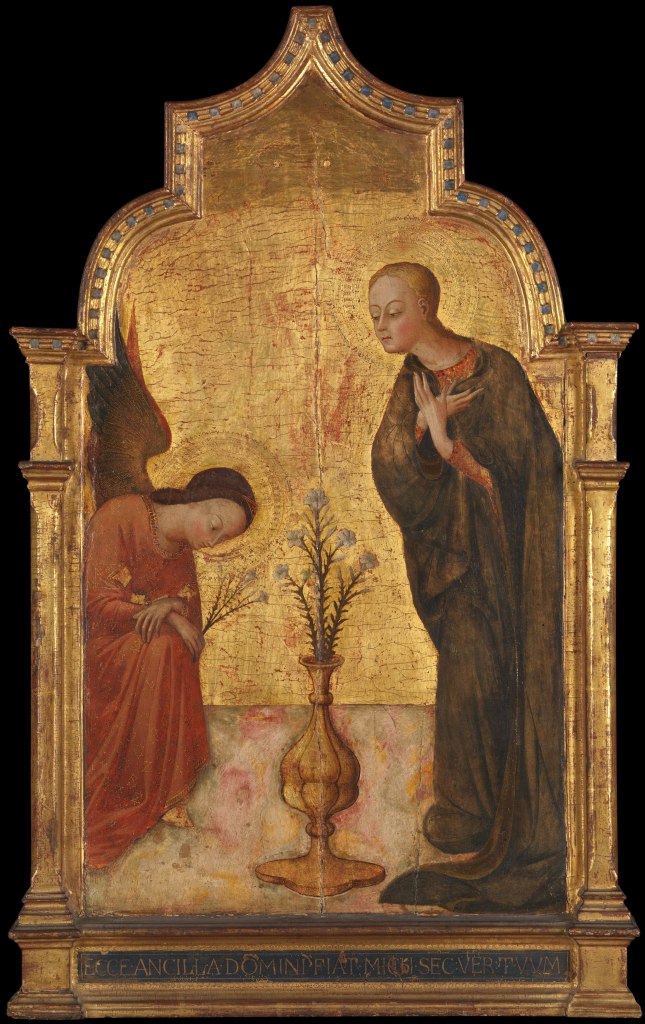
(Holy Saturday)

How to carry the world’s pain –

the cries of the children,

the palsy of their great-grandparents

confused with the tremors of memory;

the subtle, internal turmoil that turns

digestion upside down –

violence is not a visitor but

an ever-present guest.

It trains the hearts that pound the nails,

hardens the hands against the kickbacks –

iron echoes.


Iron echoes.

In the lead-lined core of history

there is one who is still absorbing

the repercussions.

Posted in current events, holy days, poetry, prayer | Tagged , | Leave a comment

Yesterday is closer than it seems

Yesterday I walked past a fallout shelter sign

in the “historic district” of a run-down part of town,

its triune logo sunny against the greying day,

repainted, no doubt, as an artefact of interest;

but yesterday is closer than it seems and safety,

like the Trinity to which we pray today for peace,

impenetrable in its mystery.

Praying for the relief of those afflicted by aggression and war in Ukraine. Praying for peace.

Image via canva.com

Posted in current events, poetry, prayer, story | Tagged , , | Leave a comment

Love your enemies

A sermon for the seventh Sunday after the Epiphany, February 20th 2022. In the Sermon on the Plain, Jesus directs us to love our enemies.


Do you believe that you have been forgiven?
Do you believe that God has forgiven you your faults and your failings and your shortcomings and your sins; that God in the person of Jesus Christ has redeemed you and restored you and brought you to new life, a foretaste of the resurrection to come?

And do you believe that God has forgiven your enemies?

If I say, “I have no enemies” (to paraphrase a psalm), then I am deceiving myself, and the truth is not in me, for I am at times my own worst enemy, and I know that the world is divided amongst itself, and that oppression still stalks the poor in spirit and the meek who have yet to inherit the earth, that sin is the enemy of God’s good grace. We cannot avoid Jesus’ strong words by replacing them with milder alternatives or euphemisms. Christ does not lie. He knew what it was to have enemies, and he knows us.

Jesus recognized the existence of enemies. He did not try to sanitize the extremism of an occupying empire, nor the cruelty of crucifixion, by “agreeing to disagree”. He did not agree that he deserved such a vile death! He refused to engage the injustice system of Pilate and that trumped-up trial by Herod’s flunkies – this is important, because loving our enemies does not demand that we ingratiate ourselves with them, or with the ways of enmity – but neither would he tolerate violence against them, healing the ear of the slave injured while arresting him in the garden. Even from the cross, he forgave them. He loved his enemies, even to the bitter end.

So Wilfred Owen, poet of the Great War, imagined in “Strange Meeting” that the enemy he had killed on the battlefield welcomed him to the underworld with “hands as if to bless.”[i]

After two brutal world wars, the powers that be came together to negotiate the Geneva Conventions; to attempt to re-humanize our relationships with one another, with an enemy. They provide for things like the imperative after a battle, as soon as is humanly possible to search, rescue, treat, and aid all injured and sick, regardless of side, and to protect them from further harm. Enemies are not our enemies forever, and the demands of humanity outweigh any other declarations of allegiance, even in war. “Prisoners of war are entitled in all circumstances to respect for their persons and their honour,” the articles declare,[ii] in a strange and somewhat perverse foreshadowing of our own baptismal covenant.

The burden of love outweighs all other duties, and not only toward those who love us. Even our secular treaties and rules of engagement declare it to be true. And still, Jesus goes further.

In the examples that Jesus gives to his followers on the plain, he is not talking about abstract love or lip-service to prayers for hypothetical persecutors. The occupying forces could and did conscript the people to bear their burdens, without regard to their interests or civil rights. If the people resisted, the occupying authorities could and did use force to persuade them to comply. As Rowan Williams writes in his haunting reflection and response to the events of 9/11, the soldier’s slap “is the kind of gesture that assumes no response at all; it’s designed to be the end of the story, because it simply affirms who is in charge.”[iii] The order of the soldier to carry his kit works much the same way. 

But for Christians, for Christ, someone else is in charge. Someone else has the final say. For Jesus, for his close followers, there is the choice not to accept the premise of the order, of the injury; there is the invitation to tell a different story.

Melissa Florer-Bixler, in the beautifully titled, How to Have an Enemy, writes that “In the teaching to ‘turn the other cheek’ Jesus does not call us to passive reception of violence but instead to dismantle the power of the old order in creative, life-giving ways.”[iv]

We do have to be very careful with this passage, not to promote the acceptance of abuse or oppression, in any form, by anyone. This is not a prescription for submission to personal abuse and harm. Instead, turning the other cheek is possible, perhaps even permissible, only where it acts as the rejection of abuse, the refusal to accept a status quo of violence and force, of “might makes right”. In this way it becomes the emblem of a new reality, one in which Jesus has already led the way.

How do we love our enemies in this reality? We respect the dignity of every human being enough to do them the honour of believing what they are capable of, protecting the vulnerable from excessive and abusive power, confronting them with justice and with peace, without losing our own humanity, and without denying theirs. We strive for a world in which enmity is no longer necessary, because the poor are protected and the meek are respected and the marginalized have been centred and celebrated, and we refuse to take up the old tools of oppression and enmity to bring that world into being. To quote Florer-Bixler once more, “Resisting the desire for retribution is the announcement of a new world. It refuses the tools of death. In the end it will save our enemies too.”[v] And, it will preserve our hearts from sin, and our souls from entropy.

And if we say, that cannot be, that’s not how the world works – perhaps that is because we are afraid to live as though Christ really meant what he said, really went to the cross, even if we hope that resurrection will follow. “Be not conformed to this world,” wrote Paul, that former enemy of the church turned avid convert; “Do not be conformed to this world, but be transformed by the renewing of your minds, so that you may discern what is the will of God – what is good and acceptable and perfect.” (Romans 12:2)

The kingdom of God is a whole new world order. Actually, it’s the original world order, the starting point and end of creation, which we’ve managed to mess up pretty brutally along the way. Jesus reminds us of the dream of God, in which justice and mercy flow like wine and water, and righteousness and peace have kissed one another, and he tells us that the dream is close at hand, if only we will wake up to it.

Be transformed by the renewing of your minds, that you may discern what is good. That transformation is not an optional part of the process. Martin Luther King, Jr., preached, “Nonconformity is creative when it is controlled and directed by a transformed life and is constructive when it embraces a new mental outlook. By opening our lives to God in Christ we become new creatures. This experience … is essential if we are to be transformed nonconformists and freed from … cold hardheartedness and self-righteousness.”[vi]

That is where the other part of Jesus’ command comes in: “Love your enemies, do good to those who hate you, bless those who curse you, pray for those who abuse you.” Pray for those who persecute you. Give to God your anger, your frustration, your enmity. Remember that you are forgiven, even for being your own worst enemy. Remember that God has judged, that God has justice, that mercy means that the oppressed will be restored, and the oppressors put in their place. Forgiveness, for God, is a first principle rather than an afterthought. Even so, trust God to deal with your enemies justly, acceptably, perfectly; however you may pray for them, God’s will be done.[vii]

Do you believe that you are forgiven?

Do you believe that God has forgiven you your faults and your failings and your shortcomings and your sins, and mine; that God in the person of Jesus Christ has redeemed us and restored us and brought us to new life, a foretaste of the resurrection to come?

If not, pray anyway. If so, let’s pray to live that way.

Amen.


[i] Wilfred Owen, “Strange Meeting”, collected in The Rattlebag, Seamus Heaney and Ted Hughes, eds (Faber and Faber, 1982), 407

[ii]   Convention (III) relative to the Treatment of Prisoners of War. Geneva, 12 August 1949. Respect for the persons and honour of prisoners. Geneva Conventions of 1949 and Additional Protocols, and their Commentarieshttps://ihl-databases.icrc.org/applic/ihl/ihl.nsf/Treaty.xsp?action=openDocument&documentId=77CB9983BE01D004C12563CD002D6B3E, accessed February 2022.

[iii] Rowan Williams, Writing in the Dust: After September 11 (Wm B. Eerdmans, 2002), 24-25

[iv] Melissa Florer-Bixler, How to Have an Enemy: Righteous Anger & the Work of Peace (Herald Press, 2021), 101. This sermon is indebted to Pr Florer-Bixler beyond the quotations cited.

[v] Ibid, 103

[vi] Martin Luther King, Jr. “Transformed Nonconformist,” collected in Strength to Love (Fortress Press, 2010), 17

[vii] See “Praying for Enemies,” in Melissa Florer-Bixler, op cit., 45-62

Posted in lectionary reflection, sermon | Tagged , | Leave a comment

What is good news?

“Take 20 minutes and list the ways God
is already using you to be good news …”

God showed me a robin in the snow,
so I hung a feeder from my window:
so far no one has used it but
the cats live in hope.

What is good?
What is news?
There is none good but God alone,
and nothing new under the sun.

Bad news from a stranger elicited
kindness from a slew of friends;
did choosing their compliments
make them smile? Good news out of self-pity.

Has it been 20 minutes
yet?

And then, I celebrated Eucharist,
giving thanks, breaking bread, singing
holy, holy, holy
Lord, is God using me?

Or, with the tenderness of love,
are They lifting me with one hand while
the other waits to catch me
as I fall?


I am participating in a 20-day Evangelism Challenge designed by the Revd Dr Patricia Lyons for and with the Diocese of Ohio. Clearly, it’s a good thing that I set the expectation up front that I might not post every day.
Today’s prompt asks participants to “Take 20 minutes and list the ways God is already using you to be good news to those around you. Are there patterns? Does anything surprise you?”

Sign up for more prompts at https://www.dohio.org/offices/congregations-christian-formation/2022-winter-convocation

Posted in poetry, prayer | Tagged , | Leave a comment

The level place

A sermon for the Sixth Sunday after the Epiphany. The Gospel lesson is from the Sermon on the Plain.


All is not what it seems. 

Jeremiah asks, “Who can understand the heart of a person, of a people?” It has a tendency to deceive itself; all is not what it seems. But God will not be deceived, nor is God influenced by the outward appearances of success, strength, social acceptability. 

Jesus’ words to his disciples in the level place take aim at the false assumptions of us all about what represents God’s favour, God’s love for God’s people.

In the gospel according to Matthew, Jesus preaches from the mountainside; in Luke, he come down to stand in a level place. He is in the levelling place, and he levels with the crowd, and with us.

“Do you think that you are secure in your status, your riches, your good reputation, your sound body and skilled mind?” he asks. “Think again. For the poor, the wretched, the hungry, the despised: those are the ones overdue for God’s blessing. These are they upon whom healing has been proclaimed.”

The people in the crowd, you may notice, were not the powerful or the self-possessed. They came with their unclean spirits and their palsied hands, with their hurts and their heartbreaks, with their hidden and public diseases, united in their unacceptable brokenness. These were the people reaching for Jesus and touching him, upon whom his power poured out, upon whom his pity rested. Those who were in need of him were healed, and those who thought that they had no need of him – they were the ones who would weep when they realized what they had tried to turn their backs upon; from whom its was they had tried to turn away.

*

“Those who trust in mere mortals and make mere flesh their strength … They shall be like a shrub in the desert, and shall not see when relief comes,” warns Jeremiah. Those who are self-possessed, self-assured, whose roots go only as deep as their own bootstraps – they are rooted in a desert. They do not see the erosion around them, the encroaching sand. There is no one near, they have not kept company with those who gather at the watering hole, who share the springs that bubble up at God’s command.

But we are dependent not upon ourselves but upon God, and if Jesus has taught us anything by his incarnation, by becoming one of us, it is that we need one another, too. Each of us. All of us. 

It is only when all are fed that there will be none left to go hungry; only when each has a voice that no one has to shout; only when there is nothing left to be lost that there will be nothing left to weep over. 

The problem of the shrub that tries to stand on its own dignity and its own shallow root system is not only that it will one day, inevitably, shrivel, but that in the meantime it will spend all of its energy sustaining only itself. It will miss out on the joy of collaborating within God’s creation, the ecosystem of grace. 

*

You know that we have a problem going in around us and within us right now. The book bannings and even book burnings, the frightening new bomb threats to HBCUs, violent acts of antisemitism and re-legalization of discrimination by gender, rumours of war and of insurrection; all of these are greater or lesser symptoms of the disease that has taken hold of us, the virus of self-satisfaction and self-reliance, which are the respectable faces of selfishness. 

But there is no blessing in privilege. Inequality is not a blessing even upon those who benefit materially from it. Freedom from love is no freedom at all. There is no blessing in superiority, let alone supremacy; these things are deceptions of the heart and perversions of God’s mercy. But God’s justice will not be mocked.

Our aspiration, if we follow Jesus, is not for ourselves, but for each other; for strangers, even for enemies, as well as for family and friends. As long as selfishness continues, Jesus and Jeremiah each warn, then the crooked and deceitful heart is just begging to be broken. 

*

The problems writ large may seem far from the everyday experience of many of us. But the symptoms of the virus start in the cells. Each one of us is susceptible to selfishness. There is not one among us who has not looked upon another with contempt, who has not justified herself by comparison, nor considered her own needs good reason to go before another. It seems to be human nature – except that Jesus took our human nature upon himself, became our human nature, without selfishness, without pride, without exceptionalism.

The root of hatred is the fear that allowing that someone else is as beloved, esteemed, filled by the Spirit of God as I am takes something away from me; that somehow if everyone is as beloved as I am, as blessed as I am, as good as I am, that diminishes my blessing, my belovedness. What nonsense! As though God’s grace were rationed! Yet time and again we fall prey to something less than love.

*

What then, are we to do, when the human heart is crooked and will keep deceiving us with its petty pride and its little victories?

Here’s where we are in luck. The people came in a great crowd, from the cities and the coastlands and the interior, from the wilderness. “They had come to hear him and to be healed of their diseases; and those who were troubled with unclean spirits were cured. And all in the crowd were trying to touch him, for power came out from him and healed all of them.”

They came to Jesus, and he healed them of their unclean spirits and their diseases of heart and soul, and of body. They came because they knew that they could not manage it on their own, and they came because they knew that he loved them, each of them, all of them, enough to share his anointing with them. He was their bright hope, and he is ours: not hope for riches or status or even acceptability; see what he says about the reputation of those who do what is right.

But he is our hope for wholeness, for a heart that knows what it is to be truly human, healed by grace of its unclean spirit; a heart to love and to know its belovedness. 

We stand on ground that is spinning at astronomical speed, hurtling through the immensity of space, at an enormous distance from the sun. No wonder we feel unstable! But Jesus is our level ground. He is here with us still, in the level place, steady and steadfast in a world full of trouble, rising above it all.

Posted in lectionary reflection, sermon | Tagged , , , , , | Leave a comment

Flotsam

There is a thread that ties the sparrow
to the hair on the pillow in the morning;
There is a straight line from “My thoughts
are not your thoughts,” through,
“There are more things …, Horatio,
than are dreamt of in your philosophy.”
There is some cold comfort in the promise
that tomorrow will bring new worries;
at least no one sugar-coats the tragedy
of salvation; 

somewhere in the midst of all
even sea monsters sport 
and play for the entertainment of God
and the bemused, slightly horrified wonder
of we who drift, moored to the flotsam 
left by the winged one who brooded over water at our beginning.

References: Matthew 10:29-30; Isaiah 55:8; Hamlet Act 1, Scene v (William Shakespeare); Matthew 6:34; Psalm 104:26; Genesis 1:1-2

I am participating in a 20-day Evangelism Challenge designed by the Revd Dr Patricia Lyons for and with the Diocese of Ohio (although I don’t promise to post every day!). Today’s prompt asks: “What is your favorite scripture when you need inspiration? Why do you love it?” I’m really not sure how to answer that comprehensively, but some candidates are included in the poem above.
Sign up for more prompts at https://www.dohio.org/offices/congregations-christian-formation/2022-winter-convocation

Posted in poetry, prayer | Tagged , , | Leave a comment

A memory in black and white


A memory so ancient, it could be in black and white.

I met the vicar on the street, in his white collar.

He said, “J’accuse!”

He did not. 

He said, “It has been too long since you received Communion.”

I was so far from grace, I heard conviction instead of invitation.

“I was busy,” with adolescent dignity, “playing your black and white Sunday School piano.”

I think he wore a black hat.

He said, “You need Communion.” 

And he passed on.

In the blackest sky I ever knew shone the most and brightest stars.

I saw some fall like the round, white wafer into my hand.


I am participating in a 20-day Evangelism Challenge designed by the Revd Dr Patricia Lyons for and with the Diocese of Ohio (although I don’t promise to post every day!). Today’s prompt asks: “Think about your life. When have you felt close to God? When have you felt far from God? What brought you home?”
Some of us have a lot of life to sift through! The longer version of the memory above is written up below.
Sign up for more prompts at https://www.dohio.org/offices/congregations-christian-formation/2022-winter-convocation


I do not have good memories of my teenage years. Make of that what you will; I do not remember those times well.

For example, in my twenties I met a woman at a hotel who swore that she knew me. We traded overlapping, intersecting stories and locations, and she pinned me down to a weeklong, residential music retreat held at a teacher training college. She was in the county youth choir; I was in the orchestra. I had often wondered how I knew so well what the entrance to that college looked like, since I did not remember going there. To this day, I have no memory beyond its front doors.

Were those the days when I was far from God? I was clearly far from myself.

I do remember a conversation I had in passing with the vicar. When I was a child, and started taking myself to church, I didn’t know that there was such a thing as Sunday School, held in the parish hall where I went to Brownies. I stayed in the service with the adults and their overcoats. I am glad no one sent me away. (This was in the olden days.)

But at a certain point in my teens, I was recruited to play the piano for the Sunday School songs, ended up spending my 11 o’clock hour in the parish hall instead of the wooden nave, in my side pew with the view of the Lady Chapel. 

When the vicar stopped me on the street, somewhere between his house and the churchyard, and said, “You haven’t been to Communion for a while,” I was indignant. “I’m busy playing the piano for your Sunday School,” I thought, and perhaps said. “Then you need to come to the 8 o’clock,” he returned, unperturbed. “You need the Eucharist.”

It was sometime close to that conversation that I saw the stars for the first time. Of course I had seen ordinary, suburban stars before, but here in the Welsh hills, on some youth group weekend that I also barely remember, I saw the stars as they were designed to be seen. I do not know even today whether there was a meteor shower, or whether with such a conflagration of stars visible one is bound to see the odd one fall.

Somehow, that memory has bound itself to the word on the street, and the knowledge more than the remembrance of returning to the altar rail, of the Sacrament in my hand, in my mouth. It turned out that Dilwyn was right: give me all the stars in the night sky; I still will need Jesus.

Posted in poetry, prayer | Tagged , , , | Leave a comment

It was the sea


It was the sea,
salt and water,
the press of the tide
and the undertow;
the frightening mystery
of jellyfish; the shells,
whitewashed tombs
yet evidence of enduring
beauty

I remember once
we went out
in a rubber dinghy,
daring the waves to drown us,
and they did.
Beneath the boat,
I held my breath,
let the currents
fight one another
for me.

The church looked like
an upturned boat;
I could count the rowers’
benches stretching
toward the Host upheld
just out of reach

When the tide went out,
mudflats emerged,
full of seagulls,
silt sucking at ankles and thighs;
as often as I entered the ocean
to wash my feet
I found myself once again
stuck in the mud.

If I could have stayed
with the sea, salt
drying on my hair …

I am participating in a 20-day Evangelism Challenge designed by the Revd Dr Patricia Lyons for and with the Diocese of Ohio (although I don’t promise to post every day!). Today’s prompt for drawing closer to God: Who introduced you to (a relationship) with the person of Jesus Christ, and how? 
Sign up for more prompts at https://www.dohio.org/offices/congregations-christian-formation/2022-winter-convocation

Posted in poetry, prayer, story | Tagged | Leave a comment

Is it joy?

Is it joy
or curiosity that binds them;
astonishment in discovering
that God
has made another, unalike,
incomprehensible if somewhat
familiar?

Is it joy,
the flick of the ear,
the tic of the tail,
a frisson of fur filled
with static
electricity,
the stuff of life?

Who would not enjoy
the vast and tiny details
of God’s imagination;
the curious creations
of Love?

Photo credit: Gareth Hughes

I am participating in a 20-day Evangelism Challenge designed by the Revd Dr Patricia Lyons for and with the Diocese of Ohio (although I don’t promise to post every day!). Today’s prompt for drawing closer to God: What in the past 24 hours has given you joy?
Sign up for more prompts at https://www.dohio.org/offices/congregations-christian-formation/2022-winter-convocation

Posted in poetry, prayer | Tagged , , | Leave a comment

A Song of Anna

Not fruit of my womb,
but fruit of the Tree
of Life, this one
who will give his flesh
for the world, and I,
who have fasted so long,
now feast my eyes,
my heart, my soul,
upon the child of God,
the promise of Israel;
Not fruit of my womb,
yet I give thanks
that I may bear this
(complicated) joy

into the world.


A version of this Song appears, with commentary, at the Episcopal Cafe.

Or, try singing this version to “O Jesulein süß”:

Featured image: Presentation of Christ in the Temple, from the Melisende Psalter, C12th British Library, CC0, via Wikimedia Commons (detail)

Posted in holy days, poetry, prayer | Tagged , , , | Leave a comment