A Plastic Story

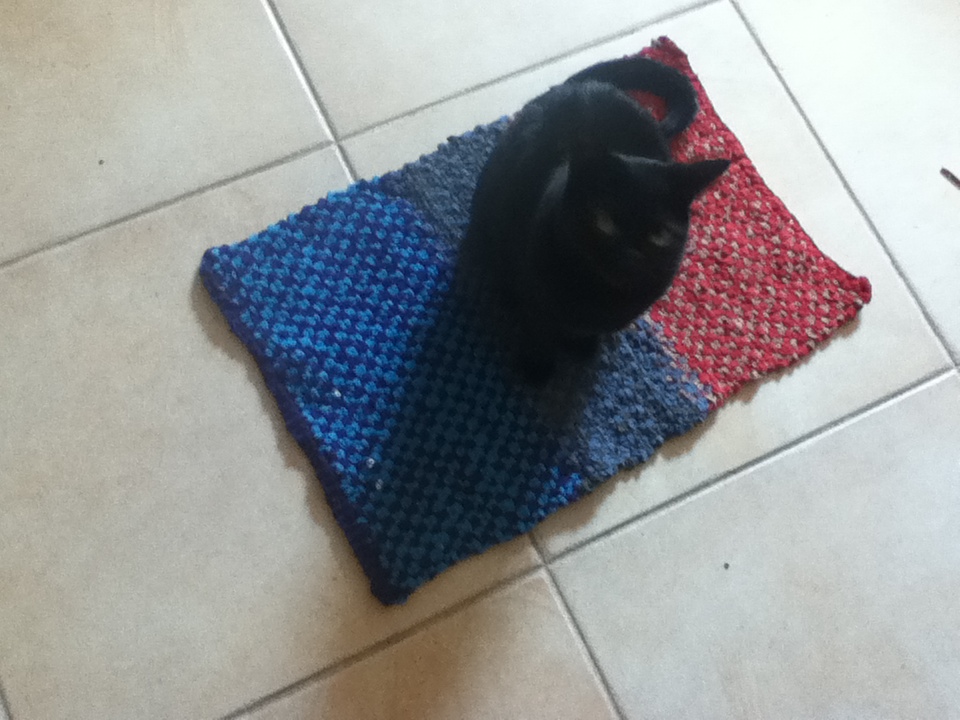
Last month, some friends and collaborators presented our church with a new set of liturgical vestments: an altar cloth, a chasuble, stoles for all the clergy and more. The twist? They were all knit and crocheted out of plastic shopping bags. (Actually, the altar cloth had some woven cloth for the table top, at the recommendation of our valiant vergers.)

The plastic recycled knitting had started for me three or four years ago, when our then-curate, the Revd Judith Alexis, called me up to exclaim, “I’m in the yarn store, and you’ll never guess what this guy here is knitting with!” Judith was the instigator of Trinity’s knitting ministry, and now she was inspired to see how we could integrate other aspects of our Christian mission – environmental stewardship, responsible consumption, respect for our Creator and creation – into our pastoral ministry of knitting shawls, blankets and garments for those in need of comfort or celebration. “Look it up online,” she urged, “and let us know at our next meeting what we can do.”

Well, for once, I needed no second bidding. I was excited by the possibilities of reusing all of those plastic bags in my kitchen closet which seem to get into the house no matter how hard I try to keep them out. I knit reusable shopping, tote, book bags and purses, branching into designs and logos to keep things fresh when my energy flagged.

When Judith moved on and away, I knit her a priest’s stole out of green newspaper bags.

I’m not sure exactly how the idea to make Earth Day vestments came about. I had made the stole; at a diocese-wide knitting event we had all talked plastic and cut strips and begun the laborious task of learning to knit loosely enough to deal with the inflexibility of certain grocers’ bags; but I suspect it was Cathy who first uttered the words, “altar cloth.” That’s when things really took off. We invited anyone and everyone to contribute strips of knitted plastic which Beth collected and organized Audrey, the seamstress among us, sewed together into a whole table covering for the altar of Trinity Cathedral in the heart of downtown Cleveland.

I knit a stole in February which we gave to the Presiding Bishop of the Episcopal Church, Katherine Jefferts-Schori, when she visited our Diocesan Convocation. Others then took that pattern and ran with it, producing a good half-dozen stoles for our own cathedral clergy. Meanwhile, I picked up a throwaway line from the Dean – “You’re making a chasuble, right?” – and set about creating that large, poncho-like garment out of 499(ish) plastic grocery bags.

The whole thing was such fun! And hard work! I had callouses on my fingers and thumbs from the unforgiving plastic, and Audrey’s fingers were sorely pricked, and it was still wonderful.

It was more than fun, though. It brought together women and men from different congregations – people of different faiths, and of no professed faith came together to create an offering to God.

The vestments were presented to Trinity Cathedral as part of that congregation’s acknowledgement of our responsibilities to our Creator and creation, as an act of repentance for our abuse, neglect and sheer carelessness of the gift within which we live, as an act of praise for the variety and inventiveness of creation and the gift of creativity, and as an offering. “All things come of thee, and of thine own have we given thee” (1 Ch 29:14)

You can see more photos of the finished product in Trinity Cathedral’s facebook album at http://www.facebook.com/media/set/?set=a.10150233208990692.365841.49984935691

To make your own recycled plastic stole, cut about 30 grocery bags into 1/2 inch strips and link together. Using this as “yarn,” cast on 20 stitches (11 needles work well; adjust to your own preference). Knit in linen stitch (which sits nice and flat) for 50″. Hold stitches on a spare needle or stitch holder. Knit another strip the same way. To join, decrease each strip by one stitch per row, mirroring the shaping, so that you achieve a mitred point. Cast off the last stitch on each strip and sew the strips together.

Posted in knitting, other words | Tagged , , , , , | 5 Comments

Telling the Truth

(A poem for Pentecost.)

“Words written in the past are fixed,” he said, “the meaning

unchangeable; otherwise, you and I,

we have no truth to tell, only words,”

and we watched the sun slip its moorings and fall

behind the trees beyond the lilied lake; but


When inspiration fell like a satellite and blew their minds,

meaning was dynamic, sharpened and blunted,

lost and found in fifteen languages,

discordantly and gloriously disarrayed,

and truth broke loose, its spirit on fire.

Posted in poetry | Tagged | Leave a comment

Waiting

Last Thursday evening, I saw a new spotted fawn springing across our lawn, full of the joy of simply being alive.

On Saturday, my teenagers reported that the fawn was sleeping in the tendrils of a fallen tree limb in our back yard.

On Monday, the fawn was still there, in its makeshift nest, shaded and sheltered by the rest of the big oak tree, apparently content.

This morning, loud thunderstorms and heavy rain ripped the morning to shreds. When things settled down, and the sun returned, I snuck round back to check. The fawn was still there.

I have checked the website of a local nature centre. Their “FAQ” section described the exact situation of our fawn: still, quiet, staying put, no sign of mother. This, the centre advised, is quite normal. The fawn can’t keep up with its mother yet, so she leaves it somewhere she considers safe, and returns at night to feed it. As long as it is lying down, keeping quiet, it is fine. Only if it gets up and goes looking and crying for its mother should we worry that she has not come back to it when she should.

On Saturday, the teenagers didn’t know the fawn was there before they stumbled into the yard; and on Sunday the telephone company came to rebury a wire which ran right past it. Still, the fawn stayed where it was put, and waited.

The patience, trust, and obedience of this small animal, while it may be instinctive, is also instructive. It has more faith in its mother’s wisdom at placing it there, more trust in her return, than fear of stumbling teenagers or working engineers. It has been “told” to wait patiently, and it does.

There is another aspect of this waiting game that struck me this morning, though. As the thunderstorms threatened, I commented to my daughter that, while I am glad that the fawn’s mother considers our home a safe place, by leaving her baby on our doorstep, she has made me feel somewhat responsible for it. I worried about it during the storms.

On Sunday evening I heard the Rt Revd Arthur Williams describe the time between the Ascension of Jesus and Pentecost, the coming of the Spirit, as a waiting period. It is almost like a little, offbeat Advent.

Like the fawn, the disciples were told to stay put and wait. Like the fawn, they did. They devoted themselves to prayer. They stayed together.

Waiting is contagious. As the fawn waits for its mother, I am drawn into waiting, too; watching out anxiously for her return. As we consider the disciples’ time in the upper room, we become anxious for Sunday and the inbreaking of the Spirit’s power. And yet, if we have faith, if we trust the one who told us to wait, if we know our Mother God to be reliable and devoted to us, we can afford to be patient as we pray:

Come, Holy Spirit!

Posted in other words | Leave a comment

Ascension

A sermon for the Seventh Sunday in Easter (the Sunday after the Ascension), June 5th, 2011, preached at Trinity Cathedral, Cleveland, Ohio – my first as a Deacon! 

A podcast of the sermon is available via http://trinitycleveland.org/podcasts/sermons.html

“Men of Galilee, why are you standing looking up towards heaven?”

The scene described by Luke in Acts can seem, to the modern vision, almost comical. As Jesus is lifted up into the distant skies, the disciples are left open-mouthed, pointing and staring, until two men in white come and chuck their chins to close their mouths, clear their throats to get the men’s attention, and send them on their way back toJerusalem. The Ascension is a difficult image for us to assimilate to our present-day day knowledge of the reach of our atmosphere, of what lies beyond the clouds, or even beyond the stars, it is a challenge.

When it comes to the Resurrection, the evangelists are mercifully coy. They describe an empty tomb, empty grave clothes, but none of them attempts to describe or explain that moment of mystery when the dead becomes the living, when life overcomes death, when Jesus first gets to his knees, and opens the seal, and steps out of the tomb. No, they leave it to our imaginations, and mine, I must admit, finds its limit with the miracle of emptiness. I do not try to envision the body rising.

But with the Ascension, we are not given that option. We are not allowed to let our imaginations rest on the opaque mystery. The evangelist insists on attempting to describe the moment at which the disciples became aware that something new was happening, something beyond the strange and wonderful resurrection experiences of Jesus they had already come to accept, something transcendent.

So we wrestle with images which make no sense to science. We are confronted with the limits of our capacity to marry faith with reasonableness. We are left open-mouthed, pointing and staring at the strangeness of it all.

But as with the resurrection, the evangelist is trying to convey something indescribable. And as tricky and sticky as it is for us, there are two aspects of this image which I would be loath to lose. One is has to do with looking up; the other is the completeness of Jesus’ leaving. Those details, I have come to believe, are important messages of the gospel. They are indicators to those of us left standing open-mouthed and staring.

Looking up.

There is a poem by Madeleine L’Engle called For Ascension Day, 1967, in which she unlikens the Ascension of Jesus to a child’s mishap. She wrote,

I know it’s not like that sunny Sunday afternoon

When we went to the zoo; evening came too soon

And we were back on the crowded city street

Still full of pleasure from the afternoon’s treat,

And our little girl clutched in her fingers a blue balloon.

It bobbed above our heads. Suddenly, there came a cry,

A howl of absolute loss. We looked on high

And there we saw the balloon, ascending,

Turning and twirling higher and higher, blending

Into the smoky blue of the city sky.

We wiped the eyes, blew the little nose, consoled the tears,

Did not, of course, offer a new balloon, instead were silly, waggled our ears,

Turned sobs to laughter, accepted loss, and hurried

Home for dinner. This day is not like that. And yet they must have tarried,

Looking up into the sky the day he left them, full of loss and fears.*

The poem continues, but the image of the balloon rising caught me, not because of the loss that it represented, but because of the possibility, the unpredictability of where that balloon might go.

The year before my family left Englandwas the year of Elizabeth II’s golden jubilee; she had reigned for 50 years. There were celebrations and holidays and my children’s school had a red, white and blue day where all the children wore, well, red, white or blue, and they had a picnic on the school field, and after lunch, there was a balloon release of red, white and blue balloons.

Each of the children in the school had a balloon with an index card attached with the school address, postage, and a space for the address of its finder, and on the count of zero, they let them go, and three or four hundred balloons sailed into the sky and drifted slowly and silently, on a soft summer breeze, as three or four hundred children stared up, open-mouthed, watching them float over the field and out of sight. Over the next few weeks, the index cards trickled back to school from improbably far away places, first from across the country, then from across the English Channel, and eventually from across the continent of Europe. The children pinned their locations on a map, and wondered at the journeys their balloons had taken.

The disciples were told that they would be Christ’s witnesses to the ends of the earth.

Looking up can be a way of looking beyond our usual horizons. It is our planet’s way of looking outside of itself. It can be a way of escaping the apparent confines of everyday details. It can free our imaginations to soar like those balloons. It can put us in touch with those whose suffering needs our compassion, whose hope needs our support, whose hope supports us, a world away.

While Jesus walked among his disciples, his own reach was limited by distance, by the confines of the everyday obstacles of limited time, energy, focus and attention. But when he ascended, he demonstrated the kind of expansion which inspired his disciples to undertake dangerous and imaginative journeys, to reach out to people across oceans, to reach beyond themselves.

The completeness of the Ascension.

The image of Jesus’ leaving the earth bodily behind is difficult, but it gives us an indication of what he wants for us, what he gives to us. I was reminded this week by an Ascension Day homily at St Gregory’s Abbey in Three Rivers, Michigan, that at his Ascension, Jesus, takes his entire being with him up to heaven. He takes his body, with its limitations and even with the scars of its torture and death on the cross. He takes his body’s regrets and pains, he takes his voice, his gaze, his soul and spirit, all together on his journey to the divine dwelling place.

If Jesus had left any part of himself behind, we might wonder, what in us is unacceptable to God, what of our lives and our selves needs to be left behind before we can enter God’s presence.

There may be many things that we would like to leave behind. There may be regrets, shameful memories, scars and painful moments that we would like to shrug off like old snake skin and rise into heaven without them. But this image of the Ascension lets us know that whatever our lives have made us into, whatever marks, visible or invisible they have left upon us, our whole selves are known and are welcome to God.

We know that there are things in each of our lives which we regret, but which we can no longer undo; We may hope that our sins, our scars, our shame will be purged away by the gaze of God when finally we are received into God’s direct presence; but we can be assured by Jesus’ Ascension that we will not need to hide anything from God. We cannot hide anything from God, and God knows and loves us along with our scars, our regrets, and our secret pain.

The completeness of Jesus’ Ascension lets us know that through his Incarnation, his life, death and resurrection, he has already united us with God. He has already opened our lives to the love of God.

Austin Farrer wrote of the Ascension that,

“We are told in an Old Testament tale, how an angel of God having appeared to man disappeared again by going up in the flame from the altar. And in the same way Elijah, when he could no more be found, was believed to have gone up on the crests of flaming horses. The flame which carried Christ to heaven was the flame of his own sacrifice. Flames tend always upwards. All his life long Christ’s love burnt toward the heart of heaven in a bright fire, until he was wholly consumed in it, and went up in that fire to God. The fire is kindled on our altars, here Christ ascends in fire; the fire is kindled in the Christian heart, and we ascend. He says to us, Lift up your hearts, and we reply, We lift them up unto the Lord.”**

As we stare up into the sky open-mouthed, our imaginations are kindled by the possibilities which come from transcending our own limitations, from working together, with and through others, to extend our own ministries and our own witness to the love of Christ for all of God’s people. As our imaginations and our hearts are lifted, we are set on fire with the Spirit of God. Whether our hearts burn with the compassion to feed the hungry, the passion to pursue peace, the warmth which comforts the sorrowing or the dying, the inspiration which produces art or music, we lift them and are lifted up into the presence of God when we burn to serve God’s purpose and God’s people.

“Men of Galilee, why are you standing looking up toward heaven?”

Called back to the present, back to earth, the disciples carried Christ’s flame in their hearts back to Jerusalem, back to their brothers and sisters, back to the prayers and the devotion which waited for the moment of Pentecost, when the flames would spread and warm the earth.

As we lift our hearts and our gaze to God, let us be assured of God’s flame, God’s Spirit, God’s love burning in us, purifying and accepting us with all of our scars and all of our secrets, inspiring us to share God’s love with all of God’s people, to the ends of the earth, and in our own lives, families, and homes.

Amen.

*Madeleine L’Engle, “For Ascension Day, 1967,” in The Weather of the Heart: Poems by Madeleine L’Engle (Wheaton: Harold Shaw, 1978)

**Austin Farrer, The Crown of the Year: Weekly Paragraphs for the Holy Sacrament (London: Dacre Press, 1952), p. 34

Posted in sermon | Tagged , , , , | Leave a comment

Backdated: Ascension (again)

As promised, here is the next installment in a three-week/three-year sweep of Ascension sermons. This one was preached on May 12th, 2010, the Eve of the Ascension, at the Choral Evensong of Trinity Cathedral, Cleveland, OH, using the Year C Ascension lectionary, especially Ephesians 1:15-23 and Luke 24: 44-53:

There is a phrase in this evening’s reading from the letter to the Ephesians which is pure poetry. “I pray, ” says the writer, ‘that with the eyes of your heart enlightened, you may know what is the hope to which God has called you.” That phrase, “the eyes of our heart,” really caught my eye when I read through the passage earlier this week.

What are “the eyes of the heart.” What does it mean to look through them, with them? What happens when their vision is impaired, or when they are enlightened, brightened, illuminated by the hope to which God has called us?

The disciples in the Gospel reading had had their eyes opened by Jesus. It’s an oddity of the resurrection stories that the people who knew Jesus the best often didn’t seem to recognize him when they first saw him after his death and resurrection. Mary Magdalene famously thought he was the gardener, although she was crying at the time and maybe not looking too hard or too clearly. But the two men on the road to Emmaus walked miles with Jesus without realizing who he was. Another time they thought he was a stranger calling out to them from the shore of the sea on which they were fishing. Each time, it was not until Jesus spoke their names, or gave a blessing, or broke bread that their eyes were opened, the eyes of their hearts were opened, and they recognized the one whom they had followed, whom they had loved, and who loved them. It was only when the eyes of their hearts were allowed to enlighten their vision that they were able to see Christ before them, that they were allowed to hope and believe that he was no longer dead but risen, that his story was unfinished after all.

Whether the eyes in our heads see or don’t see, the eyes of our hearts recognize Christ.

Donald MacKinnon, a twentieth-century British theologian, said that what it meant for Jesus to be human was “to be subject to the sort of fragmentation of effort, curtailment of design, interruption of purpose, distraction of resolve that belongs to temporal experience. To leave one place for another is to leave work undone; to give attention to one supplicant is to ignore another; to expend energy today is to leave less for tomorrow.”*

We know all about that fragmentation. There are never enough hours in the day, enough days in the week, enough weeks in the year to achieve everything that we think we should do. What can one person change in this world? What difference can one hour of work make?

If it comes to that, we might as well ask. what difference did Jesus make?

What difference did his hour of the cross make, or the hour of his resurrection, or the hour of his ascension? For us, gathered here, clearly, all the difference in the world. When the eyes of our hearts are enlightened, we find in the story of Jesus’ life, even of his death, in his resurrection and his ascension great hope in the power of God.

The image of the ascension is one of the transcendence of those very limitations that MacKinnon talked about, the fragmentation of effort, the distract of resolve, the curtailment of design. In the ascension, Jesus demonstrates the way in which the power of God has transcended and transformed that fragmentary, limited existence by the defeat of death and the promise of the Holy Spirit. No wonder the disciples were so excited! These Galilean fishermen and women from the villages of the north had just been told that they would be clothed with power that would help them to change the whole world, beginning but not ending with Jerusalem. Seeing with the eyes of their hearts, they understood the hope that lies in the power of God. Seeing with the eyes of their heart, they could see further than they had ever seen before; the possibilities for reaching beyond their limitations and fragmentary lives.

By entering their limitations, their fragmentations, Jesus had shown them God’s love for them, God’s tenderness for their situation, God’s compassion. God’s love for us, God’s tenderness for our situation.

By his resurrection and ascension, by transcending those limitations, Jesus showed them God’s love for them, God’s hope for them, God’s power in their lives. God’s love for us, God’s hope for us, God’s power in our lives.

“I pray,” says the writer to the Ephesians, “that, with the eyes of your heart enlightened you may know what is the hope to which God has called you, what are the riches of the glorious inheritance among the saints, and what is the immeasurable greatness of God’s power for us who believe.”

We are called to hope beyond what we normally see. We are called to live into our glorious inheritance among the saints, the immeasurable greatness of God’s power for us. We are called to live with compassion for those around us, seeing them with the eyes of our hearts enlightened, revealing their dignity, their belovedness, the light of Christ within them. We are called to use the power that God has given us to reach out in hope to those who need hope.

We are called to transcend our limited lives, to share our hearts with people a world away.

We are called to transcend the limits of our fragmented attention span and see with the eyes of our hearts our own city, our own communities, our own children, to bring them hope, to enact change where it is needed by the power of God.

When we allow the love of God to enter and to enlighten our hearts, we can trust that by the power of God, nothing, not even death, nor the limitations of our own lives, will defeat God’s love for the world, which transcends all limitations, which is limitless in its scope and in its power.

With the eyes of our heart enlightened, may we know what is the hope to which God has called us, and what is the immeasurable greatness of God’s power for us, who believe, by the working of that great power. Amen.

*MacKinnon, Donald, Themes in Theology: The Three-Fold Cord (London: T & T Clark, 1987), 162

Posted in sermon | Tagged , , , | Leave a comment

Backdated: Ascension stories

It’s been a busy couple of weeks, and it’s getting busier, so while I still can, I’m dipping into the archives again. This week’s homily time travels from Evensong at Trinity Cathedral, Cleveland, on the Eve of the Ascension 2009, and uses the Ascension lectionary for Year B. Next week, the same service from 2010 will come visiting; by the following week we should be back on track, in Year A, risen, ascended and relieved!

“Tomorrow marks the fortieth day after Easter, and in our gospel traditions that is the day on which the risen Lord Jesus ascended into heaven and, in the imagery of the creeds, took his seat at God’s right hand.

But for me, one of the most curious things about this curious and wonderful story is the reaction of the disciples.

What has happened to these people in the few short weeks since Easter?

They are different men (and, I suspect, different women, too).

After Jesus’ arrest, they ran away. There was violence done in the garden, and the disciples scattered and hid. They watched the crucifixion from a distance, while others stood around the foot of the cross beating their breasts. They denied ever having known the Christ.

Fear and doubt and bad feelings abounded.

But now, seeing their friend and master taking his leave from them once again, and so soon after they had received him back from the dead, these same disciples are filled with joy.

They are overflowing with joy!

They worship Jesus and they bless God continually in the temple in the days that follow.

What a difference forty days make!

What was it that could turn these disciples around so completely? How was Jesus able to turn so much fear, doubt and bad feeling into this temple singing, God blessing joy?

In this last story of Luke’s gospel, Jesus charges his disciples with proclaiming repentance and forgiveness to the whole world.

Repentance.

One of the great archbishops of the twentieth century, William Temple, had this to say about repentance:

We have lowered the term ‘repentance’ into meaning something not very different from remorse … To repent is to adopt God’s viewpoint in place of you own. There need not be any sorrow about it. In itself, far from being sorrowful, it is the most joyful thing in the world, because when you have done it you have adopted the viewpoint of truth itself, and you are in fellowship with God.*

Repentance. Adopting the viewpoint of God, being in fellowship with God. If that is the transformation which the disciples had undergone, no wonder they were joyful.

When the risen Lord had first appeared before them, they were terrified, haunted by their own knowledge of how they had let him down. But Jesus said, “Peace.” He offered them peace; he told them to be at peace with themselves. All was forgiven.

To see from God’s point of view, we are told in this gospel, is to see with a forgiving eye.

Forgiving is complicated; perhaps even more complicated than joy. It is not to forget the past, or to pretend that we have never been hurt, or have never hurt anyone else; but it is to live without bitterness, without becoming mired in regret. It is not to ignore the lessons of our failings, or to fail to protect ourselves from future harm. It is, perhaps, to wear the past loosely, and to keep our hearts grounded in the present and hopeful in the future.

I build up barriers of guilt and regret all the time against this perfect repentance. The fear and doubt and bad feeling of the disciples; those are emotions that we live with every day, when we know that we are in the wrong because of what we have done or left undone; or when we worry about what other people think of us, or when we can’t seem to find our joy; but repentance is itself a gift from God, which means that as often as we resist it, God offers it. Through the gospels, through the church, the sacraments and through prayer, Jesus has explained to us, just as he did to those disciples, that we are forgiven, and blessed by God.

So I wonder: what do we look like, seen through God’s eyes? What do we look like, forgiven? What opportunities for healing do we see when we have the courage and the grace to make or to accept an apology? What gifts can we grasp and use when we set aside our need to be perfect? What possibilities are opened up, to give and to serve and to love and to be loved, when we can accept that word of peace, when we can truly repent and enter into that temple singing, God blessing joy?

The most curious part of this story, for me, is not that Jesus was carried up into heaven. Jesus was transformed by the manner of his conception, his birth, his life, his death, his resurrection, into someone who would live at God’s right hand. Jesus was, is and always has been God’s Son. It’s there all the way through the gospel stories.

Jesus’ ascension is amazing and astonishing and mysterious and wonderful, but, after all that we’ve learnt of him along the way, I’m not sure it’s terribly surprising.

But the disciples; their transformation surprises me.

Jesus was transformed and sits at God’s right hand.

The disciples were transformed by knowing Jesus.

And most curious of all: if we only allow ourselves, we with them can be transformed by repentance, from fear, doubt, and bad feeling into temple singing, God blessing joy.”

*William Temple, Christian Faith and Life, 67, quoted more fully in L. William Countryman, Forgiven and Forgiving (Harrisburg: Morehouse, 1998), 2

Posted in sermon | Tagged , , , | Leave a comment

A Sighting

Yesterday, rounding the corner,

I saw my brother standing on the sidewalk,

dressed as ever in his soft gray t-shirt

and rough, sloppy jeans,

his scarred, shaven head

bruised with stubble,

sucking in cigarette smoke

with the sharp, spring air,

his cheeks drawn around the

delicious, pernicious breath,

head thrown back in the sunlight,

hanging loose on the street corner,

worlds away from where he lay

secure in his clean-sheeted bed.

Posted in poetry | 4 Comments

Backdated: Easter for the lost and the lonely

This was the post I had intended to use today, you know, before today happened. This sermon was preached on “Low Sunday” last year, April 11th 2010, at St Peter’s Episcopal Church, Lakewood, Ohio:

Do you remember this story? 

A shepherd had a flock of sheep, and when night came, and it was time to fence them safely up in the sheepfold, ninety-nine of the sheep came in, but one was missing. And the shepherd closed the gate on the ninety-nine, and he went out over the darkening hills, climbing and calling and searching until he found the one who was lost and brought it home, safe and sound with the rest.

 Or this one:

A woman had ten silver coins, but she lost one, so she lit a lamp and searched high and low, under the bed and between the sofa cushions, until she had found it, and she was very glad when she did.

 What about this story?

Jesus Christ had many disciples, and he appeared to them after he was raised from the dead and showed them his wounds, and breathed peace upon them and new life into them, and commissioned them to share their faith with all the world. But one disciple was missing, and he was so angry and upset at having missed the Lord, that he almost fell away. So the risen Lord, unwilling that this one should be lost to him, returned again, and showed him his wounds, just as he’d shown the others, and wouldn’t give up until the disciple was fully restored to faith and cried out, “My Lord and my God!”

 We are used to hearing today’s gospel story as one about Thomas’s doubt, but what if, instead, it is about Jesus’ persistence, about God’s insistent love for God’s people?

 On the evening of the first day of the week, Easter Sunday night, when everyone was still afraid that there might be more arrests and even more deaths, and they were confused and upset by the empty tomb and the strange stories of angels and encounters, the disciples were gathered together for comfort and safety, behind locked doors.

Jesus arrived. He greeted them with words of peace to calm their fear. He breathed on them. Just as God had breathed on the first earth creature to make him a living human, Jesus breathed on his disciples and breathed into them new life in the Holy Spirit.

 But Thomas was out when Jesus came. Thomas had left a house full of broken, grieving, fearful men and women. Broken, grieving, fearful Thomas came home and found everyone rejoicing and singing and babbling with excitement, “He was here! You missed him! I can’t believe that you missed Jesus!”

 Poor Thomas. “I can’t believe it either,” he said, and he slunk away, his grief doubled. He must have felt as though he had lost Jesus twice in the space of three days.

 “I want to see him!” Thomas insisted. “To see the wounds in his hands and feet. I want what you had: nothing more, nothing less. It’s just not fair.” Behind the cry of a disappointed child, sad and angry and bereft, you could almost hear the echo of Jesus’ own words, the words of Psalm 22, “My God, my God, why have you forsaken me?” Hope is hard when you’re grieving. Joy does not come easily to the left out, or the left behind.

 A week passed this way. Then it was Sunday again. This Sunday, the first Sunday after Easter. And the disciples were together again, just like before, and this time Thomas wasn’t going anywhere, just in case. And Jesus returned with his words of peace, and he understood what Thomas needed. “Here,” he said. “Thomas, see my hands, my side. Don’t drown in your grief and your anger. Don’t resist the love which God offers you. Believe that I am here with you, here for you, now and always.”

 And Thomas believed, and was finally able to share in the joy of the household. He came out of his corner and with a smile from ear to ear finally greeted his risen Lord, God among us, Jesus Christ.

 Then Jesus blessed us. Standing there right next to Thomas, Jesus blessed you and me. It’s right there in the story.

 Two thousand years ago, a week after the first Easter, Jesus pronounced his blessing on all of us who would come after Thomas, who would not see and touch that body of flesh with its wounds of death and its promise of resurrected life.

 Jesus blessed all of us who would come to believe because Thomas and the other disciples passed on all that they had learned about God in Jesus, and let us know of God’s love for the world, a love so deep that it overcame death.

Just as Jesus breathed new life into the disciples, Jesus blessed all of us, so that we might have new life in his name.

 Because this story, like all of the others in the gospels, isn’t about Thomas, but about Jesus. It is about the shepherd who sought the sheep, and the woman who searched for the coin, and about Jesus’ persistent and insistent love for all of God’s people.

 This story is one of hope for those among us for whom hope comes hard, for whom fear overwhelms joy.

 For those among us who are angry at the unfairness of life. For those of us who are angry at God.

 For those among us who feel that our faith is wavering, or struggling, or incomplete.

 This story is one of hope for those among us who feel left behind by last week’s resurrection.

 There’s another story, that the prophet Isaiah told about God’s chosen one: “A bruised reed he will not break,” he said, “and a dimly burning candle he will not extinguish.”

 We may feel bruised sometimes, or as though our light is burning more dimly than it used to.

 We may feel as though we, with Thomas, have been left behind, overlooked.

 We feel overwhelmed by the tragedies that we see on the news; and the tragedy that we experience in our own lives, when loved ones die, or are estranged from us, when fear, and fighting words drown out the words of love we want to speak and hear.

Perhaps we are fearful about the future; reluctant to hope in case we are disappointed; fearful about job prospects, about the political climate, about the direction of our relationships with our children, our spouses, our neighbours.

And then there are those around us who regularly feel left out of our society, because of their background, their economic status, or even simply because of whom they love.

There are many reasons to hold back from singing alleluia. There are many among us who, with Thomas, are bewildered by the empty tomb, bereft by the loss of life, and just plain mad that everyone else seems to be rejoicing except us.

A bruised reed he will not break. A smouldering wick he will not extinguish. A lost sheep he will not abandon. And a broken-hearted disciple he will not reject.

Jesus blessed us who, unlike the other disciples, unlike even Thomas, never got to see his risen body in the flesh. And here is a sign of that blessing.

Every Sunday we who never saw him in his earthly life remember Jesus anyway, just as he commanded: “Do this to remember me.”

We who never felt his breath on our faces feed on him in our hearts, and know that he lives in us.

Every Sunday since that first Easter, Jesus has invited us, the spiritual ancestors of Thomas the Twin, to see his broken body, even to take it in our own two hands.

A bruised reed he will not break. A lost sheep he will not abandon. And a troubled soul he will not leave alone.

Of course, we meet Jesus at other times, and in other places, and thank God for that!

 But here, today, as we remember the lost sheep, the lost coin, the lost disciple, we are especially invited, even in our brokenness, even with our doubt. We are sought out by Christ and invited, with Thomas, to enter into that confession, that Jesus truly is risen, our Lord and our God, and that he has not, and will never leave us alone.

 And we are commissioned to find a way to share that invitation, that good news of God’s persistent and insistent love with those of our world who find hope hard, and who feel left out of our Easter joy.

 Alleluia. Christ is risen. The Lord is risen indeed. Alleluia.

Posted in sermon | Tagged , , , | 1 Comment

Victory trembles


Someone whispers, Peace.

Triumph and fear shout aloud.

Victory trembles.

Posted in poetry | Leave a comment

Where you go, I will go

It’s Easter Monday, and this is, perhaps, a story more about restoration than resurrection; but here is Naomi’s story as told at the Great Vigil of Easter at Trinity Cathedral in Cleveland, Ohio, yesterday morning, Easter 2011:

It’s hard to believe, standing here today, that when I came back to Bethlehem I told them not even to call me Naomi anymore. “Call me Mara,” I said, “because my life has become one of bitter tears.” Yet here I stand, my name and my hope restored, holding my grandson in my arms. They say that where there’s life, there’s hope, and here is life, here is hope. God is good indeed.

It all began some years ago when we had a terrible famine here inJudea. My husband and I took our two sons and emigrated toMoab. In order to feed our sons, we left our home, our families, our culture and our community. It’s not easy being a stranger in a strange land. Our sons were young enough to adapt, though; after their father died they each married a local girl and they seemed happy enough. But then it all started to fall apart. First one died, then the other, and that was that: my husband and both sons, gone. The two girls and I were left with nothing; and it’s no life for a woman without a man out here, I can tell you.

I’d heard on the grapevine that the famine was over, so I decided that I should go home. At least inBethlehemI was not some strange old foreign widow, I was just a plain old ordinary widow; someone might show me some pity. I told my daughters-in-law, “Go home yourselves. Find new husbands. I’m too old to grow you each a new one!” Beyond the joking, there were bitter tears, I can tell you, but Orpah, good girl that she is, kissed me and went off home to start again.

But Ruth. Ruth was a different kettle of fish altogether. She wouldn’t leave my side. That girl, such love, such loyalty, such stubbornness: “Where you go, I go,” she told me. “Where you lodge, I will lodge; your people shall be my people, and your God my God. Where you die, I will die,” she said, and she would not be parted from me.

That girl. I loved her for loving me. Even so, when we got back toBethlehem, and I remembered all that I had lost, I was bitter. “Don’t call me Naomi,” I told the neighbors who came out to see us, “Call me Mara, which means Bitter in our language, for the Almighty has dealt bitterly with me.”

If leaving your country is hard, coming home can be even harder. I honestly think that I would have gone to pieces if it weren’t for Ruth. It caused quite a stir in the neighborhood, I can tell you, me turning up with this pretty young Moabite in tow, and while I stayed at home, nursing my grief, she went out to glean food for us in the fields.

Day by day, I began to see how Ruth’s love and steadfast loyalty was what kept us both going in those days. Here she was, a stranger in a strange land (and I knew what that was like), and she was here because of her love for me, and I, I had to stir myself at last and take care of her, because she loved me and, well, I loved her for it.

Well, it so happened that the field she chose belonged to a kinsman of my husband, by the name of Boaz. Now Boaz was clearly quite taken with Ruth, but he seemed a bit shy of closing the deal. But there are advantages sometimes to being an older woman who’s seen a bit of the world, and I told Ruth what to do, and lo and behold Boaz married her, and inherited my late husband’s fields and the care of his widow into the bargain. And we all lived, as they say, more happily than we had in many a long year.

It’s strange to think of it all. Here I am, Naomi of Bethlehem, widow of Elimelech, who used to have two sons and now, instead, I have a daughter. I used to have a husband and two sons, and now my husband’s cousin is my son-in-law. My daughter-in-law wouldn’t let me go, and because she loved me and followed me home, now I have a grandson, Obed, this little one here. “Your God is my God,” she told me. And God is good. Remember that, little one.

Alleluia!

Posted in story | Tagged , | Leave a comment