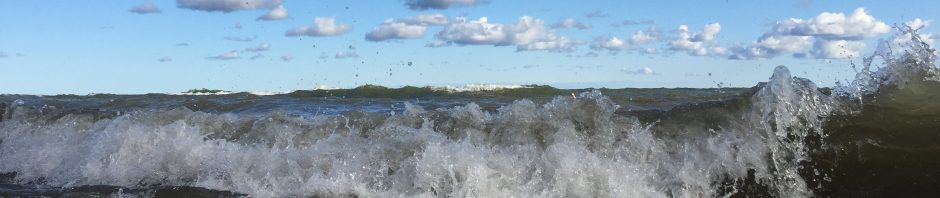
Memory

Sirens, sharks and sharp rocks threaten shipwreck;

gentle waves promise peace;

but water bends light, re-shaping and re-sizing,

scattering and re-collecting the things that lie below.

Playful, silvery creatures flash by in shoals,

some tame enough to eat from your hand.

Some have teeth and poison fins, and we cage ourselves in

and block our ears when they batter the bars.

Depth-distorted, sunken cities of calcified coral

build new and intricate structures, 

the ghosts of spires, homes and hamlets,

and the current disturbs their clarity and drifts us away.

Posted in poetry | Tagged , | Leave a comment

A prayer life or une vie de priere?

The past two weeks I’ve been constantly on the move (or so it’s seemed). First, to the centre of England and a quiet village and a quaint cottage filled to the rafters with family; then a few glorious days in Paris; then Wales; now, the long road home.
One of the things that I’ve noticed is the fragility of routine.

I’ve never been much of one for routine, anyway. If a book or pamphlet or person begins a program by recommending, “It’s best if you try to do this at the same time each day …” (as many books on prayer seem to do), then I am tempted to throw up my hands right away. My days do not seem always to have the same times in them, at least not in the same order! In recent years, though, the practice of the Daily Office has, at least mostly, helped to structured my unscheduable days, and I have come to rest on its routine to keep me tethered to a continuing strand of prayer.

In the cottage, it was possible, if I was the first one up, still to find my quiet corner and begin the day with morning prayer. At the end of the week, though, an investigation of the village church revealed that the one Sunday service would start after we had loaded up the car for our next round of rendezvous. I remembered a high Anglo-Catholic church near to my in-laws, where we would be for dinner Saturday, and on a hunch looked them up. Yes, they hold a weekly Sunday Vigil on Saturday evening! A brisk walk up hill and down dale found me in a congregation of seven, including the Curate, who performed her diaconal duties from her place in the congregation. A spare, reverent liturgy with sufficient ritual to mark its place in the ecclesiastic spectrum, with no added fuss or fervour, it was food for my soul and perhaps, by entering such a small space around the altar, I was able to add some variety to the life of the community gathered, too. Duty was satisfied, and much more besides.

It was in France that my carefully constructed house of cards crumbled. Sharing hotel rooms with the whole family, extra jet lag, late nights and mornings spent climbing towers to gaze over the beautiful city of Paris were none of them conducive to a quiet practice of morning and evening prayer. I downloaded my regular morning prayer podcast whenever I found free wi-fi, but never listened to it, and snatched gobbets of time here and there to consult my i-Pod lectionary app. My prayers were whispered in bed or on the Metro, and I wondered at the way in which my rule of life was being bent and stretched by such a simple thing as going on vacation.

A chance encounter in the middle of a tourist-trampled Notre Dame brought me to my senses. Thousands of miles from home, amongst the saints of the side chapels – Jeanne d’Arc, Denys and Denis – we found a couple of saints from home. We were astonished together, and pleased together, and after that brief encounter I found myself giving thanks for those other saints in my life, especially the ones who touch the lives of the people I love, and the litany of thanksgiving lasted through the next hour of waiting to climb the towers of the cathedral, and through the evening, and recurred like a refrain throughout the rest of our time away, and suddenly instead of chasing my prayer life, I was living in a prayer.

Tonight, I sleep in my own bed, and tomorrow, routine (such as it is) will be re-established. But I pray that it will continue to be enhanced by the gratitude, by the unpredictability and spontaneity that a chance encounter in a foreign land provoked.

Posted in other words, story | Tagged , , , , | 1 Comment

recycled knitting revisited (again)

For those following along, we began with plastic bag knitting

 (https://rosalindhughes.wordpress.com/2011/06/17/a-plastic-story/ ),

moved on to a t-shirt cat mat (https://rosalindhughes.wordpress.com/2011/07/18/more-recycled-knitting/),

then a t-shirt bag, for which I promised a “proper” pattern once I’d repeated the feat.

Here’s the pattern I used for this slightly smaller than but similarly proportioned to the original t-shirt bag. It took one t-shirt and one pillowcase pretending to be a t-shirt to complete (the original bag took 3-and-a-bit t-shirts).

Notes: I used a circular, US10.5 needle. 16″ long. Gauge is not important and will depend greatly on the weight of your t-shirt “yarn.” For a bag, aim for a tight (but not uncomfortable to knit) fabric. Adjust needle size to accommodate your yarn and knitting style and the size of the bag will vary but the shape should still be good.

Cast on 32 stitches, place marker and join to knit in the round.
Knit 2 rounds.
K8, m1, repeat 4 times to end of round (36sts)
Knit 4 rounds.
K9, m1, repeat to end of round (40sts)
Knit 4 rounds
K10, m1, repeat to end of round (44 sts)
Knit 12 rounds
K9, k2tog, repeat to end (40sts)
Knit 2 rounds
K8, k2tog, repeat to end (36sts)
Knit 1 round
K7, k2tog, repeat to end (32sts)
K6, k2tog, repeat to end (28 sts)
To finish:
Turn bag inside out. Hold both needle points together and divide stitches in half between both sides of the circular needle. With a spare straight needle, cast off 2 stitches at a time (1 from each side). Fasten off. Turn bag right side out. Add a strap recycled/reused from your material of choice.

If you prefer a circular pattern all the way to the bottom, continue reducing as established til 16 stitches remain. Draw yarn through remaining stitches, pull tight and secure. Add strap.

Posted in knitting, other words | Tagged , , , , , | Leave a comment

A gift

Shiny globes strung together to decorate

a Christmas spirit; mere baubles,

but I wanted them.


My mother loved them, too,

so I bought them for her, and,

whether out of guilt or generosity,


she said it was the right way around,

because one day they would be mine,

so it was as if I were giving them to myself


(which seemed at the time both rude

and beside the point).


Still, when all was said and done

and the heat of summer was at its height,

it turned out she was right.

Posted in poetry | Tagged , , , , | 1 Comment

More Recycled Knitting

Following my foray into recycled plastic knitting (https://rosalindhughes.wordpress.com/2011/06/17/a-plastic-story/), I was inspired by friends to try recycled t-shirt knitting. A slightly gentler and more forgiving medium, it’s perfect if you want to knit old stuff into new but find the plastic too rigid and inflexible for your fingers or needles.

 First, I made a rug, which my daughter’s cat instantly adopted.

This was pretty simple. I cut six t-shirts, one strip each, cut on a spiral from the hemline to the underarm. A helpful teenager took away the sleeves and yoke to make into a scarf. Each strip was about half an inch wide. I used linen stitch in two colours to make a nice, flat mat. Linen stitch, if you’re not familiar with it, is deceptively simple and usefully dense, and easy to use in two colours at once. The different lengths of the t-shirt strips made for easy and interesting transitions between colour patterns.

Linen stitch cat mat:

Cast on 40 stitches in colour A

Row 1: With Colour A and yarn in front, slip one. Take yarn back and knit one. Repeat to end of row.

Row 2: With Colour A and yarn behind, slip one. Bring yarn forward and purl one. Repeat to end of row.

Row 3: Join Colour B and work Row 1.

Row 4: Using Colour B, work Row 2.

Repeat these 4 rows, switching to new colours/t-shirt strips as necessary. Weave ends in to join strips and secure.

When mat reaches desired length, cast off knitwise.

I also made a little shoulder bag.

It took a few tries to find a shape that I liked and which fit the fabric, but I was quite pleased with this one, made for my 4-year-old goddaughter.

As usual, I was making it up as I went along, so the pattern is going to need some checking for repeatability before I share it, but if you feel inspired and want to go your own way, I suggest casting on about 36 stitches on circular needles, increasing over a number of rows, knitting straight for the mid-section, then decreasing until you feel comfortable turning bag inside out, dividing the stitches in half, and casting off using the circular needle as two straights with a third to knit/cast off both halves together knitwise. Then add a strap.

That’s pretty much what I did.

If you like a little more direction, check back in about a month and I’ll try to have a proper pattern posted. In the meantime, enjoy your knitting, and remember to reduce, recycle and reuse!

Posted in knitting, other words | Tagged , , , , , , | 1 Comment

The Promise

This sermon for Pentecost 5, Year A Proper 11, was preached at St Paul’s, Norwalk, OH, 17 July 2011

When we left Jacob last Sunday, he had wrestled with his brother in their mother’s womb, he had tricked his brother out of the birthright inheritance due to the elder of the twins.

In between last week’s reading from Genesis and this week’s, Jacob’s story continued. He consoldiated his position over his elder brother by tricking their father into giving him the blessing due to the elder son. Isaac, their father, told him to go away and find a wife from his mother’s people, because he would be the one to continue the promises made to Abraham, that a great people would be his descendants, that they would live in the promised land, that they would be the people promised by God.

Esau, Jacob’s brother, even though he had given up his birthright for a mess of stew, was overwhelmed with grief and anger when realised what he had lost, and how his brother had taken his place in the family, and in the promises of their father. Their mother warned Jacob that he shouldn’t wait but must leave now, because Esau was thinking of killing him.

So Jacob left home, blessed by his father and by the promises made to Abraham and his offspring, but hated by his brother;
the heir to a promise of richness, of fat and fruitful land, of a healthy and large family, of the blessings of God, yet running away with nothing, with not so much as a bedroll to give him comfort in the night.

He took a stone, we are told, and placed it under his head as a pillow to sleep when night fell and he could go no further in the dark.

That is where we find Jacob this morning. He is lying in the darkness, fleeing from home in fear for his life. He is in the middle of nowhere,
with nothing, and no one to keep him company. He has, quite literally, hit rock bottom, lying on shale for a bed, with a stone for a pillow.

What does it feel like to be alone? To be apart from family and friends, isolated by distances measured in miles or in emotions? What does it feel like to be cut adrift, to be homeless, to have nothing? What does it feel like to be alone in the dark?

We see in our own lives the echoes of Jacob’s dilemma. We fight and fall out with those to whom we feel closest. We do it as indiviuals, in family and friendship relationships. We do it as churches, splitting apart instead of working together for the kingdom, focusing on the weeds rather than on growing the wheat. We experience financial hardship, in our households, in our parishes, in our country, striving to stop our own debt ceilings collapsing around our heads. We see hunger and homelessness in the world around us, and we pray that our children will not have to suffer that way.

We know what it feels like to be alone in the dark. Some of us have felt the hard rock beneath us.

But in this dark night of Jacob’s soul, he is reminded that he is the bearer of God’s promises. Wherever he goes, whatever situation he finds himself in, however bleak things look and however alone he feels, God is still with him. There is no chasm between the divine dwelling place and Jacob’s rocky pillow that God cannot cross.

When God speaks in Jacob’s dream, it is not from the top of the stone stair. God stands beside Jacob, and says, “I am the Lord, the God of Abraham your father and the God of Isaac; … all the families of the earth shall be blessed in you and in your offspring. Know that I am with you and will keep you wherever you go, and will bring you back to this land; for I will not leave you until I have done what I have promised you.”

Close enough to whisper in Jacob’s ear, God promises never to leave him, never to withdraw the promises of the blessing which Jacob stole, but which God now freely gives back to him.

Now I don’t want to give away too much of the story and spoil your enjoyment of the next few weeks’ readings; suffice to say that God kept God’s promise to Jacob. Things did not always go smoothly for him, to say the least. He continued to duck and dive, wheel and deal his way through life, and he met his match more than once; but he was the heir to those promises that were made to Abraham and to his descendants, and he was the father of the nation of Israel, and all of the families of the earth have been blessed in his descendant, Jesus of Nazareth, that preacher from the promised land and the author of the promises to us of God’s salvation, of God’s blessing, of God’s presence among us.

Things didn’t always go smoothly. When Jacob woke up from the dream of God’s presence with him and God’s promise to him, he was overawed. “Surely God was in this place, and I didn’t know it!” he exclaimed. How could he know it, in the middle of nowhere, alone in the dark? And yet, there God was.

There is a postscript to this story. After Jacob set up his stone pillar and anointed it, he promised God that he would follow God’s promise, and be faithful to God, if God kept the promise and was faithful to Jacob. If. Even now, in the face of awe and wonder; even now, in the face of God’s promise; even now, as though he had anything left to lose, Jacob hoped in the rock of our salvation, but held on to a small, smooth pebble of fear.

St Paul wisely observes that we do not hope for what we can already see and grasp. The promise offered to Jacob was a long time coming to fruition, but he lived in its hope, and in the knowledge that God was with him, waiting patiently as he and his offspring and the whole earth laboured towards its fulfilment.

God knew about that smooth pebble of fear. God knew the sharp, cold places of Jacob’s heart, the stumbling blocks in his way, and God stayed true to Jacob and to the promises that he carried.

Life in the promise of God is not always a smooth pathway. This is not an instant fix for our grief and our divisions. We still stub our toes on the hard rocks of our debts, our hunger, and our heartsickness. We still wait for the final fulfillment of God’s promises to us. Even in our hope, we still encounter those pebbles of fear. But God is in this place, whether we know it or not. God is waiting with us. God is walking with us.

Because the promise that Jacob heard is also God’s promise to us. We are the heirs alongside Christ of the promises of God. We are children of God, adopted by the Spirit to be co-inheritors of God’s promises. God nows the pebbles of fear that we carry, the hard and sharp places in our hearts, the stumbling blocks in our way, and God promises that, flawed as we are, we, like Jacob, have the potential and the power to do great things, to bear fruit, to be a blessing to the people around us, if we trust in the Spirit to live in us and work through us.

And even when it seems hard, in the rocky places of our lives, even among the weeds, God is with us, whispering in the night, so close that we could almost reach out and touch the sound of God’s voice,

“I am with you, and I will keep you; for I will not leave you until I have done what I have promised you.”

Posted in sermon | Tagged , , , | Leave a comment

July 10 2011 – Year A, Pentecost 4 – Leftover Reflections

A couple of weeks ago, NPR carried a brief story about some research which found that people who use social networking sites, like facebook or twitter, have deeper relationship with the folks around them than people who don’t.* Maybe you’re surprised; after all, a quick google search landed me on pages of blogs worrying that social media would trivialize our relationships, would do the opposite of deepen our understanding of and commitment to one another. But in another way, it makes sense that the wider our nets are cast, the more stories we hear from one another, the more experiences we share and vicariously suffer from and celebrate, the more understanding we will have of the human condition, of one another, of ourselves.

I am reminded of the Spirit of Pentecost, which blew open the minds, ears and hearts of so many people, allowing them to understand the words of the Gospel, to understand others who spoke differently from them, to hear nad share the experience of God’s love for God’s own people.

“You are in the Spirit,” Paul tells the early Roman Christians, “since the Spirit of God dwells in you,”

Paul describes to the Roman Christians how their new life in the Spirit is different from their old life in the flesh. One leads to life and peace; the other to death. One fulfills the law of God; the other is incapable of doing so. One brings people into closer relationship with God, indeed to the mutual indwelling of God’s Spirit in and among them; the other is hostile to God.

The life of the flesh which Paul talks about is not simply the life of the body. This is not a dualism of body and spirit; it is not a condemnation of creatureliness or of creature comforts. Far from condemning them, at the end of the portion of this letter that we read today, Paul promises that God gives life to our mortal bodies.

So what does it mean to live in the Spirit and not in the flesh?

Living in the Spirit instead of in the flesh doesn’t have to be about denying our bodies. We have bodily needs, legitimate physical desires, and the Gospels tell us that our heavenly Father nows that we need all these things. But living in the flesh means being absorbed by our own wants, cravings, lusts. Life in the flesh is selfish. It is self-centred.

The result of the Pentecost event, the gift of life in the Spirit, was that people heard the Gospel in their own language. They were brought into relationship with the Gospel. They were brought into relationship with the disciples, with each other, with Christ. Living in the Spirit is about living in relationship with God and with one another.

Living in the Spirit rather than the flesh, then, might be like the difference between satiating hunger and indulging in greed. It is the difference between passion for your partners, and lust or lechery. It is the difference between resting our souls and bodies, and that seductive-sounding deadly sin: sloth. It is the difference between living for ourselves only, and living as though we love God and our neighbours.

When Jesus dealt with sin in the flesh, as Paul puts it, he freed us to live openly with one another and with God. By breaking bread with all and sundry, he opened our eyes to see the hunger of those around us, so that we might share our daily bread. By his mercy, he opened our hearts to feel the pain of the suffering, the sorrowful, the oppressed and the neglected, so that we might act out of compassion. Through his words, he opened our ears to hear and our mouths to proclaim the Gospel, the good news of God’s love for all of God’s people.

As people of God, living in the Spirit, we have been inspired – given the Spirit to live in us and to breathe through us. We have been given the Spirit to enable us to live as people whose minds and hearts have been blown open, whose care extends beyond their own flesh, beyond our own bodies, to love and to care for our neighbours.

As a people of God together, we have been given the network of relationships we need to reach out to our neighbours, to see their hunger and to offer our bread and our bodies to meet their needs. Instead of struggling for survival, lie those condemned in the flesh, we are given life to share, we who live in the Spirit.

Whether we do it through facebook and twitter, through prayerful engagement with the local newspapers and community meetings, through attentiveness to those we meet at the bus stop or the grocery store – however we do it, when we look to the needs of the city around us and ask how we can share our life with those living in the valley of the shadow of death, we deepen our relationships with our neighbours as we learn their stories; we deepen our relationships with one another as we work together to share the life and the bread we have been given; and we deepen our relationship with God as we live in the Spirit and the Spirit of God lives in us,

we who live in the Spirit, since the Spirit blew into the heart of the church and set it on fire.

*http://www.npr.org/blogs/thetwo-way/2011/06/17/137229682/pew-study-facebook-users-have-have-more-closer-friends

Posted in other words, sermon | Tagged , , , , , | Leave a comment

Numbers 22

Stubborn as a mule,

innocent of irony,

hard-headed Balaam


Felt like such an ass,

grovelling to the angel,

but not the donkey.

Posted in poetry | Tagged , | Leave a comment

“No matter what”

Last week, sitting in a field at the 2011 Alive Christian Music Festival, I heard a speaker say something quite unexpected:

“God loves you, no matter what the Bible says.”

It seemed like an odd thing to say, and it certainly left me thinking.

I remember when I first read Deuteronomy 23:2 in the Good News Bible:

“No one born out of wedlock or any descendant of such a person, even in the tenth generation, may be included among the Lord’s people.”

Well, I was born out of wedlock. I was an “illegitimate” child, as we were called in those days, “legitimized” by my adoption into a traditional family, but God knew the secret truth of my birth, and it affected, apparently, not only me, but my future children, and their children, and so on.

I was very young.

I didn’t know about temple purity, or about the concerns of a small-in-numbers culture to protect their identity from foreign marriages and assimilation. I didn’t understand the cultic context of Deuteronomy, so I spiritualized and personalized the words that I saw and concluded that someone thought me unworthy of belonging to and with God, now or at any time in the forseeable future.

Strangely, I wasn’t too worried for too long. After all, my own cultic context, the liturgy of the Church in Wales, at once affirmed my unworthiness and trusted God’s ability to tolerate, deal with and even heal it. As we approached the altar each Sunday, we would recite the prayer of humble access:

We do not presume to come to this thy Table, O merciful Lord, trusting in our own righteousness, but in thy manifold and great mercies. We are not worthy so much as to gather up the crumbs under thy Table. But thou art the same Lord whose property is always to have mercy. …

And beyond that, the prayer which comforted my heart: “Lord, I am not worthy to receive you, but only say the word, and I shall be healed.”

So, no harm done, right?

As I sat in a very muddy field last week, listening to the speaker, I remembered that first frisson of anxiety, though. I remembered the momentary doubt. I remembered what it was like to work through the fear to reclaim the trust in God’s love which healed my own feelings of unworthiness. And I remembered in the weeks that followed, the way that I wondered, looking at my friends, at my neighbours, at my priests and so on, whether they too were secretly unworthy, secretly condemned, secretly excluded from God’s people; who among them were forced to fight demons of doubt to come to the conclusion, or still struggled to conclude, that God loved them, “no matter what the Bible says.”

No one is to blame for my error in a youthful reading of Deuteronomy, and my church community never excluded me from any of its assemblies because of my own shortcomings, my birth, or parentage.

But I still hear others being informed that the Bible says this or that about them, that the Bible makes God’s love for them conditional on changing who they are, how they were born, who God created them to be.

It’s damaging stuff. And it’s wrong.

As the speaker continued last week, I realized that he had actually meant to say, “God loves you, no matter what. The Bible says…”

His misplaced emphasis had given me a very different message for a moment, though. And when we use the Bible, not as an instrument of love to spread the good news of God’s love, but as a check on that expansive love and steadfast care, then we, too, misplace the emphasis. We are very much mistaken.

Posted in other words | Tagged , , , | 2 Comments

Book Review: Plastic – A Toxic Love Story, by Susan Freinkel

Following my adventures with plastic knitting (see previous post), I was fascinated to hear of the publication of Susan Freinkel’s Plastic: A Toxic Love Story (New York: Houghton Mifflin Harcourt, 2011). Freinkel’s journalistic exploration of the history and present and future trajectory of our relationship with the ubiquitous family of materials that can be labelled plastic is a fine read.

Freinkel’s book began with an experiment. She decided to go a whole day without touching plastic. This experiment ended abruptly when she got out of bed and was confronted with her plastic toilet seat. Hence, a quite different book to the “My Year without Plastic”-type thing currently in vogue was born. I think it’s probably an improvement. Instead of focusing on the author’s individual experience, it gives a broad and compelling panorama of the place of plastic in today’s world.

Freinkel is generous in her praise and admiration for the pioneers of the plastics industries, for the designers of the molecules which are the building blocks of our plasticized lives and the designers who put them to myriad uses. As the wife of a scientist it is reassuring to read her sympathetically quoting Nathaniel Wyeth, the chemist and mechanical engineer who invented the plastic soda bottle, complaining that, “I’m in the same field as the artists – creativity – but theirs is a glamour one.” (p. 171) In her chapter about medical uses of vinyl and PVC, she leaves us in no doubt of our debt to their life-saving properties in the provision of medical equipment and technology. Nevertheless, she pulls no punches in describing the insidious effects of the ubiquity of such plastics in our lives, and invading our bodies. She is uncompromising in her description of the political and economic battles that are fought to keep the burden of proof on those who suspect plastics of causing harm, rather than on the side of safety first.

She explores the recycling movement and industry, and the new “bio-plastics” which are being engineered to assuage our guilt at the production of gargantuan amounts of plastic litter. Neither innovation, however, addresses the shift in consumption which accompanied the introduction of plastics into our lives, the “one-way” stream of disposable goods which typifies the non-cyclical life-cycle of a plastic item. Freinkel confronts that nagging problem when she considers the desirability of a totally biodegradable sofa:

Leaving aside the question of whether that goal is even feasible, what does it say about our culture? Is a biodegradable couch a sign of a more sustainable mentality?Or is it just a greened-up version of the same old shop-and-toss habits? Traditionally, durability and longevity have bestowed additional value – a great-grandparent’s walnut dresser isn’t merely a place to store clothes; with time it becomes an heirloom, a connection to a past that has been conserved. Buying a two-thousand-dollar sofa designed for guilt-free disposal bears an uncomfortable resemblance to buying a ninety-nine cent lighter also designed to be tossed.” (p. 224)

The exploitation of plastics’ natural talent for endurance is explored in an epilogue which does bring a word of hope that plastics can become an emblem of our ongoing heritage rather than throwaway consumerism

Of course, on a personal note, the chapter on plastic bags spoke directly to my heart, having just completed the plastic knitting project. The problems of recyclability, reusability, of the litter of plastic bags, their demand for petroleum resources, the pollution involved in their production, are all explored, as is the wonder of their design – so light, thin, and yet so strong. It was, surprisingly, in the chapter on plastic bottles, however, that I found a knitting reference: on p. 175, Freinkel reports that,

Nationally, we recycle only about a quarter of PET bottles … So of the roughly seventy-two billion bottles produced each year, some fifty-five billion end up being landfilled or littered. That’s nearly enough polyester to knit three sweaters for every resident of the United States.

Now there’s a challenge!

Posted in book review, other words | Tagged , , , , | 1 Comment