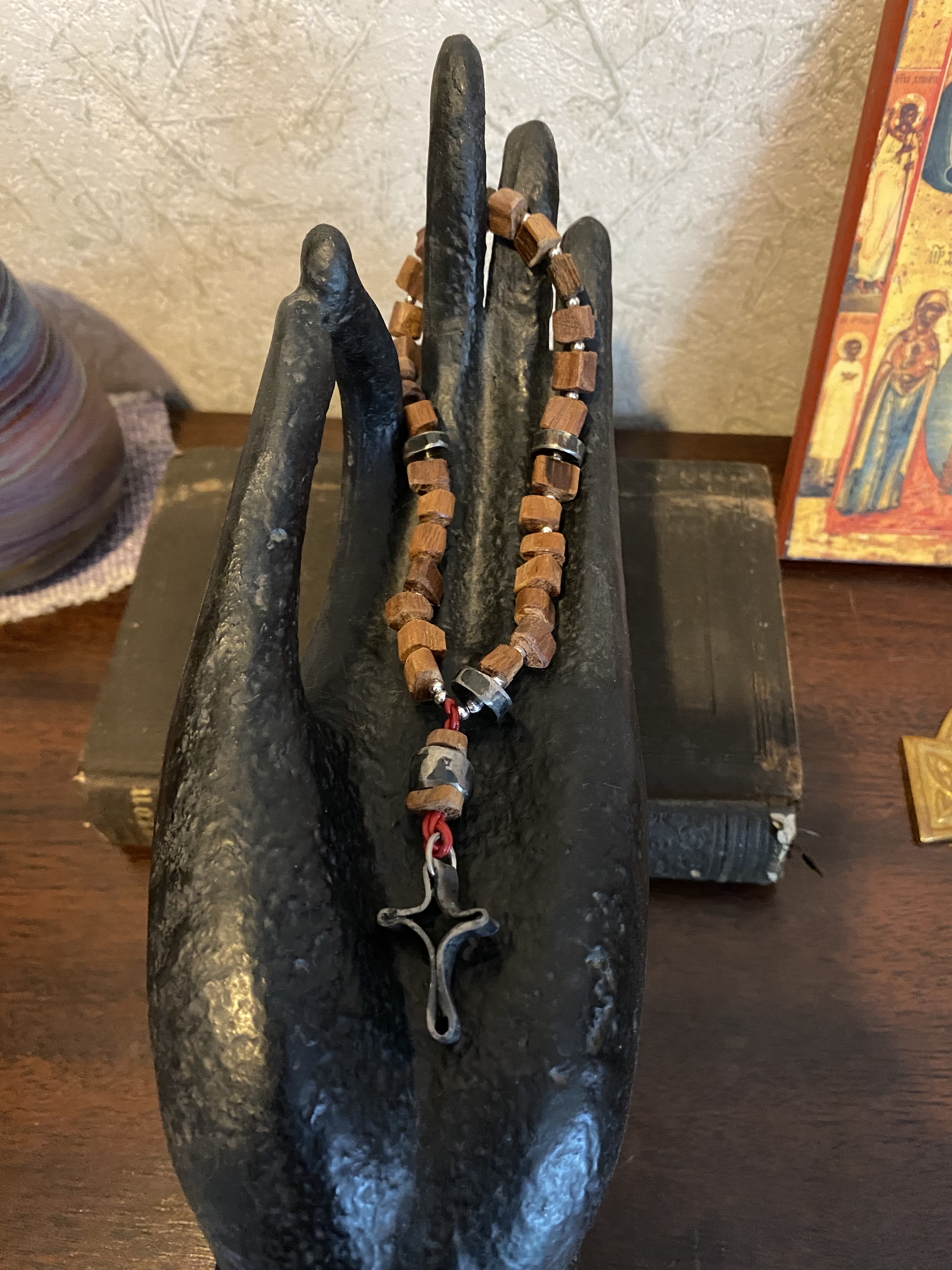
A parable for the anxious

Her voice rasped like a struck match 
from crying out her wares: 
Oil! Get your oil here! Don’t run 
out. She spent her days like a candle
burned at both ends, her core alight 
with the vision of a strip of lamplight 
creeping from beneath heavy doors 
to touch the hem of her garment 
and set her soul on fire


The parable of the “wise and foolish virgins” speaks to my anxiety: running out, being left out, being shut out, looking foolish. The thing is, though, that I don’t believe that the good shepherd who spends nights on the mountainside looking for a single lost sheep will leave me hanging. So I don’t know whether this poem is written by one of the women left out or one who was welcomed in and knows how fortunate she is.

Posted in lectionary reflection, poetry, prayer, preparing for Sunday with poetry, sermon preparation | Tagged , , | Leave a comment

Blessed are those who mourn …

A sermon for the Sunday after All Saints’ and All Souls’


 I don’t know how many of you are Beatles fans, but I watched the video of their new release, Now and Then, this week, recorded decades after half of them have died, and the intertwining of old and recent footage, present and past, creating something new and integrated reminded me somehow of this interplay of saints and souls, this life and eternity, blessing and the brutal hard work sometimes of being human.

The day will come, the Revelation says, the day will come when all of humanity, every aspect of every facet of the fractured image of God, will be reunited in awe and wonder around the throne of heaven. On that day, as at the beginning, humanity will be as one. As it was before we were divided, first in two, then into billions of scattered pieces, torn apart by deception and violence and held together by scraps of love; the day will come, the vision tells us, when all will know the glory of God, the mercy of the Lamb, the breath of the Spirit that unites us all, whether we see it or not.

In the meantime, says Jesus, there will be those who mourn. There will be those who are persecuted. There will be hunger, thirst, and suffering, in the meantime, but that doesn’t mean, that never means that God has abandoned us. To the contrary, God is never reaching closer than when we are most in need of God’s help, whether we see it or not.

Jesus preached this sermon, these Beatitudes, at the beginning of his ministry in Galilee. He preached to people hungry and thirsty for some good news. They came to him from all over: from Syria, Jerusalem, Jordan, the west bank and the east and the south. They came because they were drawn to him, who told the truth about God, and about mercy, and about mourning; because he didn’t pretend that all was well in the world, but neither did he leave them without hope.

Imagine the mother whose son had been forcibly conscripted by the Romans to make their crosses. She had little hope of seeing him again, and if she did, how would she recognize those hands that had become calloused by oppression and death? Jesus told her, “Blessed are you who mourn, for you will be comforted.” How did she hear that: Blessed to mourn?

What about the Israeli mother whose son has been missing for a month now, a month since the terror attacks befell, taking him hostage? Is there hope for her in the blessing of mourning?

What about the father in Gaza who told the world that it is a curse to be a parent there now, where thousands of children have perished in bombed out homes, hospitals, churches, and refugee camps.[i] Thousands. How can Jesus say to him, “Blessed are you who mourn now, for you will be comforted”?

You have seen the meme, taken from a sermon by Rev. Dr. Munther Isaac, the ELCA pastor of the Christmas Church in Bethlehem, saying, “God is under the rubble.”[ii]

Jesus told the people, his people, “Blessed are you because God mourns with you; blessed are you because in your sorrow you have come close to the heart of God, which is sorely grieved by oppression and death; the God who weeps with you beneath the rubble.”

And, blessed are you, because you will see your child again, at the resurrection.

Blessedness is not about material success nor even the absence of suffering in this life: it is about walking ever more closely with God. The closer we come, the greater our understanding of the rewards of mercy, the heights of humility, the purity of love, the power of peace. So yes, blessed are those who mourn when God Themself is weeping.

We have a Saviour who doesn’t downplay the enormity of suffering in the world, nor the existence of evil, of persecution, of the downright denial of righteousness and truth. Instead, he insists that the way of blessing is the way of God, no matter what the world might tell us. That mercy is stronger than murder, and humility more worthy than pride, that love endures even death, and that peace, peace is a more desirable goal than power.

You know, for all of its good news, the Gospel is a hard sell sometimes. The saints who came before us were not without their own troubles. I think of the martyrs of the early church, of Ignatius who was eager for the teeth of the lions, who saw blessedness in becoming one with Christ in the giving of his body, writing, 

Allow me to become food for the wild beasts, through whose instrumentality it will be granted me to attain to God. I am the wheat of God, and let me be ground by the teeth of the wild beasts, that I may be found the pure bread of Christ. Rather entice the wild beasts, that they may become my tomb, and may leave nothing of my body….[iii]

Few of us, I suspect, would see blessedness that way, but as mad as Ignatius might have been, he understood that our blessedness, our satisfaction, our wholeness and our humanity are made fuller the closer we stand to Christ.

Not all of the people we remember today in our prayers are venerated as saints. We tend to conflate on this Sunday All Saints’ and All Soul’s Days; we remember the saints and angels who have shown us the way of the Cross in the footsteps of Jesus, and we remember those whom we have loved, who have taught us something about what it is for love to endure beyond death, what it is to believe in eternity, what it is to be comforted by the grace of God in our mourning. And for that, we call them saints, as well.

Because they are now in the closer presence of Jesus. They are blessed by the clear vision of God. They are gathered as one around the throne of heaven, and they know the peace that passes our understanding. This we believe, and we are comforted.

Like that Beatles video that remembers old collaborations and makes them new, I imagine them standing around the throne of God. Mary is still seated at Jesus’ feet; Martha is rushing around making sure everyone has a palm branch. My mother is there; although she wasn’t a saint, only a good woman who always did love children, close to the throne she has set up a nursery for the little ones lost to war, the new pogrom of the innocents in the Holy Land. Closer still to the heart of God, they are comforted. 


[i] https://www.pbs.org/newshour/world/a-curse-to-be-a-parent-in-gaza-more-than-3600-palestinian-children-killed-in-just-3-weeks-of-war

[ii] https://sojo.net/articles/god-under-rubble-gaza ; https://x.com/ShaneClaiborne/status/1719552240229269763?s=20

[iii] The Epistle of Ignatius to the Romans, https://www.newadvent.org/fathers/0107.htm

Posted in current events, holy days, sermon | Tagged , , , , , | 1 Comment

Afterwords

Dear God, we cry, dear Lord, how much blood can humanity shed before we become something other than the body that you formed, and the spirit that you breathed, and the image that you called very good?

My Christ, can we lay down our weapons and crawl beneath your Cross, weep and water the ground there, turn it to mud with our repentance?

Dear One, we need to be created anew, to be reformed by your brooding over us; we need you to patch up our clay, renew your right Spirit within us to stop the bleeding. 

My Lord, have mercy. 

In the midst of a crisis, in the early hours of a tragedy, we are short on details and rightly cautious of certainty. The dead are not yet all identified; the injured hover on the edges of mortality. Grief clouds the very air with the fog of tears and the siren cries of mourners. The one thing we know for sure is that there has been a shooting, and that this is bad.

Against a backdrop of war and unrest elsewhere, the image of a man with military training and a military-style weapon rampaging through the quiet night of home is particularly chilling.

It is a scene that we have encountered before, and one that is fresh each time in its infliction of new pain upon another community. We struggle to respond because we have responded so many times now, and still it happens, to people we love, and to strangers on the news, and to connections six times removed, and it seems to get closer each time, too.

We struggle to respond, but respond we must, because we are called to love God more than anything else in our lives, and our neighbors, our neighbors as ourselves, and we cannot do that without sharing the burden they cannot lay down, not yet.

We begin with prayer, whether in the vigils held in Maine and online, or in the quiet of our own souls. We begin with prayer, whether that is in words or in deeds, beating the remains of a gun into a garden tool on the forge, whittling the stock of a rifle into a cross, or giving blood. We begin with lament, crying out to God for the blood that has been spilled, and hearing the echoes of heaven crying with us.

In those echoes, we hear that we are not helpless to change our situation. Within hours of the news out of Lewiston, a politician changed his mind about assault weapons, admitting to, “a false confidence that our community was above this, and that we could be in full control, among many other misjudgments.” Admitting that we are out of control is a good way to begin to change. It might even be called repentance.

And we are out of control. This month, the Supreme Court will hear arguments aimed at striking down a federal ban on the possession of guns by individuals who are subject to domestic-violence restraining orders, according to the SCOTUS blog. The plaintiff argues that there is no history or tradition of laws, “punishing members of the American political community for possessing firearms in their homes based on dangerousness, irresponsibility, crime prevention, violent history or inclination, or any other character trait or legislative goal.” But overtly allowing irresponsible, dangerous, violent gun ownership will not advance the goals of peace, nor life, liberty, and the pursuit of happiness. It will lead only to more lockdowns, and funerals.

Repentance is not an end in itself. Repentance turns us toward the kingdom of God that might be, the reign of heaven that will be. It is a resolution: our sins are resolved and absolved and our lives are strengthened, our wills made more resolute to walk in the ways of God, the ways that lead to peace.

In the meantime, in the midst of the crisis, we sit in mourning for the dead and in solidarity with the suffering. But we do not grieve as those who have no hope. For we are neither hopeless nor helpless in the face of tragedy, we who follow a crucified Saviour. The worst has happened. Resurrection is yet to come.

Posted in current events, gun violence | Leave a comment

Blessed

Blessed are those who know God’s poverty: 
            the emptying out of all that is not God. 

Blessed are those who grieve with God, 
            who know the sorrow of heaven, 
                        who nestle in God’s bosom.

Blessed are those who have the mind of God,
            not overweening, but sure of the value 
                        of life made in their image

Blessed are you whose appetite is only 
            for the crumbs of wisdom that fall 
                        from God’s table;

Blessed are those who have felt 
            the feather-touch of the brooding Spirit
                        glancing past, who reach out their fingertips 
                                    to brush mercy upon the other; 

Blessed are those who have the heart of God, 
            scoured out, filled up, purified by love;

Blessed those who weave peace between pieces 
            of clay, creating something new and calling it
                        good;

Blessed you though the world will not see you shine 
            with the luminescence of all the angels in heaven, 
                        so blessed are you.


#PreparingforSundaywithpoetry – if you are celebrating All Saints’ this Sunday, and noticing that the Gospel is already poetry itself. There’s more to say about that – that the Gospel, as a word that points beyond itself, is in essence poetry; but that’s for another time.

Posted in blessings, lectionary reflection, poetry, prayer, preparing for Sunday with poetry, sermon preparation | Tagged , , , | Leave a comment

Stop the bleeding

Dear God,
we cry, dear Lord,
how much blood can humanity shed
before we become something other
than the body that you formed
and the spirit that you breathed
and the image that you called
very good?

My Christ,
can we lay down our weapons
and crawl beneath your Cross,
weep and water the ground there,
turn it to mud with our repentance?

Dear One,
we need to be created anew,
to be reformed by your brooding
over us; we need you to patch up
our clay, renew your right Spirit
within us to stop the bleeding.

My Lord, have mercy

Posted in current events, gun violence, poetry, prayer | Tagged , , | Leave a comment

Regret

What happens when we stop 
asking questions? What if instead 
we had kept on, like a child 
of God asking why? why? but why? 
If we had trusted enough 
to stay in our cautious curiosity, 
allowed our anger, even outrage 
to feed a sceptical hope. 
He was our mirror; turning away 
we forgot how he looked 
a little like a boy we once loved. 
I could wish that instead of walking 
away that like Jacob, I had wrestled 
until there was no more night, 
no more stars falling silently to light; 
only the breaking open of day 
and the delicate wound of God.


No one was able to give him an answer, nor from that day did anyone dare to ask him any more questions. (Matthew 22:46)

Posted in lectionary reflection, poetry, prayer, preparing for Sunday with poetry, sermon preparation | Tagged , , , | Leave a comment

The flight to Egypt (through Gaza)

I can only imagine that you went that way, 
searching the skies by night for a sign 
of Herod’s madness overtaking, 
or a message from the Magi 
flashed through the heavens; 
at twilight I scan for the satellites 
that bring news and war to stream down 
like rain on an unready desert; 
I think of you bearing away the salvation 
of the world in such fragile bodies. 


Featured image: The Flight into Egypt – a night piece, by Rembrandt, via Wikimedia Commons

Posted in current events, poetry, prayer | Tagged , , , , , , | Leave a comment

Render

Give to God what is God’s,
he said, and some, taking him
at his Word, went out
to prepare the holy sacrifice.

Posted in lectionary reflection, poetry, prayer, preparing for Sunday with poetry, sermon preparation | Tagged , , , | Leave a comment

God head

Note: this week’s #preparingforSundaywithpoetry takes non-random words from the Gospel and pairs them to unearth (or undermine) the meaning of the exchange. These words appear in the NRSV translation.


sincere malice 
lawful partiality 
plotted accordance 
aware emperor 
deference test 
entrap hypocrites
know show 
truth tax 
God head 


Matthew 22:15-22 The Pharisees went and plotted to entrap Jesus in what he said. So they sent their disciples to him, along with the Herodians, saying, “Teacher, we know that you are sincere, and teach the way of God in accordance with truth, and show deference to no one; for you do not regard people with partiality. Tell us, then, what you think. Is it lawful to pay taxes to the emperor, or not?” But Jesus, aware of their malice, said, “Why are you putting me to the test, you hypocrites? Show me the coin used for the tax.” And they brought him a denarius. Then he said to them, “Whose head is this, and whose title?” They answered, “The emperor’s.” Then he said to them, “Give therefore to the emperor the things that are the emperor’s, and to God the things that are God’s.” When they heard this, they were amazed; and they left him and went away. 

Posted in lectionary reflection, poetry, prayer, sermon preparation | Tagged , , , , | Leave a comment

The erosion of innocence

Since it was more than one mile from the border (although under two kilometres), I felt that I was justified in assuring my parents that the kibbutz I visited for a long month decades ago was “miles away” from the rocket launches on the six o’clock BBC news.

Every night, we listened to the rockets fall. The one night that all was quiet, no one could sleep. Still, the most danger I fell into that summer was from the heat, high waters, and the inappropriate appetites of some men. One evening I sat on the hillside with my arm around a friendly Doberman who had planted himself between my body and that of a boy who had tried to separate me from the herd. I felt safe.

The day that we did stumble into no-man’s land by mistake, we thought we had landed on another planet. Flat earth stretched into the distance as we shuffled sheepishly back under the domed canopy of the trees, giving thanks for the absence of patrols at the crucial moment of error.

Mostly, I worked in the rubber boot factory, wiping the glue off the seams at the end of the assembly line, dipping my rag into an open vat of acetone and coming out singing, with a chemical headache swinging its way in for the afternoon. But I had a little high-school German, so occasionally I was relieved instead to join the little old ladies in the Community Room, setting up for something or another. They spoke a mix of German and Yiddish. I tried hard to understand their instructions and to avoid staring at the blue numbers tattooed on their arms, and they laughed at me.

The kibbutz is under an evacuation order now. The dog and the old ladies are long gone; I wonder who the boy grew up to be. I wonder how pain can be revisited again and again, suffered and inflicted in a never-ending cycle. I wonder what it will take to disrupt the process, where war has become a lullaby, its absence an anomaly.

Posted in current events, story | Leave a comment