In the beginning, says John, and you can tell that he is thinking back to that old story of beginnings, the one in Genesis that begins, In the beginning…
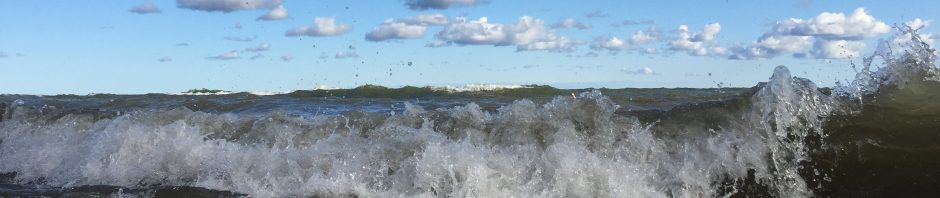
And so as God spoke light into creation, and life, so God’s Word, which was as close a part of God as God’s mind and imagination, so the Word formed the vowels of the oceans and the consonants of land, the sibilants of the serpents and crawling things, the mooing of mammals. The Word thrilled with the trilling of the birds and insects. When God created the human in God’s image, then they developed language, words from the Word, reaching back always in prayer to their Creator.
But sometimes words are insufficient. Sometimes we do not have the words, or we are afraid to speak the words, or we are tired of hearing in our own voice the words we would use to petition God, to praise God, to lament and to thank our Creator. So we turn to art, or music, or silence, or we turn away.
Is it possible that God could also exhaust the language of words? Time and again, so many words spoken through the prophets, through the scriptures, through the reading of the law and its promises, even through direct conversation with Adam, with Eve, even with Cain; God has spoken words of covenant, of mercy, of judgement, of love. And still, so often, too often, we would not listen. So we have a world full of war and hearts weary of hearing about it, of hearing the words.
There are other languages. Art, music, dance, silence – each has its place in the panoply of human expression. And presence, too. Being with someone speaks volumes, even without words. Yesterday, this church was full to bursting with people who came mostly just to be with: to be with the people they love, to be with God.
So the Word became flesh. God showed up to be with the people God loves.
Once, long ago but not too far away, I sat in a church service on a Sunday morning feeling pretty bereft. When the time came to approach the altar for Communion, I didn’t want to leave my seat. I didn’t want to show my face. I certainly didn’t want to have to explain my tears. And a stranger came and sat beside me, and took my hand, and told me, “I’m going to stay here with you. Because you are my sister, and I’m not going anywhere without you.” And just like that, and without another word, she stayed. And because she did, I found my way back to the Sacrament of flesh and blood, God’s love made manifest in and for the world.
The language of being with is powerful. The Word may have begun by calling out light and spitting stars and tongue-twisting duck-billed platypi. But in the beginning, and the end, and in our times, our history, our generations, the Word became flesh, and lived among us, because sometimes showing up is the only way to show how much we love, how much we are beloved. And because God knows, that is what matters.
Sermon for the First Sunday after Christmas, 2023: John 1:1-18
In the beginning, the Word breathed light. In the beginning, the Word formed the vowels of the ocean, hard consonants of land. In the beginning, Word crawled, swam, flew, blossomed. Before flesh, there was the Word; utter God, utter Being, utter Love.
Yesterday, during a short break in a long day, I spent an hour at the art museum, and it crossed my mind yet once again how many ways we have of communicating with one another. The brush strokes of a painter, like the word choices of a poet, are designed to convey not only the surface of meaning, but to resonate within the soul, to evoke something that binds us together in our understanding of our humanity, our place in the world, in creation.
And the Word became flesh. The Word of God, the way in which God reaches out to us became a wordless infant, and a prophet, and a preacher, and a mortal man who died and was buried, and who rose again because the Word of God is irrepressible, because the Word of God cannot fall silent when it resonates deep within the human spirit. Because the love of God will use any means, go to any length to help us understand that we are made in God’s image, and that God inhabits ours.
The solidity of a sculpture, the fragility of glass, the intricacy of brushwork, the multivalency of language, the mystery of music, the bodies of dance, art become flesh: all of these are ways that we communicate with one another and seek to understand the human condition, even the divine. And God, who danced across the waters of creation and descended like a dove and painted the sky with stars and whispered loud words into the brains of prophets: this God who would stop at nothing to let us know that God is with us, became flesh, took on the language of love, of touch, of breath, of death, of life.
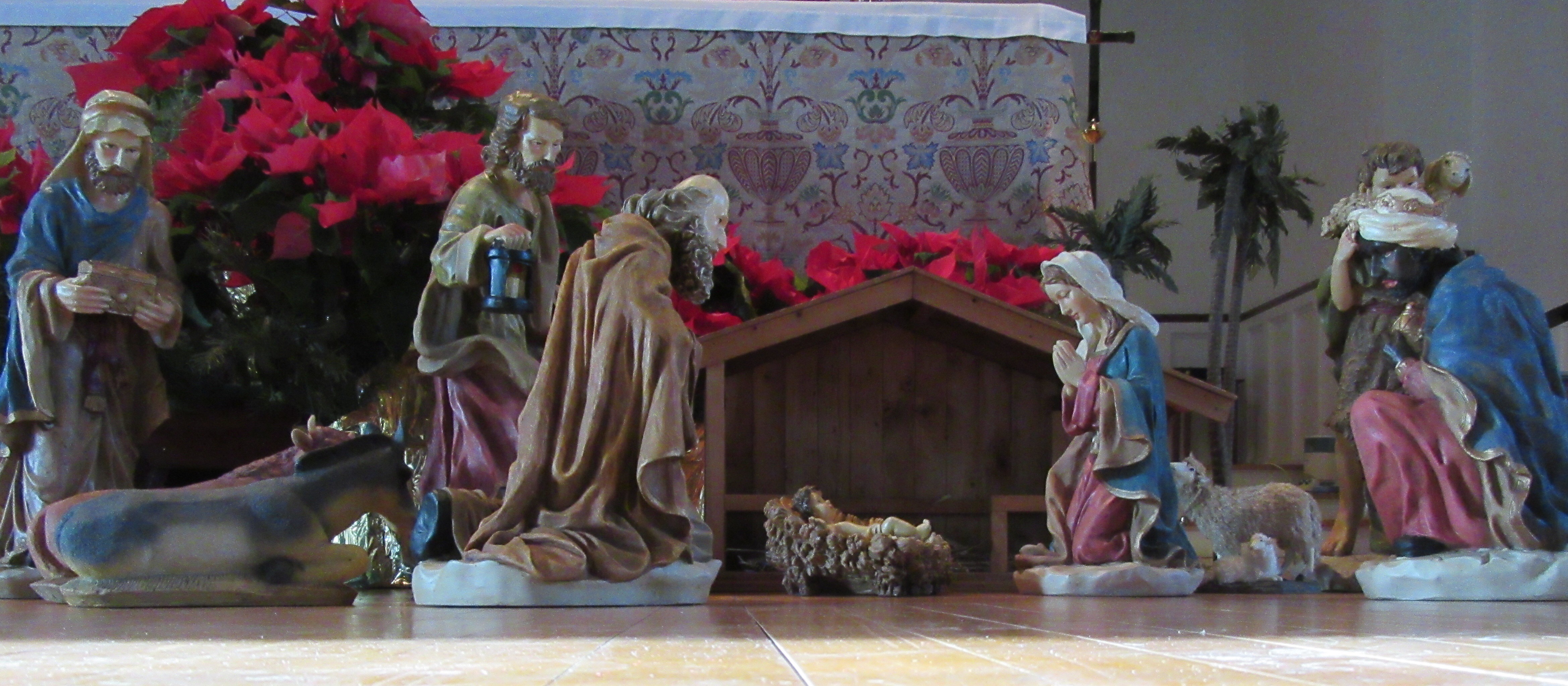
This incarnation, this child in the manger, this is the choice that God has made to be among us and to come alongside us and to share our burdens and our joy. Because love is the language that resonates within the soul of a human being, and makes it sing. Because love is the way that God will heal us, eventually, from our warring madness and sin. Because God is love, and whatever words or music or art or dance or silence is needed to convey that, God will stop at nothing, not at birth, not at death, to become new life with and for God’s beloved ones.
Mary and Joseph had a long journey ahead of them, all the way from Nazareth in Galilee down though the wilderness road to Bethlehem. They were tired and they were hungry, they were ready to lie down and rest by the time they reached the city. The sky had grown dark already, and the stars were beginning to appear. Mary was feeling twinges in her tummy, different from the ones she felt when the baby kicked. It was time to find a bed for the night.
But when they reached the city, the rooms were all full. There was nowhere to lie down except in a stable, a cave used to house animals. Well, if that’s all they had, thought Mary and Joseph, that’s where they would stay. And so they did, and Mary had her baby right there in that stable, and they laid him in a manger, which is a food trough for the animals, because was full of straw and soft enough to put a baby down for a little bit.
Even when there was no room for them, even though no one else would make room for them, the animals shared their space, their warmth, even their food. Amid their soft gentleness, Mary and Joseph found a place to lay their newborn baby, and because of it, those animals were the very first to welcome Jesus into the world. Which just goes to show what miracles can happen when we are kind to one another.
And nearby there were shepherds, keeping watch over their sheep, and suddenly they saw a bright light, and angels singing, and even though they were a bit frightened, they hurried to see what was happening, and so they found Jesus, which just goes to show what we can find when we are a little bit brave.
And in the midst of it all, the baby slept, filled and content with all of the love that surrounded him, and the warmth that enfolded him, and the love of God that had brought him into this place, and that continues to touch us all to this very day.
Christmas Eve, 2023
The angels sang Glory! Peace on earth. We love to tell the story; it takes us back to childhood and a more innocent time. It reminds us, with its carols and its Christmas cards, of the joy of the season – and it should. God is with us; Emmanuel. There is nothing more hopeful and joyful and lasting than that.
But this first, this was no Christmas card journey to Bethlehem. More likely than moonlight on a couple with a few bags and a donkey, this would have been a caravan of displaced people trekking days through the wilderness, ordered south by their occupiers, in order to be registered by their officials. And at the end of the line, crammed and jammed into a town too small for all of its descendants to come home at once, there was no room left, no bed but the floor of a cave strewn with straw for the animals. Even there, they were not safe from the Herods of the world, their envy and gluttony for violence. And it was in the midst of all of this that Mary went into labour with her first child, the difficult one that demands that your body do something it has never done before, achieve the impossible, deliver into the air a whole new living, breathing human being. Impossible, the body says, can’t be done. And yet with God, nothing is impossible.
It is only too easy to see the hardships of incarnation this Christmas. I have not forgotten the atrocities of October 7, nor the hostages that are still missing even after the miracle of Hanukkah. But in Gaza, nearly one percent of the population, and far too many children, have been killed. There is not enough shelter, food, water, humanity. up to 85% of the people are internally displaced, that is, they have been driven from their homes by evacuation orders, and they are not safe when they stay and in danger when they obey. And these, mourned tonight in Bethlehem, are not the only casualties of wars and violence that continue across the globe.
And yet, the angels over the Bethlehem hills cry Glory! And still, they sing of peace, even if it frightens the shepherds half insensible. And still, they speak of God’s good favour, over the birth of one small child in impossible circumstances.
Because that is what incarnation is. It is the enduring sign of God’s love for us, that God would become a child, take on flesh, be born even into a world torn up by oppression and quaking with war and steeped in a tea of its own tears. It is a sign of God’s love for us that in tenderness and innocence, in vulnerability and humility, God became not the heir to a kingly throne but the passing tenant of a stableful of animals. It matters that God chose to come among us not at the head of a battalion of angels come to join in our warring ways, but to be born from within us, to convert us from the inside out into people charged with carrying and feeding and tending to and growing the love of God among us. For with God, nothing will be impossible.
We look at ourselves, we look at one another, and we wonder whether we can, in fact, ever become worthy of that babe in the manger. And in one way, it doesn’t matter. It matters, of course, that we do everything we can to create a world of love for him to grow in, a world of safety for him to explore, a world of peace so that he can learn to sleep through the night; of course that matters. It matters that we practice love as often and as widely as we are able, so that we can give him the best love of which we are capable. But he will come to us whether we are fabulous or whether we fail again and again; he will love us just the same. And that is a heavy responsibility, and a huge relief.
We don’t need to romanticize the Christmas story in order to celebrate it, even now. We don’t need to turn our faces away from the suffering of the world; far from it. This story, this reality, that God is born among us, it is why, when we are torn by strife and worn by grief, yet we gather still to proclaim with the angels the joy of Christmas, the incarnation of the Christ, because this is what life is for: to love God, to love one another, to know ourselves beloved of our Creator and our End; Emmanuel, God with us, come once again to touch our hearts and turn us inside out.
Either the angel knew more than they were telling, and were sparing Mary’s feelings for the moment, or perhaps Gabriel really only saw the glory of the coming Christ, the throne, the kingdom, the eternal hope. Because when Jesus is described, that is all that Gabriel reveals. Only the glory. There is no mention of the trials to come, the betrayal, the temptations, the execution. Perhaps Gabriel was afraid that Mary would say no, if she knew how hard it would be to mother the love of God into and out of this world.
But I think that the angel, not being human, nor able to become a parent, or a lover, or a child, underestimated Mary. I don’t think that Gabriel understood the power of love to will into being a child, or any relationship, even knowing the risk of grief, the incomprehensibility of loss. Anyone who has loved can recognize that risk, the pain that follows us even through our moments of greatest joy. Yet we love anyway, and send our hearts into impossible places, into the lives and loves of others, because we have heard that with God nothing is impossible.
You know that our parish family suffered an impossible loss this week. It is untenable, and unbearable so close the celebration of Christmas and incarnation. And yet it is out of grief that we turn to God, and in our sorrow that we seek consolation among the angels and saints. We look to Mary for empathy; you know, favoured one, how dangerous love is, and still you said yes to God, yes to life, yes to Christ. Because it is only with God that nothing is impossible. It is in Jesus that we see resurrection. We see that life, his life, our life goes on.
When Gabriel came to Mary to suggest or announce the impossible, she didn’t ask, how will I survive this? What will people say? How will my body endure the pain, my heart the anguish of a labour of love? Perhaps because she knew already that it is impossible to know in advance of love how hard it will hit us, in advance of grief how low it will bring us. But with God, nothing is impossible. Despite our mortality, in love we see glimpses of heaven. Despite our knowledge of grief, we risk joy for the sake of it.
Despite Gabriel’s perplexing announcement, I do not think that in the days of his gestation and infancy Mary (nor, for that matter, Joseph) thought too much about greatness, or thrones, or kingdoms. I imagine that she was more taken with toes and fingers and flutters and feeding and the utter exhaustion of sleepless nights and colic, his and hers, and the utter joy of a baby’s smile. Gabriel could have saved their breath (provided, that is, that angels breathe). The angel didn’t need to oversell the child, the mundanity of human love, which is become the love of God made manifest, evidence that God loves us despite the risk, despite our sin, despite our pain, because God delights in us, because God is love.
Perhaps the angel didn’t know, or perhaps they didn’t want to look too far ahead, or perhaps they were protecting Mary’s heart for as long as they could. But Mary knew already what love is, what love can be, what life gives and what it takes away from us. She knew that the Author and Source of that life is to be trusted. For with God nothing is impossible, even the unbearable.
If nothing is impossible with God, what can be trusted? The sun may lose its grip on heaven, fall helpless to the ocean, sink or set the world aflame, melting its willing, molten heart. Birds of prey may sing lullabies understood by fools and babies – but not by the wise and cynical – in a conspiracy of kinds. God may labour to become a child born of laughable mercy, conceived in the creatively impossible, aching love of God.
#PreparingforSundaywithpoetry, Advent IV edition. Luke 1:37
I had a realization on Tuesday evening that our Bible Study group witnessed me coming to in real time: that John the Baptist was an Episcopalian.
In our daily office prayers, and even in our Sunday Eucharist, if we turn back the pages, we begin our approach to God always with our confession of and repentance for our sins. We hear the assurance of forgiveness, of God’s mercy upon us, and the promise of a clean slate, a new opportunity to live into the promises of love that God has made to and for us.
John came baptizing for the forgiveness of sins, washing away guilt and making ready the people for the coming of Christ, for their recognition of and worship of and following of Jesus. The great forerunner is a model of our liturgy, and a message for our lives: Be ready, for Christ is coming.
This is a promise of great joy: “Rejoice always, pray without ceasing, give thanks in all circumstances; for this is the will of God in Christ Jesus for you.” (1 Thessalonians 5:16)
Making ready for the Messiah, confessing our sins and asking forgiveness and assistance not to repeat them is a matter of hope. Though we may grieve what we have wrought, through confession we hope to do better. With forgiveness we have the hope once more to take on the mantle of discipleship, to follow Jesus with the expectation of joy and peace. We repent, we rely on the mercy of God, we are freed to find and follow Jesus.
The people sent to John questioned who he thought he was, to promise such forgiveness, to proclaim such a hope, in a land oppressed by occupation, and riven by war, and stricken. What good could the waters of the Jordan do, they wondered, when they run only into the Dead Sea, and there become stagnant and still.
But the Spirit of God sent the prophet to bring good news to the oppressed, relief to the brokenhearted, liberty to those held captive to the sins of the world; to proclaim the coming of the Lamb of God, who takes away the sin of the world.
These past two weeks we’ve had artwork hanging in the Chapel made from guns. It is a strange thing to take apart the pieces of a weapon made for death and turn it into something that brings hope to life. It is a blessing. This past week, someone who pastors the living and the dying came and took away with him the heart that you all forged together out of broken pieces of a broken gun. In it I imagine that he saw the brokenness of our world, our conflict and our violence and our constant appetite for war, and at the heart of it the Cross, the breaking in of God’s compassion to break open our compassion and draw out our understanding of the way of mercy, the way of love. The coming together of those broken pieces, surrounding the Cross, making a new thing out of an old means of dying, the way in which all of us together have found a new pattern modeled on the way of Christ’s Cross; that is hope.
Choosing to repent of old ways and forge a new path; that is hope. It is a reason for rejoicing.
There is no doubt that we find ourselves in the waning days of Advent in need of hope. We are busy, we are stretched and stressed, we are missing those whom we have lost. We see the perfect gift and remember that there is no one left to unwrap it. The nights grow long and cold, and the days are brief and the sun gets in our eyes. Who are you, we ask the prophet, to promise rejoicing in the midst of winter?
And John replies honestly, “You are right. I am not the light; but Light is coming.”
You are right, a few strings of Christmas lights and strains of Christmas carols cannot undo nor drown out the news of human suffering and continuing strife. But the Light is coming. And the way that we prepare for him is with rejoicing.
Not rejoicing in the sins that we confess, but rejoicing that God sanctifies us nonetheless, because the mercy of God endures forever.
Not rejoicing despite the wars and ways of the world, but rejoicing that we have seen a better way, have glimpsed the glory that emanates from the humility and vulnerability at the heart of the human condition: the way in which we become not less but more human when our hearts our broken open by compassion, when our tenderness is piqued by the plight of a baby born in a broken manger instead of a hospital or home. The way that we come closer to Christ when we confess, in all honesty, our need for forgiveness and our hope for a more peaceful future, a more peaceable spirit, a more peaceful world.
It’s even a good way to prepare for the holidays at home, isn’t it? To confess our faults, clear the air, make way for a better relationship.
John came proclaiming baptism for the forgiveness of sins in preparation for the coming of Christ. The people sent to confront him asked who he thought he was to declare with such audacity the faithfulness of God. They wondered what good it could do to submerge themselves in the River Jordan when it runs only into the Dead Sea. But there is another prophet, Ezekiel, who sees a river of life running down from the city of God and renewing everything in its path. “When it enters the sea, the sea of stagnant waters,” he said, “the water will become fresh … It will become fresh, and everything will live where the river goes.” (Ezekiel 47:8-9)
Because God makes all things new, and Christ is coming anew, and we are ready to rejoice in that good news, which is our salvation.
A star is a miraculous being, born of the infalling of dust and ashes, the sacred debris of creation set aflame on the altar of nightfall;
A miracle blazing by night, as dawn breaks open the path of the rising Sun, outshone, the star remains, its fire burning still in the cold heart of space.
“There was a man sent from God, whose name was John. He came as a witness to testify to the light, so that all might believe through him. He himself was not the light, but he came to testify to the light.” Year B Advent 3: John 1:6-8,19-28
A homily for Evensong at Trinity Cathedral, Cleveland, Ohio
If there were no space between the stars, we would not know their light. They shine in our vision, twinkle on our retinas, because they are set against a velvet jewelers cloth of midnight and the occasional occlusion of a cloud.
The Light of the World came into a world that did not recognize him among the jostle and hustle of human birth, rejoicing, suffering, and death. But from the distance of time, we see him shine like one transfigured on the mountaintop, and against the shadowed backdrop of the empty grave, even those closest to him could not miss the brush-strokes of glory.
Lucy, in mid-winter, light in the darkening days, stretches herself toward the Light that will not be extinguished, nor overcome. I learned at school from the poet and priest John Donne that Lucy’s was the shortest day of the northern year; “the year’s midnight.” But that was before the calendar was changed and Lucy’s day gained eight grains of extra time between the darkness before dawn and the gathering of nightfall; now, she sits at the cusp of the yeares midnight, a week’s waning before the longest night. When the calendar was changed, and the days shifted, there were riots. Never mind the light that Lucy gained; the people had lost eleven days, and they were astonished and outraged that such a thing could happen. I suppose if one of them were your birthday you would be rightfully aggrieved. What they did not recognize is that whatever names and numbers we put to the days, the stars do not follow our designs, but we their dance, and that we cannot contain the turning of the world. Midnight will come, and dawn will follow. The Light of the World cannot be suppressed.
Change is not an easy thing, even for the enlightened. It always involves loss. I say this knowing that in the background of this evening, in the shadow of the candles and the glorious lightness of music lifted up to heaven, we are a little maudlin with the knowledge that when we return next spring, our beloved Todd Wilson will be making music elsewhere. I am not about to riot, but I’ll admit to feeling a little salty about it. But I remind myself not only that I should celebrate his new beginnings, new dawns, new shoots; not only that I should be grateful for the many times we have worshipped together over the years; but that all light, all music, all prayer comes from the same source and will comingle on its way back to heaven; we will still be singing together, in a sense, wherever we are making prayer out of music. Seen from above, from a distance, the lights of a city become one: one symphony, one score of grace notes and sustaining harmony.
We don’t know a lot about Lucy of Syracuse, the Sicilian martyr of long ago. We see her dimly through the clouds of time, yet the way in which her day on our calendar stretches toward the light that is to come continues to illuminate us.
We have seen enough of shadows this year to make us shudder. In the land of Jesus’ birth, chaos appears to reign. In Bethlehem this season, the manger scene is surrounded, almost buried, by the rubble of war. There are no festival lights, no tree or markets in the square outside the Christmas church; only the kind of sombre silence that accompanies the empty seat at the family table; the silence of search and rescue crews; the kind of silence that hopes valiantly to find signs of life beneath the architecture of death. I was reminded today, though, of a quote from the late and gracious Archbishop Desmond Tutu: “Hope is being able to see that there is light despite all of the darkness.”
There is a legend that – and pardon me, this is a bit gruesome – there is a legend that Saint Lucy’s eyes were put out before her martyrdom, and that her sight was nevertheless miraculously restored. We know that our vision is an interpretation of the light that surrounds us; I imagine that her vision was able to return because she saw the Light of the World, because she had drawn close enough that Christ’s light could not be extinguished within her.
I think of the long aperture of a camera taking pictures of the night; instant to instant, our eyes see only the tiniest pinpricks in the darkness, but left open to the sky, the camera is able to absorb and interpret those tiny messages into images of great light and beauty; images of hope.
Lucy, whose name means “light”, was not herself the Light, but Christ’s light filled her so that nothing, not even those torturers and persecutors, could touch her vision of him. Her memory no longer illuminates the longest night of the year, but accompanies us steadfastly into that darkness. While we continue through the ages to face changes and challenges, loss and life, sparks of hope and anxious moments, her legend reminds us that we have seen the changeless and unextinguishable Light, which shines in the darkness; that come what may, the darkness has not, and will never, overcome it.
Featured image: Great Sand Dunes National Park & Preserve (Dark Sky Preserve), courtesy of Edward Hughes
Not in glory but in the gloom of winter glimmers a light born of love, warmed by love, worshipped by angels; humble beginnings swaddled and held close promise the earth and deliver the heavens.