Custody of the eyes

Jesus said, “If your right eye causes you to sin, pluck it out.” Gruesome stuff. And what on earth does he mean by it?

I remember when our youngest child was newborn, and sleeping in my arms in the living room in front of the television, asking my husband to change the channel. Whatever movie was playing was too violent, or graphic, or somehow unsuitable for viewing with a baby in tow. My husband quite sensibly pointed out that, a) she was asleep, and that b) at a couple of weeks old she was unlikely to understand what was happening on the screen if she did happen to wake up. I don’t suppose that it was completely rational (I was a brand-new mother, and rationality was not top of my list of priorities at the time), but my gut feeling was that a) it was nevertheless bad for her to absorb such influences, even subliminally, and that b) I was at risk of passing the ill effects of such viewing on to her through my milk. I know it sounds a little crazy, but still I think that there is something to the idea that whatever we choose to take in and absorb, we will in some way pay out and feed to those around us, especially those closest to us.

to be continued…

Posted in lectionary reflection, sermon preparation | Tagged , | Leave a comment

Happy valentine

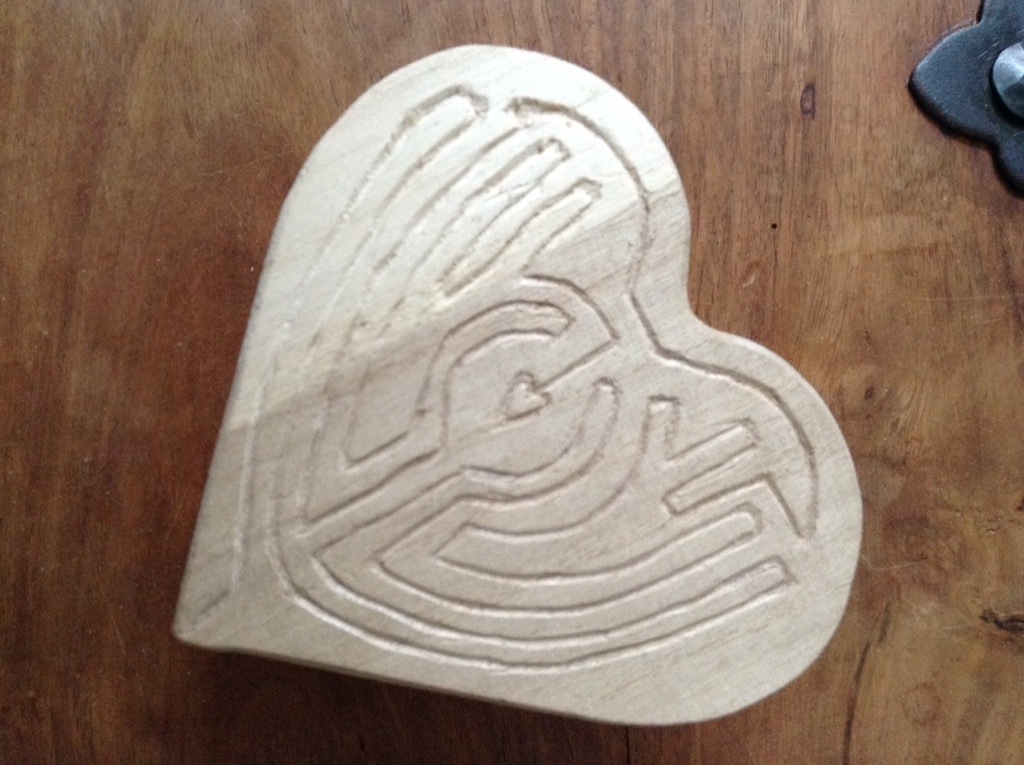
A heart labyrinth design for Valentine’s Day (I’ve also used them as prayer aids for cardiac patients and others). Although I didn’t consciously plan it that way, I like the way that the two sides can be read either as separate chambers of the heart or as hands embracing the smaller central heart.
Happy Valentine’s Day, lovely ones!

20140214-165330.jpg

Posted in holy days, image, labyrinth | Tagged , , , | Leave a comment

It’s still cold

Water pipes slamming,
cranking out icy fury:
I know how they feel.

Posted in poetry | Tagged , , , | Leave a comment

Year A Epiphany 5: salt

If rock salt comes from rocks (hence the salt mines), and sea salt comes from the sea, where does table salt come from?

Jesus said, “You are the salt of the earth. You are the light of the world.” But salt without saltiness is good for nothing, and a light hidden under a bushel sheds no illumination.

There’s an old folk tale about a princess, the youngest of three, as it goes, whose father wanted to test the love of his daughters. He asked each of them how much they loved him. The eldest daughter said, I don’t know, more than gold and silver, and the king was pleased. The second child said something about ponies and rainbows and unicorns – I really don’t remember this part too well – and the king was well satisfied. The youngest daughter, the smart one, said, “I love you more than salt,” and the king was outraged. Salt? The peasants had sufficient salt, the deers licked in from the rocks in the forest, they used it to kill slugs in the royal lettuce garden: salt? It was an insult! So the king banished his daughter from his sight, and what’s more, he outlawed the use of salt throughout all his lands.

It wasn’t long before the king found the need to haul up the castle cook to complain about the food. Everything tasted the same, he complained, nothing popped, nothing sparkled on his tongue any more, everything was bland and blah. The cook, rather fearfully, since he was essentially telling the king how dumb he had been, explained the role of salt in food preparation. It is not, he said, so much that it speaks for itself – sometimes you want salty, for sure – but much more often, it is the salt that brings out the flavours of the other ingredients, and binds them together, and makes them pop and fizzle on your tongue. Without salt, explained the cook, the rainbow had gone out of his flavour palette and everything had turned sepia and insipid. Without salt, the food was sad.

The king realized that his youngest daughter had been telling him of the depth, the breadth, the essence and embrace of her love for him, and he was very sorry that he had rejected her, and that he had banned salt from the kingdom because now he was going to have to pay a lot of money to restock their supplies.

Of course, salt does more than flavour our foods. Salt is a preservative, and a stain remover. It can be used to set the colour of a dyed cloth. It helps ice cream to set. It is used in skin creams and lotions – that Dead Sea mud is full of the stuff. Salt has been used as a disinfectant and even an antibiotic agent for millennia. What parent here hasn’t bathed a child’s scraped knee with salt water, or prescribed a salt water gargle for a sore throat?

You are the salt of the earth: the healers, the soothers, the cleansers, the purifiers. You have the capacity to bring health and wholeness to those around you.

You are the salt of the earth: you are everywhere, you get into everything. You don’t have to be especially strong or dominant, or overwhelming. Sometimes, to be sure, you are the centre of attention, but always you have a vital role in lifting the colours, the flavours, the essence of those around you; you spice up their lives. You make them pop and sparkle.

The letter to the Colossians advises, “Conduct yourselves wisely toward outsiders, making the most of the time. Let your speech be gracious, seasoned with salt, so that you may know how you ought to answer everyone.”

Let your speech be seasoned with salt, that is, let it bring out the best in the those to whom you speak. Look for ways to enhance the lives of those around you, not by overwhelming them but by lifting up into the light that which is already good and sound and flavourful in them.

Of course, this time of year, we can’t help noticing that salt can be used to help us on our way, wherever it is we may be going – it lowers the freezing point of water to prevent it from becoming solid ice, so we use it to keep our arterial pathways clear, our highways and our sidewalks.

You are the salt of the earth. You have what it takes to melt a frigid heart.

The prophet says, “Remove the yoke from among you, the pointing of the finger, the speaking of evil; offer your food to the hungry and satisfy the needs of the afflicted” – be the salt that the world needs – “then your light shall rise in the darkness and your gloom be like the noonday.”

Light, like salt, points beyond itself. Light, like salt, is good in itself, but we notice it the most when it illuminates other things, when it allows us to see the way before us, or chases away the shadows that frighten us; the light shines and something as scruffy as a spider’s web glistens. The light shines, and the very walls around us become beautiful.

“You are the light of the world,” says Jesus. Elsewhere, Jesus said, “I am the light of the world.” He shone in the darkness of a fallen creation and showed us the beauty all around us, of God’s love for us. He illuminated a pathway for us, into the kingdom of God. He brought us out of the shadows to stand in sunlight and see for ourselves, all around us, the city of God. We are to shine, not to glory in our own light, but to show others the glory, the mercy and grace of God; to illuminate their lives.

“You are the salt of the earth,” says Jesus. We season the earth, not so that our saltiness can be admired, but to help others to taste the goodness of creation. How are we affirming the essence of others, letting them know that they are made in the image of God, every one of them; healing their hurts and melting their hearts?

To claim the titles of light, of salt, is not to boast in our own properties, but to own our call to bring out the best in those around us, to show them wholeness, health and warmth, and the beauty that lies in the love of God. It is one more way in which Jesus tells us, not only that we are loved, but that we are to love God and our neighbour, with all of our hearts, more than silver and gold, more than rainbows, puppies and ponies, more than salt.

Jesus tells us that we are to season our relationships with respect for the variety of flavours that people come in, with encouragement, to draw out the best in them. We are to season our lives with helpfulness, healthfulness, warmth, comfort, perseverance, not only for our own sakes, but to lead others to the glory of God, to illuminate their pathways, to guide them home.

I suppose if you were to really stretch and twist the metaphor, you could make Peter into rock salt (because his name means Rock). James and John the fishermen might be sea salts. So what does that make us?

altarWhere does table salt come from?

Posted in sermon | Tagged , , , | Leave a comment

the light of the world

When you hide your face, the sky falls.
Stars burn cold; the sun slumps,
refusing to rise to the occasion;
the moon gapes like a dumb rock.
When you look away, ashen shadows
coat everything with their fingerless touch.
Turn back.
My life is in your eyes.

Posted in lectionary reflection, poetry, sermon preparation | Tagged , | 2 Comments

Seasonal

Dislocated daydreams:
salt spray from a city street;
unkept promises.

Posted in poetry | Tagged , , , , | Leave a comment

Year A Epiphany 3: walking in the light

There was a fascinating piece on yesterday’s NPR program, Weekend Edition, about a man named Pedro Reyes who is working on a huge collection of guns.[1] In fact, he has access to thousands in the city of Culiacan, Mexico, where he lives. But this is not the man you might imagine. He is an artist, using weapons collected by the city in an effort to reduce gun violence to sculpt musical instruments. Imagine playing a flute made from the barrel of a long gun, or a steel guitar collaged together out of handguns. Imagine, if you can, repurposing metal made for killing, putting your lips, your hands, your heart into it and instead producing music.

“There will be no gloom for those who were in anguish…those who lived in a land of deep darkness – on them light has shined; and for those who sat in the region and shadow of death light has dawned.”

The story about transforming weapons of destruction into instruments of art and music came at the end of yet one more week in which we heard about students shooting other students, schools which should be havens of hopeful learning teaching instead the ominous lessons of mortality.

Just a few hours after the segment about Mr Reyes aired, the news reporters were telling us about another shooting in a shopping mall in Baltimore.[2] Three more people died.

“There will be no gloom for those who were in anguish. For those who sat in the region and shadow of death light has dawned.”

“Reyes believes art should address social issues like gun violence, even when they’re difficult and controversial,” said the NPR presenter.[3] I think that our theology should do no less.

It is our job, together as Christian disciples, called by Jesus to leave our tangled nets and consider how to catch our neighbours up into his kingdom; it is our job to consider how we might shine a light on those who are in anguish, who sit in the region and shadow of death. It is our job to consider which ways of working things out we are called to leave behind, and what is the nature of the work into which we are being called by Jesus instead.

I don’t know Mr Reyes’ religious beliefs or affiliations; they were not discussed in the interview. But I do believe that he is on the side of creation, life, light, over the gloom and shadow of death.

Last spring, the House of Bishops of the Episcopal Church had this to say on the subject:

 As bishops of The Episcopal Church we embody a wide variety of experiences and perspectives with respect to firearms.  Many among us are hunters and sport-shooters, former members of the military and law-enforcement officers.  We respect and honor that we are not of one mind regarding matters related to gun legislation.  Yet we are convinced that there needs to be a new conversation in the United States that challenges gun violence.  Because of the wide variety of contexts in which we live and our commitment to reasoned and respectful discourse that holds together significant differences in creative tension, we believe that The Episcopal Church can and must lead in this effort.  … We call all Episcopalians to pray and work for the end of gun violence.[4]

Just in the past ten days in this country, there were two school campus shootings, one shopping mall with multiple casualties, a man shot to death by a retired police officer for texting in a movie theatre, and those are just the incidents I remember reading about off the top of my head. Closer to home, since last Sunday night a five year old died and her mother was shot in the head because their car looked like that of someone the gunman’s girlfriend had argued with. A couple died at MetroHealthHospital after a double shooting in the parking lot. A man was shot to death in the early hours of yesterday morning breaking up a fight outside a Cleveland bar.[5]

We are the people living in anguish and gloom. Of the children I knew in Sunday School over the past ten years, four have been in schools when one of their fellow students wielded a gun with the intent to end a life. Two of them were there when lives were lost. Most of them have heard threats of gun violence in their schools. All of them, all of our children have received instruction in what to do if an active shooter comes into their school to hurt or kill them; it’s become like running a fire drill or a tornado practice. We are the ones living in the region and shadow of death.

Whatever your views on gun ownership, licensing or control, it is not hard to see that we have a real and abiding problem with gun violence. It is all around us, and it is time we shone a light on the subject.

Because we are the ones called to pray and work for the lifting of the gloom that envelops too many; the relief of the anguish of bereaved mothers, sons, and lovers; we are called to shine a light into the dark corners of our own souls and sweep out the webs, the networks of vengeance and violence that we harbour there. We are called to bring our creativity, our liveliness, our hope to transform our region from one under the shadow of death to one that shines with new light; the light that shines in the darkness, and the darkness has not overcome it. We may not always see it shining so brightly, but the light itself will not fail; the shadows of death cannot overcome it. It is, as Teresa of Avila explained, “as if a person were to enter a place where the sun is shining but be hardly able to open his eyes because of the mud in them.”[6]

It is time for us to wash the mud from our eyes and see the light. It is time for us to leave our tangled and tainted nets, the violence that ensnares us, and follow Jesus, for the good of all the people we know and those that we only read about in the papers; for the good of our children, who grow up learning to expect an outbreak of violence at any moment in time.

Only when we have washed that mud from our eyes, only when we have seen the light and answered the call to leave our nets and follow Jesus will we be able to proclaim with a clear conscience,

“The people who walked in darkness have seen a great light, and for those who sat in the region and shadow of death light has dawned.”

Amen. Let there be light.

[1] http://www.npr.org/2014/01/25/265794611/artist-transforms-guns-to-make-music-literally

Posted in gun violence, sermon | Tagged , , , , , , , , , | 1 Comment

Failing Grace

The dark wood, its grain barely illuminated by
the stained-glass shafts, invites introspection,
the fear of failing, flailing: “Wait!
I am not ready,” but
it consumed me anyway,
half-baked.

Posted in poetry | Tagged , , , , , | 1 Comment

A reflection for a community celebration of Martin Luther King, Jr

Delivered at Lakeshore Christian Church, Sunday 19 January 2014

Last spring, when word got out about the women who had escaped from a cruel kidnapping, about the decade that they had spent imprisoned in an ordinary little house in an ordinary little neighbourhood, I remembered the week I’d spent just around the corner, helping to rehab another ordinary little house for a group of interns to inhabit, chatting with the neighbour on the front porch, cleaning up the yard … it was hard, it was gut-wrenchingly hard to realize what had been happening just out of sight.

Later, I was travelling when the news came in of the bodies found in East Cleveland, close to the homes of too many of my own parishioners. Once again, I encountered that shock of realizing that I had – unwittingly; still, I had been the priest who passed by on the other side whilst the one set upon by bandits lay dying in the ditch.

I was convicted, and I was convinced that my call as a Christian was to repent, to turn around, go a different direction than the one that left me looking the other way when help was needed, looking the other way when hope was hard to find, looking the other way when the kingdom of God lay in ruins, waiting for the demolition crew to come and haul it away.

I needed to repent.

I prayed. I prayed in the streets, going around in circles, while all overhead the raptors wheeled and banked as well, seeing the whole city spread out beneath them, the tiniest creatures running between the buildings.

We do not get a God’s eye view of the city from where we stand. We have to do things a little differently, if we are to see our neighbours clearly, truly, to spread hope where there is fear, light where the shadows gather, if we are to rebuild the kingdom of God in our community, we have to do it up close and personal, at street level, one step at a time.

We have seen, too many times and in too many ways, what happens when we put up walls between ourselves and our neighbours, when we refuse to rub shoulders with the ones around us. But we have seen, too, what marching, what simply walking together can do; in the marches of the recent past that we remember today we saw how walking together can rouse the dispirited and inspire the faithful to new hope and new fellowship with those very neighbours that we once never saw, never noticed, never acknowledged as God’s light to us, made in the divine image and carrying the face of Christ among us.

Last fall, some of us started walking together in Euclid, praying for our neighbours and our neighbourhoods – and our steps are going somewhere. People are noticing that we are praying for them, for us, for all the people of our city, our community. Side by side on the sidewalk, we learn about one another, we tell our stories, we share our faith and our hope. Step by step we break down the walls between us and learn to rub shoulders with one another.

We won’t solve all of the world’s problems in a single journey; we never did; but walling ourselves away from our neighbours does no good at all. Instead, one step at a time, at street level, up close and personal, we have seen that we stand a chance of bringing light to our lives, one small corner of the kingdom of God, and who knows where we will go from there?

So here is my prayer:

Merciful God, I am sorry for the times that I have passed by on the other side when a child of yours has needed my help. I am sorry for the times that I have averted my eyes, built up walls of distrust, fear, distaste, when the face of Christ was looking back at me. I repent, and with your help I want to do better. I want to walk a different way. I want to see around me the light of your salvation, not the sin of the world that separates us but the better kingdom we can be, together. Walk with me; hem me in behind and before and lay your hand upon me, upon us, so that walking with you we cannot fail to bear your grace to your children, your lambs, your beloved ones. Through the one born a stranger in the manger, crucified as a criminal, and all the while your beloved and exalted son, our saviour Jesus Christ. Amen.

Posted in holy days, homily, meditation, prayer, story | Tagged , , , , , | Leave a comment

Year A Epiphany 2: the Lamb

It seems oddly fitting that we are dedicating altar bells to the accompaniment of the Gospel reading of John announcing the arrival of the Lamb of God. Actually, there have been a couple of coincidences with the choosing and dedicating of these bells which have indicated a certain movement of the Holy Spirit; I love it when that happens, and you just know that God is smiling.

But to return to the Gospel: John announces, twice, upon seeing Jesus that here is the Lamb of God. He draws attention to the one that he has been talking about all along, the one who is greater than he, who will come to draw all people to God. But only now, seeing Jesus, does he offer this title, this caption or description: the Lamb of God.

The title might refer to the lamb of the Passover: at our Eucharist we say, after the breaking of the bread, “Alleluia. Christ our Passover is sacrificed for us.” The lamb of the Passover was a common meal shared amongst all of the Israelites, hurriedly and ready to go out at a moment’s notice to do God’s will. It was a sacrifice whose blood was daubed on the lintels of the Hebrew houses, so that the final plague of their captivity in Egypt would pass them by. It was a meal shared between neighbours; if a lamb was too much for one family, they were to combine with another. If one couldn’t afford a whole lamb, their neighbour would invite them to supper. It represented community, faithfulness, and freedom; readiness to move on God’s command, protection; God’s watching over God’s people.

We talk, too, about the Lamb of God that takes away the sins of the world. Later, long after the first Passover, the lamb of a goat, a kid, would be laden on the Day of Atonement with the sins of the whole community which they would confess and lay on its head; then the goat, the lamb would be driven into the wilderness, taking away the sins of the people: the original scapegoat.

Isaiah (our favourite prophet here at Epiphany) described the suffering servant of God as a lamb: “He was oppressed and afflicted, yet he did not open his mouth; he was led like a lamb to the slaughter, and as a sheep before her shearers is silent, so he did not open his mouth.”

Back in Genesis, when Abraham and Isaac have travelled to the summit of Mount Moriah to make sacrifice, Isaac asks his father,

“Father?”
“Yes, my son,” Abraham replied.
“The fire and the wood are here,” Isaac said, “but where is the lamb for the burnt offering?”
Abraham answered, “God himself will provide the lamb for the burnt offering, my son.” And the two of them went on together.

John says, “Behold, the Lamb of God,” and it is sufficient for two of John’s own disciples to leave his side and run after Jesus. One of them, Andrew, will not rest until he has also found his brother and given him the news: “We have found him. The Messiah.” The Lamb of God, the one whom God will provide.

So what does this have to do with bells? The bells are designed, are used to draw our attention to what we are saying, what we are doing, what we are confessing and proclaiming at the altar: that here is the Lamb of God, the one whom God has provided to us for our salvation, our freedom protection, for us to share readily but ready, too, to go out at a moment’s notice to do God’s will in the world. On a weekend when we remember the sacrifice that many made, and especially Martin Luther King, Jr, for freedom and community, the bells remind us that as often as the body of Christ is broken, still there is resurrection, return, restoration.

The bells speak to us of the holiness of the offering, of the grace of God, of the mercy and magnificence of the sacrifice that God has made on our behalf.

Today we have our Annual Meeting. In part, it is a business meeting designed to elect faithful stewards of the church and report on certain designated activities. It is also a chance to reflect on the way in which we, like John’s two disciples, have responded to the news that here is the Lamb of God. Andrew ran and told his brother. They left what they were doing and followed Jesus home, eager to hear from him the word of God. Do we get so excited about the offering which God has made on our behalf that we would drop everything to do God’s will? Do we come to the altar like those prepared for a Passover meal, with our belts tightened and our staff in our hand, ready to run out at a moment’s notice to follow God’s command?

I don’t know about you, but I move a little more slowly than I used to. Still, I wonder, where is that excitement, that irrepressible joy and wonder that drove Andrew home to pick up his brother on the way? Do we have that? Can we find that? Will we share that?

If you ever listen to the nine lessons and carols from King’s College, Cambridge on Christmas Eve, the chances are that you’ve heard the strange and wonderful setting of William Blake’s poem, “The Lamb,” by John Tavener. In part, the poem reads,

Little Lamb, who made thee?
Dost thou know who made thee?
…
Little Lamb, I’ll tell thee:
He is callèd by thy name,
For he calls himself a Lamb.
He is meek, and he is mild,
He became a little child…

It is extraordinary that John’s disciples would up and leave him at a moment’s notice, just as though they were prepared for a hurried Passover journey, just because he saw Jesus wandering by and said, “Look, there goes the Lamb of God.”

But it is more extraordinary that Jesus would become the Lamb of God, the one whom God provided to be the perfect, sufficient sacrifice; to take away the sins of the world; to protect us from calamity and mark us as the chosen people of God. It is extraordinary that he returns, every day, in every city of the world, to meet us at the altar in the bread and the wine, a meal eaten with our shoes on and our belts fastened, ready to go out into the world and act on the word and the will of God.

That is why the bells ring out. Because it is, truly, extraordinary.

Amen.

Posted in sermon | Tagged , , , , , , , , | Leave a comment