The Eve of the Epiphany

A side note to tomorrow’s sermon:

It is not unimportant that the wise men came from the East. Why not from the West, from Rome or Greece or Gaul? Maybe in part to undermine the wisdom of the empire, but also in the scriptures of Genesis, thestories of the early Bible, east was the direction that took the people away from God. East was as far as you could get from God. Adam and Eve left Eden by the eastern gate; Cain, the murderous son of Adam and Eve who killed his brother, “went away from the presence of the Lord” by settling in the land of Nod, “east of Eden.” To summon the men from the East, in the traditions, the conventions of the story, God reached as far as God could, to the people as far from Eden, as far from the promise of paradise as God could, in order to cover the whole world, those found, those lost, and everyone in between.

Posted in sermon preparation | Tagged , , , , | 1 Comment

Breast feeding in church

Breast-feeding is on the rise, but in church it’s still an issue

I saw this on Facebook this evening, and I had to wonder all over again how feeding babies ever became such a hot button issue. Admittedly, first time around was a learning experience. Still, each of my three was breastfed for an average of a year. For the youngest, it was by far the easiest way to have fresh milk preserved and available on tap in a tropical climate. Each of the three was most definitely fed in church. When my son was small I perfected the art of taking PCC (Vestry) minutes with one hand while he lay on the other arm and drank his fill. The only challenge was reading notes taken with my left hand when he needed to swap sides. The priest dreaded his weaning, noting that no one raised their voice in front of a breast feeding baby.

I wrote about baptizing boobs a while back ( https://rosalindhughes.com/2012/06/06/breasts-babies-and-baptism/ ) but for variety here is a list of some of the more unusual, far-flung, mundane or uncomfortable places I have breastfed a baby. Church doesn’t even come close.

5) Raffles Hotel, Singapore
4) an extremely crowded intercity train complete with scowling man opposite and no elbow room
3) on the roundabout at the playground
2) sitting on the floor in Maiden Erleigh public library (needs more chairs – or pews)
1) on the back of an elephant halfway down a hill in Thailand

How did this ever become an issue, and when will we grow up and get over it?

Posted in other words | Tagged , , , , , | Leave a comment

Reflection for the turn of the year

I told you, didn’t I? I told you that
the walls were cracked and warped,
crumbling and full of rising damp and
dry rot, unfit for habitation.
But you went right ahead and moved in anyway.
First, you knocked though a few walls,
to let in some light, you said.
You seemed unconcerned that the sunshine simply
showed up the dirt; dust bunnies waltzing slowly.
Most people would build an addition,
but you reduced to rubble all the
vain architectural accretions and redundancies;
you toppled chimneys, crenellations, took out
carpets, curtains, photographs, furniture,
turned the whole place inside out, so that
a bare footprint remained behind a false front door
whilst out in the yard, a pile of rubbish threatened
to outgrow the oak trees.
You took an armchair and set it in the centre of
the cold cement foundation floor,
rubbed your hands and looked around
with something approaching glee.
“Now, where shall we begin?” you asked the clear, blue sky.

Posted in poetry | Tagged , , | Leave a comment

Christmas 1

Tomorrow is children’s day at Epiphany – the children are leading us, as in “a little child” etc.
For me, poetry is timeless and ageless. The Prologue of St John might be a little obscure to the 6-year-old mind, but it is not impenetrable. So, given that the children will give most of the sermon, but might need some help summing it up, here, without the illustrations, is my children’s version of John 1:1-18 (I may or may not get around to expanding it/uploading the illustrations at a later date):

In the beginning was the Word.
(way back in the beginning, when the earth was without form, and empty, and there was darkness over deep waters – in that beginning was the Word)
In the beginning, the Word was with God. There was never a time that God remembered being without the Word, because the Word had been there since God began (which was forever ago), tickling the insides of God’s imagination.
Sometimes, the Word felt like cave drawings scratching on the insides of the Godhead.
Sometimes, the Word sounded like music. God called it, the music of the spheres, because it sang the planets into being.
Before the Word, there was nothing, not even time. But the time came for God to speak the Word.
There was something different about the light that day: the light was shining in the darkness, and the darkness chased it with shadows – but they couldn’t cover up the light, and the light shone them away, and a bright star shone in the sky and refused to stop.
Then God knew that it was time to say the Word.
So God took a big, deep God-breath (which is called ruah, or which we call the Holy Spirit) –
God took a big, deep God-breath, and God said
(very quietly, so as not to wake the baby),
Jesus

– the end (and the beginning)

Posted in sermon preparation | Tagged , , , , , | Leave a comment

A light reflection for Christmas Day

Why do we read John on Christmas morning, instead of one of those cute pageant stories from Matthew or Luke? It is because for John, this is Christmas: that Christ was born before the worlds began, as old as God, as eternal as light, and that the Christmas we remember from two thousand years ago, when Jesus was born, truly a baby, truly of God, that Christmas is like a star shining in the night sky, still spilling its light into the world, seen now as though from a distance, but covering space and time so completely that we are never in its shadow.

The light that comes from the brightest stars is years old by the time we see it in the night sky. Even our sun takes some seconds to illuminate our days. But even the vast darkness of space will not overcome it; light endures.

Even in the darkest room, if a light is struck and then blown out, the image that stays on the inside of your eyelids is not one of darkness, but of the glow of the yellow flame.

We are meant for the light, and the light was meant for us.

In him was life, and the life was the light of all people.

The amazing thing that John points out with his poetry is that all of those children who act out the pageant of angels and shepherds and Mary and Joseph; each of them has the power to be the child of God, born not of blood nor of the will of the flesh, but of God.

The life that lights up the world is contained in a tiny child, and cries out to the darkness, splitting it with its brightness and creating new life wherever it is seen, creating new life even today, even in us, who see in the night sky the light that has travelled many years to get here, and will not be overcome by space or time.

And the Word became flesh, and dwelt among us, and we would never see things quite the same way again, seeing them, seeing God, as it were, in a whole new light.

Amen.


Posted in holy days, homily | Tagged , , , , | Leave a comment

Sermon for a Christmas Eve with pick-up pageant

This sermon was written for a Christmas Eve on which the Church of the Epiphany hosted a pick-up pageant, invited any and all children to come and pick out a costume to join in the play as they arrived in the church that evening. No one knew who to expect, or how many, or whether it would work. I’ll let you know!

There is always a sense of trepidation in trying something new for the first time. I know that for many of you, these pageant costumes are as old as your memories, but they have been packed away for a long, long time, and they are doing a new thing tonight, with new characters to try them on and bring to life for us that ancient Christmas story.

There was so much that we didn’t know, going into this. We didn’t know if we could find the costumes, or what state they would be in (we did wash them); we didn’t know who would be here tonight, and whether they would want to be part of the play, and how it would all work out. But we trusted that our worship is acceptable to God when we play with it out of love, out of reverence and gratitude for all that God has done for us.

There was a whole lot that Mary and Joseph didn’t know, going into all of this. They had a long journey, from Nazareth to Bethlehem, and they didn’t know whether the baby would arrive in the middle of the night in the middle of the desert along the way, and they didn’t know when they got there where they would stay, and no new parent knows, really, the first time around, what to expect when those first twinges start and the baby announces that, ready or not, it’s on its way. There’s a lot they had to take on trust, that God was with them, and would see them through.

The animals were truly out of the loop in terms of knowing what to expect. Their routine was pretty well set: at sundown they got fed, then the innkeeper went to bed, and they would snuggle down for the night and snore till sun-up. Not tonight; they were woken up, their beds borrowed, their feed tray invaded by a squalling new infant, hairless and strange to them, but rather lovely. The animals didn’t know what to expect, but they were very kind, making room, sharing their home, warming their unexpected guests.

The shepherds were just plain astonished. They had never dreamed of anything like this, angels singing and the sky lit up like Christmas (see what I did there?). I don’t know what the angels were expecting, but they might have been a little nervous about how the shepherds would react. I would be. And the sheep were simply not used to being left behind, so they tagged along to the stable, and everyone looked at each other, amazed and bewildered but incredibly happy to be there.

And that’s just the thing about God, about Jesus, about Christmas and Easter and everything else. It’s all so unexpected and unpredictable – who would have thought that God could be born as a baby and still be God? It’s amazing! Who would have thought that God could be killed as a criminal? It’s beyond believing. Who would have thought that a man could rise from the dead and kick closed the doors of death behind him? It’s astonishing.

We live in an unpredictable world, and we rarely know what is going to happen next. Sometimes, as with presents under the tree, surprises are good. Sometimes, the uncertainty that troubles a life is almost unbearable. But when we find ourselves here, at the manger, with Mary and Joseph, embarking on a whole new journey of parenthood, with the animals, generously making room and sharing, with the shepherds, who are just plain astonished, and the angels, keeping watch over these flocks by night – when we find ourselves here, a little bewildered as to how we got here, and not sure what will happen next, we might remember that as unpredictable and unexpected as God is, God is always Emmanuel, always with us, in the confusion and in the joy.

The reason we tell this story time and again is not because it’s the usual story, but because it is so astonishing, that God would be born as a baby and still be God, just to be with us, just to love us and bring us home, that we tend to forget it from one Christmas to the next. So I thank our brave pageant players for giving us such a wonderful image of God’s grace, to carry in our memories, to refer to on the days when we wonder how we got here, and where we will go next.

May the light of God guide you, the whimsy of God entertain you, and the warm embrace of God enfold you this Christmastide, and until we meet again.

Amen.

Posted in holy days, homily, sermon | Tagged , , , , , , , , | Leave a comment

Year A Advent 4: playing the fool

You have to wonder how many times Joseph had that dream. I mean, once is good; but after a few days, a weeks, wouldn’t you find yourself wondering all over again what was going on, worrying whether you had been made out a right royal fool? And then, perhaps, the dream would return, the angel so clear, so present that its light was like the daytime and its message the voice of God; and Joseph would waken and see his wife, Mary, and decide, yet again, that it was worth seeing this through, this strange thing that had come to pass; that he would take a risk on her, on God, on the angels, on this unusual, unexpected baby.

It must have been a decision he had to make time and time again, daily as he woke. It must have been the last resolution he made before he went to sleep, to make it again tomorrow. I wonder how many times he had that same, recurring dream.

We know that Joseph was visited more than once in his dreams; later, he was warned to take his family across the border as refugees, ahead of the genocide that was about to be visited on his people. Later still, the angel of his dreams called him home, sounding the all-clear and promising, once again, to go with him, at least in his dreams.

There would be people who would think Joseph soft in the head, to listen to such night stories, to listen to Mary’s stories, to have such trust and such faith; there would be people who thought him a fool. But Joseph knew, one day at a time, that God was with him. Joseph trusted, one day at a time, that God would not leave him. Joseph decided, one day at a time, not to leave Mary, or the baby, but to become his father, and know himself blessed to do so.

The genealogy of Jesus the Matthew sets out makes Joseph the son of David; so Jesus, “son of David according to the flesh,” became Joseph’s son somehow in a very real sense, when he chose to make it so. We all know that there is more than one way to make a family, and the gospel blesses and embraces us by choosing a non-traditional family for the Son of God to be born into.

Still, there would be those who thought Joseph a fool.

The Bible’s answer is, the fool is the one who says in his heart, “there is no God” (Psalm 14:1). The Bible’s answer is, the foolishness of God is wiser than human wisdom (1Corinthians 1:25). God is not afraid to look foolish, even to the point of gurgling and cooing like a baby. Jesus didn’t fear looking foolish in front of the crowds at the foot of the Cross. Fear of being made out a fool is our problem, not God’s.

We fret about what to wear, how to act, what to bring to the party. We wonder if the person we just helped when they were short of change at the coffee shop really was broke, or just canny. We worry that it may be too innocent to hope for peace in a violence-riddled neighbourhood, let alone a war-torn world. We consider that if we talk to frankly about God, about Jesus, about our feelings for each other and ourselves, we will look naïve and unsophisticated; so we guard ourselves and end up feeling lonely and anxious instead.

Well, I’ve looked a fool enough times to tell you, I believe it all. I don’t know what it all means, and I frankly don’t need to know all of the intimate details of how it all happened, but I believe, I trust, I know that at the conception and birth of Jesus, God entered the world in a new and totally unexpected way; that God was born into our world, into our history, into our DNA, in order to love us more closely and restore us to the relationship that God had intended for us at creation; and every time I really think about what it meant for God to be born of Mary, I fall in love all over again.  I get so excited that I want to shout it from the rooftops (I wonder who else I might meet up there by the chimney pots!). I love that God loved us so much that the ultimate divinity would take on the ultimate in humanity, the utterly vulnerable, utterly dependent form of a child, of suspect parentage and insecure birth, in order to save us from our cynicism and our sin.

I know it’s still Advent. Some of you may be shocked to hear me using the C-word before Tuesday, but I told you, I’ve looked a fool enough times to risk it once more. I believe that Joseph did the right thing, believing his dreams, and following them. I believe that he loved Mary, and that he loved Jesus and fathered him as best he could. I believe that his willingness to be a fool for love, a fool for God, a fool for Jesus is one of the best examples of Christian discipleship we could have, and that before Christianity had even been invented.

There was more to the story. The dream that sent Joseph scurrying for the refugee camps; the dream that called him home to start over. We still see his kind, refugees pouring across war-torn borders, carrying their children, their few small belongings, trying to outrun death. We still see those who settle as immigrant, or those who return from war, or from prison or from poverty, struggling to start over, to make ends meet. We know those returning from illness, from bereavement, from sorrow, struggling to build a new life out of the ashes of the old.

We know something about new life, just as Joseph did. We know that there is still hope for that peace on earth that the angels proclaimed, just as Joseph did. If we are just faithful enough, just foolish enough, we might even recognize it when we see it, in a sleeping child, or a friend’s hand on a shoulder, a gift of food, an embrace. If we are truly faithful enough, foolish enough, we might even find opportunities to be that new life, that friend, that gift that reminds the foolish that God is still good, God is always good.

[I know I keep talking about the Euclid prayer walks, but I can’t help it: on our first walk, a woman of the city described how she had dreamed that the people of the city would come together and form a human chain, holding hands along Euclid Avenue, ringing the city with their prayers. God still visits our dreams; and dreams can come true.]

The promise of Advent is that Christmas, the Incarnation, was a unique event, but it was not a one-off. Like Joseph’s presumably recurring dream, we expect Christ to come again. Our Collect for this last Sunday of Advent invites God to make daily visitations to our conscience, to remind us one day at a time that God is still with us, and will come again and again, one day at a time, to help us.

If Joseph was a fool, to listen to those recurring dreams, then I think that I would rather be a fool than a wise man, because Joseph got to live out the rest of his days delighting in Jesus, seeing God at play in the world, Jesus at play in his own hearth and home.

Posted in sermon | Tagged , , , , , , , , , , , , , | Leave a comment

Blue Christmas 2013

There is a scene in the extended poem by W.H. Auden, For the Time Being, that has never left me since I first read it. The language is so visual I can almost see it. Transplanted into contemporary England – contemporary, for Auden, being the 1940s, in the middle of World War II – Joseph is telling of how he discovered that Mary was pregnant, and he not the father:

My shoes were shined, my pants were cleaned and pressed,
And I was hurrying to meet
My own true Love:
But a great crowd grew and grew
Till I could not push my way through,
Because
A star had fallen down the street;
When they saw who I was,
The police tried to do their best. [1]

The Star of the nativity, that shining, joyous light, had fallen with the bombs of the Blitz and blown Joseph’s house away. His life was strewn across the street in disarray; nothing would ever be the same again.

The gift of Christmas was not an easy one for Joseph to receive. Yet he didn’t say no.

Receiving life, receiving love: it’s a high-risk strategy, a potentially explosive gift. We open ourselves to the danger of loss, of injury and trauma. Yet we do it, because when the stars align and the sky is bright, it’s so worth it.

Was it the dream? Or did that only encourage Joseph to have the courage, not to be afraid to do what he really wanted to all along, to marry her anyway, to continue to strive for the happy-ever-after he had always seen in her company? He must have loved her so much.

The Incarnation of the Christ-child did not solve all of Joseph’s problems. It saved the world; but it didn’t make Joseph’s life any simpler, or his sleep any more deep and dreamless. Jesus was born to save the world, but that wasn’t the end of the story. Instead, life continued, with its gifts, its unexpected explosions, its promises and its plot twists.

Joseph married Mary. He looked at life with her, with God, with Jesus, and his house broken down and the neighbours sorting through his scattered belongings; and he looked at life intact, unbroken, but alone; and he made his choice.

The gift of Christmas was not an easy one for Joseph to receive. But he loved her, and he loved God, and that love – never mind dreams of angels, would that convince you? – no, it was love that carried him through. No matter what he lost that night, nor how many doubts he carried on with him, how many worries, it was the fact that he said yes to love that saw him through, and brought him to Jesus.

Jesus, who was born and himself broken for us, and for our salvation, to bring to us the knowledge of God, of God’s love, of God’s peace; peace even in the midst of exploding stars and disordered lives and fallen houses; love that is always worth receiving.


[1] Lines from ‘The Temptation of St. Joseph,’ from “For the Time Being: A Christmas Oratorio,” in Collected Poems, by W.H. Auden (Random House, 2007), 362

****

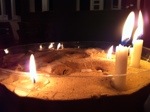
After the service, someone asked if she should blow out the prayer candles. “They can carry on praying on our behalf for a while,” was my response. They clung to life tenaciously on our behalf, only succumbing one by one, defiantly.

20131218-200633.jpg

Posted in homily | Tagged , , , , , , , , , , , | Leave a comment

Year A Advent 3

John sends a message from prison. Whether he is worried, depressed, or angry we don’t know; but he asks, through his disciples, “Are you the one, or are we still waiting for somebody else?”

John has already told the whole Judean countryside the answer: “Here is the Lamb of God, who takes away the sin of the world!” (John 1:29). Yet now, languishing in prison, he wonders why the sin of the world is still chaining him, weighing him down, oppressing him. Herod is hosting wild parties in his palace and hobnobbing with the Romans; John’s disciples are dwindling as they move on to the next great leader, even as John told them they must, and John is angry, and worried, and depressed that so little seems to have changed. His personal imprisonment is eating away at his personal and impressive faith.

In the book Night, Elie Wiesel describes the welcome offered by the block leader when he arrived in his own prison: “Comrades, you are now in the concentration camp Auschwitz. Ahead of you lies a long road paved with suffering. Don’t lose hope. You have already eluded the worst danger: the selection. Therefore, muster your strength and keep your faith. We shall all see the day of liberation. Have faith in life, a thousand times faith. By driving out despair, you will move away from death. Hell does not last forever. …And now, here is a prayer, or rather a piece of advice: let there be camaraderie among you. We are all brothers and share the same fate. The same smoke hovers over all our heads. Help each other. That is the only way to survive.”

Jesus answers John’s disciples, “What do you see? Do you see how the prophecies are being fulfilled? Have you read your scriptures, the ones that say, “Strengthen the weak hands, and make firm the feeble knees. Say to those who are of a fearful heart, ‘Be strong, do not fear! Here is your God. He will come and save you.’ Then the eyes of the blind shall be opened, and the ears of the deaf unstopped; then the lame shall leap like a deer, and the tongue of the speechless sing for joy. For waters shall break forth in the wilderness, and streams in the deserts.” “Do you understand?” asks Jesus. “Tell John what you see, what you hear, and tell him, blessed is he who takes no offence at me, who will accept these signs for what they are; promises of the salvation that has begun, and is at hand.”

Have faith in life, a thousand times faith. Be strong, do not fear. Help each other; that is the only way to survive. Strengthen the weak hands, and make firm the feeble knees. Encourage those who are of a fearful heart.

A year after the tragic events in Newtown, Connecticut, I stand here again on another Sunday after another Friday which witnessed the terror of another school shooting, and there is a part of me that is despairing, that wonders why we must still be patient, what it is that we are waiting for, why we are still imprisoned and oppressed by sin.

James advises, “Be patient, beloved, until the coming of the Lord. Strengthen your hearts.” Jesus says, “Look, I am already here, and blessed is the one who takes no offence at me.”

Another prisoner, Dietrich Bonhoeffer, wrote after ten years of confinement, “It is more prudent to be a pessimist. It is an insurance against disappointment, and no one can say ‘I told you so,’ which is how the prudent condemns the optimist. The essence of optimism is that it takes no account of the present, but it is a source of inspiration, of vitality and hope where others have resigned; it enables a man to hold his head high, to claim the future for himself and not to abandon it to his enemy. Of course there is a foolish, cowardly kind of optimism which is rightly condemned. But the optimism which is will for the future should never be despised, even if it is proved wrong a hundred times. It is the health and vitality which a sick man should never impugn.”

After ten years, Bonhoeffer was still hopeful. He knew that while his enemies might imprison him bodily, they could not confine his soul, much less constrain the goodness of God. He might just as well have added, “and blessed is he who takes no offence at me and my optimism.”

In Advent, we look towards the return of the Christ, the coming of the king, the completion of God’s kingdom. We remember the birth of the incarnate God, Emmanuel, God among us, God with us, and we read with great wonder the stories of healing and new life, of lives transformed and of great joy. Yet still we wait.

I don’t know if John was angry, or impatient, or despairing when he sent his disciples to question Jesus. I don’t quite know what Jesus meant when he said, “and blessed is anyone who takes no offence at me” at the end of his description of his signs of power, the signs that the prophetic Day of the Lord had arrived. But I am drawn to the words of those other prisoners: have faith in life, a thousand times faith; and help one another. Optimism for the future should never be despised; it is the health and vitality which a sick man should never impugn.

We approach the Christmas season, we live through another Advent in a world that is still waiting for the peace of God that passes all understanding. We pray, “Stir up your power, O Lord, and with great might come among us.” We are told, “Be patient.”

Jesus’ answer to John, to us, is yes; yes, I am the one you are waiting for. Yes, I do bring deeds of great power and good news for the poor, and for the poor of spirit. I am with you. And blessed are you that are with me; who take no offence at my walking with you, but who walk with me, who work with me, in hope and faith that the kingdom of God, the peace which passes all understanding is drawn near, is at hand, is ours for the grasping. See it in the small miracles: a woman set free from captivity; a child given a second family; our own failures forgiven.

Strengthen, then, the weak hands, make firm the feeble knees. Take your neighbours by the hand and lead them to the promised land. Tell them of the promises that God has made, that Jesus has confirmed. Say to those of a fearful heart, “Be strong, do not fear. I am with you.” God is with you. Practice optimism; not the cowardly, wishful thinking that Bonhoeffer rightly condemns, but the faith that God does work for good in the world, and that good will prevail; that good already has, in the person of Jesus. Help one another to have faith in life; a thousand times faith.

We need wait for no other. Amen: come, Lord Jesus.

Posted in sermon | Tagged , , , , , , , | Leave a comment

Saint Lucy’s Day

An Advent meditation for the Episcopal Diocese of Ohio

Friday, December 13, 2013

I remember learning, from John Donne’s Nocturnall, that S Lucie’s day was the shortest, the darkest, “the yeares midnight,” as he would have it. It took me decades to remember why the thirteenth should be the shortest, instead of the twenty-first or second, as we all know it to be. It’s because the calendar changed, during Donne’s lifetime, and the season shifted, in case, like me, you’d forgotten.

Still, since those school days for me, Lucy has always been associated with that “year’s midnight.” Her candles hardly seem sufficient to drive away the tired dullness of a day on which “the Sunne is spent, and now his flasks Send forth light squibs, no constant rayes.” And yet, remember this:
If, in a vast, velvet darkness, you strike a single sulfur match, and watch its tiny flame flicker and fade, and close your eyes, the image that burns on inside your eyelids will not be of the surrounding darkness, but of light, spreading to fill your inner vision.

“The true light, which enlightens everyone, was coming into the world.” (John 1:9). Amen: Come, Lord Jesus.

John Donne, A nocturnall upon S. Lucie’s day, Being the shortest day, in The Complete Poetry of John Donne, John T. Shawcross, ed. (Anchor Books, 1967), 155

A nocturnall upon S. Lucies day,

Being the shortest day.

Tis the yeares midnight, and it is the dayes,
Lucies, who scarce seaven houres herself unmaskes,
The Sunne is spent, and now his flasks
Send forth light squibs, no constant rayes;
The worlds whole sap is sunke:
The generall balme th’hydroptique earth hath drunk,
Whither, as to the beds-feet, life is shrunke,
Dead and enterr’d; yet all these seem to laugh,
Compar’d with mee, who am their Epitaph.

Study me then, you who shall lovers bee
At the next world, that is, at the next Spring:
For I am every dead thing,
In whom love wrought new Alchimie.
For his art did expresse
A quintessence even from nothingness,
From dull privations, and leane emptinesse:
He ruin’d mee, and I am re-begot
Of absence, darknesse, death;things which are not.

All others, from all things, draw all that’s good,
Life, soule, forme, spirit, whence they beeing have;
I, by loves limbecke, am the grave
Of all, that’s nothing. Oft a flood
Have wee two wept, and so
Drownd the whole world, us two; oft did we grow
To be two Chaosses, when we did show
Care to ought else; and often absences
Withdrew our soules, and made us carcasses.

But I am by her death (which word wrongs her)
Of the first nothing, the Elixer grown;
Were I am man, that I were one,
I needs must know; I should preferre,
If I were any beast,
Some ends, some means; Yea plants, yea stones detest,
And love; all, all some properties invest;
If I am ordinary nothing were,
As shadow,’a light, and body must be here.

But I am None; nor will my Sunne renew.
You lovers, for whose sake, the lesser Sunne
At this time to the Goat is runne
To fetch new lust, and give it to you,
Enjoy your summer all;
Since shee enjoyes her long nights festivall,
Let mee prepare towards her, and let mee call
This houre her Vigill, and her Eve, since this
Bothe the years, and the dayes deep midnight is.

Posted in advent meditations, holy days, poetry | Tagged , , , , , , | Leave a comment