Unmiracle

A miracle is, by definition, unlikely to happen.

When our daughter was ten, I lost her in the woods.

She was ten, and actively honing her skills in defiance, contrariness, and flouncing. It was our first visit after moving away, over the ocean, and we had met up with friends for a picnic and playtime, and it was sunny. The afternoon was drawing to a close. We said goodbye, set off, we for our temporary home, they for the permanent nests we left behind. Daughter walked with them.

I had learned, by wearying trial and error, to pick my battles. Let her walk with them a while, then, pretend for a moment longer that this was home. At the brow of the hill, the emptiness of the field sweeping down to the edge of the woods took my breath away. She was gone.

I ran along the edge of the woods as well as I could with her siblings in tow. I dared not enter: if she was on one path and I chose another, we would never find one another between the thick darkness of the trees and brambles. I hurled her name as hard as I could between the branches, knowing that it was being swallowed before it was even out of sight by the thickets. I bellowed, over and over.

When they were three, we found a friend of hers walking away from his own front door, weeping with the all of the grief that only a three-year-old knows. “What’s wrong?” The words were hard to make out, but we divined that his parents had left him, left home, and that he had set out into the world to find them.

“That seems a bit unlikely,” I told him, and rang the doorbell. Mother came. Father had returned from work and gone upstairs to change; she had followed with a few words about their day; he had been playing in the living room beneath the stairs that, open-slatted, wound right out of there; but he hadn’t noticed them go. Looking up, he leapt straight to abandonment and set off to find and, if necessary, avenge them. We just happened to pass by.

A man came out of his house and looked at me strangely, bellowing like a bereaved milk cow at the woods, at the trees, into the dusk. I had no time nor breath to stop and explain.

After a nondescript division of time, she wandered out of the woods to our right. Until she saw my face, she had no idea that she was lost. We wept together.

I prayed for a miracle then, the other day, scanning the edges of woodland and scrub, for a child to wander out with all of the insouciant innocence of one who doesn’t even know that he is lost.

A miracle is, by definition, unlikely to happen.

I preached yesterday on the miracles of Elisha, who proclaimed to a woman a child, and who returned him to her from the lip of the grave; who assured her by word and by deed that God is good, that God’s mercy is not retractable, nor insufficient, nor thwarted by death. And I believe it; but even as I spoke, I knew that there were some who hated me, if only for a moment, for saying so.

Where is our miracle? they murmured. Why not one more? Why not for us?

My God, my God, why have you forsaken me? Why are you so far from helping me, from the words of my groaning?
O my God, I cry by day, but you do not answer; and by night, but find no rest.

It is the prayer of ordinary, everyday life, ex deus ex machina, lived in the empty, rolling wilderness of unmiracle, whose natives spend the rest of their days snagging on the edges of briared thickets, searching for signs of hope.

Posted in current events, lectionary reflection, prayer, story | Tagged , , , , , | Leave a comment

Year B Proper 12: Breaking bread

“All things come of thee, and of thine own have we given thee,” many of us grew up intoning at every Offertory presentation. We are familiar with the concept that all that we have is of God, and that there is nothing we can offer back to God that God has not already given us.

But this story breaks that circle wide open; its arc is much more expansive than we imagine.

The man from Baal-shalishah, an evocative name in itself, suggesting a history of paganism and heathen ways; this man knows the covenant of God with the people of God. He recognizes that everything that he has is of God, and in the absence of a temple, a priest, an altar in the place where he lives, he brings to the prophet the offering of first fruits designated by the Law as a sacrifice to God, a few barley loaves as a thank-offering for the sustaining nature of God’s creative power; a blessing on God for the life with which God has blessed him.

And God, working through the prophet, offers these gifts right back to God’s people.

We offer to God only what God has given us, and God offers it right back, multiplied and stretched out and shared out, in an act of divine grace and mercy.

The context of Elisha’s little miracle is one of famine and fear. The country is at war, besieged by bad politics, and worse, by bad weather. There is little food to be found, and little hope. Just before this happens, a pot of soup is spoiled by the addition of a poisonous gourd, and the whole company falls into despair, because there is nothing else for them to eat.

“There is death in the pot,” they cry, death either way, either by hunger or by harmful herbs. But Elisha adds the antidote, and all is well.

Just before that, he offers a picture of enduring mercy, following grace with grace. After declaring a child to a woman who wants one badly, after the child is born and grown and has an accident in the field, dying in his mother’s arms, Elisha returns, and somehow, by some miracle, returns the child to his mother. God’s mercy, Elisha proclaims in word and in deed, is not limited, is not reversed or taken away.

God’s mercy abounds, and expands, and gives back tenfold, twentyfold, infinitely more than we can offer or expect.

So the child is cared for, the company is fed, and there is more left over.

In the story told by John, a little boy brings to Jesus his few barley loaves and a couple of fish. There is a large crowd following, because of the acts of mercy that Jesus has already done. In a context of fear and faith, wondering where God is in the midst of the empire, the fall of Israel, he heals many, offering grace and mercy to those in pain, in need, in hunger for the love of God. And still there is more. The child offers what he has to Jesus, that which has been given to him for his own sustenance. And Jesus offers it back to the people following, stretched out and multiplied and shared out in an act of divine grace and mercy. And there is more left over.

That which we have been given, we offer back to God at the altar: our faith, our hope, our lives and the first fruits of our labour. And God offers it back, to be stretched out and multiplied and shared out in acts of mercy and of grace.

The gracious act of God in creation and redemption and the sustaining of the earth does not come full circle with our offerings at the altar, despite the neatness of our words, despite even their truth: “All things come of thee, and of thine own have we given thee.”

The circle is wider than that; much wider. God breaks open our little ways of thinking, our little thank-offerings, and throws them wide into the world, expanding the arc of mercy, grace, abundance, beyond our measure, beyond our view, beyond our expectation.

Jesus, when he perceives that the people are about to make him their king, slips away; he will not let the circle become closed, contained, curtailed. He has not come for the few, or even for the multitude on the mountainside, but for the sake of the whole world.

It seems as though our default position is one of fear of famine. We hold tightly to what we have, in case there is not enough to go around. We may offer to include God in our gracious circle: “all things come of thee, and of thine own have we given thee,” but God forbid that God should then give away the gifts that we have brought so earnestly out of the goodness of our hearts.

It is an attitude of fear, of famine that sustains the tight circles of privilege, and of discrimination.

It is an attitude of fear, of famine that perpetuates cycles of violence visited on those who might otherwise expect to share our resources, our circles, our lives.

It is an attitude of fear, of famine that withers our imaginations, closes our minds and our hearts to the expansive nature of God’s grace, God’s mercy, God’s goodness.

Breaking open the circle, breaking through the barriers of fear of famine, trusting God’s providence means breaking out of old ways, breaking down old walls, breaking through social barriers and fearful reticence, learning to offer our blessings back to God, not for the sake of the offering itself, but participating in the work of God.

As long as our offerings, our thanks, our praise, our prayers; as long as our faith is between ourselves and God and the gatepost, the circle remains closed, the bread remains unbroken, the miracle remains buried, sealed in the stone cold tomb, a victim of fear, of famine.

When we recognize that all that we do here at the altar, here in the coffee hour, here in the garden, here in the food pantry, here at the hot meal, here in our hearts; when we break open our hearts and bring our offerings not to close the circle but to participate in the work of God, to share God’s blessings with the world, stretched and multiplied, without holding back, without fear; then the stone is rolled away, the miracle breaks through into the light of day.

We will talk more about bread, in the coming weeks, and a lot more about what it means to break it open, stretch our limits, share it out, beyond our reach or our imagination.

For now, how did it feel, do you think, to be that man, with his little offering of first fruits, brought out of duty, out of gratitude, out of defiance of the famine, out of trust in the faithful abundance of God, when he saw what God did with his little barley loaves?

What did the child tell his mother when she asked him, “Did you eat all of the lunch I packed for you?”

Our faith is not a private, closed matter between ourselves and God and the gatepost.

Our parish is not a small circle of friends, but a kernel, a seed, a first fruit with the potential to grow into something magnificent, miraculous, when it is offered back to God without reservation, without expectation, without fear; when the circle is broken open, stretched out, shared out, for the sake of everyone whom God loves, whom God has created, whom God sustains.

The prayer of Paul is this,

that you may have the power to comprehend, with all the saints, what is the breadth and length and height and depth, and to know the love of Christ that surpasses knowledge, so that you may be filled with all the fullness of God.

It is too much, too big, too high and too deep for one person, one small circle to grasp. The fullness of God would overflow us and drown us if we tried to contain it by ourselves, slight vessels that we are.

May we embrace it anyway, and find ourselves broken open with the bread; broken open in our hearts; breaking way beyond ourselves and our imaginations, the inbreaking miracle of God’s abundant grace. Amen.

Posted in sermon | Tagged , , , , , , , , | Leave a comment

Empty churches

Mary, the mother church,
eking out milk to last the week;
Monday morning, spent, she rests
convalescent, quiet

A void of another kind,
Shakespeare’s tomb hastily built into Babel;
who sees the stranger seeking sanctuary
from its old iron face?

St Teilo’s silence echoes another place
where love was consecrated,
death given its due;
the air shivers, ghost-breath cold.

And at last the sea, an empty horizon never failing
its salt-water promise of salvation.

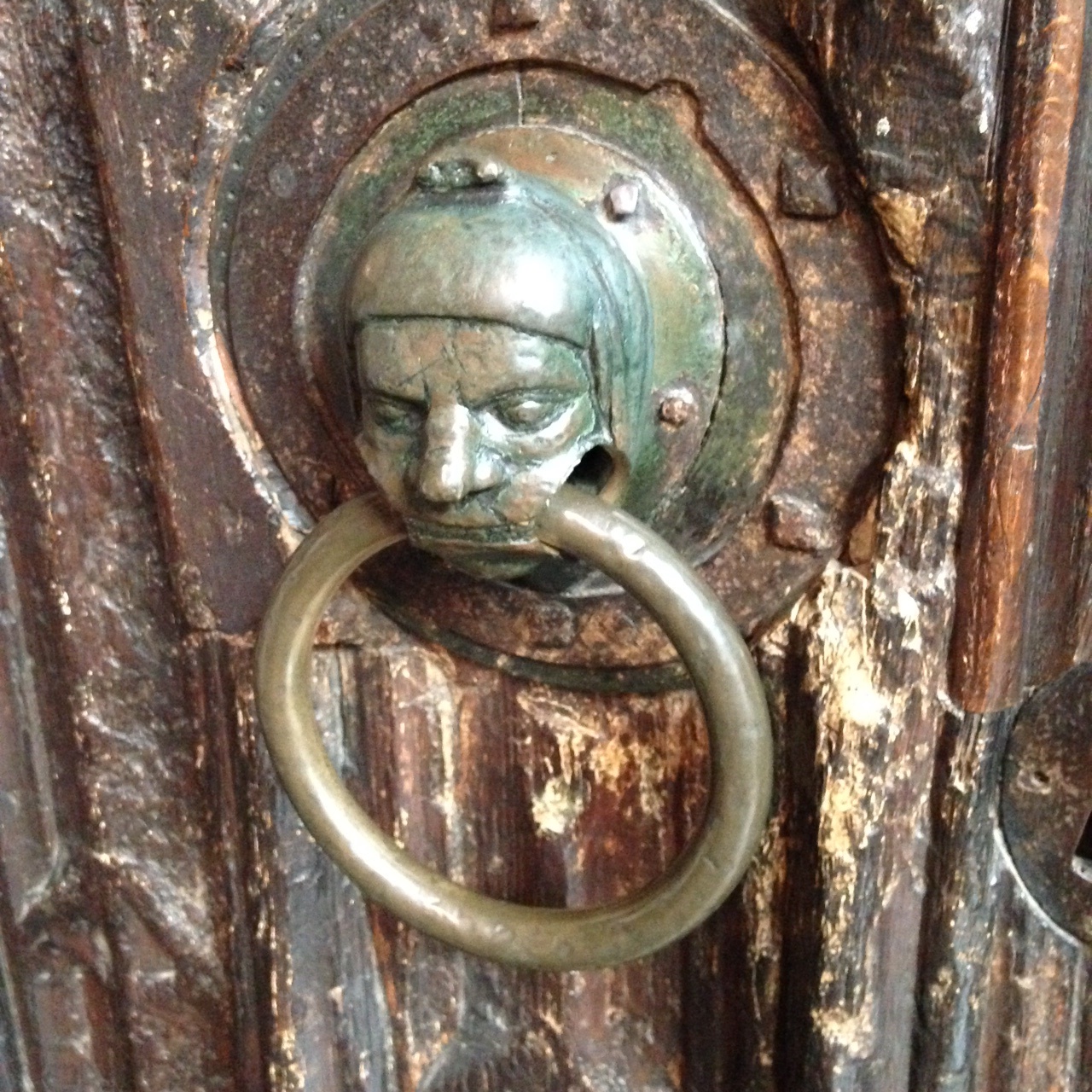
The sanctuary ring on the door of Holy Trinity, Stratford-upon-Avon. Dating from the 1200s, one who touched the ring could claim 37 days' sanctuary from the church which now holds Shakespeare's tomb.

The sanctuary ring on the door of Holy Trinity, Stratford-upon-Avon. Dating from the 1200s, one who touched the ring could claim 37 days’ sanctuary from the church which now holds Shakespeare’s tomb.

Posted in poetry | Tagged , , | Leave a comment

Family entertainment

“Off with his head!” cried the Queen of Hearts.
It had all begun much earlier, with
a powerless princess, pawn pushed about
in a dizzying dance by the Queen and her King;
the Bishop turned slantwise away, his excited
disapproval of the King’s headstrong rush
to consummate his pleasure, while his Kinghts
pawed the ground and tossed their tails.

His head was the bloodier sacrifice,
but she the one who would live to regret it,
raging through life, her humiliation blazing 
Red: “Off with his head!” cried the Queen.

Posted in lectionary reflection, poetry | Tagged , , | Leave a comment

Innocents

three little girls, pink suits and brown bodies,

shrieking false fear under the sprinkler

while hoses play over the flames,

prayers rising like hot steam

Posted in current events, poetry | Tagged , , | Leave a comment

Old moon

Yellow moon tonight:

jaundiced, gibbous, waning; still

shining like the sun.

Posted in haiku, poetry | Leave a comment

My Jairus moment

The “problem” with finishing a sermon on Friday night is that it leaves far too much room for reflection, inspiration, and downright interference by the Holy Spirit.

Here is the version of the sermon I preached Saturday night at St Thomas Episcopal Church, Berea; and I stand by it.

Nevertheless, sometime early on Sunday morning, She nudged me gently and said, “So when was your Jairus moment?” So the first page of the sermon delivered at the Church of the Epiphany, Euclid, Ohio remains the same. Here’s how it changed on the turning of the page:

Elsewhen on Friday, the Supreme Court graced us with the legal means to complete the doing of that which too many have desired too long in vain: to marry, to respect the marriages of others, to respect the dignity of every human family. God bless us, every one! For those who are grieved by Friday’s decision, I am grateful nevertheless that this same grace will still be there for us when we come to need it, for ourselves or for a loved one.

Several years ago, a friend asked me why I took the gay issue, as he called it, so personally, and the answer is simple. A friend whom I love dearly and fiercely came up against religious authorities who rejected his identity and his great capacity for love. And it nearly killed him. We came so close, too, too close, to losing him. That was when it got personal for me. That was my Jairus moment.

And nearly thirty years later … “Finish what you started,” says Paul.

Since dawn yesterday, that flag has come down from in front of the capitol building in South Carolina, thanks be to God and to a woman named Bree. And the Episcopal Church has elected its first African American presiding bishop, Bishop Michael Curry of North Carolina; and I couldn’t be happier for us.

And I am delighted to say our own bishop has already authorized clergy of this diocese to solemnize any legal marriage, using any authorized liturgy of the church, adapted for gender as necessary. He also notes that no cleric or congregation is required to offer such services, and so I will be consulting with our vestry to determine how best we will live out our promise of a loving welcome to all of God’s people. My prayer, and my advice, is that we will persevere on the path of justice, of grace, and of love; to finish the work that has begun; for such is our baptismal promise to uphold the dignity of every human being; and such is our call to uphold the dignity of every human family.

Like Jairus, our eyes have been opened to the grace that Jesus offers; and we must keep working to the completion for that which we desired, and not sink back into sleep; for he comes to us and says, “Child, get up,” and takes us by the hand, and offers us food and refreshment, and sends us on our way, to do what we may, knowing that we owe him our very lives, and the lives of all those whom we love.

Amen.

Posted in sermon | Tagged , , , , , , , | Leave a comment

Year B Proper 8: Jairus, Jesus, gay marriage, and grace

This is an updated and expanded version of a sermon that appeared in an earlier draft form, and replaces that post.

A few short weeks ago, was Jairus among those religious leaders who thought Jesus mad, even demon-possessed, coming out of nowhere as he did to proclaim the kingdom of God drawn near, the day of salvation, the bending of the arc of justice, that ancient bow, close over the earth? After the scribes and the Pharisees came from Jerusalem to accuse him, his mother and brothers came to take him home, hide him away, thinking him mad; what part did that ruler of their synagogue, Jairus, play in that plan?

Yet now, with one of his own at risk, with his own life and love on the line, Jairus finds that the time is right, the day has drawn near, to give this good news a chance: the good news of God’s day of salvation, when the sick are healed and the lepers cleansed, the prisoners set free, and when good news is proclaimed to the poor. Jairus is converted by his own need for grace to seek and find grace in Jesus, to find the face of God in the one whom he had so recently opposed in no uncertain terms, to find Jesus.

I feel as though we’re living in a parable here. And into this parable speaks Paul:

And in this I give advice: It is to your advantage not only to be doing what you began and were desiring to do a year ago; but now you also must complete the doing of it; that as there was a readiness to desire it, so there also may be a completion out of what you have.

Friday was a complicated day. In one day, we heard joy and grief, jubilation and lamentation; but the theme of the day was most certainly grace.

At the funeral of Clementa Pinckney, pastor of Emanuel AME Church, President Obama, out of his own grief and as chief mourner of the nation, sang Amazing Grace, because, he said

As a nation, out of this terrible tragedy, God has visited grace upon us, for he has allowed us to see where we’ve been blind.Blind to racism. Blind to the outrageous proliferation of guns and gun violence. Blind, but now we see. And as we see, says Paul, and begin to desire better, so we also must complete the doing of it. We must keep our eyes open, our hearts clear-sighted, and our arms full of grace.

The Rev Gay Jennings, President of the House of Deputies, took up the theme of finishing what we started in her opening remarks to General Convention this week, when she said,

Even as we wrestle with the church’s future, we must reckon with its past. We must realize that the long, hard struggle to eliminate discrimination within the church required so much energy and vigilance, that we did not do enough to right the wrongs of discrimination, white privilege, and inequality in the world around us. This summer, especially, we must repent of that. Ferguson, Cleveland, Baltimore, Charleston – General Convention is where we Episcopalians have the ability not only to proclaim that black lives matter, but also to take concrete action toward ending racism and achieving God’s dream of racial reconciliation and justice. We can do no less.

For one legislator in South Carolina, the death of his friend was the catalyst that moved him from bright-eyed blindness to seeing in the Confederate flag an image that he could no longer endure, that he could no longer ignore. It was the personal connection which moved him from denial to grace, from grief to resolution, to complete what he had begun to desire upon the death of his friend. He was like Jairus, grieving for his own lost love.

For many of us who grew up in traditional households with rather uniform expectations of family life, it has been our encounters with the unexpected, the beloved other, the grace of difference that has moved us from suspicion, ignorance, and denial to the understanding that the blessings that we have received are owed by us to all; that we are called to share the grace that we know and learn from the grace that others offer. We have all, or mostly all, stood in Jairus’ shoes at one time or another; and it is where love has touched our lives that we have been moved us from blindness to grace, to see Jesus in the love of one another; to celebrate love as the victory of the kingdom of God.

And there is little more moving than a marriage.

In the morning, on Friday, the Supreme Court graced us with the legal means to complete the doing of that which too many have desired in vain: to marry, to respect the marriages of others, to respect the dignity of every human family. God bless us, every one!

In Friday’s decision, the Supreme Court cited the dignity of those seeking marriage for themselves and their loved ones. Our Presiding Bishop, Katharine Jefferts Schori, responded,

I rejoice that the Supreme Court has opened the way for the love of two people to be recognized by all the states of this Union, and that the Court has recognized that it is this enduring, humble love that extends beyond the grave that is to be treasured by society wherever it exists.  Our society will be enriched by the public recognition of such enduring faithful love in families headed by two men or two women as well as by a woman and a man.  The children of this land will be stronger when they grow up in families that cannot be unmade by prejudice or discrimination.  May love endure and flourish wherever it is to be found.

And I am delighted to say our own bishop has already authorized clergy of this diocese to solemnize any legal marriage, using any authorized liturgy of the church, adapted for gender as necessary. He also notes that no cleric or congregation is required to offer such services, and so I will be consulting with our vestry to determine how best we will live out our promise of a loving welcome to all of God’s people. My prayer is that we will persevere on the path of justice, of grace, and of love; to bring to completion the work that has begun; for such is our baptismal promise to uphold the dignity of every human being; and such is our call to uphold the dignity of every human family.

For those who are grieved by Friday’s decision, I am grateful nevertheless that this same grace will still be there for us when we come to need it, for ourselves, or for our loved ones.

For like Jairus, our eyes have been opened to the grace that Jesus offers; and we must keep working to the completion for that which we desired, and not sink back into sleep; for he comes to us and says, “Child, get up,” and takes us by the hand, and offers us food and refreshment, and sends us on our way, to do what we may, knowing that we owe him our very lives, and the lives of all those whom we love. Amazing grace, indeed.

Amen.

Posted in sermon | Tagged , , , , , , , , , | 1 Comment

Year B Proper 7: partial Christianity and false peace

On Wednesday of last week, in a city a few hours from here, Loretta Lynch was finally sworn in as Attorney General, the first African American woman to hold the position. During the ceremony, she used a bible that had belonged to Frederick Douglass to take her oath of office.

Douglass was a remarkable man. Born a slave in maybe 1817 or 1818, he describes in his autobiography how he came to stand on the Chesapeake Bay, longing to cross over to the other side, envying the freedom of the boats set free from their anchoring chains, come whatever storms may. He finally escaped slavery, and became an eloquent and sought-after speaker on both sides of the ocean, on the subject of abolition. He wrote in an appendix to his autobiography, Narrative of the Life of Frederick Douglass,

… between the Christianity of this land, and the Christianity of Christ, I recognize the widest possible difference – so wide, that to receive the one as good, pure, and holy, is of necessity to reject the other as bad, corrupt, and wicked. To be the friend of one, is of necessity to be the enemy of the other. I love the pure, peaceable, and impartial Christianity of Christ: I therefore hate the corrupt, slaveholding, women-whipping, cradle-plundering, partial and hypocritical Christianity of this land. … Never was there a clearer case of “stealing the livery of the court of heaven to serve the devil in.”

And indeed, Douglass did not use his eloquence only for political means, but he was also a preacher in the African Methodist Episcopal Church.

Later on Wednesday, at an African Methodist Episcopal Church in Charleston, South Carolina, nine black men and women, descendants of Douglass in their faith and their civic involvement and their thirst for justice, for the kingdom of God; nine men and women were murdered by one who thought that they had no place there, no place here, no place in the kingdom of God.

Jesus told his disciples to get into the boat, let’s go to the other side, he said. And they ran into a storm.

Jesus is not here to lead us into harm. Praying in church is not what got those nine people killed. Racism, the direct descendant of the barbarity of Frederick Douglass’ tormentors, is the storm which surrounded them and overwhelmed them.

Jesus spoke peace to the storm, raised his voice above the wind and the waves, and even the wind and the waves obeyed him. And there was a dead calm.

But this one this one’s ears were full of the noise of racism and of hatred and of gunfire. Even in church, at prayer, this one, his middle name Storm; this one failed to hear above the noise of the storm the voice of Jesus calling, cajoling, pleading: Peace. Be Still.

Our Bishop, the Rt Rev Mark Hollingsworth, Jr, wrote this week from the road, in part,

In the futile attempt to make some sense of so senseless an act of evil, I am wanting to categorize this as an isolated act of a solitary and deranged individual. But of course I cannot separate myself from it; it is a reflection of a social system in which I am complicit, by my action and my inaction alike.

The noise of the storm that we call racism is still the background sound track to everyday life in this country. A black president swearing in a black AG on the bible of a former slave come good has not silenced the storm of hateful prejudice and oppressive privilege that still runs riot; far from it.

Who shut in the sea with doors when it burst out from the womb? asks God of Job. And even the seas obey. But not us. We will not be held back, our proud flags and our preening privilege shall not be stopped like the tide. We rage on, oblivious to the commands of peace, the arms of Jesus outstretched.

Those of us who have the privilege of tuning out the noise, those of us who do not see colour, do not hear it, I’m sorry to say, are part of the problem. If we are able to ignore the storm, it may be that we are sitting in the eye of it.

The only way to remove ourselves from the storm, to stand on the side of Jesus, is to wake up, to stand up, to step up and to speak up, and not to let up until the chaos is quelled and true peace stretches out across the waters all around us, as far as the eye can see.

I am trying. I want to stay in the boat with Jesus, full of the faith that defies all fear, speaking peace to the storm, commanding peace, calming the chaos, even clinging with the disciples to his coattails. But I know that there is a part of me that still swirls away with the clouds, oblivious of the havoc that I am wreaking. And for that, I am sorry.

Meanwhile, back on the boat, words of peace flatten the waves, astonish the wind into silence. The relatives of the slain churchgoers naming their grief and their anger directly to their tormentor, the storms that rage in their hearts, and then speaking mercy, forgiveness, peace.

I can barely imagine what is must be like for that church, for Emanuel AME Church in Charleston to come together to worship this morning. But these few brave disciples have already shown us that their faith is stronger than their fear. They do not want to become a part of the storm. They would rather stay in the boat with Jesus, come what may. In voices ripped by the wind and shredded by a rain of tears, they have stood with Jesus and spoken into the face of the storm and said, Peace. Be still.

Not without anger. Not without fear. Not without grief. Not without passion. Peace is not the absence of emotion, but the presence of God.

Peace is not the absence of passion, but the presence of Christ.

There is peace to be found, with the help of Christ, by the grace of God. But it is not the false calm at the eye of the storm. It is not found in among the blustering winds but back in the boat, shoulder to shoulder with the other disciples, awake, alert, and close to Christ.

Elizabeth Eaton, Presiding Bishop of the ELCA, the denomination of the church to which this week’s shooter belongs, also wrote this week:

I urge all of us to spend a day in repentance and mourning. And then we need to get to work. Each of us and all of us need to examine ourselves, our church and our communities. We need to be honest about the reality of racism within us and around us. We need to talk and we need to listen, but we also need to act. No stereotype or racial slur is justified. Speak out against inequity. Look with newly opened eyes at the many subtle and overt ways that we and our communities see people of color as being of less worth. Above all pray – for insight, for forgiveness, for courage.

There is peace to be found, not without passion, not without work, not the false calm at the eye of the storm, but the peace of Christ which passes all understanding, which makes no sense but leave his disciples dumbfounded, asking, Who is this, that even the wind and the waves obey him?

And so let us pray for that peace, and for our part in it, using the prayer of St Francis [via the Book of Common Prayer]:

Lord, make us instruments of your peace.
Where there is hatred, let us sow love;
where there is injury, pardon;
where there is discord, union;
where there is doubt, faith;
where there is despair, hope;
where there is darkness, light;
where there is sadness, joy.
Grant that we may not so much seek to be consoled as to console;
to be understood as to understand;
to be loved as to love.
For it is in giving that we receive;
it is in pardoning that we are pardoned;
and it is in dying that we are born to eternal life. Amen.

Posted in sermon | Tagged , , , , , , | 1 Comment

Year B Proper 6: Consider the birds

“Consider the birds,” says Jesus. Not here, in the passage we read today; but he says it. I was drawn to consider the birds when we read from Ezekiel, about the twig from the top of the majestic cedar tree that would be transplanted and grow to new heights, attracting all of the birds of the air to its shade and strong branches: eagles and hawks and owls. Then there’s the mustard bush, the greatest of all shrubs, which seems like a comical commendation. The very word “shrub” shrugs off majesty. It is no cedar tree. Yet it provides shelter to the little birds that live on the ground, nesting in the earth under its shade, resting in its protective shrubbery, hidden from predators and the noonday sun.

There are a lot of birds in the Bible. They seem to have a special place in the divine heart. And as I read more and more of them – the birds of the Bible – I was reminded of a book I read as a child, about the special place of birds.

“Do you know about storks? Storks on your roof bring all kinds of good luck. I know this about storks; they are big and white and have long yellow bills and tall yellow legs. They build great big messy nests, sometimes right on your roof. But when they build a nest on the roof of a house, they bring good luck to that house and to the whole village that that house stands in. Storks do not sing. They make a noise like you do when you clap your hands when you feel happy and good. I think storks clap their bills to make the happy sounds when they feel happy and good. They clap their bills almost all the time except when they are in the marshes and ditches hunting for frogs and little fishes and things. Then they are quiet. But on your roof they are noisy. But it is a happy noise, and I like happy noises.

That is all I know about storks; but my aunt in the village of Nes knows a lot about storks, because every year two big storks come to build their nest right on her roof. But I do not know much about storks, because storks never come to Shora. They go to all the villages all around, but they never come to Shora. That is the most that I know about storks, but if they came to Shora, I would know more about storks.”

So writes little Lina at the beginning of the book, The Wheel on the School, by Meindert de Jong (HarperCollins, 1954). Lina decides that the reason the storks don’t come is because the roofs are too sharp – in her aunt’s village, every house has a wheel on top, so that the storks have a safe and comfortable place to land and build their large nests. But an older woman who had lived long enough to remember the storks coming to Shora wondered if they wouldn’t also want trees, to rest in; to take shelter and shade, and to hide from prying eyes. It’s difficult for trees to grow in Shora, because of the salt spray from the sea; only one survives, and it is in a walled garden behind one of the houses. That shows, suggests the teacher, that the trees need our protection, and sanctuary from the salt sea spray in order to grow and offer protection and sanctuary to the storks. As the story continues, and the quest for a wheel, trees, and most importantly storks to stay in the village broadens and deepens, it draws everyone in, from the youngest to the oldest, and draws them together, to share their stories, their ideas, their inspirations, their abilities, their selves. They learn to give shelter and shade to one another as they seek to offer sanctuary to the storks.

And that, says Jesus, is what the kingdom of God is like. The seed, the germ of a mustard seed plant, or of wheat and barley, or the cedar tree, or of an idea, or of a story, or of friendship, of love: “Friendship,” wrote the poet Samuel Taylor Coleridge, “is a sheltering tree.” These things can grow to great heights and breadths and bear fruit for those that need it, bring heat and flavour to life, and provide shelter and shade and rest to the birds of the air, the large and the little, the strong and the vulnerable. All share together in the bounty of the seed, the germ of the kingdom of God.

And as birds tend to do, they themselves will raise fledglings who will fly from the nest and reach new trees and shrubs and spread their seeds and the cycle start over again. All from one little seed, says Jesus.

Which might lead us to consider how careful we must be about the seeds that we plant.

If we plant weeds, they will strangle the newly sprouted seedlings before they get a chance to grow. Negativity and pessimism and prejudice and habitual self-interest, all will eat away at the root that the kingdom of God is trying to set in our hearts, and we will struggle to see it grow if our hearts are turned only to the darkness. I rarely find evidence of the kingdom of God in the online comments section of the news sites, where bitterness and bile run rampant.

If we plant thorns, they will not only keep our enemies out but they will pierce us too, close in as they grow. They soon get out of hand, even if when we plant them we think we can control them, like the habits of fear that feed on themselves and breed further fear, until we are afraid of our own shadows, our own mirror image. The kingdom of God, to my knowledge, has never been compared in parables to a thicket of thorns from which no one can escape.

And if we will sow the seeds of enmity, of violence, of oppression, of jealousy and pride, then we will find that the trees we thought to see grow into majestic cedars have all been cut down for crosses.

The good news is that no one is too small or insignificant to make a difference in the landscape in which we live. The girl in the story, Lina, was the only girl in her school: excluded from the boys’ games because of skirts and such: but she was the one who dreamt of storks and the seed, the germ of her idea got the whole village not only dreaming but acting and … well, I won’t give away the ending.

The seeds that we sow can give real and needed shelter to those that need it. When we say, “God loves you. No exceptions,” do we understand that there are people who have never heard that? There are people who have heard that God watches the fall of a sparrow but never known that God reaches out to catch them? When we say, “God loves you. No exceptions,” do we mean it? If so, we are planting seeds that shelter and shade and offer safe nesting material to all sorts of strange and familiar birds, no exceptions; and both we and they are blessed.

The cedar tree sends out eagles as messengers across the land and sea to proclaim the kingdom of God. But just like the mustard seed, the tiniest grain, even the smallest and shyest of God’s creations can branch out to offer shade and shelter to the birds of the air and the little ones that nest close to the ground, and camouflage from danger, and rest for one who leans in the little branches.

Think of a hotdog without the hope of mustard, and consider how fortunate and elevated and blessed we are to have been scattered and sown, little seeds of God’s kingdom.

Amen.

Featured photo: our own little visitor attracted by the hedgerow outside the church, napping.

Posted in sermon | Tagged , , , , , , | Leave a comment