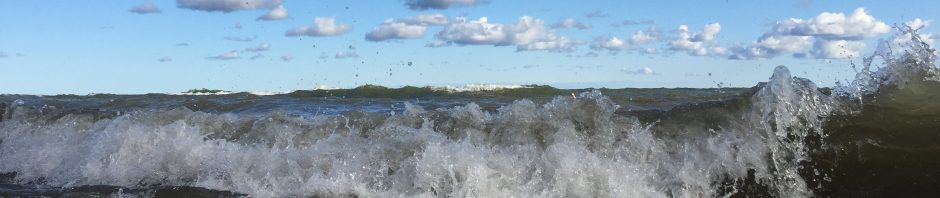
evening, midweek,
overwhelmed and underprayed,
counting blessed sheep.
evening, midweek,
overwhelmed and underprayed,
counting blessed sheep.
Not that Donald. That Donald isn’t keen on losers. But Jesus is a total loser, and we like him all the better for it. Don’t we?
Then he began to teach them that the Son of Man must undergo great suffering, and be rejected by the elders, the chief priests, and the scribes, and be killed, and after three days rise again. He said all this quite openly. And Peter took him aside and began to rebuke him. But turning and looking at his disciples, he rebuked Peter and said, “Get behind me, Satan!…”
He called the crowd with his disciples, and said to them, “If any want to become my followers, let them deny themselves and take up their cross and follow me. For those who want to save their life will lose it, and those who lose their life for my sake, and for the sake of the gospel, will save it. …Those who are ashamed of me and of my words in this adulterous and sinful generation, of them the Son of Man will also be ashamed when he comes in the glory of his Father with the holy angels.” (Mark 8:31-38)
Donald MacKinnon (aka [my] The Donald) wrote that
It is commonplace in theology to speak of the Resurrection as the Father’s Amen to the work of Christ; yet it is a commonplace to whose inwardness writers on the subject often attend too little. For if it does anything, it drives one back to find the secret of the order of the world in what Christ said and did, and the healing of its continuing bitterness in the place of his endurance. (1)
The secret of the order of the world in what Christ said is that those who want to save their life for later will lose it in the present; those who save their love for later will find their hearts hardened to stone when the moment comes; those who save their best for special occasions will watch it crumble to dust; and that those who squander their lives, their love, their best on the least, the littlest, the laughable and the loathsome; those who are not ashamed to weep for the lost and welcome the lousy, to waste their despair on the hopelessly wretched; they will be the ones who recognize life, the light of Christ, when they find it.
Those who are not ashamed to love recklessly, indiscriminately, foolishly, mortally wounded by opened hearts.
Because Jesus is a loser, betrayed by a friend that he knew he should know better than to trust, to whom he turned his cheek for another kiss.
To speak of Christ’s readiness to embrace failure and defeat is familiar in the almost casual language of traditional piety. In consequence it is easy to forget that the words should be used and should be understood as being used to state simple fact. (2)
Are we ashamed of the continuing bitterness of the world, and Christ’s endurance of it? Do we wish in our hearts that he would come down off that cross and smash it with their mallets and pile the pieces into a funeral pyre for all death and suffering, all grief and strife?
Of course; the crucifixion is a waste, and a shame. The Donald again:
It is sheer nonsense to speak of the Christian religion as offering a solution to the problem of evil. (3)
Even Jesus fell in the face of it. And yes, there is Resurrection. Thank God!
After which I refer you back to The Donald’s first comment above.
No, it isn’t easy. No wonder Peter took Satan’s side instead. Yet our hope is in Jesus, who fell on his face in the garden of Gethsemane, as human as we, and unashamed.
Shame
He is the child rolled up like a rug,
carried away in the night by parents
harried by war and fright;
he is the child that died;
he is the child that survived.
He is the earnest young man
cross-legged at the feet of his temple teachers,
a zealot with extreme dreams.
He is a radical:
he is
love in a time of war; he is
laughter at a funeral;
he anoints the joyous with tears.
He despises misery and squanders charity.
He is the heart of the riot,
upsetting the apple cart,
pushing his luck.
He is the grand romantic gesture, rejected.
He has made a mockery of us all, and in
the marred, scarred mirror of his final shame,
we see that we would burn our own cross
before we would hang on it.
______________________________
(1) MacKinnon, Donald, “Order and Evil in the Gospel”, in Borderlands of Theology and Other Essays, by Donald MacKinnon, and edited by George W. Roberts and Donovan E. Smucker (Eugene, OR: Wipf and Stock, 2011), 96
(2) MacKinnon, “Atonement and Tragedy”, op.cit., 103
(3) MacKinnon, “Order and Evil in the Gospel”, op. cit., 92
This morning, I had time:
time to laugh, to stay, to pray,
time to waste before the day ran in
all bossy and efficient,
time to wonder and to ponder.
This morning, I had time,
primal creature, wild and untamed,
from which we like parasites
cling by our claws
for dear life.
Broken waters heave;
Spirit gasps, shrinks, shocked breathless,
breeching the shore, still.
The calendar says that there are three weeks left of summer, up here in the northern hemisphere; but today was full of autumn leaves, red and gold and fallen. Clearly, my calendar is not fully in control of the seasons.
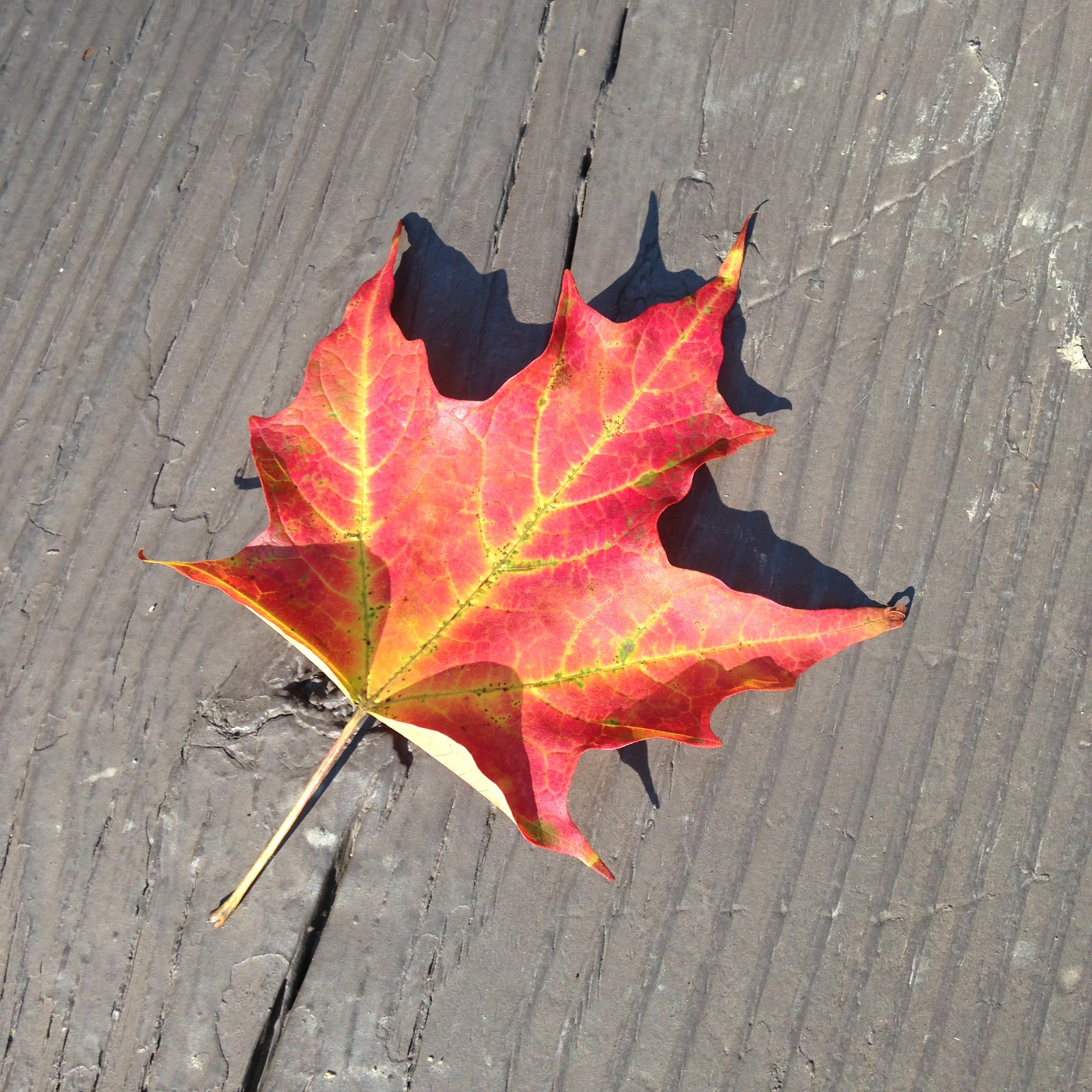
Like most people, I have experienced many times and seasons feeling out of control. Parents learn the feeling quickly. Or maybe we just remember; children get it, too.
When smallest child was very small, she very suddenly and dramatically developed asthma. This diagnosis hit me in the pit of my stomach. Since childhood I have been haunted by my brother’s asthmatic attacks, and one particular night when all was dark and I was pretending sleep while he resisted any attempts by our mother to soothe his raw attempts at breath. “Can you die of asthma?” he asked her. I never heard a reply. That silence haunted me until that lunchtime in the doctor’s office in Singapore, with my own rasping, gasping child.
When she was still very small, I would sneak into her room at night and count her breathing.
As out of whack as it sounds, I was thinking about those days of worrisome watching when eldest cat was diagnosed with diabetes last week. The first day of injecting him with insulin, I was worried about hypoglycaemia, which, in cats, can be as strikingly obvious as a seizure, or as frustratingly vague as “acting differently.” Given that I spent much of the day tracking him down and asking him if he was feeling ok, and given what we know about the act of observation inherently changing the thing observed, especially cats …
Teaching them to drive, too. Children, not cats. All of the responsibility sitting in the passenger seat while all of the control is one seat and a million miles away.
Sometimes, it is possible to reduce the responsibility (pay someone else to teach them), or to increase control (install dual controls in the family car). Most of the time, we’re left fretting about the cat in the box.
So where does that leave summer, and my autumn leaf?
Today has been designated as a World Day of Prayer for the Care of Creation. One might feel a certain degree of responsibility to do one’s part for the sustainability of the planet and its seasons, without owning as an individual a great deal of control. The options to palm off our responsibility are few: cats are notoriously indifferent to reducing any kind of warming. The only way to increase our control over climate change, clean water, a cared-for creation is to own it.
“The Lord God took the man and put him in the garden of Eden to till it and keep it” (Genesis 2:15)
Lord God, forgive us our failings. Teach us humility, our place in creation less one of control than one of service, and of love. Teach us beauty, to see and to sustain and to preserve what you have made out of wonderment. Teach us gratitude, for the food of the earth, the fruit of creation, the labour of love that is life. Help us to till and to keep your garden, to restore its glory, to return all glory to you. Amen.
part of the beauty with which we were crafted,
the genius; fragility invites gentleness.
our hairline fractures allow luminescence
to dance with infinite grace against
the canvas of creation.
betrayed, it is our curse.
a blessing, it reveals
the resilience of love,
the heft of forbearance,
the endurance of mercy.
It all starts out so well: “This will show your wisdom and discernment to the peoples, who, when they hear all these statutes will say, ‘Surely this great nation is a wise and discerning people!’” pronounces Moses, so full of pride and hope, who has led his people, God’s own people, to the brink of the Promised Land (Deuteronomy 4:6).
And yet, centuries later, in that very land, Jesus throws back the words of another prophet: “This people honours me with their lips, but their hearts are far from me” (Isaiah 29:13).
Their hearts, says Jesus, are full instead with the rank growth of wickedness: avarice, adultery, deceit and envy, murder, theft; all folly. They abandon the commandment of God to hold to human tradition: and look where that leads: to sordidness, slander, pride, licentiousness; evil intentions (Mark 7:21-22).
The Ashley Madison data dump has held up a mirror to our own inclinations to put human folly before the faithfulness of God. The website, if you haven’t yet caught on or caught up, provided dating services to married people seeking actively to have an extramarital affair: paying an online company to arrange adultery, to be delivered at the convenience of their computer screen. I read one report that said that only three zip codes in the United States did not show up on the data hacked and released about the site’s customers: two in remote Alaska, and one in the New Mexico desert. Much has been made of the celebrity info and the gotcha grabs of profiles of supposed Christian crusaders like Josh Duggar and Sam Rader; but the real indictment is of a culture where a company can thrive on the tagline: “Life is short. Have an affair,” making out of infidelity a bucket-list item; making out of deceit and betrayal a game; making the kiss of Judas a thrill worth seeking.
For those whose lives have been affected by infidelity, I am sorry that this is painful. I am sorry that it is hard to wrestle with our own sin, and I am sorry that it is hard to forgive those who sin against us, and I am sorry that our hearts are breakable. Of course, I pray for the healing of those hurt by these affairs and by these games; and still I question a marketplace that thrives on such “sordidness and rank growth of wickedness” (James 1:21).
“Surely this great nation is a wise and discerning people!” said Moses. “This people honours me with their lips, but their hearts are far from me,” replied Jesus (Mark 7:8). If he had gone on just one verse further, we would have heard him say, “The wisdom of the wise shall perish, and the discernment of the discerning shall be hidden” (Isaiah 29:14)
Our public foolishness is not limited to adultery. This week, we watched in horror as a journalist and her cameraman were murdered on live television, one day after a fourteen-year-old took his class and teacher hostage with a gun one state over. There may be no way for us completely to eliminate the “rank growth of wickedness” within the human heart that may lead to murder; but neither is there any wisdom in giving up all discernment, and doing nothing to change a status quo in which 88 people per day are killed by guns in America. Eighty-eight people every day.
And it is simply not true to think that there is nothing we can do, that whether or not the guns kill people, the people will kill anyway. The numbers beg to differ. Women in abusive relationships are five times more likely to die at the hands of an intimate partner if that partner holds a gun, and domestic violence that involves a gun is twelve times more likely to result in death than assaults carried out with another weapon or with bodily force alone.
No, we can’t solve all sordidness and rank growth of wickedness that soils the human heart, but we can use our discernment to look for ways to reduce the risk to widows and orphans, the vulnerable, the innocent, the at risk, choosing God’s law over human traditions.
“You abandon the commandment of God and hold to human tradition,” Jesus accuses (Mark 7:8). What would he say about our relationship to the sixth commandment, “Thou shalt not kill”; and to the second amendment?
Jesus sounds pretty cynical about the state of the nation, the state of his religion, the state of the human heart in this story. He is angry with those who would let their own pride, avarice, envy, their own folly blind them to the goodness that is in God, that God wills for us. He is angry, and he is frustrated, and he keeps on trying all the same, to open the eyes of the blind, the ears turned deaf, because he loves them.
He loves them. With all of their “sordidness and rank growth of wickedness” and hypocrisy and foolishness and willful denial of wisdom; he still loves us. He still tries to teach us right from wrong, love from hate, life from death.
Our Collect for today asks God to “Graft in our hearts the love of your Name; increase in us true religion; nourish us with all goodness; and bring forth in us the fruit of good works” (Book of Common Prayer, 233). The letter of James exhorts us to “welcome with meekness the implanted word that has the power to save [our] souls” (James 1:21).
Grafted, implanted, growing, the love of God, the love of Jesus Christ has the power to drive out the “rank growth of wickedness” that restricts our hearts and constricts our lives. It has the power to nourish something better, something cleaner and greener, livelier, lovelier than that list that Jesus enumerated to the Pharisees.
You’ve heard the old story that an old Cherokee man told his grandson, about the battle within the human heart between two wolves.
He said “My son, the battle is between two ‘wolves’ inside us all.
One is evil. It is anger, envy, jealousy, sorrow, regret, greed, arrogance, self-pity, guilt, resentment, inferiority, lies, false pride, superiority, and ego.
The other is good. It is joy, peace, love, hope, serenity, humility, kindness, benevolence, empathy, generosity, truth, compassion and faith.”
The grandson thought about it for a minute and then asked his grandfather: “Which wolf wins?…”
The old Cherokee simply replied, “The one that you feed”
May this wise and discerning people choose to feed, to water, to nurture the implanted word which has the power to save our souls, rather than the rank growth of wickedness.
May we remember God’s commandments before our own choice traditions.
May the good Lord Jesus continue to teach us patiently, and as often as we need reminding, the difference between right and wrong, love and hate, life and death.
In the name of Christ. Amen.
Vain and foolish,
one would not think that with
no animal spirit, nor soul,
no mind of its own,
but an idle thing
could inspire such passion,
such pain, such tearing,
such rending of hearts,
of lives apart;
only with our consent, assent
to live under its power:
we have absolved ourselves
of discernment, of wisdom,
choosing instead the cradle of
a vain and foolish thing.
Constant God,
You are the one fixed point in a universe that never stops moving;
expanding, exploding, orbiting, spinning on its axis;
the very earth beneath our feet shifts and shrugs,
magma boils beneath the surface, fluid.
No wonder we find it difficult to keep our balance.
When we learned to dance, the teacher said
to pick a spot on which to fix our eyes,
and let our body spin around it,
our focus constant,
to guard against motion sickness, dizziness, the fall.
Constant God,
fix us on you so that in the rise and fall of
breath and death,
in the steady erosion of glacial grooves
and the rush of the flood, we are not overwhelmed,
nor frightened to fall against you.
Amen.
If I am working into the evening, I try to get out around four or five o’clock for a walk. It’s cheaper than caffeine, and it doesn’t keep me up all night.
So I found myself contemplating our contemplative prayer session to come tonight while walking an unfamiliar path. That was something of a miracle in itself: lately, I’ve been hard pressed to take a new breath, let alone a new path. When I was working the hospital chaplaincy, and I’d come home sad, my spouse would ask if it was the death that did it. No, I told him, death was one thing; life, in its infinite variety, that’s what would do you in.
Anyway so, on a new path, wondering if it would take me under the road with the water, into pastures new. Instead, at the break, it made a sharp turn to the vertical. Lacking the initiative to do otherwise, I followed it.
As I wandered along the top, I contemplated the fact that I had not seen any other trails up from the bottom, which meant none down. The head of the valley was far too far to reach in time for contemplative prayer, and for some reason, going back the way I had come was unthinkable, fearful.
As the road in the valley below kept pace, I meandered past spent fireworks and beer cans, plastic chairs cascading down the cliffside. I reviewed the fact that I was wearing a skirt and proper sandals for a light afternoon stroll, and that the proximity of the parish precluded hitching everything up over my shoulders and sliding down the hill.
I found an opening, and began gingerly, sideways, to inch my way from tree to tree – I think this is how we became tree-huggers – down the hill. I contemplated my imminent embarrassment. After about two-thirds of the descent, I took off my shoes, despite the earlier broken glass and large red spiders, feeling the need to grip the dirt with my toes.
As I reached the last line of trees, I saw across the divide another woman of a certain age, wearing a pretty blue dress and proper shoes, walking on the all-purpose tarmac trail, and I felt such kinship that I wanted to hug her and douse her with my elation, but it seemed unfair to frighten the poor thing.
Smiling foolishly, I made my way across the valley floor towards my little red car and reality. Little had changed. Except that as I left the path for the sunlight, my eye fell upon a little heart of stone. A little dirty, and not quite as perfectly shaped as it first appeared, it was, I thought, a start.