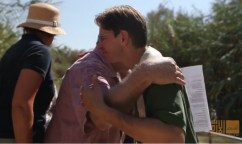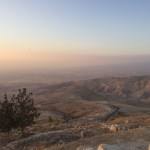
This gallery contains 20 photos.
This is a place of revelation. Continue reading
Today was our first full day in Jordan, guests of the Jordan Tourism Board and Royal Jordanian Airlines.
Having wrestled with sleeplessness till daybreak, I watched the sun rise over a city of cinder blocks and minarets, marvelling at the landscape taking shape before my eyes.
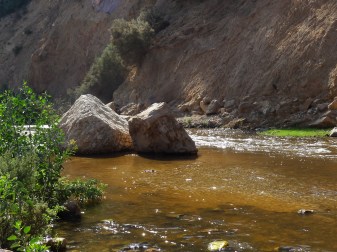
After breakfast, we set out for a day of pilgrimage, stopping first by the Jabbok River.
I had missed, in many readings of the passage, that the river where Jacob wrestled with the angel of the Lord (or whomever) till dawn is described as shallow. In fact, it looked little more than a slight, storm-swollen stream; he should have expected to cross it with ease. Much more difficult was the terrain either side: steep banks and long, scrubby hills.
But Jacob was never one to do things the easy way. He wrestled all night, unable to cross the narrow, shallow river that divided him now for his whole family and household, not only the twin he had come to petition for peace.
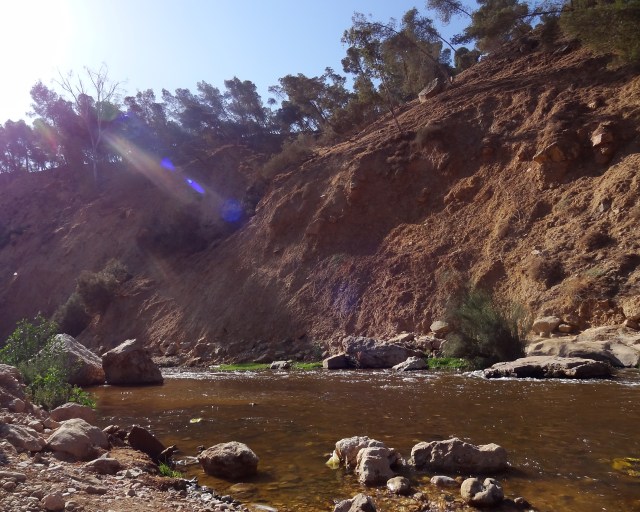

In my sleep-deprived state, I am struggling to find the meaning in standing this morning in the cool, shallow water, rooted to the spot and unable to cross to the other side because of flowing waters, the waiting buses, watching strangers and friends.
A strange light was captured in the camera, and we joked about angels, as we were driven away.

May you always have cause to remember God, pause to give thanks for the One who is your Creator, Redeemer, and Sustainer; and may God’s blessing follow you and face you, this day and for ever. Amen.
It’s been twenty-nine years since I was in the Holy Land. My memories have become like a photograph album full of moments in time, frozen in stasis, many frayed at the edges or fading. There are a few that stand out and still have the power to make me shiver. I do not believe (I hope) that I will never forget standing at the Wall of the Temple praying, laying hands on stones that seemed to come alive beneath my palms, breathe with the prayers of millennia, the prayers of so many spiritual ancestors, the prayers even of Jesus …
I had a bit of a moment yesterday, considering the journey to Jordan. You see, nearly three decades later, I am travelling to see things from the other side of the river. By the kind invitation of the Jordan Tourism Board and Royal Jordanian airlines, a group of twenty-eight religious media types, and even the occasional blogger like myself, will visit “the Other Holy Land,” as the tagline goes. The other Episcopalians in the group and myself have met online. We have talked about our itinerary, whom we will meet, what we will see. I am intrigued to see the scene of the Legion, the deliverance of the Gerasene demoniac and the stampeded of swine. I am in awe of the fact that I will see Petra, which I have wondered about since I learned as a child of the “seven wonders of the world.”
We have talked about our visit to the site of John the Baptist’s ministry in the Bethany Beyond the Jordan; the site (perhaps) of Jesus’ baptism. That’s what gave me pause yesterday. We plan to renew our baptismal covenant in the waters that flow through the pages of my Bible. One of my Episcopal colleagues, Fr Tim Schenck (of Lent Madness fame), is bringing the wherewithal to celebrate the Eucharist.
When I last looked out across these waters, I was a student of Theology in a church and a system that had yet to admit that a woman may become a priest. (A woman is the Chaplain of my old college, which for some of us is something of a miracle.)
I have packed the stole that was handed down to me, and made by the hand of, my own dear friend and ordination preacher, Nancy Wittig, one of the Philadelphia Eleven, groundbreakers for women’s ordination in this church. It may seem superfluous, but since when did we decide to become ordinary?
When I last looked out across these waters, it was from the other side of geography, and history, and years, and tears, so many births, deaths, moments and memories.
There was a currency, a current that ran through the stones of that other holy city, that turned my bones to water, baptized me from within, that ran through me to ground, to the very source of my being, that confirmed me in faith and wonder.
I do not expect the same to happen in the River; I dare not place such a challenge before God, whose currents run swift and deep, sometimes dangerous, often unseen. But I do challenge myself, to remember. To remember my faith, my call, my God who creates such wonder; such wonder; washed in the waters of baptism; set loose in the wilderness
It was not ingratitude silenced me,
but inadequacy; the paucity
of my language; the paltry dance
of palsied limbs, trembling as a fawn,
trembling as one newly born,
barely breathing; rasping
out music as though the song
had been buried too long
in the earth, in dusty lungs,
swallowed by the furred tongue,
unclean, unheard, so long unseen, afraid
to try on its first note to kiss the air,
insult your ears with faint praise,
my all too humble thanks.
We had a church full of animals this morning, so I kept the sermon brief and, hopefully, to the point. I did say a little more, but here was the crux of the matter, reckons this worthless slave:
Jesus asked, “Who, when his slave comes in from the field, says, ‘Sit down, eat’?”
Jesus who, when his friends arrived to prepare the Passover meal, took off his robe, tied on a towel, washed their feet.
Jesus who, when his disciples drew in their nets from a long night’s fishing, greeted them on the beach with bread and fish cooked over a welcoming fire.
Jesus who, each time we come to the Table, welcomes us with wine poured out like blood and water; bread broken open …
We had an interesting discussion at Bible Study this week on the slave parables and sayings of Jesus. The harsh judgement that is rendered this Sunday:
Do you thank the slave for doing what was commanded? So you also, when you have done all that you were ordered to do, say, ‘We are worthless slaves; we have done only what we ought to have done!’ (Luke 17:9-10)
contrasts with the scene a few weeks ago, when the master comes home in the middle of the night and finds his slaves waiting up for him:
Blessed are those slaves whom the master finds alert when he comes; truly I tell you, he will fasten his belt and have them sit down to eat, and he will come and serve them. (Luke 12:37-38)
This Jesus is not an easy man to understand, always, or to follow.
Dear God,
dare we ask for your blessing, worthless slaves that we are?
And yet for our sake you suffer; life and death are within your gift, and you shun neither.
And so, trembling with our faith, we beg your blessing still, be it even as little as a mustard seed…
I am tired of angels.
I am tired of their wings beating hollow drums of war,
their obsequious, their patronizing, “Do not be afraid;’
their inconvenient words to frightened virgins and old women.
I am tired of their entrapment
of innocent rams; their oppression and possession
of dumb asses, their impassive stance, swords of fire and backs
turned towards the gate of Eden, while we trudge east,
casting glances beyond the reach
of their shimmering glory.
A homily for Unity at the first Euclid Ecumenical Service at the Cathedral Worship Center of Euclid, Ohio
We read from John 17.
You know those public prayers where the person praying ostensibly addresses themselves to God, but in reality they have a whole other audience in mind? Something like:
“Father God, we praise you and we bless you. We ask that you would turn the hearts and minds of your children so that they would remember, and not forget, that without the refrigeration of your grace, the milk of human kindness sours and spoils. Remind them, Lord, to put the milk back in the fridge, so that we may be cool with one another.”
There is a turning point, at which you realize that this prayer has now gone way beyond metaphor, and that someone other than God may be the one called upon to answer it.
So that, of course, is not exactly what Jesus is doing when he prays out loud for his disciples to come together as one: “Holy Father, protect them by the power of your name – the name you gave me – so that they may be one as we are one.”
But.
There is a difference between the prayer that we make in the silence of our own hearts, and the prayers that we speak aloud among those for whom we pray. When we pray aloud, with and for someone, there is a part of us that hopes that the act of praying may itself be part of the answer to prayer: that it may be a source of encouragement, comfort, challenge, peace.
And while we pray for ourselves, for one another, for our city and our community, we do hope to be overheard. We hope that in the act of coming together, as one body, we may answer some of those prayers for peace, for unity, for common civility, for humanity which cry out for some grace, some mercy, some peace in our times.
Jesus prayed out loud: “My prayer is not for them alone. I pray also for those who will believe in me through their message, that all of them may be one, Father, just as you are in me and I am in you. May they also be in us so that the world may believe that you have sent me.”
We read Jesus’ prayer as those eavesdropping on his conversation with God, but we are meant to hear him, and perhaps we are even meant to answer him.
Is that possible, that we are called to answer Jesus’ prayer, by coming together as one?
Now, there are wildly different ways that we can think about becoming one.
You know the Borg, from Star Trek, which assimilates everyone into one mind? Resistance, famously, is futile. I am suspicious of the kind of unity that depends on squashing differences, that commands conformity over comprehension.
Fortunately, there are other models that we have for becoming one. When two people come together in one marriage, for example, and we say that they become one flesh, although they walk around and talk as though they were still two completely different and independent individuals, sometimes even with opposing opinions and beliefs. Still, at the heart of a marriage is a singularity that is born out of that commitment, that covenant; a unity of purpose, and of faithfulness, and of love.
Or when a child is born or adopted, brought home, and a new family unit comes into being – a unit, a oneness. The individuals within the family might not even always agree.
Especially when the child is a toddler or a teenager; parents at that age always seem to think that we know best. There may be times when the bonds of love may be stretched, even strained; but there is a unity, a singularity that comes out of a commitment, a faithfulness to the family unit.
The vows that we make when we come together in one marriage, in one family, in one body of Christ: those are vows that we find lived out in the life of Jesus, who is, as he says, one with his Father, and the Father one with him.
We promise to put one another’s interests ahead of our own; as Jesus prayed even in the Garden of Gethsemane, “Your will, not mine, be done.”
We promise to bear with one another for better or for worse, as Jesus shared his table even with Judas, and embraced Peter with a kiss of peace even after Peter denied him three times. doing his Father’s work of loving us no matter how hard it became, how hurtful. Bearing with us and bearing all for us in order to reconcile us to God and to one another, that we may be one, with one another, and with God.
We promise to be together in praise, transported, as Jesus told the thief crucified next to him, “Today, you will be with me in paradise.”
We know well enough all the things that divide us. I am not going to list them here; I hardly think that would be helpful.
But if Jesus has the will to pray that our differences may not divide us, then he also has the power to heal our divisions.
If Jesus has the will to pray that the valleys be lifted up and the mountains laid low and the paths be made straight between us, then he has the power to say that today, this has been fulfilled in our sight.
If Jesus has the will to pray that his disciples may be one body, then who are we to resist his prayer?
And if we will hear it, and heed it, and maybe even answer it, then who knows what God will do with our own prayers? We can only guess that it will be something beyond our wildest imaginations.
After all, who would have imagined that God would become Incarnate as a man, only to be one with us?
Jesus prayed out loud: “My prayer is not for them alone. I pray also for those who will believe in me through their message, that all of them may be one, Father, just as you are in me and I am in you.” Amen.
A sermon on Luke 16:19-31: the parable of the rich man and Lazarus
The parable describes a way of life which starkly separates the rich man from the poor, the privileged from the dispossessed. It describes how these differences and divisions set up an exponentially greater divide in the life to come: “A great chasm has been fixed between you and us,” advises Father Abraham.
It is, more clearly than most of Jesus’ parables, a fantasy. I do not think that we are to read literally the illustrations of an afterlife; but I do think that we are to take seriously the warnings that the divisions between us in the lives that we lead today have much greater consequences than we can imagine.
I think, too, that the one telling the parable knows all about the chasms that are fixed between worlds; and I think that he knows the way to heal them, and that this is his purpose: not to condemn, but to plumb the depths of those chasms of sin and division that threaten to keep us forever apart, and to pull us up out of them, set us on solid ground before the throne of God.
Because if we are divided from one another, then we are divided from God. If we cannot love our neighbour as ourselves, we have already failed to love God with our whole imaginations, since we have failed to love God’s image set before us, ready for love, fixed in our sights daily.
*
If the story of Lazarus and the rich man is one of an exponentially expanding chasm, it’s possible to imagine a backstory in which they were, at one time, not quite so far apart.
Of course, there was always a division. The rich man was always a rich man, but once upon a time –
[this is not in the Bible, you understand, but in my imagination] –
once upon a time, perhaps, Lazarus worked for the rich man. He lived in employer-provided accommodation, out in the rich man’s fields. He was reasonably healthy and well fed. He even had a family – a wife and a son.
Every so often, the rich man would come out to visit the workers’ village, and everyone would stop what they were doing and stand still, out of respect, until he laughed and waved them on with their work.
The rich man’s son and Lazarus’ son used to play together when they were younger. As they grew, Lazarus and his wife worried about the association, and warned their son, but he was young.
No one knew exactly what happened in the town the night of the troubles. This was before the days of CCTV, and dashboard cameras, smart phones and body cams.
When the rich man’s son came home, he was shuffled straight back out to live with one of his uncles in the country.
Lazarus’ son never did come home. They say his wife died of a broken heart.
The next time the rich man came to visit his fields, Lazarus did not stop, and stand still. His back bent over, he carried on working. The rich man was outraged by the insult and what he called the sheer ingratitude. I think he was mostly embarrassed.
He had Lazarus fired, and put out of his employer-provided accommodation.
Lazarus didn’t go far. He set up his little shelter outside the rich man’s gates. Every time the rich man came and went from his house, his conscience was offended by Lazarus’ plight. He was sick of the sight of him. From time to time, he would let out the dogs, but they were house dogs and not much good at chasing people off.
By the time the two men died, the chasm between them had grown so large that they could barely see one another.
And then the rich man had the audacity to ask Lazarus to go and warn his brothers – the ones raising his son – about the dangers of digging ditches!
Abraham replied, “They have Moses and the prophets; they should listen to them.” He said, “No, father Abraham; but if someone goes to them from the dead, they will repent.”
As though we could see and hear again from the dead: see Tamir playing in the park; hear Eric pleading to breathe; see Terence shot with his hands up.
*
By the time Jesus returned from the dead, he had bridged many chasms. Born as a brown-skinned child in a city ruled by the Roman Empire; taken as a refugee on a moonlight flit to Egypt; killed as a criminal on trumped-up charges, sacrificed as a scapegoat, condemned as a rabble-rouser.
He returned from the dead alright, and told us yet again about the love that God has for the least of God’s people, for the littlest piece of God’s image in the world, for the lives of the children of God.
He laid his cross across the chasm between life and death. He put the lie to Father Abraham’s claim that there is no way back, no way to reconciliation; but he didn’t take an easy path, and he never denied the divisions, the depth of the chasms that he had to plumb.
What he did was to proclaim that the kingdom of God entertains no such chasms or divides, but in the kingdom of God, we shall live on level ground. As the prophet writes,
Every valley shall be lifted up, and every mountain and hill be made low;
the uneven ground shall become level, and the rough places a plain.
Then the glory of the Lord shall be revealed,
and all people will see it together,
for the mouth of the Lord has spoken. (Isaiah 40:4-5)
In the name of the Father, and of the Son, and of the Holy Spirit. Amen.