Prophets and privateers: by their fruits shall ye know them

A sermon for the sixth Sunday after Pentecost at the Church of the Epiphany in Euclid, Ohio. In the news this week, the crisis of immigrant and refugee detention centers continues. A presidential campaign rally broke into chants of “Send her back,” targeting a congressional representative. It is the fiftieth anniversary weekend of the first footsteps on the moon. We also memorialized a parishioner who died in the spring, and his wife of some sixty years.

From the readings: Amos had a vision of a basket of summer fruits, and the people’s just desserts.


Amos has been seeing visions of how things will end up. His basket of fruit, in Hebrew, is a play on words: fruits and ends. The fruits which he sets before our vision are the end, the outcome, the results of the people’s actions and inactions, religion and rebellion.

At best, a basket of fruit might conjure up appetite, and gratitude, and wonder at the Providence of God. I have been following, as I am sure many of you have, the fiftieth anniversary celebrations of the first human footprints on the moon. But landing on a space rock, as astonishing an accomplishment as it is, is not an end to itself. The men who went there took Communion, took a Bible, took their sense of wonder. They understood that there is an end beyond our imaginings, in which all our journeys are begun and run their course; the imagination of our Creator.

We have mentioned Angus and Anna this morning, and we will again; Angus, as a physicist and an astronomer knew well this sense of wonder. In our book group this morning, we heard C.S. Lewis describe it:

“Any patch of sunlight in a wood will show you something about the sun which you could never get from reading books on astronomy.”

And so, in a shaft of sunlight, like a still life, Amos presents to us as a vision of endings a bowl of summer fruit – an appealing, appetizing image, you might think. But Amos’ words to the people do not match that palatable impression. They are, instead, a warning against strange fruit.

“Beware,” Jesus preaches elsewhere, “of false prophets.” He doesn’t mean Amos. Amos’ vision is faithful. But beware, Jesus says, “of false prophets, who come to you in sheep’s clothing but inwardly are ravenous. You will know them by their fruits. Are grapes gathered from thorns, or figs from thistles? So every sound tree bears good fruit, but the bad tree bears evil fruit. … Thus you will know them by their fruits.” (Matthew 7:15-20)

Amos warns the people to be careful of the fruit we produce. Jesus warns us to be wary whom we follow, into whose visions we invest our faith. Watch out for the fruit they produce.

Amos places before us a basket of summer fruit. We turn over the pieces, looking for something sweet – a glossy cherry, perhaps, or a crisp apple. But something is not right. There is a hardness to the grapes, and a waxiness to the skin of the pear. There is sawdust at the bottom of the bowl, instead of the dusting of peach fuzz that we expected to find. We have been fooled. The fruit is a fake. It is plastic and wood, made only to decorate the room. It is not even a still life. There is no nurture or nutrition in it. It is lifeless. It is a scam.

By their fruits shall you know them. If the vision painted for us does not nourish God’s children, nor foster their freedom, their health and wellbeing; if it proffers life with one hand and snatches it away with the other; if it distorts or defrauds, diminishes or shortchanges the image of God imprinted on any of God’s children, then it is a false vision. Watch for the bait and switch. Look out for the privateers who profit from false prophecy, while others bear the cost of their sin. By their fruits shall you know them. If the basket does not feed life, love, liberty, then it is false, and ungodly.

Try another basket. While on the surface, there is a blush to the fruit, underneath, it has gone bad. There is a bruise, and an infection that spreads from one apple to the next, until all dissolve together in their rottenness. Any new, good fruit that joins them risks their mould.

“I do not sit with false men, nor do I consort with dissemblers,” said the Psalmist. “I hate the company of evildoers, and I will not sit with the wicked.” (Psalm 26:4-5)

Of course, wickedness has become a matter of opinion to us; but by their fruits you shall know them, says Jesus. If they produce strange fruit (you remember the Billie Holiday song, written by Abel Meeropol: “ …strange fruit/blood on the leaves and blood at the root”); if they look to be producing or pollinating strange fruit, be very wary. If their fruit is poisonous to any one of God’s children, they are false prophets, and ungodly.

Fortunately, we have a healthier vision to follow. We have sounder and more sustaining food at hand. “Those who eat my flesh, and drink my blood,” Jesus says, share in the life of Christ. And those who abide close to the root and shoot of Jesus will bring forth fruit for the good of the world: lifegiving, healing, and sustaining food. That is the vision we would rather follow, and the fruit we would rather eat and offer to our neighbours, to our children, and at the altar of our God.

You know that this morning we are remembering particularly in our prayers Angus and Anna, bringing them home, as it were, one last time to Epiphany. One story that stuck with me was about how Angus would choose where to sit in this church. It was a system of randomized coin selections and manipulations that were assigned mathematical calculations that would eventually land on a point on an imaginary grid laid over the pews, and wherever that was, Angus would set himself and his family down. It was a system designed to promote equity and to eliminate bias. We each have a tendency to love best those who are like us, and to lean towards those whose sympathy we can rely on. But the love of God in Christ is unbiased and rather indiscriminate. The only way to buy into that, Angus felt, was intentionally and randomly.

“By their fruit you shall know them.” We recognize those who are sound of spirit by their actions, by their interactions with others, by the way in which they live out their faith in their daily life, in acts of wonder, of service, of kindness.

When we taste the good fruit, we know its sweetness, and its soundness. In his letter to the Galatians, Paul describes the fruit of the Spirit:

“Love, joy, peace, patience, kindness, goodness, faithfulness, gentleness, self-control; against such there is no law.” (Galatians 5:22)

How could anyone outlaw kindness, such as offering water to a parched man in the desert? How would anyone pass a law against gentleness, and the tender treatment of the traveller found at the side of the road? Why would anyone want to draw up rules against love?

Instead, like pollen on the breeze, or like the bees, let us randomly and intentionally propagate good fruit, seeding kindness where we can, settling gently where we land, leaving footprints grainy with wonder, spreading love across creation; for by our fruits we shall be known.


C.S. Lewis, Letters to Malcolm: Chiefly on Prayer (Harcourt Brace Jovanovich, Inc., 1963), 91

Strange Fruit, by Abel Meeropol, performed most famously by Billie Holiday (YouTube)

Posted in current events, lectionary reflection, sermon | Tagged , , , , , | Leave a comment

Morning meditation

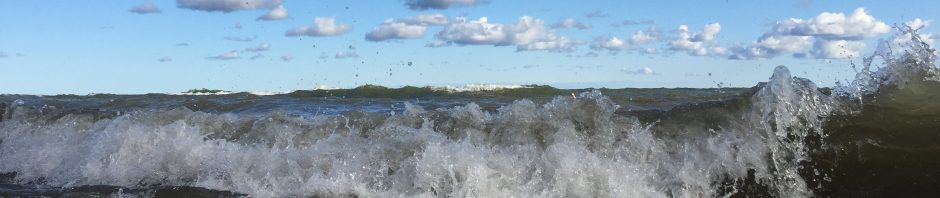
I squeezed in a swim
before work; the lake
was grumpy, turning
its shoulder to the shore.

Now, traffic shimmers
the road like fish, still,
something within me
flexes her wings, soaring

among the shrill gulls,
over the water.

Posted in poetry | Tagged , , , , , , | Leave a comment

Do good. Don’t stop.

A sermon for the fifth Sunday after Pentecost (Year C Proper 9). Also in the news today, the humanitarian crisis in detention centers and camps holding asylum seekers and other immigrants to the United States, including children; the Women’s World Cup Final; and the July 4th weekend. Readings include the healing of Naaman, Paul’s admonition not to become weary of doing good, and the sending out and return of the seventy by Jesus.


The seventy returned to Jesus excited and amped up, saying, “You should see how we owned the forces of evil! How we slayed in the name of the Spirit! We are on fire!”

And Jesus said, “Yesss. Awesome. You are amazing. You are undefeatable. I know, I know that the way of love wins (because, ahem, I am the Way, and the Truth, and the Life). I know that you have it in you to do great things.

“But, not to rain on your parade or anything, but … don’t peg your faith, your hope, your sense of self too closely to the score. It is more important to endure.

Do not become distracted, even by your own indisputable awesomeness, from the way of love.”

This morning’s readings contrast the thrill of the grand gesture against the quiet satisfaction of doing the right thing, come what may, do or die, in a world that may or may not reward it. They encourage us to stay strong, to stay the course, knowing that whether or not the world recognizes it, the reign of God is not far from us.

So Naaman is angry that his healing miracle is not more splashy (pun intended) – but Elisha is more interested in witnessing to the word of God than in pandering to the preferences of an imperial commander. And still, Naaman is healed, when he decides to submit to God’s way, because God is merciful, when we look to them for loving kindness.

Jesus sends the seventy out “like lambs among wolves,” travelling quietly, preaching generously, refusing to be distracted from the way of Jesus into arguments, disputes, or discouragement.

Paul counsels gentleness, and warns against the weariness that comes from setting one’s sights on showy achievements, rather than the steady work of simply doing what is right and loving, for the good of all people and the glory of God.

This is not to discourage grand gestures, and there is certainly a place in our worship for God to celebrate the achievements of the gospel, especially when we have been granted a part in them – what joy! But the way of the gospel, of the cross and the resurrection is walked one step at a time. Sometimes it runs uphill. Sometimes it is dirty, dusty, full of stumbling blocks. Sometimes, it requires assistance, like Simon of Cyrene stepping in to help Jesus with his cross – “bear one another’s burdens,” Paul advises, even as each carries their own. Sometimes, it requires a Sabbath rest in the quiet darkness of the tomb, awaiting resurrection. Sometimes, seemingly insignificant actions build to big rewards.

I read a sweet story recently about a woman in British Columbia who waved every day out of her front window to the schoolchildren going by. It was perhaps the smallest and simplest of gestures, yet it conveyed the message that every child of God needs to hear: You are seen. You are recognized. Your presence matters. You are loved.

The story hit the papers because in May, Mrs Davidson moved from her house to an assisted living facility, no longer on the children’s route to school. Before she left, hundreds of the students she had greeted through the years gathered on her lawn to blow her kisses and wave their signs of love and gratitude to her. Who knows how many times a child had set out on a day that didn’t feel so good, that loomed like a forbidding mountain before them. Who knows how many times they had pegged their hope, their encouragement on seeing that wave, that smile, that small gesture of acknowledgement, the love that would keep them going, one foot in front of another, giving them courage to face the day to come. Through small and faithful gestures of love, Mrs Davidson had taught a generation of children that there would always be someone watching for them, waiting for them, caring about them, their lives, their feelings, their seasons; and they delighted in her affection, and their own love grew. What a parable of God’s loving care for God’s children.

Of course, it isn’t always so simple. Last summer, you remember that while I was visiting General Convention, some hundreds of us travelled to a detention center in Texas holding immigrant and refugee women, many separated from their children. We prayed, we sang, we preached (even better, Michael Curry preached). About half the group or more defied the limits of our event permit, broke away from the pack, and walked the road to the front of the detention center, and waved to the women inside. The imprisoned women described through their contacts later the strength they derived from being seen, being loved; those waves of love mattered. Yet we know that so many of them, or other women and men like them, might still be separated from their children; that they are suffering in squalid conditions unbecoming of one made in the image of God; and that we continue to fail miserably to sustain their children in the knowledge that they are deeply and deservedly beloved.

“The enormity of the challenge is daunting. It is easy to feel helpless to make a difference. While we cannot do everything, we can do something,” Bishop Curry said this month. We can call those representatives who, on our behalf, are elected to organize a righteous, respectful, and human response to those seeking asylum in this country, and call them to account where that response is unacceptable. Where we find opportunity, we can share our resources with refugees resettling in our local communities. We can always pray. We can promote, with our lips and with our lives, in actions large and small, with faithfulness the dignity of every human being made in the very image of our God.

Do not grow weary, Paul advises. Do not pin your hopes on the glorious accolades of empires, splashy success stories, Jesus warns; but don’t give up. As labourers in God’s fields of justice, and of mercy, hoe a straight row, feed the good seed, and do not get tangled up in the weeds. Do good wherever and however you can, for the love of God.

Jesus tells his disciples – and you are his disciples – “You are indisputably awesome. You have infinite potential to love and to be loved. You have great power over all of your adversaries, the serpents and scorpions that bite and sting. Their poison cannot contaminate you, who are sustained by the blood of Christ. Your names are written in heaven.

And even when it seems that no one is paying attention, when no one will hear you, your love, large or small, is not wasted. Let your peace return to you. For in Christ, in love, in fierce righteousness, justice, and in peace, the kingdom of God draws ever near.”

Amen.

Posted in current events, homily, lectionary reflection, sermon | Tagged , , , , , , , , , | Leave a comment

The cathedral

Entering a slanted cathedral,

pilgrim feet sheathed in tourist shoes,

watching for the Spirit’s tell

between the illustrated tombs;

some unquiet air consecrated

to the sighs of an unquiet world.

If our hearts remain stone, and cold,

at least, let their chambers echo mercy.

Attune their empty rhythm to

these stubborn remnants of your praise.

Posted in poetry, prayer | Tagged , | Leave a comment

Stronghold

On a mountain of modest height,
rendered in verse for its appetite
for irony and steadfastness,
they found the man, the poets say,
guarding his skeleton where it lay.

The way to the summit is strewn
with the rubble of prayer, sown
among the crags and cloven rock;
the shifting slate of creation
leavened by small revelation.

The hill, unmoved by pilgrims’ passion,
has shrugged off radioactive ash,
the dust of human hubris, and ice.
The retreat is littered with the living,
hauling home their hope and misgiving.

Posted in poetry, prayer, story | Tagged , | Leave a comment

Birdsong

Birdsong drizzles through

evergreens, soaking earth with

sweetness and alarm.

Posted in haiku, poetry | Leave a comment

Trinity Sunday, 2019

We celebrated the sacrament of Baptism with a baby on her first birthday weekend during this morning’s service. Later in the day, we commended a dear friend to God on what would have been her eighth-seventh birthday. We read from the Proverbs: Wisdom … cries out … “I was daily [God’s] delight, rejoicing before [Them] always, rejoicing in [God’s] inhabited world and delighting in the human race.” In the morning and at the grave, we make our song, Alleluia, alleluia, knowing that God delights in the infant and those full of days, each well-beloved.

A minor technical problem this morning meant that the iPad in the pulpit presented me with an earlier draft of this sermon; but this is approximately and hopefully what I mostly preached.


Baptism is such a hopeful sacrament. It is full of promise: the promise of God‘s mercy, and our commitment, our promise, to live into that mercy. It speaks to the hopefulness of humanity, that we believe that we can do better than to wallow in original sin in all of its all too present ramifications. When we promise, for ourselves or on behalf of our children, to resist evil, to proclaim the good news of God in Christ, to respect the dignity of every human being and to serve Christ in everyone we meet – those promises lay out a roadmap of hope for humanity, for living into the image of God in which we were created.

The waters of baptism speak to us of the original waters of creation, out of which we were created. From the beginning, says Wisdom, God delighted in the human race, in us. In the waters of baptism, we are reminded of John the Baptizer, who saw Jesus coming and declared, “Here is the Lamb of God, who takes away the sin of the world.” And when he came up out of the water, God declared God’s delight once more, saying, “This is my child, my beloved.”

In the waters of baptism we are reminded of the waters of the Flood; the waters with which God has promised never again to overwhelm us; the deep waters from which God has promised to save us, parting the Red Sea, the River Jordan, breaking open a way when we have run out of ways to move forward.

In the Episcopal church we baptize people of all ages, and we have always baptized babies. When people ask me why, I have to wonder why not, because babies themselves are such hopeful sign up new life, new promise. It makes so much sense for us to invest our hope in them, and to share our hope with them.

How do we share our hope?

We put chairs outside the church this week, in order to sit around and maybe have some conversation with our neighbours who might pass by. Some people have voiced a little shyness around what would happen if somebody asked a difficult question that we don’t know how to answer. This could take many forms. We might want to talk, as we go along, about how to find resources for particular needs that might be presented to us, beyond the immeasurable and often underestimated resource of prayer which, trust me, you each carry. Those are things we should talk more about as a community as we continue in this experiment.

But when it comes to describing who we are as Christians, and what we believe in this church, each of you is as qualified to answer those questions as any other.

When we bring a baby into the church and baptize her into this form of Christ’s body, we promise, as parents, as godparents, and as witnesses, a communion of saints, if you like; we promise to raise her in the knowledge and love of God as it is revealed to us in Jesus Christ. And we don’t all promise to do that by going and studying theology at seminary, not that such study isn’t fascinating and useful. But what we more usually understand by that promise is that we will share what we know of the love of God; that we will share the love that God has made known to us in Christ Jesus. We mean that we will share our stories: the stories that sustain us; the stories of hope when all hope was lost. We share the stories of connection and community. We tell the stories of comfort in times of grief, and stories of entertaining doubt. We tell the stories that sustain our own faith, and lift our heads above the water. If we tell our stories of the love which God has for us then we can’t go too far wrong in describing what we believe as a church, because it is those stories that bring us together week by week, that bring us to the font and to the table.

Today is the feast day of the Trinity, when traditionally preachers have turned themselves inside out and committed heresy attempting to explain how God’s unity is expressed in three persons … I am not going to try that today. It is a mystery. But what it means for our everyday prayer is the realization that within God’s perfect being is the reconciliation of relationship, the interplay of love, the communication of difference and solidarity. Those aspects of God promise that we are understood, that we are accepted in all of our difference, diversity, struggle, and longing; that within the heart of a God who knows all about it from experience, we are healed. Within the heart of a God who knows even brokenness, betrayal, the shadow sides of love, we are recognized, accepted, restored.

Within the sacrament of baptism, we participate in a ritual that Jesus modeled for us. The power and the hope of these symbols is tangible. That is the very meaning of sacrament: the tangible, visible sign of God’s invisible and ineffable grace: the mystery of our Creation, the solidarity of Christ’s Incarnation, the continuing delight of the Holy Spirit.

As we are blessed by the hope that is set before us in the sacrament of Harper’s baptism, let us live into the promises we make on her behalf, and on our own. Have no fear, but always to be ready to give an account of the hope that is within you, with gentleness and reverence, by the grace of God (1 Peter 3:15).

We will, with God’s help.

Amen.

Posted in holy days, sermon | Tagged , , , | Leave a comment

Fridays are for mortality

It had been quite a week, what with the outrageous fortunes of modern medicine: half miracle, half guesswork, half science; early morning conversations about the (hopefully hypothetical) call to martyrdom in a culture that refuses the way of the cross, preferring to “stand its ground.”

It had been a week, with sudden death, and the impossible burden of stewardship over the life of others; decisions over what constitutes a full life, a good death.

Mortality is a beast, and in the midst of its mob we proclaim eternal life.

Broken eggshells on the ground outside my door might signify birth or its interruption; regardless, the birds sing mightily. I wish my prayer was as articulate as theirs.

Then, the choice of incarnation, an island carved out of immortality, implies that God is not immune to hard weeks.

The endless knotted dance of the Trinity replies that even such grief as love often hatches can find comfort in the intertwining of time and eternity, embodiment and ashes, the lilting of the birds and the sighs of prayers too deeply buried for words, disinterred and sung aloud around the throne of heaven.

Posted in prayer, sermon preparation | Tagged , , , , | Leave a comment

Pentecost 2019: Come, Holy Spirit

A sermon on the Day of Pentecost at the Church of the Epiphany, Euclid, Ohio


The church sometimes refers to the time “before the Holy Spirit came,” which is a nonsense, when you think of it, since the Spirit has been present since before the birth of creation, brooding over the waters of the uncreated deep. She breathed life into the nostrils of the first human animals, according to the old stories. She has never been far from us.

The trick is to catch sight of the movement of her wings, to hear the vibrations that she creates, the rush of air, the breath of heaven.

We are often, in this day and age, and in this demographic, and in this denomination of the church of Christ a little frightened of the possibilities and permutations of the Holy Spirit. We do not trust her power not to overwhelm us. We do not trust ourselves to resist her, should she ask of us something outrageous, like preaching the gospel, like laying down our lives for the one in whom we profess to have faith, like opening ourselves to the mockery of the crowd, our peers, the worldly ones; because that is what happened to the apostles on Pentecost.

Actually, it was not only the apostles, but all of Christ’s disciples who were filled with the Spirit and drunk on her heady intervention. So who are we to hold back?

The story of the Babel tower in Genesis is part of the prehistory of the first several chapters: myths and legends from the mists of time, seeking to understand and illustrate our preexisting condition of dependence upon the love and mercy of God. It is clearly on a par with other ancient folk tales that seek to explain how the human race learned to make tools, and bricks for building, and language. It is a story that understands our origins in beings that we would struggle to recognize as human – with few words and little diversity of language; who were only just discovering the means to build beyond the capability of other animals. It is always astonishing to realize how instinctively our ancestors grasped the evolutionary concepts which it has taken us centuries to rediscover.

Anyway, the authors of this story in the Bible understood that it said something not only about our relationship to creation and time, but to our Creator and the eternal Spirit that continues to draw us together however diligently we divide ourselves by language, tribe, and nation. They explained that the reason we were scattered was that in our pride, and in our fear, we, in the form of our ancestors, decided that the only way for us to grow stronger was to contend with God in God’s own domain, and to build such a fortress as could reach out and contain God’s power.

Control issues are so often rooted in fear. Our ancestors were afraid to be a little less than gods, and so they fell away from loving God, and in turn were divided from their neighbour.

I sympathize: I do not like relinquishing control. Once, at college, I attended a Christian Union event in which we prayed for the anointing of the Holy Spirit, and I guess my prayers were answered, because I found myself reduced to a weeping wreck. I felt within me my defences dissolve, and the barriers to mercy and embrace that I had, in good faith, erected swept away. I will be honest; I would prefer for that not to happen again. I might even prefer martyrdom.

The experience was, however, cleansing for me. It helped to wash away the shame that came with hiding the grief I had built up through that day. It opened my heart to the tears of others. It spoke in a universal language to those around me – they did not need to know me, my story, my family, to recognize what my tears were saying. In other words, the Holy Spirit did her work as the universal translator, healer, caller.

The disciples who received the anointing of the Holy Spirit on the day of Pentecost found themselves opened up to their own experience of Jesus, of death and of resurrection. They found themselves wide open to the understanding and the misunderstanding of others. They found themselves impelled and compelled to share the gospel, the prophecy, the truth that God is with us, that God speaks our language, that God will not leave us alone. That the way of love alone is viable.

We like to say that we live in the most divided times we can remember or imagine. Imagine being at the construction site around the tower at Babel, and in a moment to be divided from your neighbour, your son, your cousin whom you have known all your life, by a sudden change in language, in intonation. We are not the first to suffer this impediment.

Imagine gathering around the City of David, waiting to enter the Temple on the Feast of Weeks, Pentecost, and hearing of a sudden that clarion call of the Holy Spirit: the gospel of Jesus Christ, the hope of the world and the grace of salvation offered through the way of the Cross, of death and resurrection, of the rejection of the limitations and liabilities of this world and its empires. Would we be among those awestruck and leaning in – “They speak in my language” – or would we stand with those descendants of the Babel crowd, protecting ourselves from the Holy Spirit, saying, “Go home. They’re drunk.”

The language of the people building Babel was limited. In the RSV, it says, they had few words. They spoke in the slogans that they had inherited and they did not explore nuance nor wait for gray areas to develop in the darkroom. But the Holy Spirit, who brooded over the waters before creation began, has every good idea imaginable in her vocabulary, if we will only hear her.

It is frightening, laying ourselves open to ideas beyond our experience. It is exhilarating, though, to learn another language, to communicate beyond borders, to be understood and to understand as though we were made in one image, descended from one ancestor; as though we were one family, with God as our Mother and our Father.

The people of Babel wanted to control the Holy Spirit and claim the knowledge of God for themselves. The disciples of Jesus were pretty well schooled in the concept that God works outside of our constructions, having witnessed Jesus’ Incarnation, Crucifixion, Resurrection, and Ascension. The choice that we have inherited is whether to work without or even against the Spirit, risking division, disruption, decay; or with the Spirit, risking mockery, madness, mayhem, in the name of the reign of God that restores our unity in the image of God. The choice is still ours.

We are often, in this day and age, and in this demographic, and in this denomination of the church of Christ a little frightened of the possibilities and permutations of the Holy Spirit. We do not trust her power not to overwhelm us. We do not trust ourselves to resist her, should she ask of us something outrageous, like preaching the gospel, like laying down our lives for the one in whom we profess to have faith, like weeping openly in mixed company.

Yet Jesus told his disciples, Do not let your hearts be troubled, and do not let them be afraid.”

The story of Pentecost is paired with Babel in our Bible readings because when the lives we thought we were building fall apart, it is the Holy Spirit, our comforter and advocate, who can interpret for us and show us the way forward.

The choice is still ours, but I invite us to take a minute or two, on this her festival day, to pray for the visitation of the Holy Spirit, to do what she may, because she has been with us since creation began. Without her, we have no idea how to build our future. With her, anything is possible.

Come, Holy Spirit. …


I am currently reading The Holy Spirit & Preaching, by James Forbes (Abingdon Press, 1989)

Posted in holy days, lectionary reflection, prayer, sermon | Tagged , | Leave a comment

On Pentecost

Few languages are universal.
That we have made the gun one
of them is blasphemy against the Spirit
who brooded over creation; ever the image of life.

Would that we would bury the language of death under love,
even if the mockery of the crowd follows us to the morgue.
If we preach the empty tomb, we should be prepared,
perhaps, to explore it.

________________________________

The title of this post has been updated.

Posted in gun violence, holy days, poetry | Tagged , , | 2 Comments