Salt, light, love

A sermon delivered at the Solemn Sung Eucharist service of Trinity Cathedral, Cleveland, Ohio. The propers are for the Fifth Sunday after the Epiphany

_______________

You are the salt of the earth; … You are the light of the world.

What do salt and light have in common? Each of them works to enhance everything around them.

Salt is used to bring out the flavour of food, to nourish the earth, to melt the ice beneath our feet or our car tires; it has many uses, and each of them draws focus from the salt itself to the environment which it is improving and healing. Salt dissolved in water is an antiseptic and a balm. In one of the stories from the law and the prophets, Elisha casts salt into the stream near Jericho and the water is cleansed and the land that it irrigates begins to produce good food after a long period of famine (2 Kings 2:19-22).

Light, likewise, illuminates not itself but the space around it, and the faces, those images of God dimly revealed and deeply shadowed. Looking into the light itself may be contraindicated: never look directly at the sun; even reflected off cold snow, it can be blinding. But without it, we are lost. A candle set upon a lampstand sheds light upon the room in which it stands: the people, the well-seasoned food, the furniture, so that you don’t stub your toe on the lampstand, or the bushel in the corner.

Salt and light: this service, this outreach, this is their essence. They are vital, and they exist not to their own ends, but are part of God’s marvellous and intricately interwoven plan for the sustaining of God’s creation.

Another thing that salt and light have in common is that they can become dangerous. Salt, if it becomes too concentrated, causes all kinds of chaos, from kidney stones to the lifeless waters of the Dead Sea.

And in the example that Jesus gives, hiding a light under a bushel is not only counterproductive, but it’s really quite risky. If you put a candle or an oil lamp under a rush basket you are asking to burn down the entire house. If you set it under a ceramic bowl, it will consume all of the oxygen surrounding it before it burns out; it may even crack the bowl with its heat as huffs up all of the available air.

The light cannot exist only unto itself, or things will begin to go awry.

You are the salt of the earth; you are the light of the world. Jesus is telling his disciples something about our essence, the ideas that God had about us when we were created. That we were not meant to be and live only for ourselves, but made in the image of God, to point one another back toward the source of our life and all that is beloved.

Jesus goes on to say that he has come to fulfill the law and the prophets. And how does he sum them up, when he is asked later by a lawyer? “You shall love the Lord your God with all your heart, and with all your soul, and with all your mind … You shall love your neighbour as yourself. One these two commandments hang all the law and the prophets.” (Matthew 22:34-40)

To quote our Presiding Bishop, if it’s not about love, it’s not about God.

Love, salt, and light: none of them is designed to serve itself. Each of them is essential to the order that God has created. Salt does not lose its saltiness when it is used to flavour our food. Light is not exhausted by its shining. Love does not run out.

But if salt has lost its saltiness, Jesus warns, then it is worth nothing. If we forget that even our righteousness is not ours to keep or to hoard, but it is to do justice, to love mercy, to walk humbly with our God (Micah 6:8), as we heard last Sunday – if we for a moment think that our righteousness is ours to keep, then we have lost our way.

No: like salt, like light, like love, it is ours to spend. As salt, we can make a difference for someone slipping on thin ice; as light, give hope and a hand to someone who is lost and afraid of the dark. It is our righteousness, if we understand ourselves to be disciples of Jesus, salt of the earth and light for the world it is our call to right the wrongs of injustice, to free the oppressed and the tormented, to heal the bruised, to bring the dead to life (Matthew 10:7-8). To bring the dead to life: to say their names.

We may say, but I am only a little pinch of salt, a modest candle.

But here’s another astonishing thing about what Jesus tells his disciples, and the crowd, pretty indiscriminately on the mountainside. He says, “You are the light of the world.” Who is the Light of the world? He is the Light of the world! He says it himself elsewhere (John 8:12): “I am the light of the world. Whoever follows me will never walk in darkness but will have the light of life.”

Salt of the earth, essence of creation, light of the world, love of God: he is telling us that he is with us, that we are not alone, that we were not created to be alone, apart from him, apart from God. He has shed his light upon us, dim and deeply shadowed images of God that we may be, so that we can see and taste God’s glory, God’s mercy, God’s justice, God’s grace among us.

You are the salt of the earth; you are the light of the world. It is our call and it is our essence, to give thanks to God who created us; to follow Christ, who grounds us; to love God, to love our neighbours; thereby to change the world even one grain at a time, trusting that, in the words of the apostle, “What no eye has seen, nor ear heard, nor the human heart conceived, [that is] what God has prepared for those who love him”. (1 Corinthians 2:9)

Posted in homily, lectionary reflection, sermon | Tagged | Leave a comment

From the forge

I made
a heart; hammered
away at steel
hot from the forge
until I got into its groove,
turned the base until
it barely looked
like the barrel of a gun
any more.
I sliced it with the saw
until it wouldn’t hold
any more.
I thought about
that Bible verse,
turning hearts of stone,
but this one,
these are still metal,
and magnetic;
they make that hard
ringing sound when they fall.
They remember
the hardness of heart
that created them.
I hope that they remember,
too, the fire
that moulded them
into something new.

Posted in gun violence, poetry | Leave a comment

A Song of Anna

This post first appeared at the Episcopal Cafe


In the story of Jesus’ Presentation at the Temple, and the purification of his blessed mother, Luke tells of two words that Simeon utters. The first is a hymn of praise to God that Simeon should have seen the coming of his Christ. The second addresses the holy family, blessing them, but adding some words of caution for his mother, that this epiphany would not be without trouble, and that its sword would pierce her own heart.

Then we are introduced to Anna. She has spent several decades, the majority of her life, in the Temple as a widow devoted to worship, fasting, and prayer. When she sees the family and their child, she too breaks into praises, and she, too, has something to say about what this means, the coming of the Messiah, the birth of the Christ, and his appearance in the Temple. She tells all who will listen – but her words, unlike Simeon’s, are not recorded.

Simeon’s song, the Nunc Dimittis, crops up regularly in our liturgies, especially during Evening Prayer. I wonder what it would sound like, what it would feel like, if we had Anna’s song, too, to sing as our prayers rise like incense at the end of the day.

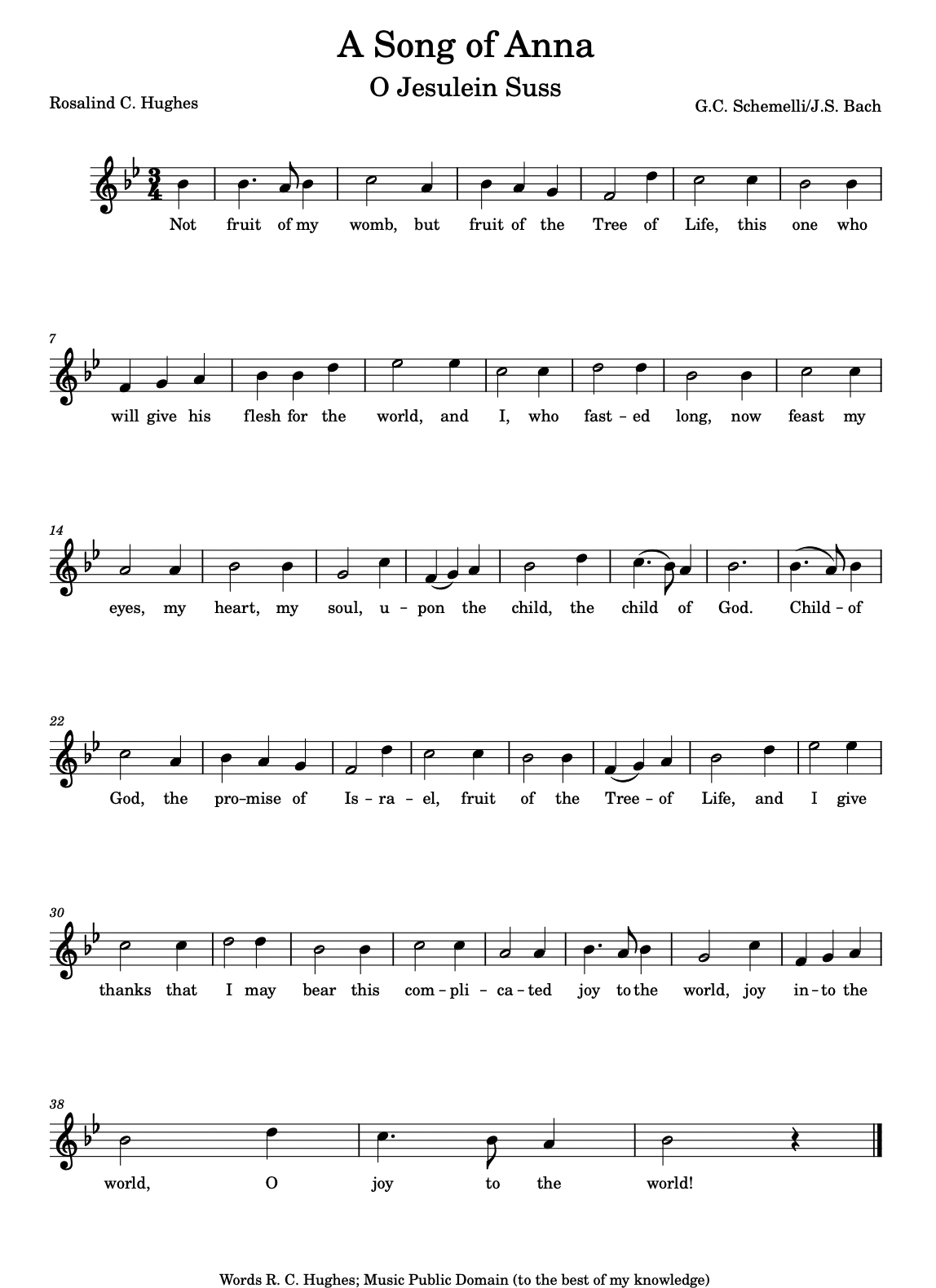
Not fruit of my womb,
but fruit of the Tree
of Life, this one
who will give his flesh
for the world, and I,
who have fasted so long,
now feast my eyes,
my heart, my soul,
upon the child of God,
the promise of Israel;
Not fruit of my womb,
yet I give thanks
that I may bear this
joy into the world.


Posted in holy days, lectionary reflection | Tagged , , , | Leave a comment

A hymn in response to gun violence.

Feel free to sing, share, etc (you can also sing it with your favourite LM hymn tune). Message me if you’d prefer it as a pdf. I’d love to hear from you if you do sing it – or even hear a recording. And if you have been affected by gun violence, my prayers are with you.

Posted on by Rosalind C Hughes | Leave a comment

(A conversion) not (of St Paul)

No lightning bolt
nor sudden fall
but the gentle tap-tap
of mercy raining
like hoofbeats
like heartbeats
over the umbrella
of consciousness –
Who are you?

You sang,
my pied piper;
I was powerless
not to follow;
you led my soul
astray, and it has never
(it has rarely)
looked back to see
the salt flats
of life without
You.


This poem first appeared at the Episcopal Cafe in the Episcopal Journal

Posted in holy days, poetry, prayer | Tagged , | Leave a comment

Fishing

A sermon for the Third Sunday after the Epiphany, Year A Epiphany 3: Matthew 4:12-23. In our prayers we remembered those killed, injured, and terrorized by another mass shooting overnight, this time during celebrations of the lunar new year in Monterey Park, CA.

______________________

Once upon a time a hundred years ago when I was about nine or ten, I embarked upon a fishing trip off the west coast of Scotland. The sea that summer day was white and gray, the spray was cold and constant, and I think that may have been when I found out that I suffer terribly, horribly from sea-sickness.

For all that, I can’t bring myself quite to wish it hadn’t happened, or that I hadn’t gone, because a couple of hours in, at our furthest point from shore, we saw suddenly a pair of pilot whales breaching. It really was the most amazing thing. It was almost like looking into another world, and if I’d stayed safely back on dry land, I would have missed them. Worse still, I might never even have known what I was missing.

All of which is to say that if Jesus comes by and invites me on a fishing trip, I’m going to be torn. I know that there is going to be deep and abiding misery: look at the garden, look at the cross; look at John’s imprisonment and the people who wanted to throw Jesus off a cliff; look at his own words, “Foxes have holes and birds have nests, but the Son of Man has nowhere to lay his head.” Look at the storm, and the disciples’ terror: “Master, do you not care that we are perishing?” There will be sea-sickness.

And yet there will be, too, those glimpses into another world. Moses and Elijah on the mountaintop. Jesus preaching in the synagogue, “Here, today, the words of the prophet are fulfilled.” The healing miracles, the victory over demons and death, and that other scene on the beach, after the cross, after the disciples have come home here once more to Capernaum, to the Sea of Galilee, and to their nets, when they come ashore in the morning light and find Jesus and the fire and the food, and he calls to them to catch one last harvest before sending them back once more to Jerusalem.

How much of this do Andrew and Simon anticipate when Jesus comes to them in the morning as they fish from the shore? This is after John the baptizer has been arrested and imprisoned; Jesus has withdrawn north to Galilee, and so, it seems, have these two, whom we last met down by the Jordan river, when they were disciples of John who turned to follow the stranger whom John called the Lamb of God, whom Andrew already recognized as the Messiah.

After John was arrested, they returned to Galilee and to their nets. They must have lost track of Jesus when he went into the wilderness alone after his baptism, during those long days of fasting and temptation. And here he is, back as if from the dead, and once again, they follow him.

They know that following will not protect them from the world, any more than putting out to sea shelters them from the storms that follow the water. There are still fevers that put fear into a community; Simon Peter’s mother-in-law nearly died of one, before Jesus lifted her up and set her back on her feet – remember that story? Not everyone in town got so lucky.

There are still harsh words from those who don’t understand the lives they lead, the choices they make to leave the traditions of their fathers, to leave father Zebedee in the boat with the hired men, to walk away first to follow John, and now this other, this Jesus, this dangerous preacher. “Shake the dust off your feet,” advises Jesus, but it’s not so easy. Mud sticks, and dust gets in your eyes.

There will be worse to come, from the Romans, in due course. Following will not save them from seeing their loved ones die, nor from burying them.

Jesus is not taking them out of the world, but into it. He calls them away from the nets and the open water, and promises to make them fish for people. He is calling them back into community, but a community centred no longer on survival, but on salvation. And they follow.

Julian of Norwich, medieval mystic, in one of the visions granted her at death’s very door, saw herself walking as it were upon the seabed, and she understood from that “showing” that if one were to walk with God, in the plain and certain sight of God, that person would not only be safe in body and spirit from the weight of the ocean and its depths, but they would know greater peace and comfort than anyone still on dry land, safely and ordinarily ignorant of the ever-tending mercies of God.[i]

There have been times, to be sure, in the past few years filled with fevers and violence and more when we have felt at sea, or underwater, or worse. But then there are those moments where we see into another world, the world as it might be, the world as God wants it to be, with all of God’s heart, with all of God’s might, with all of God’s life. The moments when we recognize that here is the Messiah, that God is with us, that God is calling to us, in the midst of the everyday, after the arrest, in the midst of the fever, in the wake of bad news or good; that Christ has come to find us, to feed us, to save us.

That when we are farthest from the shore, glory will still breach the surface.


[i] “One time mine understanding was led down into the sea-ground, and there I saw hills and dales green, seeming as it were moss-be-grown, with wrack and gravel. Then I understood thus: that if a man or woman were under the broad water, if he might have sight of God so as God is with a man continually, he should be safe in body and soul, and take no harm: and overpassing, he should have more solace and comfort than all this world can tell. For He willeth we should believe that we see Him continually though that to us it seemeth but little [of sight]; and in this belief He maketh us evermore to gain grace. For He will be seen and He will be sought: He will be abided and he will be trusted.” The Second Revelation, Chapter X, “God willeth to be seen and to be sought: to be abided and to be trusted.”

Julian of Norwich, Revelations of Divine Love, edited by Grace Warrack (digireads.com, 2013), via Kindle

Posted in lectionary reflection, sermon, story | Tagged , , , , | Leave a comment

Leading cause

I saw the eagle twice today;

once above the middle school

pinned out against the sky,

spread upon the wind,

a standard flying;

then again a vision

hunched over the cemetery,

image of an angel,

ugly crying.

__________________________

In 2020, gun violence became the leading cause of death for children and teenagers in the US

Posted in gun violence, poetry, story | Tagged , , , | 1 Comment

What’s in a name?

A sermon for the Second Sunday after the Epiphany, Year A


A couple of weeks ago, we celebrated the Feast of the Holy Name, and we talked about what it meant for Jesus to be given a name that means Saviour: what it meant for him, what it means for us. 

This Sunday’s readings call us back into the contemplation of names; or they did for me. The prophet writes, “While I was in my mother’s womb, God named me,” and he links that to his call, to prophesy, to proclaim to the people the faithfulness of God. Isaiah’s name means, “[God] is Salvation.” Was his name itself a prophecy, a promise, a call?

We read, too, the epistle from Paul, who was once called Saul; who embraced another name as part of his new vocation to preach good news to the nations, to the gentile world. 

Then there is this Gospel, in which Jesus meets Simon for the first time, and without hesitation (apparently) looks at him and sees the rock, his rock, Peter. 

Peter wasn’t always rock solid. He had his moments of fear, of confusion. When he tried to walk on water, he sank like a stone, or he would have, if Jesus hadn’t been there to hold out his hand.

But in this moment, Jesus calls him, names him, prophesies that this will be the one against whom the first generations of the church will crash and clash; who will stand firm, and found a community that will build upon the Gospel, and bring the good news of the salvation of God, Jesus, to a new world.

We talked a little at Bible Study this week about what it means for Jesus to call Simon Peter. What he might call one of us, each of us, if he were to name our call to discipleship, if he were to prophesy about our ministries, if he were to offer us a name to live into, to live up to.

Take a moment to consider that: by what name does God know you? By what name, into what name does God call you? What does that tell you about the path of your discipleship, about the ways in which you are called to live into the Gospel of Christ?

In today’s Gospel, John calls Jesus by a new moniker: the Lamb of God. Is it a prophesy? Here is the lamb of God who takes away the sin of the world. Here is the scapegoat, the one who takes on the curses that this world offers and removes them from the faithful community, through the cross, through the tomb.

Here is the lamb of sacrifice, the Passover of our God, who marks us safe from the angel of death, and leads us to new life beyond the sea.

In today’s Collect, he has yet another name: the light of the world. Here is the one who saves us from the weight and drag of the “mire and clay”, who pulls us out of deep waters when we are sinking, who does not let the world drown in its own sin.

Here is the Lamb of God. The disciples of John heard him say it, and they turned immediately and followed him. Jesus saw them following and asked them what they were looking for. And when they stayed with him, and when they told their friends and family about him, and when Andrew went and found his brother, and brought him to Jesus, Jesus looked at him and named him, called him, claimed him as his rock.

By what name does he call you? And will you follow?

Posted in lectionary reflection, sermon | Tagged , , , , , , , , | Leave a comment

A star that never burns out

A sermon for the Sunday of the Epiphany, 2023


At the Epiphany, God revealed Godself to the nations, to us, to the world. But we are no longer the outsiders; Christendom has become the establishment, the seat of power. Things change, empires shift, history shuffles the players. God remains true, and unhidden, if we will but look for the Christ-child.

Whenever we read the story of the unveiling of the Messiah to the gaze of the world, we read, too, of the willful and deviant way in which Herod receives the news. 

Because Herod had everything that he needed to hear from God. He had the same revelation that the magi received, the natural phenomenon of the stars in the night sky, interpreted by some as omens; he could have heard the music of the spheres, but he was afraid, and the harmonies soured in his ears.

Herod had the scriptures, the prophets of the Lord, the ones who foretold God’s coming in peace, in mercy, to hasten the salvation of God’s people and their reconciliation with God and with one another; the dawning of a new light, as different from day and night as darkness of the ocean depths is from the stars of outer space.

Herod had the community of faith, to parse and discuss and pray and to apply the scriptures to their current situation: Here, they said, Bethlehem is the place. There is where we will find the Emmanuel of God, the good shepherd, the anointed one.

This is the good news of the boundless riches of Christ’s grace, writes Paul; the mystery of God’s mercy, revealed “so that through the church the wisdom of God in its rich variety might now be made known to the rulers and authorities in the heavenly places” (Ephesians 3:10) 

And instead of hearing good news, and celebrating with his scribes and recognizing the glory to which he had been called – nations shall stream to Zion, wrote the prophet, and here was Herod’s Great Temple to welcome them – instead of living into the revelation that had been opened to him, instead of accepting the role of that had been offered him, of ushering in the new messianic age as architect of his worship and protector of his person, Herod chose destruction. His is a cautionary tale amidst the strange and foreign joy of frankincense, gold, and myrrh.

The star contains within its fiery heart the flaming gas of the Hindenburg; the clouds that obscure it are full of the tears of the innocents and their mothers terrorized by Herod and his historic descendants; revelation is not always received, and even wisdom may be misapplied. 

This week, a ceasefire was suggested to mark the birth of Christ in the east; the suggestion was not taken. 

Back here, as we marked the feast of the Epiphany, a six-year-old got into a fight with his teacher and shot her. Where do you think a six-year-old got that idea, or the means to make it real? What does it say about us, our received wisdom about the rights that bind us to violence; how can we receive the revelation of God’s incarnation in a child, when we allow for this new and twisted massacre of the innocents?

This week, in our world, leaders made fools of themselves and one another. It’s a good thing that we do not elect our god. We Christian churches amongst ourselves cannot agree half the time on what it means to follow Jesus, what it means for us, what it means for the world.

Yet it is “through the church [that] the wisdom of God in its rich variety might now be made known,” writes Paul. Which means, church, that we have work to do: work of discernment, work of prayer, the work of declaring peace on earth and making it real; the joyous journey of making known to the world the munificence of a God who was born king of the stable, lord of the manger, hope for the world.

We may have begun this year a little weary from our worldly journeys. But this feast, the Epiphany, God’s revelation of Godself to the nations of the earth, to the people of east and west, to the uninformed and the interested, the powerful and the poor, the wise and the fools who do not know God; this is our feast day. It is ours to celebrate, and it is our calling.

Herod was afraid of what the birth of a messiah might mean for his way of life, his compromises with the Caesars of the world, his great legacy. But God reveals Godself in love, in humility, in vulnerability, so that we may be in awe, but not afraid.

The magi were drawn far from home, pilgrims to a strange land, where they may have received an uncertain welcome; the king met with them in secret, there was subterfuge and whispering. But when they reached Bethlehem, they knew that they had come home. They unpacked their treasures, and left their hearts open on the floor before the cradle, the manger, the messiah.

The wise ones came seeking Christ, but the foolishness of God is famously wiser than the highest wisdom of humankind (1 Corinthians 1:25). In God’s foolish wisdom, God came looking for us, in the form of a child, in self-revelation, through the stars, through the scriptures, through the discerning community of faith.

Ninety-five years ago, the parish of Epiphany came together to seek and serve Christ in this place. They had everything they might need. We still do. While things change, empires shift, history shuffles the players, God remains true, and unhidden, if we will but look for the Christ-child.

The world still sometimes seems impervious, even opposed to the messages of mercy, the humility of incarnation, the love of God, peace that surpasses understanding, but we are not, are we?

So be of good courage. Follow, not the flaming ball of gas, but the light that is Christ: the embodiment of the love of God; the innocence that is wiser than our wiles, the grace that journeys with us, washes our feet when we are weary, feeds us when we are hungry, encourages us where we are faithful; the star that never burns out.

Posted in holy days, sermon | Tagged | Leave a comment

Follow the star

But what if I have spent too long 
staring into space longing for a sign

What if the mystery were here all along 
in the tall grass of childhood 
the stumbling steps of grief 
the sudden sharp discovery underfoot 
that all is not yet seen 
the dizzying descent of life into earth 
disturbed by the late winter planting

Light from the star is too long arriving
Mined from the mundane hope is arising

_________________

Photo credit: Edward Hughes. First published at https://episcopaljournal.org/follow-the-star/

Posted in holy days, poetry, prayer | Tagged , , , | Leave a comment