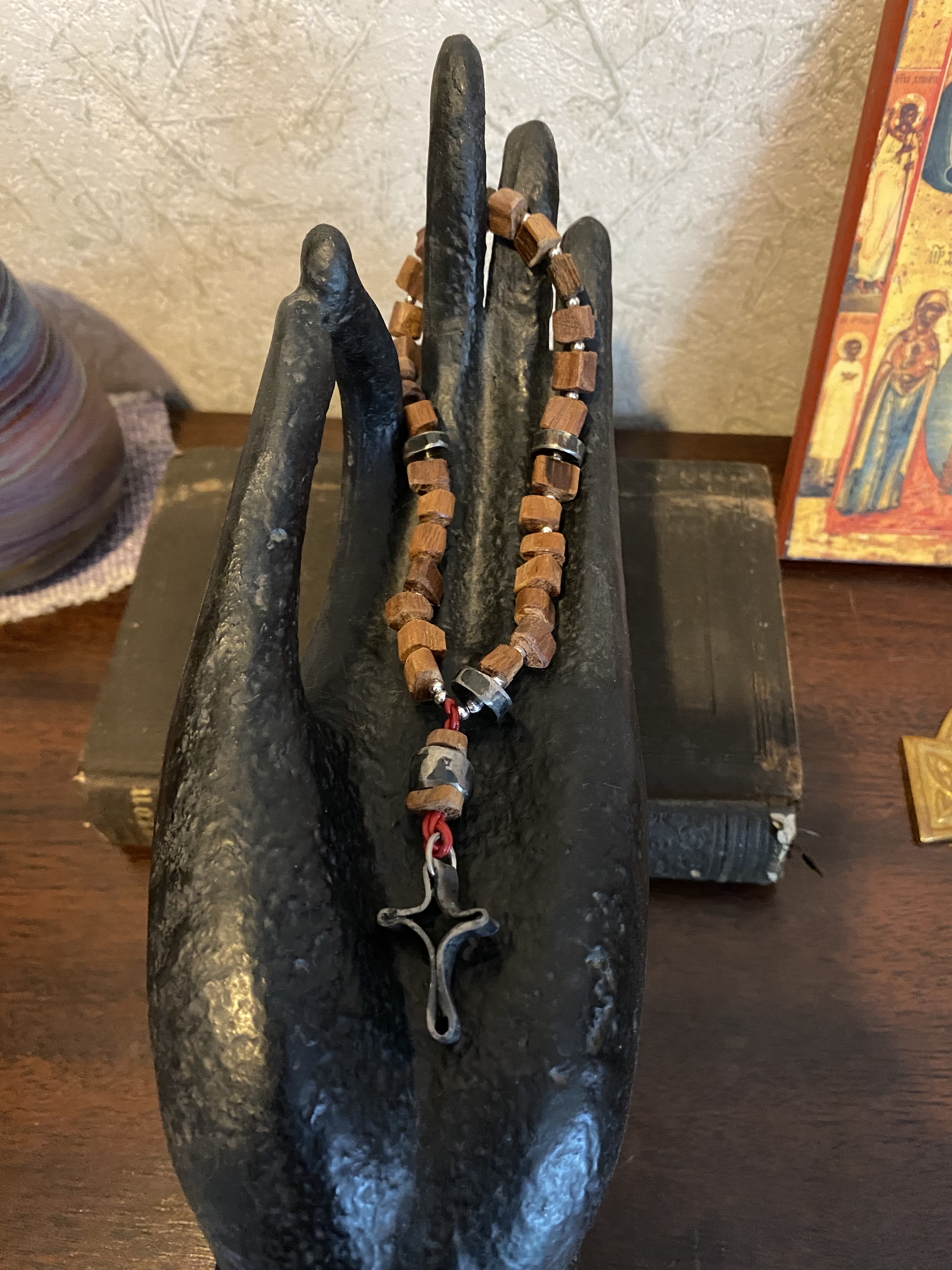
Dressed for a wedding or a war

A sermon for 15 October 2023, on Year A Proper 23 readings Matthew 22:1-14, Philippians 4:1-9, Exodus 32:1-14, at the Church of the Epiphany, Euclid, Ohio


Paul writes, Beloved, whatever is true, whatever is honorable, whatever is just, whatever is pure, whatever is pleasing, whatever is commendable, if there is any excellence and if there is anything worthy of praise, think about these things. Keep on doing the things that you have learned and received and heard and seen in me, and the God of peace will be with you.

“The God of peace will be with you.” But this is not a peaceful parable. 

Remember that it is being told in the holy city during Holy Week. Tensions abound, becoming unbearable. As Jesus was arriving to Hosannas through one gate, Pilate was processing with Aves through another.[i] The chief priests and elders, the Pharisees and the faithful are caught between them, fearful not only of God but of the empire. The so-called Pax Romana, an uneasy and ill-named peace maintained only by brutal conquest, was not an easy rule under which to live.[ii] And they so wanted to live, and to sacrifice the Passover in the Temple, and to tell their children the old stories of God’s deliverance, and for their children to believe them.

And how is that even possible, when the fear of the golden calf, or the bull-calf sacrificed to Mars the Roman god of war, is as strong a motivator as the love and fear of God? 

So Jesus tells them this parable, about a wedding feast, the consummation of God’s love for God’s people.

In the story, there is a king. He invites the kind of guests a king would expect at his table: rich merchants and so on; but they will not come. Worse, they do violence to the messengers sent to bring them, just as Herod beheaded John the Baptizer, as Zedekiah handed Jeremiah over to be half-drowned in the mud pit, as Jezebel and Ahab tormented Elijah and pursued his life.[iii] Some do not want to hear the summons of God, even to the feast. Some would rather dress for war than for a wedding.

Too often we have heard this parable as the rejection of one class, race, or religion of people and the elevation of a substitute, as though God were subject to the same division as we practise among the bearers of God’s image. Too often we have decided that we are to judge who is invited first or second, or who is improperly dressed, instead of looking at our own invitation and making sure that we are ready.

But in the story, the people are not shut out of the feast because of who they are, but because they refuse to come, because they refuse to lay down the distractions of business, money-making, empire-building, or simple self-interest that keep them from seeing the grace that God has laid out before them. And look, the others that are gathered in from the highways and byways, they are good and evil alike. They are not the virtuous, the moral elite. They are just people, willing to come to the wedding and sit down together around the table.

There is no avoiding the acknowledgement, with fear and trembling, of the terror attacks that ravaged Israel last weekend. Let it be said clearly that there can be no justification for such cruelty, such atrocity. The terrible stories, the awful details continue to emerge. We hesitate in the face of raw pain, yet it must also be clearly said that there can be no justification either for cruel vengeance. We have heard from our own churches and hospital there how desperate conditions have become in Gaza. To withdraw the human rights to life and living water and any hope for peace from an entire people cannot be what Christ commands. 

Too often we dress for war instead of the wedding feast, ready to wield the sword against the unworthy, to cast out one people and elevate another. We relegate Christ to the role of the man of sorrows, cast out by our arrogance into the darkness, where he wails and weeps over Jerusalem.

There is, it has to be said, a moment in the parable which would seem to prop up our desire for punishment, whether or not it results in peace. The reaction of the king to the rejection of his invitation and the abuse of his servants is fierce. He destroys those murderers, and burns their cities. How many innocent servants and citizens, how many children perished in that revolt? It is unfathomable.

Yet when the moment comes for the elders and the authorities to come and arrest Jesus, as the prophets were abused and killed before him, he does not wreak vengeance. He tells them clearly, I could bring down legions of angels to destroy you (Matthew 26:53-54); but that is not how this story goes. That is not how the Gospel goes.

Because the parable, the Gospel, is not about revenge. It is not about rejection. It is about the complicated, difficult time we have gathering around a table, good and evil alike. It is about the tendency we have to pull away from God’s invitation to celebrate the Christ, even on his way to the Cross, because we would rather look away. It is about the ways in which we resist the call to end the violence, against the prophets, against the innocents, against God’s invitation to mercy, against each other, preferring to keep up the cycle, dressing for war instead of for a wedding. 

And it is about God’s tendency to keep reaching out into the highways and byways, calling good and evil alike, anyone who will listen, regardless of history, ethnicity, anything except the willingness to accept the invitation to come to the table, to put down the sword and put on the wedding garment, to be fed with the bread of life, the water that washes away all tears, the medicine of mercy.

Because the Gospel is the incarnation of God’s love, not of our failure to love.

St Paul knows that better than many. And so he writes, Let your gentleness be known to everyone. The Lord is near. Do not worry about anything, but in everything by prayer and supplication with thanksgiving let your requests be made known to God. And the peace of God, which surpasses all understanding, will guard your hearts and your minds in Christ Jesus.

May it be so. Amen.


[i] See The Last Week: What the Gospels Really Teach About Jesus’s Final Days in Jerusalem, by Marcus J. Borg & John Dominic Crossan (HarperOne, 2006), 2-3
[ii] See Post-Traumatic Jesus: A Healing Gospel for the Wounded, by David W. Peters (Westminster John Knox, 2023), esp. chapters 2, 9
[iii] Matthew 14:1-12, Jeremiah 38, 1 Kings 19:1-3


A lament for peace

God of mercy,
your peace still passes our understanding, and far off seems the time when we will study war no more. Rachel weeps anew and unconsoled, for her children dead and missing; a grief which is both universal and particular. 
God of compassion,
protect the innocent, receive the dying, be among the grieving, strengthen the hands of those who labour for life and peace.
God of peace,
save your children from vengeance. Turn our hearts toward wisdom. Guide the powerful, stay the hand of the desperate, and shepherd your people toward your peace, though yet it passes our understanding.
Amen.

A prayer for the helpers

O God, our salvation and our hope,
be with those who venture into danger to help and save the innocent, the injured, and the lost. Be with those who continue to work for the relief of pain and grief under impossible circumstances. Sustain those who bear the weight of their own trauma even as they tend to the wounds of others. Protect the hearts of those who will see terrible things. Give them hope that in serving the vulnerable, they are your hands and feet and heart in your world. Save them, save us from this time of trial, and deliver us from evil.
Amen.

Posted in current events, lectionary reflection, sermon | Tagged , , , , , | Leave a comment

Burned

This week’s #preparingforSundaywithpoetry is informed not only by the Gospel and its parable of rejection, revenge, celebration, and their cycle, but inevitably by the images it calls up of contemporary violence, war, and burning cities; God save the innocents.


After the burning,
in ashes stirred by the tow
of a cautious breeze,
dawn steps with reverence
over the city so heavy in its fall;
over its delicate fragments
a mourning dove hovers, weary
yet unwilling to alight
upon her sorely singed feet.

Posted in current events, lectionary reflection, poetry, prayer, sermon preparation | Tagged , , | Leave a comment

The cornerstone of mercy

A sermon for October 8th, Year A Proper 22, Matthew 21:33-46, Exodus 20


The chief priests and the Pharisees realized that Jesus was telling parables about them.

Notice that it’s parables – plural – that they cite. Last week and this, we hear Jesus talking of vineyards. Throughout the stories of scripture, God’s vineyard is the chosen people, the beloved ones with whom God has covenanted throughout all generations. Last week’s image was domestic, pastoral; a father and his sons and the family vineyard. This one is broader. It involves larger economics, even international scope, greater distance between the landowner and the workers, and a lot more violence. 

How quick we are to repay violence with violence! We elders and betters, chief priests and Pharisees, we stand together with our biblical counterparts and pass righteous judgement on those wicked tenants. They will get what’s coming to them, we mutter, with satisfaction.

The problem is that what God has coming is mercy. See what God did to Paul, that arch-Pharisee, persecutor of the church, blameless Benjaminite! God struck him down and raised him up to be among the chief of the apostles. No, the cornerstone of the kingdom of heaven is mercy, and it crushes our dreams of vengeance and wrecks our fantasies of karma.

The vineyard endures. The landowner will not simply give it up and give it away, because it is beloved of God. The landowner will not allow the bloodthirsty violence of the tenants to sour the land, because it is beloved of God. My God, we could use some assurance of that now, as violence and terror erupt once more in the holy lands, and innocent blood again cries out. 

Yet as hopeless as it seems in the moment of crisis, in the parable, in the parable at least, the landowner reclaims the vineyard, and restores its cycle of fruiting and harvest, because God loves to surprise us with new life.

The constant between these two parables is the vineyard, the symbol of God’s loving care and tending to God’s people. In both stories, others are invited into that loving care with, let’s call them, mixed results. 

The commandments are clear: no lying, no stealing, absolutely no murdering, no coveting of what is rightfully another’s – and it all belongs to God. Honour your father and your mother, our God who asks us to labour in the vineyard.

But the commandments are about more than prohibition. They are our invitation to love the Lord our God with all of our heart, mind, strength, and life, and our neighbours, those images of God, as are we.

They are an invitation to participate in tending the vineyard.

Do you remember how, in the stories of the beginning, God set the humans in a garden, and bid them tend it, care for it, and all of the creatures within it? We were made for love, for tending, and for tenderness.

As in the parables, we are called to labour domestically, within our homes and families and circles of close companionship. We will honour today those who care for God’s creatures by ensuring that they have a home, somewhere to rest, somewhere to trust that when God created them, God saw that they were good, because this, too, is the work of the vineyard.

We are called to labour, not because the vineyard belongs to us, not greedily to grasp its fruits, but because we have been called to tend and grow the vines.

How will we do that? We do it by resisting violence in our communities, by refusing to allow the vineyard to be soured by bloodshed, by working for peace. I was so pleased Friday evening that the High School football team got to have their senior night with a home game. Those who would give up on the vineyard, let its walls fall and its vines run to brambles, perhaps they have not heard that the landowner has not let go of his claim on this land.

We do it by praying fervently for the peace of Jerusalem, as the psalm calls us to do, and by holding our leaders accountable for protecting the innocent and preserving the lives of civilians and children, in the midst of war. 

Since before the law was inscribed on stone tablets, God has planted and tended and protected and saved God’s people. It is unthinkable that God would let them go to seed now.

Martin Luther, the great reformationist, wrote in his Small Catechism that the commandments given to Moses and the people are both small and domestic and of eternal consequence in their call and their impact. Commenting on the commandment against murder, Luther concludes that this applies equally to harm, hurt, anything that might “destroy, shorten, or embitter” our neighbour’s life.[i]

Can you imagine taking such care of those set before us as tender vines as to avoid so much as to cause them grief or worry, which Luther says will undermine their health? In fact, he writes, we keep this commandment not merely by refraining from murder, but by being merciful, compassionate, kind, patient, and forgiving. Tending the vineyard means not only refraining from killing the vines, but actively nurturing them so that they can fulfill their potential, become all that God planted them to be, and produce good fruit.

In the story Jesus tells today to the elders and the chief priests and the Pharisees, preaching from the middle of Holy Week from the shade of the palms and the shadow of the Cross, there is too much trouble, too much violence, too much strife. We feel it. We know it.

But there is more to follow. There will be another season for the vineyard. There will be another seating of the cornerstone. There will be another chance. Because this is a parable, not a prophecy; a caution, not a prediction. As Moses tells his people, do not be afraid. 

Because the fruit that grows from the vines of the kingdom of heaven are mercy, forgiveness, the very love of God. And God will not give up God’s beloved vineyard for anything less.


[i] Luther’s Small Catechism, annotated by Edward W. A. Koehler ((Concordia Theological Press, 1946-1981), 75-80,

Posted in homily, lectionary reflection, sermon | Tagged , , , , | Leave a comment

The witness

And in the dirt between the rows
a single grape transfixed my pity,
split, seed spilt on unforgiving earth,
ragged skin torn from purple flesh;
like a dog, I wanted to kneel down
and lick the wine from its tender wounds.


‘Listen to another parable. There was a landowner who planted a vineyard, put a fence around it, dug a wine press in it, and built a watch-tower. Then he leased it to tenants and went to another country. When the harvest time had come, he sent his slaves to the tenants to collect his produce. But the tenants seized his slaves and beat one, killed another, and stoned another. Again he sent other slaves, more than the first; and they treated them in the same way. Finally he sent his son to them, saying, “They will respect my son.” But when the tenants saw the son, they said to themselves, “This is the heir; come, let us kill him and get his inheritance.” So they seized him, threw him out of the vineyard, and killed him.’ (Matthew 21:33-39)

Posted in lectionary reflection, poetry, prayer, sermon preparation | Tagged , , , , , , , | Leave a comment

Love and authority

A sermon for the parable of the two sons (Year A Proper 21), delivered at Trinity Cathedral, Cleveland’s Solemn Sung Eucharist, 1 October 2023


Let the same mind be in you that was in Christ Jesus,
who, though he was in the form of God, …
emptied himself… (Philippians 2:5-7)

When did you last change your mind? Not just a wobble – cherry or chocolate ice cream? Hmm, no, cheesecake – but a true changing of mind and heart and direction?

In this tiny, three sentence story that Jesus tells, a man asks his two sons to help in the vineyard. One is too busy with his own stuff, and says so. The other is willing to help, until the Browns game begins and he gets sucked into the sofa and tells himself, with each ad break, I’ll go after this. 

His brother, passing by to pick up a tool for his own project, sees the depression in the couch cushion, and the empty (non-alcoholic) beer cans, and the lowering of the sun. In the distance he can almost see their father, out by himself in the lengthening shadows of the afternoon, labouring over his vineyard, which he tends as though it were a flock of sheep, so beloved it is to him. 

The son experiences a twinge, as though of heartburn. His heart is turning toward his father, and pulling his body and his mind with it. He goes out to work.

The second son, later, over dinner, insists, “I was going! You didn’t wait for me.” And perhaps he even meant it.

When the authorities prevaricated over how to describe John and his mission, they betrayed the direction of their hearts. They were less interested in true discernment than in political power and influence. They were afraid to find the truth, let alone tell it; they didn’t discuss amongst themselves which answer was right, only which was more expedient. No wonder they came up with empty words.

So the second son, who wanted only to keep the peace and say the right thing in the moment, made an empty commitment. His heart was not in it, and he followed his heart right out of it.

The first son, whose words appeared so selfish, was nevertheless open-hearted enough to be changed, to be persuaded by love for his father and his family to be diverted from his own interests, to allow his heart to go out to his father’s vineyard, and to follow it there.

This is how we often hear the story; but it does raise the temptation to justify ourselves against the other. We have to be careful of the dangerous, deadly idea that the second son is the foil for our own, righteous, repentance. Such interpretation, especially in the context of chief priests and elders, has been known to lead to conscious and unconscious antisemitism, and the stumbling block of pride.

The only authority worth following, worth citing, worth wielding is love.

So, then, let’s try another scenario for brother number two. Perhaps he was all ready to go out into the vineyard when his friend stopped by with an emergency. The friend’s spouse had to go to the emergency room, and they needed someone to watch their small child until they got back. Could brother number two help?

Well, of course he would. He took off his boots and took up the child and sat down with her in front of the tv to watch Dora the Explorer or whatever’s on these days. When son number one walked by and saw them together, his brother’s hair tangled in the toddler’s curls, his heart went out to them. Moved by the tender scene, he borrowed his brother’s boots and went out into the vineyard.

Second son becomes less selfish; the conversation at dinner that evening is hushed and healed by the presence of the small child in the high chair, dug out of storage for the occasion; still, it is the melting of the first son’s heart, it is love, the love of brother for friend, godparent for child that leads him to change his mind over helping out, and sends him out to work.

Love is the only authority worth following.

Jesus’ complaint to the authorities confronting him is not, “You didn’t do the work.” It is, “You didn’t change your minds.”

It is not easy to change hearts and minds, particularly our own. We have all heard of confirmation bias, the invisible internal force that tempts us to seek out information to keep our impressions steady, and discount evidence that might knock us off balance. Then there’s that sunk cost fallacy: if I have followed a certain path for six miles, admitting that I might have missed a turning requires retreading ground I have already put time, energy, and knee pain into overcoming. And none of us likes to lose face. “What will people say?” we ask, along with the authorities standing open-mouthed in front of Jesus.

Changing one’s mind requires humility. We get so entrenched in our rights and “you’re wrong”s. But love changes everything.

“Let the same mind be in you that was in Christ Jesus,” writes Paul, “who, though he was in the form of God did not regard equality with God as something to be exploited, but emptied himself.”

Love is the only road worth taking.

Then let’s visit the brothers one more time. We know what happened in the morning. Father asked one to help out in the vineyard, and he said no. Father asked the other, and he said yes, but somehow he got sidetracked; we don’t know how or why.

But the first went into his workshop, hell-bent on doing his own thing, forging his own path, knowing that he had what it took to make something remarkable. He worked until lunchtime, when he went into the kitchen to make a rough sandwich, which he took back to his workshop to eat. When he got there, the door was open. A shaft of sunlight fell on his workbench, and sat among the sawdust was an open carafe of wine and a single glass. A scruffy index card leaned up against them; it said, “First pressing. Enjoy. Love, Dad.”

Looking up, he saw a familiar figure ambling away, and running out he called, “Hey! Wait for me!” And his father turned, arms outstretched, silhouetted against the sun.

Posted in lectionary reflection, sermon | Tagged , , , , , | Leave a comment

The tax collectors and the prostitutes enter a fancy hotel called The Kingdom of God

Please, I said, go ahead, 
sweeping open the door in a hurry 
so that I need not sully 
my hand with your grime; 
a false smile is no crime 
in the service of good manners 
and fine hygiene. You scurried 
through as though afraid 
that I might change my mind 
but behind you like the coat tails 
of the pied piper, a living river 
of people pressed me into place,
hair and scarves caressing my face 
with the scent of defeat, until finally
one with dancing eyes and feet 
held out his hand as though 
I would take it; instead I let go
and the door, as though arrested 
by his spellbinding steps 
stayed open after all 
without me.


Jesus said to them, “Truly I tell you, the tax collectors and the prostitutes are going into the kingdom of God ahead of you.” Matthew 21:31b

Posted in lectionary reflection, poetry, sermon preparation | Tagged , , | Leave a comment

The justice of God is love

A sermon for 24 September 2023 at the Church of the Epiphany, Euclid, Ohio. The parable of the day labourers is told in the context of manna in the wilderness and Paul’s letter to the Philippians. Content warning: This sermon addresses thoughts of suicide.


The justice of God is generous. 

This parable, in which God, as represented by the owner of the vineyard, overturns all expectations of what is just and right and due to the people in the field. It confounds those who demand righteous judgement, reward and punishment according to our scheme of justice. Instead of giving them each according to his works, God gives them all exactly what they need: their daily bread, simply because God can.

It is the will of God, then, to care for God’s people, to love them, sustain them, be generous to them. And when the first ones grumble, God asks them, did I not give you, too, what you need, as we agreed? Why then do you begrudge the gift to these others, instead of rejoicing with them that they, too, can eat tonight? Why, indeed, when otherwise they would be dependent upon your charity instead of my largesse?

I can’t help hearing the grumblings and mutterings of those who complain about immigrants receiving healthcare, or their children an education, or grouse about those who cannot work getting benefits, each their daily bread. Why would we not provide for those to whom God would undoubtedly be generous, if this parable were to be believed?

And the owner of the vineyard, notice, does more than sit back and wait for the needful to come to him. No, he goes out into the marketplace not once, not twice, but hour after hour, looking for those in need of his help, seeking people to whom to be generous. God does not wait to be merciful, but God goes out, God comes to us, offering God’s hand; “Come with me, let us go together to the vineyard, so that I may show you grace.”

And who are we, honestly, to complain of it.

It is human to complain of it. But if we try to partner instead with God, to see as far as we can from a Christ’s-eye view, can we see ourselves invited into the celebration of generosity, to rejoice with those who had no expectation of mercy, of grace, instead of complaining that we deserve more?

It’s a process. It takes practice. It takes prayer.

There is another point of view to take into account, of course, when reading this parable. What about the ones who were left in the marketplace all day, increasingly anxious about how they would earn their daily bread, whether they would be chosen, what they were worth to anyone who came by.

We know, as those who have read the parable through, that a satisfying ending is coming; more than satisfying: a generous ending. But for those waiting in the shadows of the story not yet told, as the shadows shorten and lengthen across the town square, there is a sense of despondency, of dread, of depression that hangs heavier with each hour. How does the vineyard owner find them? Do they stand eager and hopeful every time a cart rattles by, or are they slumped into corners of the courtyard, kicking up dust with their sandals?

I’m going to mention something very sensitive now, because given what we have heard from St Paul about living and dying, and hearing it in September, which is national suicide prevention month, and imagining the ebbing hope of the labourers left behind in the marketplace, I think we need to talk about it.

There are those of us here who can relate to Paul’s expressed struggle over which he prefers: to live this life or to hasten into the next. He concludes that he will stay here, and I have to say how glad I am that we are all still here. But if the waiting, the hoping, the living become heavy enough that you feel the scales tipping, I want you to do three things. I want you to have the suicide crisis line, dial 988, on speed dial in your phone. And I want you, if you have guns in your home, to find someone you trust to take them out of your reach. 

And I want you to remember this: the vineyard owner did not give up on the day. He did not give up on those waiting for relief, for someone to choose them. He did not see them idle and consider them worthless; he sought them out and paid them their dues as people deserving of daily bread, of dignity, of generosity, of the love of God.

However the shadows lengthen, the vineyard owner is still on his way. He has not given up on the day. He has not given up on us.

The justice of God, then, is this: that whether we consider ourselves deserving of pleasure or punishment, bonus or the bare minimum, God gives us each our daily bread. The justice of God is this: that whether anyone else sees it, God looks at us as though looking in a mirror. We are made in the image of God, and in that image, God sees infinite value. The justice of God is this: that at the end of the day, God’s mercy is waiting to surprise us with God’s righteous and marvellous, unearned and undeservable generosity.

The justice of God is that God loves us, first and last. No exceptions.

Amen.


Exodus 16:2-15, Psalm 105:1-6, 37-45 , Philippians 1:21-30, Matthew 20:1-16

Posted in lectionary reflection, sermon | Tagged , , , , , , | Leave a comment

The middle man

The manager suspected
that his boss might be a good man,
God help us, he muttered,
manipulating money into
open palms and curling fingers alike.
Sunset played the devil with his eyes,
garbling the complaints of weary
and incandescent workers,
while those who left first,
looking back, saw him haloed
as though with living fire.

Posted in lectionary reflection, poetry, prayer, sermon preparation | Tagged , , , , | 1 Comment

Quality and quantity

A sermon for Year A Proper 19, particularly Matthew 18:21-35

__________________________________

It’s not often that Jesus answers a question with a straightforward and immediate answer. I’m not entirely certain that’s what Jesus is doing here, either: Peter asks how often he should forgive a fellow church member for sinning against him: as many as seven times? And Jesus answers right away, depending upon your translation, “Not seven, but seventy-seven (or seventy times seven) times!”

The difficulty is immediately apparent. We don’t even know what number Jesus quoted: how are we to know how many times we have to count to ten before we get to the number after the one Jesus set as the outer limit for forgiveness?

And that’s the point, isn’t it. It’s the point of the parable that Jesus tells before circling back to Peter with some pointed words about forgiving from the heart. From the heart. As from the heart of God that knows no outer limits of forgiveness.

The amount owed by the slave in the parable was astronomical. There was no way that king was ever getting all of his money back! How the slave had accumulated such a debt is not addressed: was the interest punitive? Was it the product of embezzlement? There is something not right about this debt from the start; yet the king, who has the power to do so, decides to forgive not only the debt, but the servant himself. He doesn’t even ask for a payment plan!

Then the forgiven one goes out and, despite the mercy shown to him, fails to extend that mercy to others. Having failed to extend it, he falls victim to his own failure, and ends up in prison after all. Not through his original debt but through his refusal to offer mercy to others does he fall.

So, Jesus concludes to Peter, that’s what happens when you don’t forgive from your heart. You are imprisoned, hoist by your own petard, bound by your own fetters, your own meanness and unmercy.

If you are counting how many times you have had to forgive this brother of yours, then in your heart of hearts, you have not really forgiven him. The wound is still festering.

This whole discourse about forgiveness, offence, discipline, the community of mercy that we have been following for the past few weeks is exposed, laid bare, solved by Jesus’ unmathematical formula. Seven, the perfect number of creation, used biblically to represent what is holy, is itself multiplied until we no longer know even what the number is supposed to be. Seven, the number that crowns creation with sabbath, with rest, is multiplied toward the peace of God that passes understanding.

It is not the quantity of forgiveness that is in question, then, but the quality.

We’ve talked before about the need to be careful of language that makes forgiveness a foil or cover for abuse. Forgiveness is not trying to make ourselves feel better about what has been done wrong. It is about trying to bring justice, not vengeance or punishment, but healing to a wrongness, to make it as right as we are able.

Sometimes, that has to happen from afar. Our forgiveness cannot depend upon the repentance of the other, since that would rob us of our ability to be merciful without the other’s permission. That doesn’t sound very Christlike.

But sometimes, sometimes we are implicated in helping make the situation whole, so that the sin doesn’t keep on happening seven times, or seven times seven. Sometimes, if we are to forgive from our heart, unlike the slave in the parable, we need to change, perhaps allow ourselves to be changed.

Can I talk about something hard for a moment (none of this is easy!)?

On Wednesday, I wrote the following in response to some nasty news out of Euclid:

The headline [read]: 10-year-old girl shot in arm in Euclid, suspect arrested.

It was the middle of the afternoon, and her school had just let out. She was about home. Thank God, she is reported as recovering from her injury; how long it will take her, her family, her friends, her community to stop shaking was not speculated upon in the article.

The report went on to say that she was hit by a stray bullet. … Think about it: stray bullets with no home nor owner, wandering our streets, looking for somewhere to lodge. …

Calling a bullet stray, like a wandering and mangy dog, is akin to brushing off offence without regard to healing the conditions that gave rise to it or the harm its kind can continue to cause as long as we refuse to call it what it is. Justice is not just a matter of calling the bullet-owner to account. It is coming to terms with our loose culture of bullet-ownership.

The way of the Cross calls us to look death (its dominions and its minions) in the eye and call it what it is, not in fear but in faith that Christ has already trodden this path for us. There are no stray bullets, just as there were no stray nails pounding themselves into the Cross.

What good is forgiveness that doesn’t make a difference? That keeps the offences coming? No, it’s not about the quantity of forgiveness, but about its quality.

Later this morning, a small group of us will gather to continue our work toward Becoming Beloved Community through our Sacred Ground curriculum. We learn about our history and the ways in which it has divided and categorize us and continues its aftershocks of racism throughout our communities. We learn not only for information, but in hope that we can change the patterns, little by little, with God’s help, one breath at a time.

On Wednesday, I wrote:

Last evening, at Bible Study, we discussed our responsibility not only to forgive, but to change situations, structures, and relationships that give rise to trespass, so that the sin does not keep repeating; to create conditions where true repentance and healing are possible. We talked about the need not to paper over patterns of harm, but to confront them with truthful, hopeful, discerning hearts, in order to bring mercy not only to sinners but to the sinned against.

True forgiveness does not enable continuing harm. That was not Jesus’ purpose on the Cross. Rather, his forgiveness is something that changes hearts, changes lives, turns our souls toward God. Remember the Centurion who witnessed it all, who could not help but cry out, “Surely this man was innocent, righteous, the Son of God!” (Matthew 27:54, Mark 15:39, Luke 23:47).

How many times must we practice such forgiveness from the heart before we begin to make a difference in our world? It starts with a single breath, a heartbeat, and multiplies to fill God’s creation with the love that we have received, and that we are called to share with all whom we meet, seventy time seven, or as far as Christ’s love can reach.

Amen

Posted in lectionary reflection, sermon | Tagged , , , , , , | Leave a comment

Seventy times seven

How many hurts accumulate
like straws under a camel’s nose
before it sneezes,
before the involuntary blast
of anger, grief, ugliness propels
one’s inside out, clutches
at the throat like stone eggs,
tears a slow, impassible river
floating faded, sodden grass
toward the sea? Seven and seventy
you say? And tell a parable
of how the only way to lessen
that weight that scores
the camel’s back is to lose count.


For a different approach to this Sunday’s Gospel, see yesterday’s post: No stray bullets

Posted in lectionary reflection, poetry, prayer, sermon preparation | Tagged , , , | Leave a comment