Leftovers

One made bread pudding.

Another, croutons for soup.

One mashed them in milk

for the tomorrow baby’s

breakfast. The important 

thing was, they got to

keep the crumbs; no more

maggots in the manna;

they got to bring it home,

swapping hunger for

sufficiency, sharing

recipes for remainders;

their very bodies would

remember. He was

all about that.


And all ate and were filled; and they took up what was left over of the broken pieces, twelve baskets full.

Posted in lectionary reflection, poetry, sermon preparation | Leave a comment

Re-creation

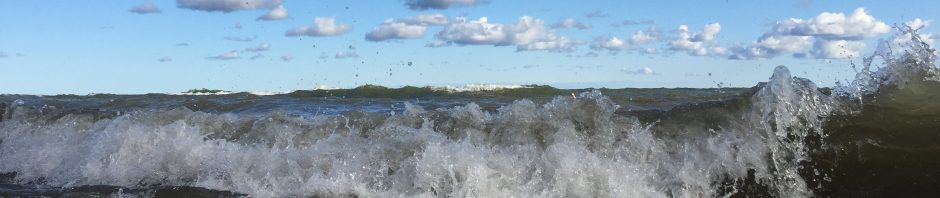
in the beginning, when God began to create the heavens and the earth, all was formless and void, and the Spirit of God moved over the dark waters

Suspended in salt
water, albatross passes
over; create me.

20140724-111305.jpg

Posted in poetry | Tagged , , , , , | Leave a comment

The patient God

This Sunday, we read the pinnacle of Paul’s poetry:

I am convinced that neither death, nor life, nor angels, nor rulers, nor things present, nor things to come, nor height, nor depth, nor anything else in all creation can separate us from the love of God that is in Christ Jesus our Lord.

Nothing in all creation; even our fallen, failing selves. God must need a great deal of patience.

in my dream, you call.
I dream a graveyard, mist
between the tombstones, hidden
dangers, tree roots grabbing
at my ankles; I am afraid to come,
and so you lay me down
gently on my own marble slab,
call again; in my dream,
the city rushes, buses, taxis,
children crying in strollers, lights
changing at lightning speed – Don’t Walk:
the red man stands between us,
forbidding. You send
an angel in white gloves, halt
the madness, part the sea;
in my dream, his right
hand holds a warrant. I run
from what I have done; I run.
In my dream, you call.
A chasm divides us.
You lay the timbers you have
carried across the abyss:
nothing can separate us,
you say, in all creation.
Who created, then, this fear
I dream that holds me?
In my dream, you call.

Posted in lectionary reflection, poetry, sermon preparation | Tagged , , , , , | Leave a comment

Night prayer

I pray this night for those who have lived
so long that no one who knows
can imagine life beyond them.
I pray this night for those whose breath was never strong;
whose lives are counted in days;
whose days are counted miracles.
I pray for those whose burdens
weigh down the sun and shackle the stars,
whose agony and ecstasy are out of this world.
I pray for us left in between, in the mess of
ordinary lives lived beneath the slight touch of blessing,
barely turning to hear who it was whispered our names.

Posted in poetry, prayer | Leave a comment

Early week wordplay

Let tares grow,
let tears flow;
there is no
justice without
tearing our
selves apart;
Until life’s ending,
we are left tending
weeds tenderly
as the wheat field.

alternatively

Let tares grow,
let tears flow;
there is no
judgement without
tearing our
selves apart;
Until its ending,
life’s left tending
weeds tenderly
in the wheat field.

Posted in lectionary reflection, poetry, sermon preparation | Tagged , , | Leave a comment

Year A Proper 10: seed for sowing and bread for eating

Frederick Buechner says that parables are like jokes: if you have to have it explained, it’s just not worth it.* In some ways, this parable says the same thing about itself. The last line of Jesus’ explanation is that those who hear and understand it – the ones who get it – those are the ones in whom the seeds take root and grow and bear fruit. If you get it, you’ve got it.

Perhaps this is a rare opportunity for spiritual self-congratulation. We consider ourselves, after all, part of the inner circle of disciples who understand Jesus, who hear him and who get him, so we are by definition, aren’t we, good soil, that yields a fine harvest. If we look at this church, and its nearly nine decade history, we can see some of the good that has been done.

Eighty-six years ago, in January 1928, the first meeting to form an episcopal congregation in Euclid took place. The first service was attended by 39 adults and 19 young people in March of that year. In December 1928, the Church of the Epiphany was named as a Mission of the Diocese of Ohio, and building began not too long afterwards. This building was first dedicated more than eighty years ago, in 1933, and the extensions completed twenty years later. In the meantime, in 1947, the church was incorporated as a parish and a nonprofit in the State of Ohio.

Since 1959, which is the first year for which I have good records easily at hand in my office, so just in the last 55 of its 86 years, in less than two-thirds of its life in this city, this church has baptized 888 people. It has blessed the beginnings of 481 marriages. It has raised up at least one curate, who came here as a young transitional deacon, to become a bishop. Last year, in one year alone, this parish offered the gifts of God to the people of God 3615 times. In 2006, the number was over 6000. It is impossible to calculate the number of people that this parish has touched, served, prayed with, prayed for;

To borrow a phrase from another parable: “You good and faithful servants!”

Of course, we know that sowing and growing and the harvest are not one-off events. They are a cycle. The farmer cannot sit back after one good harvest and live off it for life. She has to go back out, in the spring, and renew the soil, refresh the earth, reseed the rows, and wait all over again to see what takes, what gives.

So it is with ministry. It is never a once-and-done affair, no matter how successful it may once have been.

In the old country, crop rotation would be a way of making sure that soil didn’t get used up and worn out. A field that grew wheat one year might grow barley the next, and in the third year it would lay fallow, that is, nothing would be sown; the soil would rest and regather its strength, so that it would be healthy and have sufficient nutritional substance the next year to grow a new crop. Soil that was reused over and over, especially for the same crop, farmers found, would become stale and exhausted, and the harvest would gradually weaken and falter. It seems so wasteful in our economy to let a whole field lie fallow for a whole growing season; but the wisdom of the long view says that it is worth it to take care of the soil so that the soil can take care of the harvest for the long haul.

It’s ok if everything doesn’t look the same year by year, season by season. Of course, that doesn’t mean we get to rest on our laurels, but it does mean that we shouldn’t get too anxious if every harvest is not as rich as the ones that we remember. There may be something new trying to grow, that we have yet to recognize.

The landscape around this church has changed in nine decades, as landscapes will. The landscape of the lives of those of us who have been around for a few of those decades has transformed itself from generation to generation, seed time to harvest.

Cycles rise and fall, the seasons in their sequence come and go; nothing stays the same. The landscape has changed; there may be more rocks in a field that used to be loamy; there may be new pathways across old meadows. Some fields that once were well-tended may have become overgrown with weeds. Other plots have opened up where once nothing grew, because someone went out with a hoe and a vision and broke open the earth to give it a fresh outlook on life.

I’ll be honest: I don’t know quite where we find ourselves in this parable today. On an individual level, each of you is quite capable of praying through that dilemma for yourselves, and hearing the call of God on your souls, where your soil needs food, rest, or celebration. As a congregation, as a community, we know that we have some work to do, to align ourselves with the landscape around us; to get to know all over again the soil in which we are planted, so that we can grow most effectively within it; because nothing stays the same.

Here’s the thing that I find most strikingly hopeful about this whole parable, though. Every single time we read it, year after year, that sower goes out and sows the seed this way and that, across pathways and rocky ground and thistle beds and good soil; indiscriminately. This sower is not concerned about who grows the best. The sower doesn’t learn from one outing to the next to restrict the seed to one good area. The sower continues, against conventional wisdom, to seed everyone, everywhere, with the word of the kingdom; because even the cracks in the sidewalk sometimes bear fruit, and even the birds of the air need to be fed by the seed that falls on rocky ground.


God speaks through the prophet: “’My thoughts are not your thoughts, neither are your ways my ways,’ says the Lord. ‘For as the heavens are higher than the earth, so are my ways higher than your ways and my thoughts than your thoughts. For as the rain and the snow come down from the heaven, and do not return there until they have watered the earth, making it bring forth and sprout, giving seed to the sower and bread to the eater, so shall my word be that goes out from my mouth; it shall not return to me empty, but it shall accomplish that which I purpose, and succeed in the thing for which I sent it.”’

Whether or not we get the parable, or the joke, God’s word does not fall flat; whether or not we get it, whether or not we see it, God’s word is not wasted, but it shall accomplish God’s purpose, and it will succeed in the thing for which God sent it.

Thanks be to God.


  • Frederick Buechner, Wishful Thinking: A Seeker’s ABC, revised and expanded (HarperSanFrancisco, 1993), 81
Posted in sermon | Leave a comment

Wormfood

Whilst musing over this Sunday’s parable (the sower and the different soils), I hit upon the Dummies.com article, “How to Improve Soil Quality for Healthy Plant Growth,” by Sven Wombwell. Sven suggests that “Worms really are a gardener’s best friends. They feed on organic matter and then disperse it through the soil.” There are many ways to engage in analogical soil/soul improvement preaching on this parable, but the worms, and the organic matter that they eat, stuck with me…

worms eat through the dead

making soil for the living;

some resurrection.

Posted in lectionary reflection, poetry, sermon preparation | Tagged , , , , , | Leave a comment

Crossover

A crossover from today’s Bible Challenge blog, just because Leftovers:

Readings for today were Isaiah 7-9, I Thessalonians 5, Psalm 28, OR Judith 15

The day of my graduation from seminary was supposed to be the Rapture (according to the late Harold Camping). Cue a few juvenile jokes at commencement, and my own attempt to get an ad campaign going for the next day – Sunday – “Still here? All are welcome.”

Anyway, some people say that the closing words of Saturday’s Thessalonian chapter are all about the Rapture – being caught up in the air. Others point out that those who attempt to predict such events, however, have it all wrong; chapter 5 is much more in line with the rest of scripture when it asserts that no one knows the Day of the Lord, which comes suddenly, swiftly and silently, like a thief in the night.

I heard recently that a Tom Perrotta novel, The Leftovers, has been made into a tv series, with the author himself at the helm. I have never read the Left Behind series (I keep thinking I should, for research), but I have read Perrotta’s book, and enjoyed it. Whilst a reviewer of the tv show (who should know) bases the storyline firmly in rapture mythology (http://www.cnn.com/2014/07/06/opinion/parini-rapture-real), the novel itself allows its characters to believe one thing or another at will, and the narrator does not choose or force an explanation of the Sudden Departure upon a reader. It is an exploration of loss, love, and how life lives with them in tension, rather than a theological novel. In fact, reading a few other Perrotta books, I would venture that he tends to “redeem” characters from the extremes of evangelical religion to something more ordinary, to find the wonder in a life lived for the sake of life itself, as, one might think, God intended.

Posted in book review, lectionary reflection | Tagged , , , | Leave a comment

Year A Proper 9: of fourth of July fireworks, parades and prophecies (and little donkeys)

When I was growing up, a trip to the seaside meant (if we were lucky and good) a ride on the beach donkeys.

These little donkeys plied their trade on every tourist beach in England. Usually, there would be about half a dozen of them, wearing colourful straw hats and blankets. They usually looked a bit grumpy. Their attendant traditionally was equally taciturn. For the equivalent of about a quarter, a child would be hoisted across a grumpy grey donkey and bounce across the sand and back for about five or ten minutes while their mother looked on in terror (our mother did not approve of the donkeys, but we loved them.)

This is the image that I have in my mind’s eye whenever I read this prophecy of Zechariah, whether on a summer’s weekend, or in the snow of early spring, on Palm Sunday: the slow, silent, long-suffering beach donkeys and their childish burdens. Not the noble, elegant humility of the silhouetted donkey on the Christmas cards; but a truly humble, humbled and humbling, scraggly, shabby, scruffy little donkey, beast of burden and the patient plaything of children.

According to Jesus scholars Marcus Borg and Dominic Crossan, on the day that we commemorate as Palm Sunday, two processions entered the city of Jerusalem.* Pilate’s people would converge on the city from their Roman garrison on the sea, a show of strength before the festival of the people, the Passover that represented to the people of Israel deliverance from the evil empire of Egypt; a dangerous proposition for the Roman occupiers. Pilate’s procession was a show of strength, of military might, and of the complete dominion of the Caesar, the son of the Roman gods.

On the other side of the city came the royal procession predicted by Zechariah, one in which the Son of the true God arrived at the seat and centre of his kingdom, humble and riding on a donkey. The use of the Zechariah prophecy makes the counterpoint even more clear: this king is not the one in pomp and splendour, nor is he seated on a war horse, because his purpose is not war but peace, and his strength comes from his humility, his closeness to the people, and, seated on a small donkey, his closeness to the ground. He has broken the bows of war, and retired the chariots of the empire. Instead of a Roman fortress on the sea, he sees peace extending from shore to shore; not the Pax Romana enforced by the sword, but the peace of God that passes all understanding.

It is not enough for the people of the Passover. They want a new set of plagues to destroy the Roman destroyers. They want a new Red Sea miracle to divide them from their oppressors. Instead, Jesus comes preaching peace, loving them, laying down his life for them. They don’t get how that is supposed to help them. But his procession is not a challenge to Pilate’s; that, in the circumstances, would be laughable and rather sad. It is, instead, an inversion of it; it makes a mockery of the Caesar’s claims to dominion.

Jesus said, “To what shall I compare this generation? It is like children sitting in the marketplace, saying, ‘We played weddings, and you wouldn’t dance; we played funerals, and you wouldn’t wail.’” This generation wants Jesus to dance to its tune, and he will not.

This generation, too; we would like to pull the strings, play the tune, and see Jesus dance to it. We saw it in the courts this week; whatever else you think of the so-called Hobby Lobby decision, the appeal to religious freedom to decide what is or is not contraception, let alone what is or is not healthcare, is surely symptomatic of that tug-of-war, that push and pull over whose god rules, and which tune God dances to.

We saw this week the limits of our recognition of the Passover of others; the Red Sea miracle that delivered a child to its Promised Land looks to another like an unmitigated crime. I can’t imagine bellowing at a busload of children, “No one wants you here,” as we saw on the news from Murrietta; but we are all guilty of blinkered vision, and selective hearing; hearing only the tune that we play, that we think all must dance to.

We still struggle with the idea that loving God, loving Jesus, means loving all of our neighbours, unconditionally. Even after all those Palm Sundays followed by Good Fridays, we struggle with the idea that humility is stronger than oppression. It doesn’t sit comfortably with us. Perhaps we just aren’t ready for it yet.

On this past Friday evening, like many others, like many of you, I went out to watch the fireworks. In the explosions that reverberated in my ribs, that knocked holes in my stomach,

I heard the shells that I had heard falling over Galilee, quarter of a century ago, night after night, from my bed in a kibbutz just south of the Lebanese border. The same gunpowder blast that propelled missiles into the night sky, to explode just far enough from our camp to lull us to sleep. It’s amazing what you can become used to; after a couple of weeks, there was one silent night in which no shells fell, and no one could sleep without them. We had become conditioned to expect the sounds of war; peace undermined our equilibrium and disturbed our sense of normality.

On Friday night, I wondered, watching the red, white and blue afterimages sparkle over the Great Lake, what it would signify if we had invented gunpowder only for this, to create beauty, and not death; to inspire, instead of to exterminate. What if in centuries to come this were to be the only use left for it, to invite the celebration of our liberty together, instead of an unequal freedom; our joy in one another and the lands in which we live; a mutual joy instead of an instinctive mistrust?

What if the only parades left in town were attended by children on bedraggled beach donkeys, laughing and waving palm branches, dancing to merry tune, instead of war horses and worse, and the funereal sound of the gun salute was no longer needed, the bows of war having been long since broken? We can’t even imagine it, can we?

The future into which the prophet invites us is not a brighter, more triumphant version of the way that we live now. It is not a romance, but a real revolution. It is not a future in which we win. It is a future in which we do not even have to fight.

Oh, but it is so hard to give in to humility! It is the wisdom of fools and of children, and we are so wise. Lay down your burdens, receive my rest, says Jesus, but it is so hard to give up the fight to be right.

But when we come to the table, we receive the body and blood of a king who gave his life for his people. And we receive the humble offering of a humble peasant who died a criminal, oppressed by foreign powers, betrayed by his own, beloved only of a few, most of whom thought that he must have got it wrong, somehow, somewhere along the line.

Yet wisdom is vindicated by her deeds.

So rejoice greatly, and shout aloud. Your king comes to you; so triumphant and victorious is he, that he rides humbly on a donkey, and on a colt, on the children’s donkey.


*Marcus J. Borg and John Dominic Crossan, The Last Week: What the Gospels Really Teach About Jesus’s Final Days in Jerusalem (HarperOne, 2006), chapter 1, “Palm Sunday”

Posted in sermon | Leave a comment

Year A Proper 9: Little Donkey

When I was growing up, a trip to the seaside meant buckets and spades, sandcastles in the sand, fishing nets, for catching shrimps in the rockpools, ice cream, and late in the afternoon, before loading up the car for home, if we were very good and our mother was in a particularly relaxed mood after all of the sun and salty goodness, a ride on the beach donkeys.

The little donkeys – some young, some old but small – plied their trade on every tourist beach in England. Usually, there would be about half a dozen of them, wearing colourful straw hats and blankets. They usually looked a bit grumpy – think Eeyore, the chronically depressive donkey from Winnie the Pooh. Their attendant was equally taciturn; he would be a man of indeterminate age and few words, with a look of the Roma Gipsy. For the equivalent of about a quarter, a child would be hoisted across a grumpy grey donkey and bounce across the sand and back for about five or ten minutes while their mother looked on in terror (our mother did not approve of the donkeys, but we loved them.)

This is the image that I have in my mind’s eye whenever I read this prophecy of Zechariah, whether here on a summer’s weekend, or in the snow of early spring, on Palm Sunday: the slow, silent, long-suffering beach donkeys and their childish burdens. Not the noble, elegant humility of the silhouetted donkey on the Christmas cards; but a truly humble, humbled and humbling, scraggly, shabby, scruffy little donkey, beast of burden and the plaything of children.

Posted in lectionary reflection, sermon preparation | Leave a comment