First and last

Do you remember how,
in the parable, 
he paid them, last and first?
To the first he was fair, 
but to the last he was 
magnificent. 
Neither knew 
whether to laugh or shout 
or fall to their knees; 
so we, too, 
swayed between the thirsty 
and the relieved, 
envying and blaming 
each in turn …

So too, at last, 
he spoke glory
to whom he first served silence 
more merciful 
than his passing 
words, and she, 
risen lately from her Baals 
and run with twisted tongue 
to the Son of David, 
was buried by the weight 
of faith worth its salt 
and borne again; 
and we stumble to understand 
her meaning


This Sunday’s Gospel includes the challenging story of the Canaanite woman who comes seeking healing for her daughter, “crumbs under the children’s table,” whom Jesus seems at first to reject, but whose faith he then praises with healing power.

Featured image: Bowyer Bible Print. The Syro-Phoenician Woman. Jan Luyken. wikimediacommons

Posted in lectionary reflection, poetry, prayer, sermon preparation | Tagged , , , , , | Leave a comment

Have a heart

A sermon for 13th August, 2023; Year A Proper 14.


Once upon a time, some forty+ years ago, an academic who was not a mathematician did some wage review for the civil service, and accidentally became responsible for the teachers of England and Wales receiving a well-deserved but rather unexpected – on all sides – pay boost. That is how my father ended up buying a boat.

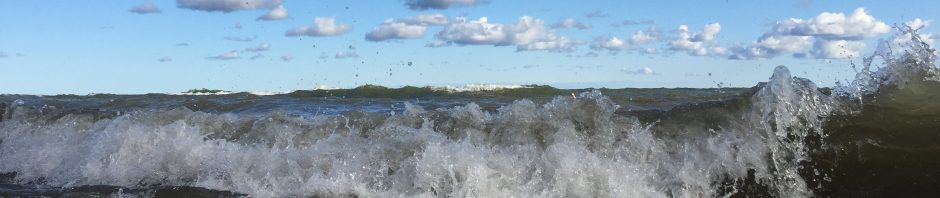
It was a small boat, with a very small outboard motor. Did you know that the Bristol Channel, that little strip of salt water between England and Wales, has the second largest tidal drop in the entire world, second only to somewhere up north of here (Canada? Alaska?)? Having been in a very small boat with a very, very small outboard motor, boat-surfing around Lavernock Point in a foolhardy effort to get home ahead of the tidal turn, swamped by waves that I worked ravenously to put back into the Channel using a very small bucket, I can believe it. My father tells the story of one such outing; when we finally got back to dry land, he asked me, “Were you scared?” With as much teenaged bile and bravado as I could muster, I replied, “Scared? I was too busy bailing out!”

I know who I am in this morning’s Gospel story. If I had seen Jesus walking towards us on the water from Flatholme, I would have thought he was a ghost, too, because I would have assumed at that point that I was a ghost. 

Evening had come and gone, and it was already the dead of night. Wind and the waves were battering the boat; if there was a moon it was obscured by the spray. The elements were against them, and they knew themselves no match for the chaos.

Then came Jesus. Then came Jesus, descending the mountain on a cloud of prayer, drifting across the sea like a breath, like an angel, like a ghost. Then came Jesus, and he said to them, “Take heart, it is I. Do not be afraid.” (Matthew 14:27)

There is a theological aspect to this story, of course. It speaks not only to what happened, what Jesus did out there in the dark and the storm, but it speaks, he speaks of who he is. “Take heart, it is I. Do not be afraid.”

In the beginning, when the world was formless and void, the authors of Genesis imagine a storm of oily water, suffocating and chaotic, devoid of life, empty of breath, but full of chaos. Then came the Word of God, speaking light, speaking land, speaking heavens and earth and ocean, speaking life. (Genesis 1)

When Jesus treads upon the storm, he reminds his disciples, he reminds us, that he is that Word of God that quells any force that mitigates against life, against light, against hope. The commentaries tell us that walking on water is a feat reserved to the divine; it is a quelling of the chaos, a subjugation of the elements that belongs only to the Creator of all things.[i] Jesus, coming to his disciples on the sea, was showing them who he was, who he is. The wind and the waves may have been against them, but Jesus says, “Take heart, it is I.” No one, nothing can stand against the love of God made manifest and standing before them, in the heart of the storm.

“Do not be afraid,” he tells them, because perfect love casts out fear, and he is the perfect love of God. “Do not be afraid,” speaks Emmanuel; “I am with you.”

In the midst of the storm, or facing down the wildfire, in the deep pit, in the wake of bitter betrayal, after the scary diagnosis, even when planning the funeral, the question arises, “But what of it?” The text does not tell us that the wind and the waves subsided when Jesus made himself known – this is not the same story as the, “Peace, be still!” moment. No, but Peter says, “If you call me, I can come to you on the water.” And when he starts to sink back in fear, Jesus catches him. (Matthew 14:28-31)

I know who I am in this story. Sometimes I think I only went out in that ridiculous boat on the Bristol Channel because no one else would, and I didn’t want the man to die alone, and I hope that counts for something. I am hoping for courage but my heart is sinking. I am too busy bailing out the boat to pray. The wind and the waves are against me, I am underpowered and overwhelmed, and as much as I want to keep my attention fixed on Jesus, the storm is stealing it, and sinking me. That’s just how it goes, sometimes. 

But I know who Jesus is, too. When he says, “Take heart, have courage” – because courage is heart, encouragement is the giving of one’s heart, votre coeur, to another – when Jesus says, “Take heart, it is I,” he is not saying, “Be brave. Man up!” Rather, he is offering his heart, himself, his courage, his power, his love and mercy, his life to his disciples. He will not leave them to face the storm, the fire, the flood, the betrayal, alone. And when he does get in the boat, the wind drops immediately, like the others, falling down in worship before him.

From the very early centuries of the church, our prayers have included the Sursum CordaLift up your hearts; we lift them to the Lord. The original said simply, “Up with your hearts.” “We have them with the Lord,” was the response.[ii] As we come to celebrate and commemorate and rely on Christ’s presence with us, we begin by taking heart, taking encouragement, that his heart is with us; and we place our hearts with his. 

So take heart, whatever the storm, whatever is against you, whatever has you sick or afraid or wanting to walk on water; take heart, Jesus is with you. Even when we are distracted and rightly dismayed, he is already reaching for us to pull us back from the abyss. Nothing, no distance nor elements nor trouble can keep him from you. Indeed, “The word is near you, on your lips and in your heart.” (Romans 10:8)

Amen.


[i] The New Interpreter’s Bible, Volume III, pp. 326-330

[ii] Prayers of the Eucharist: Early and Reformed: Texts translated and edited with commentary, R.C.D. Jasper and G.J. Cuming, third edition (The Liturgical Press, 1990), 31-38

Year A Proper 14: Genesis 37:1-4,12-28 (Joseph’s is sold into slavery by his brothers); Psalm 105, Romans 10:5-15 (“the word is very near you”), Matthew 14:22-33

Posted in lectionary reflection, sermon | Tagged , , , , , | Leave a comment

Walking on water

Heart
racing like the tide
ebbing and flowing without
volition, permission
battering this vessel
battered by the moon
and its phases
fading

Do not be afraid
of ghosts
conjured of foam
and fearsome prayer
on the cusp of
translation

Take
a step
my hand
my life and let it be
take heart
the storm by its horns
a bucket and bail, kneeling
at the back of the boat

It is
I am

Posted in lectionary reflection, poetry, prayer, sermon preparation, story | Tagged , , , | Leave a comment

Transfiguration and the transformative gospel

“For we did not follow cleverly devised myths when we made known to you the power and coming of our Lord Jesus Christ, but we had been eyewitnesses of his majesty,” writes the letter attributed to Peter (2 Peter 1:16).

Myself, I enjoy a cleverly-devised myth, one that illustrates truth as through a poem, constructing a work of art that speaks to the soul without claiming accuracy or articulation, but empathy and experience. Story tells truth without objective data. It relies on the innermost secrets of the human soul to recognize it.

Such, over the centuries, has been our experience of the gospel. Translated and retranslated through language and art, music and light, liturgy and drama, even bread and wine: whatever comes to hand, mouth, and heart to convey the truth of that Majestic Glory, that Jesus is the Son of God, that God loves us enough to stand with us in the cloud, on the mountaintop, in the valleys of shadows, shining like the sun.

But Peter was there. He needed no one to describe to him the chill of the cloud, the sudden warmth that broke through, the terror of the thunderous voice, the familiar comfort of figures he knew without ever having seen them before, they were so sound a part of his faith, his formation, his family: Moses and Elijah. Peter saw it all, he knew that what he saw and heard and felt was real, as real as life in the valley; and he was dazzled and dazed into silence by its glory. “They kept silent and in those days told no one any of the things they had seen.”

This time last month, I was at St Paul’s Cathedral in London, a wonderfully and marvellously devised dome in the heart of the city, full of colour and light, stories told in paint and stone and glass, and the music, of course, soaring at eventide. I went for Evensong, and I went back in the morning to join the throng of tourists, a few school groups, people from every language and nation gathered with their cameras – with our cameras – and our cacophony. I climbed the several hundred stairs to the galleries high up on the dome. I found the effigy of John Donne, that constructor of clever conceits and poetry, who knew for himself the transformative power of the glory of God. I lit candles for some of you, for all of you, for us.

Then, as I was crossing the transept for one more look up into the dome from the centre, a woman in a black cassock stepped unobtrusively up to a lectern and began to speak gently but clearly into the mass of sightseers. She took a just a minute or two to introduce a prayer for all those in need of healing, and I thought of our candles; then she led the Lord’s Prayer, and I couldn’t tell you what proportion of the visitors joined in, but I was fixed as if by lightning to my spot on that tiled floor until the final Amen.

They do it every hour, stripping away the veil of the tourist trap and reminding those with the will to hear why it is that the cathedral stands, and sings, and prays. They do not dwell on it; there are no booths built for Moses and Elijah. The moment passes like a cloud across the sun. But it is unmistakable.

I’m not sure how else to describe it to you, except that in that moment the grand cathedral had put on the garment of prayer; and the glory of the world and its myths and its memories of war and its forgetfulness of mercy – all of this had been transfigured by the quiet voice that insisted that we listen, for a moment, to the Word of God, and the prayer that Jesus himself has taught us, to a God who listens to us.

After Moses went up the mountain in those earlier days, even the reflected glory of the experience was enough to light him up so that people were afraid to come near him. He had to put on a veil, tone it down, in order that his experience of the living God might be acceptable to the general population.

So it goes. We tame our religious experience with cleverly designed veils and shadows, artifice and myths, even the music and art that we lean into as through a window disguises as much as describes that Majestic Glory that shines like nothing on earth.

We are afraid to tell the truth, as eyewitnesses, of what it is really like to encounter God, in case it makes people back away. Peter even says, I am only saying this now because I am about to die.

But what if we were to be honest about what brings us here, week by week, hands open and hearts guarded, eyes glistening with unshed words, unmet hopes, unveiled desire? What if we were to tell the true story of how we met God, in all of that terrible glory, on the mountaintop or at our lowest ebb, and heard the voice of truth say, “Here is my Son, beloved so that you might know yourself beloved. Listen to him!” What if we were to share that light with the world, a world awash with cleverly devised myths and arguments?

When I first met Jesus, listening with the curiosity of a child, I heard him proclaim that the kingdom of God was at hand. I heard him heal the sick, comfort the demon-assaulted, undo grief, reconcile life and death, mortality and eternity within his own body. That gospel was, for me, life saving. It still is. I enjoy a cleverly devised myth as much as the next person; but what sustains me is this: that I know that God is with us, that God loves us more than we love life itself; that when the world is too loud, or stuns us into silence, Christ is still speaking in that still, small voice, the language of mercy. Listen to him.

Posted in holy days, homily, lectionary reflection, sermon, spiritual autobiography | Tagged , , | Leave a comment

The mountain

The mountain 
was known for its faces: 
old as time and containing 
the capricious moods of a newborn, 
mewling and frost-bitten on day, 
green and friendly another. 
squalling cloud and light 
enough to keep its suitors guessing 
and hoping, climbing into eternity 
just for the view. 

                                    Nothing 
so elementally expressive 
could contain the steadfast, 
implacable, 
untimely mercy that met them 
beyond the tree line, 
muttering amongst the crows, 
“Listen …”


This poem first appeared at the Episcopal Journal. This Sunday celebrates the Feast of the Transfiguration, that mysterious moment upon the mountaintop …

Posted in holy days, poetry, prayer | Tagged | Leave a comment

Pressed

What if the robes were reversed
and among the throng of sweaty suitors
for my notice you
were plucking at my sleeve;
would I know your touch
from the pickpockets of power,
care enough to turn and ask
what you require, hear
from you the whole truth
that makes of the world a liar; follow
through the mob of mourners
for a life worth leaving behind?


A brief reflection on the Gospel reading from today’s Daily Office: Mark 5:21-43

Posted in lectionary reflection, poetry, prayer | Tagged , , , , , | Leave a comment

Mustard seed

Split it with thumbnail or teeth,
feel its tiny fire upon the tongue,
a supernova soon consumed;
or
let it swell from within, fed by filtered light
and living water, until it bursts
open and eager, expanding like a universe
alert with wonder


The Gospel for Year A Proper 12 includes the parable of the mustard seed: Matthew 13:31-33

Posted in lectionary reflection, poetry, prayer, sermon preparation | Tagged , , , , | Leave a comment

Together

Together

we grow side by side

rise and fall

together

who can tell us

apart but God?

Together

in awful glory

we will shine

together

with all the fire

of the sun

_______________________

Year A Proper 11: the parable of the wheat and the tares, Matthew 13:24-30,36-43

Posted in lectionary reflection, poetry, prayer, sermon preparation | Tagged , , , | Leave a comment

Confessions of a crow

Dear One, do I perceive that you 
have told this parable against me? 
Have I stolen the seeds of contentment 
from those with whom I am on the way, 
the path that you have laid out 
in crazy paving, gravel, and grass, where joy 
should be in abundance, the hopscotch, 
skip, and jump of children? We swoop 
instead with greedy, beady beaks and raucous crows.

We have scorched the earth, flooding 
your fields with fire; we have pierced 
the body you laid out and choked from it 
black bile; it quakes beneath our power. 

In the beginning, when the soil was planted 
with food and beauty, in your Wisdom, 
choosing your Words carefully, you said 
that it was good; 
good for growing grace and the glory 
of the image of the living reign of heaven.

Dear One, may it be so. 
May we first fall down and be forgiven 
by your good earth, 
by your creative and therefore compassionate 
mercy.


The Gospel reading for Year A Proper 10 includes the parable of the sower and the soil from Matthew 13. Photo credit Gareth Hughes.

This poem-prayer first appeared at https://episcopaljournal.org/confessions-of-a-crow/

Posted in lectionary reflection, poetry, prayer, sermon preparation | Tagged , , , , , , , | Leave a comment

Rest

Did you recall,
as you were falling into the earth,
into the abyss of memory,
before the ground dented the palms
of your hands before their time;
did you recall,
as the once-living wood pierced your side
with bitter splinters, telling them
that your burden was easy,
the yoke upon your neck un-heavy?
Do you remember,
or is it like the view from a mountaintop,
all rocks and ridges forgiven,
loud aches drowned out by awe –
for a moment, you feel
that you could harness the clouds
to carry you


The Gospel reading for Year A Proper 9 contains the verses. “Come to me, all you that are weary and are carrying heavy burdens, and I will give you rest. Take my yoke upon you, and learn from me; for I am gentle and humble in heart, and you will find rest for your souls. For my yoke is easy, and my burden is light.” (Matthew 11:28-30)

Posted in lectionary reflection, poetry, prayer, sermon preparation | Tagged , , , | Leave a comment