

This gallery contains 21 photos.
This gallery contains 21 photos.
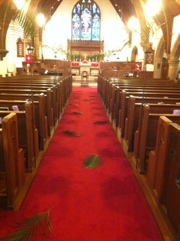
The children are playing “parade.” They cut branches and leaves and grass to wave like flags. They throw their coats on the earth to make a colourful parade ground. They ride on their neighbour’s baby donkey and their friend’s large dog. They take turns riding, while the others sing and shout and laugh, Hosanna! – a childish parody of Pilate’s parade processing in by another gate across the city.
The stranger comes in through their little decorated gate. They have heard of him; strange stories, wonderful things. He is riding a small donkey, as though he were one of them.
The children sing and wave their branches. Their parents join them, laughing and singing “Hosanna!”
“Blessed is the One who comes in the name of our Lord!”
Their voices trail away as they listen to what they say, and the stranger continues to smile and to wave and wink at the children …
_________________________
Indebted to Marcus J. Borg and John Dominic Crossan, The Last Week: What the Gospels Really Teach About Jesus’s Final Days in Jerusalem (HarperOne, 2006)
The adjudicator comes
in pomp; the judge in
different circumstances.
Sunday’s parodied parade
is parlayed into
Friday’s farce of a trial.
_________________________
Indebted to Marcus J. Borg and John Dominic Crossan, The Last Week: What the Gospels Really Teach About Jesus’s Final Days in Jerusalem (HarperOne, 2006)
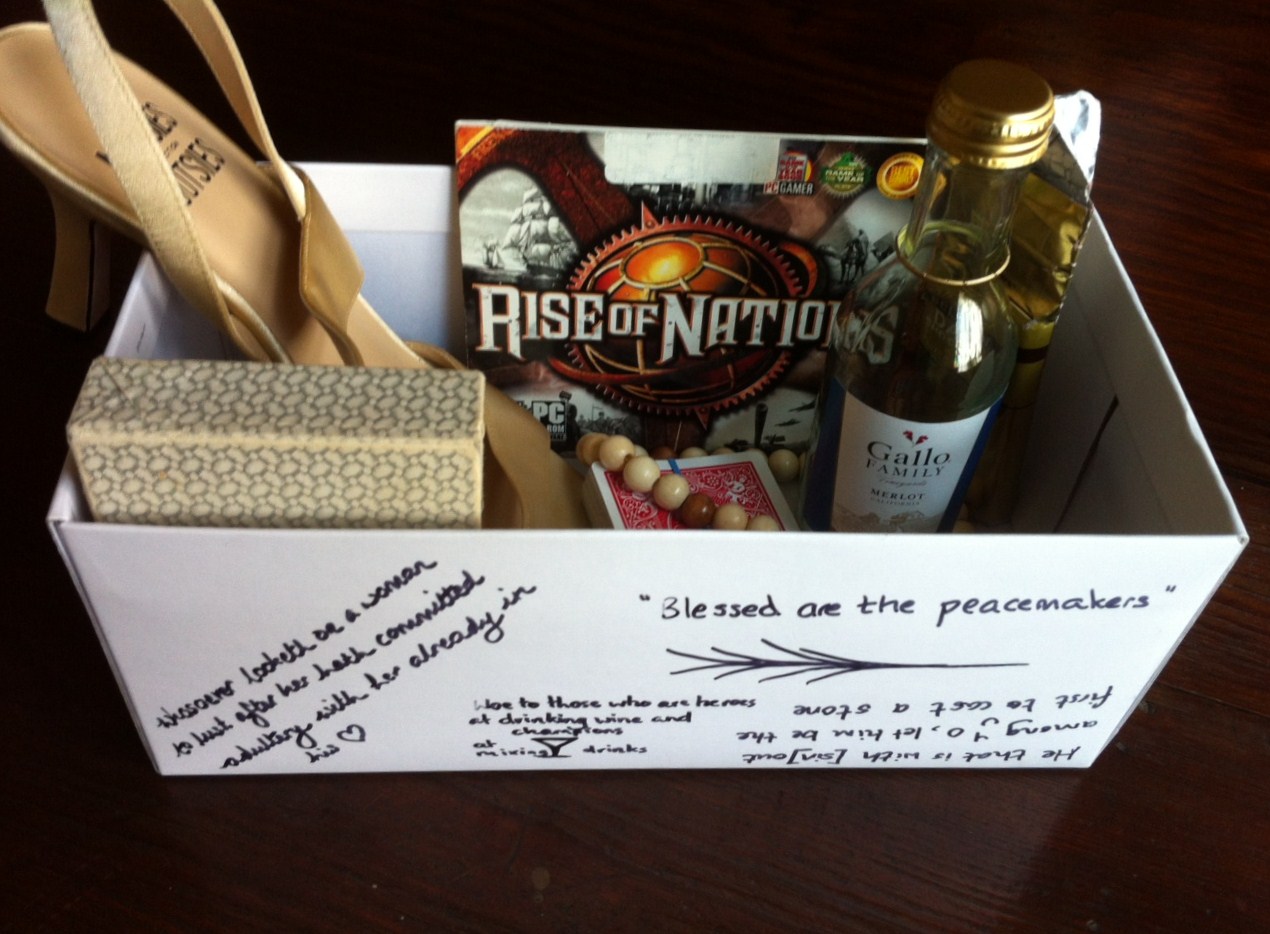 I have spent some time this week replacing our traditional Stations of the Cross – marked by burlap and felt minimally abstracted designs hung at fourteen points around the church sanctuary – with “interactive” or “experiential” Stations.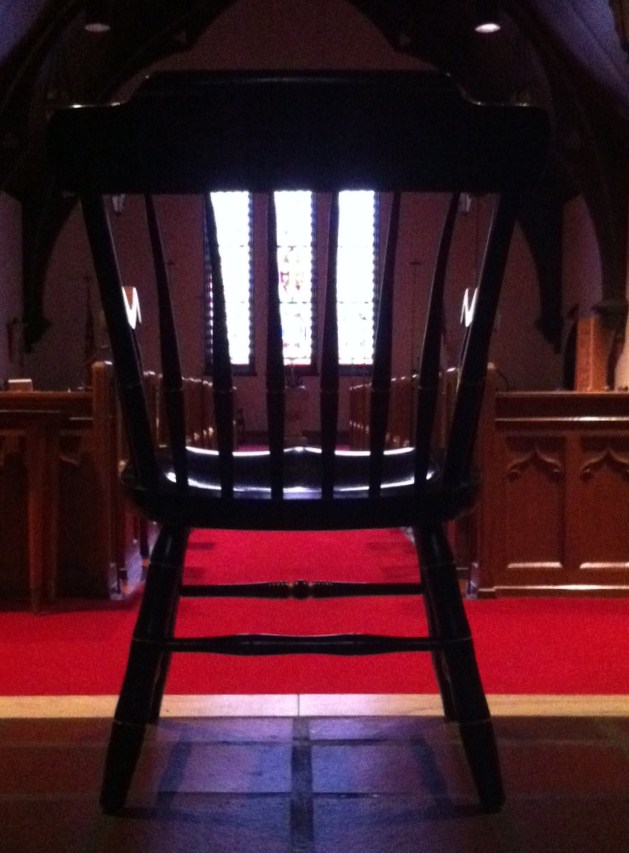
I think I’ll hang on to those quotation marks. My experience with the traditional stations last Friday was profoundly interactive and experiential. The prayer sequence of the Book of Occasional Services was more than equal to the occasion, and the Holy Spirit did the rest.
Still, for those who prefer their contemplation a little more “hands-on,” here is an extract from the Stations that will be positioned around the sanctuary at St Andrew’s Episcopal Church, Elyria, until Maundy Thursday, next week:
Station 10: Jesus is stripped of his clothes
There is a frame, with a brief story, and a piece of a small, white towel within. Next to the frame is a basket of clothes: hats, baseball mitt, a lab coat, a hoodie, masks, scarves, both functional and frivolous. They spill out, inviting further exploration.
The story reads:
“I visited a man in the hospital who was close to death, but defying it. He was laid out on a white-sheeted bed, his skin almost the same colour as the background. His bare body was surrounded and caressed by wires, stuck with sticky pads. His face was plugged into breathing machines and his eyes stared across the vinyl tubing. His legs and feet looked cold. Across his lap, a concession to dignity by the indignity of dying, lay a very small, white towel.
Because of the tubes, and his condition, he could not speak, but he had at his hand a paper pad and a Sharpie marker. He wrote something and offered me the page, but what caught my eye was the one thing written before I got there, the only unprompted request that he had made since arriving in this hospital bed:
‘Please could I have a towel?’”
The commentary in the leaflet accompanying the Stations reads:
We choose our clothes to project an image of ourselves which we prefer others to see. We dress for work, or for play, or for praise, or celebration, or to keep others at bay.
We judge others by their clothing – classy or trashy, loud, elegant, dirty, in/appropriate.
We define people’s occupations by their uniforms, and people by their occupations.
Children try on different outfits as they try on ways of being in the world.
Stripped of our clothes, we are exposed, defenceless. More than suffering simple social shame, we find ourselves unprotected by our images, our shells, our choices, our privacy.
The first thing that Adam and Eve did when they acquired self-knowledge, so the story goes, was to make clothes for themselves.
Jesus’ tormentors were trying to remove all of those layers of acquired humanity, self-definition, pride, and dignity from him, but perhaps they forgot:
Before God, we all stand naked, with only the gift of our true selves to offer, which perhaps is what makes prayer at times so uncomfortable.
Prayer:
“Blessed are the poor in spirit, for theirs is the kingdom of heaven.” Amen. (Matthew 5: 3)

Join us this evening, Friday March 30, 2012 at 6 pm for a group experience of this Way of the Cross.
Death breaks more than the body.
This morning, I came home to an email – because that’s how we’re doing it now – to say that my Auntie Joyce had died.
It was not unexpected, and in many ways I do not think she will have been sorry. I will miss her, and I’m so glad to have seen her and hugged her last time I was in England. I called my father back, and persuaded him to tell me a story of when he was a child, and she was a teenager dating his brother. She covered for him when he smuggled home a fish in his pocket after his brother had vetoed the idea at the end of a day’s fishing trip. We laughed, then he choked up a bit.
I asked him to email my cousins’ addresses, so that I can write to them. There’s no question of my flying over for the funeral; quite apart from all of the other logistical problems, my recent change of citizenship has left me, for the first time since the age of nineteen, temporarily without a passport valid for international travel.
I think of the last time I saw my cousins. It was at their aunt’s – my mother’s – funeral. The elder told me, as I drove her back to the railway station, that she was sorry never to have got to know me, really. The younger, my age, who came by train to my eighteenth birthday party, who moved home from Singapore month after I moved out there, and made sure I knew my way around before she left, said how sorry she was that we only saw each other at funerals these days. We planned to keep in better touch, but that was six years ago, and we haven’t.
I know that my failure to attend this time will breathe that seam open just a little further open. Auntie Joyce’s absence will leave a silence larger than her own.
May she find peace. May light perpetual shine upon her. May her daughters be comforted by those who are close to them. Love to them all x
Luke 1: 26-38: In the sixth month the angel Gabriel was sent by God to a town in Galilee called Nazareth, to a virgin engaged to a man whose name was Joseph, of the house of David. The virgin’s name was Mary. And he came to her and said, ‘Greetings, favoured one! The Lord is with you.’ But she was much perplexed by his words and pondered what sort of greeting this might be. The angel said to her, ‘Do not be afraid, Mary, for you have found favour with God. And now, you will conceive in your womb and bear a son, and you will name him Jesus. He will be great, and will be called the Son of the Most High, and the Lord God will give to him the throne of his ancestor David. He will reign over the house of Jacob for ever, and of his kingdom there will be no end.’ Mary said to the angel, ‘How can this be, since I am a virgin?’The angel said to her, ‘The Holy Spirit will come upon you, and the power of the Most High will overshadow you; therefore the child to be born will be holy; he will be called Son of God. And now, your relative Elizabeth in her old age has also conceived a son; and this is the sixth month for her who was said to be barren. For nothing will be impossible with God.’ Then Mary said, ‘Here am I, the servant of the Lord; let it be with me according to your word.’ Then the angel departed from her.
Wisconsin Senate Bill 507:
February 23, 2012 – Introduced by Senator Grothman, cosponsored by Representative Pridemore. Referred to Committee on Public Health, Human Services, and Revenue.
SB507,2,18 (End) https://docs.legis.wisconsin.gov/2011/related/proposals/sb507
What action do the promoters of this Bill deem appropriate in the light of the angel’s flagrant proclamation of a particular nonmarital parenthood as a contributing factor to the salvation of the world?
And now, a slideshow game: Spot the Un/holy Family
So, it has come to this.
This weekend, a thousand or so local souls gathered to protest and pray that the plan to prohibit the exception of contraception from select people’s health insurance would be overturned.* Put another way, the plan to “force employers to provide health insurance coverage and benefits for contraceptives.” Actually, I prefer my first presentation, and I think that it’s accurate. We have successfully, in the past few years, brought mental health insurance coverage out of cold limbo and into the fold of mainstream health insurance, no longer allowing it to be a special category added or denied at the whim of employers or insurers. Now it is the turn of reproductive and sexual health to be rescued from “special” status.
The arguments of those who gathered recently were that religious freedom is inhibited by the ending of such an exception. It is not, as far as I can see; no one is demanding that anyone use contraception. It is a simple case of placing those prescription in the same category as any other. Is there anything else that employers are allowed to except from all employees’ health coverage as a matter of principle? (This is not a rhetorical question; if you know the answer, please enlighten me!)
I do not know very many religious arguments against contraception, to tell you the truth. If someone would care to educate me, then I would be interested to hear their persuasions. If, however, the general idea is that if sex is to happen, it must be left to chance or to God whether or not it results in offspring, well, I have two answers. One is, there is no such thing as 100% effective contraception, nature is a tricky beggar, and therefore those of a certain age take their lives in their hands (so to speak) every time they make love with someone of the opposite sex, and offer them up to chance, or to luck, or to God.
The second is the answer which Galileo, in another context, employed: “I do not think it necessary to believe that the same God who gave us our sense, our speech, our intellect, would have put aside the use of these, to teach us instead such things as with their help we could find out for ourselves…”** I am convinced that God who created us to grow to be as intelligent, complicated, and creative as we are would fully expect us to use our creativity to control our fecundity at least to the extent that it leads to responsible population growth or maintenance, at least within our own families.
So, it has come to this: I come before you as a woman and a priest, telling complete strangers that I have used contraception in the past, and still would if it were still needed. I am not a “slut” but a married and faithful woman who loves and respects her spouse and her children enough to wish to preserve a reasonably stable and manageable family life, as far as it is within her control. I also used contraception before I was married; I was first prescribed it as a highschooler to manage horrific monthly events which left me living in fear of them all the other days of my teenaged life; I was not a slut then, either. I have used various types of prescribed and unprescribed contraception, including emergency contraception, and I stand by my use of them as congruent with God’s plan for me and for my family, congruent with my love for my family and for God, and at least morally neutral, if not positively beneficial in looking out for the welfare of my family and the greater good of the communities in which I have lived. When I used prescriptions, in the place where I lived then they were provided free as a benefit to public health. I worry for those who struggle to make the decisions of how best to care for their reproductive health in the face of high prescription costs, and I applaud the move to care for them and extend benefits to them, because they are benefits that will provide better public health for our society, our parents, potential parents, and their children.
May God bless them all.
*As reported in the Cleveland Plain Dealer, Friday March 23rd 2012
**Quoted in Galileo’s Daughter: A Drama of Science, Faith and Love, by Dava Sobel (London: Fourth Estate, 1999), 65
My younger daughter, elder god-daughter, and their friends are out tonight sleeping in boxes in solidarity with the people of our region who sleep that way regularly, and not by choice. Needless to say, I am proud of them. It also seems as good a time as any to add a reflection which has been building in my mind over the past several weeks and months:
In the months since I was ordained, conversations with other clergy and church folks has often turned to how we help the people who come to the church in times of material need. At some point, it is usually said that we are in dereliction of our duty if we do not use these requests – which are often quite straightforward in their presentation (I need $X for a housing deposit; I need food for X number of people until Tuesday; I need bus fare from A to B for a job interview/family funeral/ride home from jail) – as opportunities for evangelism.
At which point, the argument is usually made that offering help where we can, or dignified refusal, referrals, and inquiries about other ways we might help where we can’t fulfill the request as presented, is in itself evangelistic. We act out the gospel by loving the one who comes to our door in the best way that we can, doing them the courtesy of answering the question they ask, rather than the one we think they should be asking.
Which is unsatisfying in many ways, because so little is changed by the encounter. A little short-term relief is offered. A vaguely quantifiable amount of good feeling about the church/religious people may be engendered in the one helped; equally, resentment towards the charitable giver might be solidified (no one likes to be dependent upon strangers).
And we ourselves are not Jesus: however much we read into or out of the scriptures about his encounters with those who came to him for help, and let them shape our own responses, as well we should; however the wise words of St Theresa of Avila, “Christ has no body now but yours,”* challenge us, and challenge us they do; still, we ourselves are not God incarnate, but mere images, just like those who see themselves mirrored in our eyes.
So if we do push further into someone’s life than we are invited, are we doing it for their sake, for God’s sake, or to feel as though we have done better? And if we stand back, is it for the sake of their dignity, or because of our own guilt, helplessness, and the shame it engenders in us?
You can tell that I am far from having this sorted out. I continue to pray through it, and to pray for those whom I encounter in times of need, whether I pray with them or not. As I do, I am aware that the ideas that we absorb growing up shape with heavy hands the ideas that we express as adults, since I remember with absolute clarity the passages from George Orwell’s accounts of adventure in the land of poverty relating to religious charity that I read as a young teenager, and they are cautionary tales told to my developing vocation. I offer them as food for thought:
“At about five the Irishman said, ‘Could you do wid a cup o’ tay? De spike don’t open till six.’
‘I should think I could.’
‘Well, dere’s a place here where dey gives you a free cup o’ tay and a bun. Good tay it is, Dey makes you say a lot o’ bloody prayers after; but hell! It all passes de time away. You come wid me.’
He led the way to a small tin-roofed shed in a side-street, rather like a village cricket pavilion. About twenty-five other tramps were waiting. A few of them were dirty old habitual vagabonds, the majority decent-looking lads from the north, probably miners or cotton operatives out of work. Presently the door opened and a lady in a blue silk dress, wearing gold spectacles and a crucifix, welcomed us in. Inside were thirty or forty hard chairs, a harmonium, and a very gory lithograph of the Crucifixion.
Uncomfortably we took off our caps and sat down. The lady handed out the tea, and while we ate and drank she moved to and fro, talking benignly. She talked upon religious subjects – about Jesus Christ always having a soft spot for poor rough men like us, and about how quickly the time passed when you were in church, and what a difference it made to a man on the road if he said his prayers regularly. We hated it. We sat against the wall fingering our caps (a tramp feels indecently exposed with his cap off), and turning pink and trying to mumble something when the lady addressed us, There was no doubt that she meant it all kindly. As she came up to one of the north country lads with the plate of buns, she said to him:
‘And you, my boy, how long is it since you knelt down and spoke with your Father in Heaven?’
Poor lad, not a word could he utter; but his belly answered for him, with a disgraceful rumbling which it set up at sight of the food. Thereafter he was so overcome with shame that he could scarcely swallow his bun. Only one man managed to answer the lady in her own style, and he was a spry, red-nosed fellow looking like a corporal who had lost his stripe for drunkenness. He could pronounce the words ‘the dear Lord Jesus’ with less shame than anyone I ever saw. No doubt he had learned the knack in prison.
Tea ended, and I saw the tramps looking furtively at one another. An unspoken thought was running from man to man – could we possibly make off before the prayers started? Someone stirred in his chair – not getting up actually, but with just a glance at the door, as though half suggesting the idea of departure. The lady quelled him with one look. She said in a more benign tone than ever:
‘I don’t think you need go quite yet. The casual ward doesn’t open till six, and we have time to kneel down and say a few words to our Father first. I think we should all feel better after that, shouldn’t we?’
… Bareheaded, we knelt down among the dirty teacups and began to mumble that we had left undone those things that we ought to have done, and done those things that we ought not to have done, and there was no health is us. The lady prayed very fervently, but her eyes roved over us all the time, making sure that we were attending. When she was not looking we grinned and winked at one another, and whispered bawdy jokes, just to show that we did not care; but it stuck in our throats a little. No one except the red-nosed man was self-possessed enough tot speak the responses above a whisper. …
The prayers lasted half an hour, and then, after a handshake at the door, we made off. ‘Well,’ said somebody as soon as we were out of hearing, ‘the trouble’s over. I thought them ___ prayers were never goin’ to end.’
‘You ‘ad your bun,’ said another; ‘you got to pay for it,’
‘Pray for it, you mean. Ah, you don’t get much for nothing. They can’t even give you a twopenny cup of tea without you go down on you ___ knees for it.’
There were murmurs of agreement. Evidently the tramps were not grateful for their tea. And yet it was excellent tea … I am sure too that it was given in a good spirit, without any intention of humiliating us; so in fairness we ought to have been grateful – still, we were not.” (Down and Out in Paris and London, chapter 26 extracts)
“At half-past eight, Paddy took me to the Embankment, where a clergyman was known to distribute meal tickets once a week. UnderCharing CrossBridgefifty men were waiting, mirrored in the shivering puddles. Some of them were truly appalling specimens – they were Embankment sleepers, and the Embankment dredges up worse types than the spike. …
Presently the clergyman appeared and the men ranged themselves in a queue in the order in which they had arrived. The clergyman was a nice, chubby, youngish man, and, curiously enough, very like Charlie, my friend in Paris. He was shy and embarrassed, and did not speak except for a brief good evening; he simply hurried down the line of men, thrusting a ticket upon each, and not waiting to be thanked. The consequence was that, for once, there was genuine gratitude, and everyone said that the clergyman was a ___ good feller. Someone (in his hearing, I believe) called out: ‘Well, he’ll never be a ___ bishop!’ – this, of course, intended as a warm compliment.” Down and Out in Paris and London, chapter 33 extracts)
Extracts copied from George Orwell, Down and Out in Paris and London, Kindle Edition
*Christ has no body but yours, No hand, no feet on earth but yours, Yours are the eyes with which he looks compassion on this world, Yours are the feet with which he walks to do good, Yours are the hands with which he blesses all the world. Yours are the hands, yours are the feet, yours are the eyes, you are his body. Christ has no body now but yours. – Theresa of Avila
Tonight we prayed the Stations of the Cross. There were only three of us, so there were no robes or processional cross; but we sang the Stabat Mater in the plainest of plainsong made beautiful by the gift of prayer; and I lit a candle from the tapers at the altar to illuminate each station. After a while, it became quite heavy, and then – the strangest thing – when all was said and done and the others were gone, it was the hardest thing to bear to snuff it out.
***
The sixth station – that extra-biblical scene in which a woman, traditionally named Veronica, wipes the face of Jesus – was near our intecessory lights, so we lit candles for those who have no one to care for them, or to wipe their brow.
On the way home, I was accosted by a memory from my first term away at college. I had been laid low by the flu, and kept to my bed well into the afternoon. I was startled awake by a knock at the door. Someone wanted to know if she could make me a cup of tea.
I think that I said, “No, thank you,” not because I didn’t want the tea, but because she took me by surprise. It had not occurred to me until that very moment that I did not have to muddle through, manage, cope, suffer – be – alone.
I don’t suppose she remembers. It seemed the most natural thing in the world to her to offer a virally distressed classmate a little tea and sympathy. But I have never forgotten her kindness, or the healing she offered in her outstretched hand.
A Homily for Evensong at Trinity Cathedral, Cleveland, on the feast day of Thomas Cranmer, Archbishop and Martyr, March 21st 2012
Thomas Cranmer: was he a romantic or an adventurer? A wise man or an opportunist? Was the man better suited as an academic or an archbishop? Was he a realist or a reformer? A faithful friend to his king, or a clever fake? Was Henry VIII’s Archbishop of Canterbury a poet, or a politician, or a parable?
Simeon’s words to Jesus’ parents seem very appropriate to the story of Thomas (Luke 2). Simeon prophesied that Jesus was a person who would bring out the innermost thoughts of those around him; powerful people would rise and fall as their true colours were tested and reflected in the mirror of this man, and the hearts of those who loved him would be pierced by their own vision of the truth, of the light that had come into the world.
Only Jesus knows all that was in Thomas Cranmer’s heart as he went to the stake and held his hand to the fire. Only God knows if the archbishop was as true a man, as true a priest and a Christian as he could be, or whether he had played the politicians’ game, only to lose at the end. Only the Spirit knows how he was inspired to write that poetry, those prayers, which have inspired generations to prayer and to the love of God and of the Word.
Thomas Cranmer was born at the end of the fifteenth century, a middle son of a middling family, with no prophesies to predict the fame with which he would be remembered. He went up to Cambridge and studied at a time when Erasmus, the pre-Reformation humanist scholar, was visiting, and when continental ideas were slowly fermenting. His career as an academic seemed set to course, except that he married, inexplicably to his friends, a woman named Joan, and lost his fellowship at the university because of her, and placed his ambitions and his advancement on hold apparently for the love of her. Their union was short; Joan died along with their baby shortly after giving birth a year or so after the wedding. The damage of his marriage undone, Thomas picked up where he left off at the university, and became a priest. A romantic or an adventurer?
Sent by the king at the recommendation of friends to Europe to canvas the greatest theological minds of the age on their opinion of Henry’s “Great Matter,” the question of his marriage to Catherine of Aragon and whether it could be set aside, Thomas Cranmer, who had by all accounts been a faithful Catholic priest in England, seemed to be persuaded by the Protestant arguments against the sacrifice of the Mass, against the imprisonment of the sacred words of Scripture and liturgy in Latin, and against the celibacy of the clergy. He married again, his new bride, Katharina, a relative of one of his new Protestant friends. Presumably, given that Henry was never persuaded that priests could or should be allowed to marry, Thomas did not anticipate the honour that his king was about to confer upon him; shortly after his wedding, the Archbishop of Canterbury died, and Henry called upon Thomas Cranmer to be his new primate. An academic or an archbishop?
Thomas spent the next decade balancing the concerns of his faith and its developing Protestant sympathies, the needs of the English church as he came to see them, the preferences and peccadilloes of his king, and the responsibilities of being a married man and the archbishop of Canterbury, who by law could have no wife. Katharina seems to have spent much of this time with her family on the continent, hidden away while her husband managed his career and that of the king. A faithful friend or a clever fake?
Thomas was able to introduce some reforms, such as the new English Bible translation which he caused to be placed in all of the nation’s churches, even while passing along with Henry and Parliament the Act of Six Articles which reaffirmed catholic theology and practice in England. A realist or a reformer?
And on a more sinister note, although Catholic martyrs were fewer during the reign of Henry’s son than were Protestant ones during the reign of his elder daughter, still the Archbishop of Canterbury with the powers lent him by the state did silence by violent and merciless means some of the critics of his reformation. One wonders whether this irony helped him in his final hours to at last find the strength to speak his position plainly and to die heroically.
Simeon prophesied that Jesus would be the destiny which caused the fall and rise of many, that he would be a sign to many whose opposition to him would expose their inner secrets, the thoughts of their hearts.
During the ups and downs of the Reformation, in the violence and intrigue, in the poetry and secret romance, in the politicking and the rifts and reconciliations, the thoughts and secrets of many hearts were laid bare. Ambition, zeal for the gospel, resentment, revenge, steadfast love and faithfulness; all were revealed as the sign of Jesus Christ was held up before the people. Did they believe that the Bread of the Eucharist was really Jesus’ body, or was the symbol simply a creature of wheat and water? Did they read the stories of Jesus for themselves, or did they require them to be translated to them by those more learned and wise? In whom did they invest the power to represent Jesus to the church on earth, and more specifically in England?
Of course, Jesus survived all of these questions. Just as in the first century after Simeon’s blessing, when the people either believed in him as Lord or crucified him as a criminal, and Jesus could not be defeated by the gallows, but he defeated death himself; so in the sixteenth century the person of the Risen Christ was never at the mercy of Catholics or Protestants or proto-Anglicans; but they were at the mercy of one another and themselves.
The Archbishop was called to the primacy at an impossible time, and asked to hold together a church, a country, a people of faith impossibly divided. There were casualties of his course of action, even among those whom he loved. The benefits of his legacy were not recognized for many years, being buried by his successors and their Queen in a reactionary riot of undoing.
If he had been more outspoken earlier to King Henry about his evolving theology, his end might have come sooner, and we might never have inherited the poetry of the Book of Common Prayer, which some have called the greatest spiritual work beside the Bible itself. Even his strongest detractors had to admit that he was a gifted wordsmith and that his liturgical works laid the groundwork for beautiful English language and prayer for generations to come.* Without him, our prayer life would be the poorer.
But Simeon prophesied to Mary, “A sword will pierce your own soul also.” The mother of the living God must have felt her heart break as she saw her son die. Those standing by the ones who rose and fell felt that soul pain, too. Whether persecuted or ignored, vilified or set aside, burnt or betrayed, the Archbishop’s fate was not his alone. How did it feel to Katharina, to be married to a man who, once he became Archbishop of Canterbury, upheld the law that men such as he had no right to marry?
Poet, politician or parable? Only Jesus knows what was in Thomas Cranmer’s heart as he went to the stake and held his hand to the fire. Only God knows if the archbishop was as true a man, as true a priest and a Christian as he could be, or whether he had played the politicians’ game, only to lose at the end. Only the Spirit knows how any of our legacies will be received, what acts of devotion they might inspire.
One thing is certain: the person of the Risen Christ was never at the mercy of those of his followers who argue amongst themselves about the right way to follow him. In and through his person is true reconciliation found, and true worship practiced. He is a light to all people, of all stripes and all generations. May each of our hearts tell a story of love and devotion for God, for respect and kind regard for each other, for repentance and peace which he delights to read, since to him our hearts, preferences and prejudices, our pragmatism and our poetry, are all an open book. Therefore let us pray often in the words that Thomas Cranmer, archbishop and martyr, taught us:
ALMIGHTIE God, unto whom all hartes bee open, and all desyres knowen, and from whom no secretes are hid: clense the thoughtes of our hartes, by the inspiracion of thy holy spirite: that we may perfectly love thee, and worthely magnifie thy holy name: through Christ our Lorde. Amen.
(http://justus.anglican.org/resources/bcp/1549/Communion_1549.htm)
* See Hilaire Belloc, Characters of the Reformation (New York: Image Books, 1958)

 over the water