A sermon for Trinity Sunday, 2026
Is it wrong to have a favourite person of the Trinity?
One of the things I love about Trinity Sunday, which is always the first Sunday after Pentecost, is how we find ourselves thrown into confusion by the image of a God who is One, who is Three, who is Spirit, who is Incarnate, who has known breath and who breathed breath into being. We are tempted to try to make sense of it all, with pictures and patterns of three-leafed clovers and Celtic knots. But God is not a mathematical problem, and God – while we can see God everywhere – God will always be more than our vision can contain, or our words describe, or our hearts need.
God is more than a formula: Father, Son, Holy Spirit; Creator, Christ, Holy Ghost; Maker, Redeemer, Sustainer. God is always defying the algorithm. There is nothing artificial about God. God is always more than we can create even in our dreams.
In the beginning, Genesis tells us, before there was anything, before there was nothing, before there was even a word for nothing, there was God. And God breathed over the nothingness that had no name – Spirit – and God spoke creation into being – Word made manifest – and God created something out of nothing. Everything that is, everything that breathes, whether with lungs or leaves or through the heaving of the tides; everything has its genesis, its origin, in God.
And God continued to be with, to breathe with, to love God’s creation. God walked in the garden of Eden in the cool of the day, and burned like fire to lead the people of God out of slavery, and brooded like cloud over mountaintop moments, and brooded like a mother hen over her chicks, loving the creation that God had made. God made sea monsters and calmed storms. God had fun with creation, at least from time to time.
And God became human, lived, died, defeated death, because God loves us enough to live with us, and because God is more than our life can contain, and God gives us more life than we can imagine.
And God, the Spirit, descending like a dove, found us refuge from the Flood, found us out when we were afraid and hovering behind locked doors. And God, the Spirit, sang to us in the language of our hearts.
It’s all there, in the stories of the Bible, and there is so much more. It is part of our DNA. It is our history and our hope, the ground of being and our glory, and it is always more than we can ask or imagine.
So when Jesus tells us to go and make disciples out of all kinds of people, in the name of the Father and of the Son and of the Holy Spirit, this is at least something of what he means. Not to have all of the right answers about how God can possibly be three and one all at once, or whether it’s ok to have a favourite person of the Trinity, or fine to be totally confused about the whole thing; but to tell the stories of how God made me, a whole person, out of next to nothing. Of how God walked with you in the cool of the evening, when you needed not to be alone any longer. Of how God burned like fire within you until you could keep silent no longer, or burned like fire before you to show you the way to freedom, or sheltered you as a mother hen shelters her chicks with the strength of her feathers.
And when Jesus told his disciples all of this, the eleven who were still with him, they worshipped him, but some doubted. Because the mountain was high and its sides were steep and their bodies hurt and they remembered the betrayal that reduced them from twelve to eleven, and the cruelty of the cross, and the fear that kept them confined behind locked doors. Some doubted.
And that was ok, too, because they were there, with their friends, with their community, and they were with Jesus, and Jesus came to them. And this was a story they would tell, too, of how when they doubted, and thought all was lost, their community held them, and Jesus promised beyond hope that he would be with them always, to the end of the age, even if they couldn’t always see it.
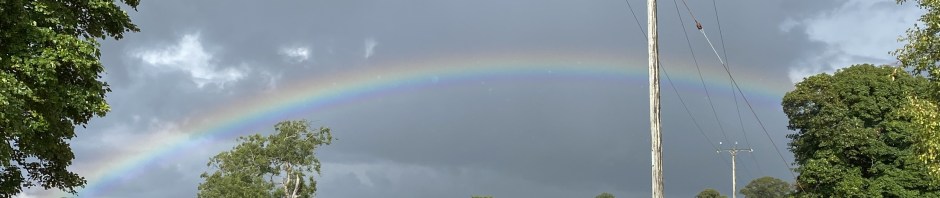
I don’t really have a favourite person of the Trinity. I have all of the favourites, depending on the story, depending on the day, and I know that it doesn’t really matter, because they are all One, and they surround me and sustain me and love me. You know God loves us, right? And when the world is troublesome, and life is weary, and truth is elusive, and freedom like a cloud on the horizon, God is there, in the cloud, in the fire, in the fragile feathers, in the cool breeze, God’s glory humming over all creation like the colours of the rainbow. Amen.