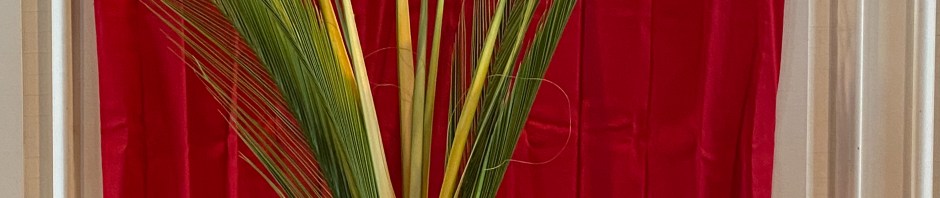
A sermon for Palms and the Passion; John 12:12-16(9-19); the Passion according to Mark
Either side of the palms passage we heard from John this morning, quiet in the background, is Lazarus. Lazarus, we are told, is the reason that such a crowd has gathered to greet Jesus. More: the people who witnessed Lazarus’ return from the tomb have told everyone what they saw, what they smelt, what they heard, what they felt when the tomb was opened and Lazarus emerged from his grave clothes. Mystery and magic are in the air, along with rumours of a Messiah, and the people flock to see what will happen next.
What happens next is apparently the reversal of Lazarus’ miracle. At the beginning of Palm Sunday, the authorities are looking to put Lazarus to death because they cannot comprehend how a dead man can walk, and they are frightened and confused at what this means, that the boundaries between death and life have been breached. And by the end of Holy Week they have hung all of their insecurities and outrage around Jesus neck, and the Romans, with the power of life or death over anyone they choose to occupy, have obliging crucified the people’s Messiah, putting to death not only the man but the miracle, and the magic, and the mobbing of the crowd.
I wonder if all who passed by, demanding that Jesus save himself as he had saved others, were mocking him, or whether some still held out hope that even now, as he had raised Lazarus, he could bring down this cruel system of execution around the ears of the Romans and all who supported the violence that they called peace-keeping.
They still did not understand the breadth and depth of Jesus’ transgression of those boundaries between life and death, that in order to defeat death not only for Lazarus but for all, in order to reverse the injustices not only of the Romans but of all corrupt powers, in order to be fully human, and to reconcile that with his divinity, he had to harrow hell himself, within his own body and blood.
I’m not sure we’ve fully understood it yet.
There is a part of us, isn’t there, that still wants magic; for Jesus to wave his hands and turn water into wine, or wine into water; to take away not only the sting of death but the ache of grief that it leaves in its wake; to come down from the Cross so that we don’t have to walk that way. Otherwise why cry, “Hosanna!”?
Yes, I can get behind that turn in the crowd, that shouts for joy at the raising of Lazarus, and is dumbfounded by the crucifixion of Jesus. “Why don’t you save yourself?” How can you save us, they mean, if you die?
The late theologian Alan E. Lewis puts it this way:
“The world we know is one in which unjust oppressors too regularly hold sway; in which the innocent suffer through disease, disaster, greed, and war; in which the lifelong threat of death, and the pervasiveness of evil, conspire to make belief in a God of love and power impossible.”[i] And on the Cross it looked as though that evil had defeated God. Yet, says Lewis, after St Paul, where sin abounds, God’s grace abounds all the more (Romans 5:12-21).[ii]
To put it another way, when the forces of evil, sin, and death increase so far as to destroy God on the Cross, God does not squash back but expands to encompass even this with grace, with forgiveness, with love. Because it is the nature of God to love, to forgive, to overwhelm sin with grace, it is only by engulfing even those forces that would deny God’s grace with grace that God acts.
So where does that leave us? We are standing in the crowd still, our palm branches in our hands, Hosannas still hovering on our lips, and we are as confused as the next person about how this way of the Cross makes sense. His disciples did not understand these things at first (John 12:16). Turning to Lewis again, he writes, “At the time, not even the closest of his disciples could tolerate or understand the thought of such a denouement to the ministry of Jesus. But faith’s perceptiveness came finally to see that his suffering, cross, and tomb were Christ’s glory and his triumph, the very source and form of his rule and judgement of the world.”[iii]
If we are still looking for a military ruler, or a magician, or a mighty Messiah, we had better look elsewhere. What Jesus offers us is merely the humility, servitude, self-sacrifice, self-abandonment of an all-encompassing, death-defeating love: the creative, life-giving, all-absorbing love of God that will not let us go, nor let us down, nor leave us alone.
I suspect that if there was one person in the crowd who understood, it was Lazarus. He alone had made that journey to the grave and back again, had seen his sisters’ grief and disbelief, had witnessed the wonder and anger of the crowd that saw the boundaries of life and death broken open before them. He understood their bewilderment, since he had experienced things no mortal can properly process. And he knew what Jesus was doing: that he was ready to take Lazarus’ place in the tomb, so as to sanctify even death with his love; so that Lazarus need not be afraid to die again, even if his enemies had their way, because Jesus had overwhelmed their evil designs with his grace, such that even the centurions were won over in the end, their eyes opened and their hearts broken by the knowledge that this, indeed, was the Son, the life of God, that they had nailed to the Cross.
[i] Alan E. Lewis, Between Cross & Resurrection: A Theology of Holy Saturday (Wm B. Eerdmans, 2001), 97
[ii] Lewis, 96-97
[iii] Lewis, 116


 over the water