
Christmas Eve children’s time
Mary and Joseph had a long journey ahead of them, all the way from Nazareth in Galilee down though the wilderness road to Bethlehem. They were tired and they were hungry, they were ready to lie down and rest by the time they reached the city. The sky had grown dark already, and the stars were beginning to appear. Mary was feeling twinges in her tummy, different from the ones she felt when the baby kicked. It was time to find a bed for the night.
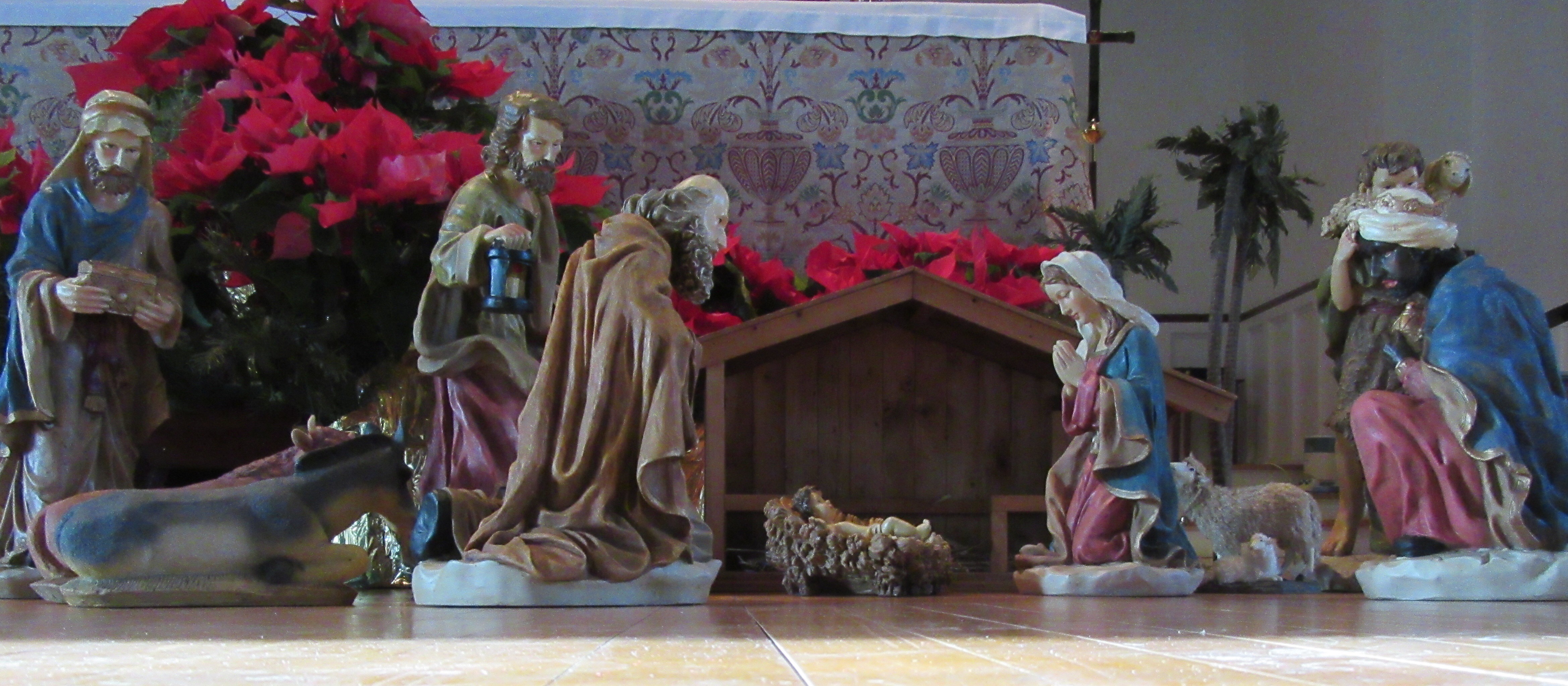
But when they reached the city, the rooms were all full. There was nowhere to lie down except in a stable, a cave used to house animals. Well, if that’s all they had, thought Mary and Joseph, that’s where they would stay. And so they did, and Mary had her baby right there in that stable, and they laid him in a manger, which is a food trough for the animals, because was full of straw and soft enough to put a baby down for a little bit.
Even when there was no room for them, even though no one else would make room for them, the animals shared their space, their warmth, even their food. Amid their soft gentleness, Mary and Joseph found a place to lay their newborn baby, and because of it, those animals were the very first to welcome Jesus into the world. Which just goes to show what miracles can happen when we are kind to one another.
And nearby there were shepherds, keeping watch over their sheep, and suddenly they saw a bright light, and angels singing, and even though they were a bit frightened, they hurried to see what was happening, and so they found Jesus, which just goes to show what we can find when we are a little bit brave.
And in the midst of it all, the baby slept, filled and content with all of the love that surrounded him, and the warmth that enfolded him, and the love of God that had brought him into this place, and that continues to touch us all to this very day.
Christmas Eve, 2023
The angels sang Glory! Peace on earth. We love to tell the story; it takes us back to childhood and a more innocent time. It reminds us, with its carols and its Christmas cards, of the joy of the season – and it should. God is with us; Emmanuel. There is nothing more hopeful and joyful and lasting than that.
But this first, this was no Christmas card journey to Bethlehem. More likely than moonlight on a couple with a few bags and a donkey, this would have been a caravan of displaced people trekking days through the wilderness, ordered south by their occupiers, in order to be registered by their officials. And at the end of the line, crammed and jammed into a town too small for all of its descendants to come home at once, there was no room left, no bed but the floor of a cave strewn with straw for the animals. Even there, they were not safe from the Herods of the world, their envy and gluttony for violence. And it was in the midst of all of this that Mary went into labour with her first child, the difficult one that demands that your body do something it has never done before, achieve the impossible, deliver into the air a whole new living, breathing human being. Impossible, the body says, can’t be done. And yet with God, nothing is impossible.
It is only too easy to see the hardships of incarnation this Christmas. I have not forgotten the atrocities of October 7, nor the hostages that are still missing even after the miracle of Hanukkah. But in Gaza, nearly one percent of the population, and far too many children, have been killed. There is not enough shelter, food, water, humanity. up to 85% of the people are internally displaced, that is, they have been driven from their homes by evacuation orders, and they are not safe when they stay and in danger when they obey. And these, mourned tonight in Bethlehem, are not the only casualties of wars and violence that continue across the globe.
And yet, the angels over the Bethlehem hills cry Glory! And still, they sing of peace, even if it frightens the shepherds half insensible. And still, they speak of God’s good favour, over the birth of one small child in impossible circumstances.
Because that is what incarnation is. It is the enduring sign of God’s love for us, that God would become a child, take on flesh, be born even into a world torn up by oppression and quaking with war and steeped in a tea of its own tears. It is a sign of God’s love for us that in tenderness and innocence, in vulnerability and humility, God became not the heir to a kingly throne but the passing tenant of a stableful of animals. It matters that God chose to come among us not at the head of a battalion of angels come to join in our warring ways, but to be born from within us, to convert us from the inside out into people charged with carrying and feeding and tending to and growing the love of God among us. For with God, nothing will be impossible.
We look at ourselves, we look at one another, and we wonder whether we can, in fact, ever become worthy of that babe in the manger. And in one way, it doesn’t matter. It matters, of course, that we do everything we can to create a world of love for him to grow in, a world of safety for him to explore, a world of peace so that he can learn to sleep through the night; of course that matters. It matters that we practice love as often and as widely as we are able, so that we can give him the best love of which we are capable. But he will come to us whether we are fabulous or whether we fail again and again; he will love us just the same. And that is a heavy responsibility, and a huge relief.
We don’t need to romanticize the Christmas story in order to celebrate it, even now. We don’t need to turn our faces away from the suffering of the world; far from it. This story, this reality, that God is born among us, it is why, when we are torn by strife and worn by grief, yet we gather still to proclaim with the angels the joy of Christmas, the incarnation of the Christ, because this is what life is for: to love God, to love one another, to know ourselves beloved of our Creator and our End; Emmanuel, God with us, come once again to touch our hearts and turn us inside out.


 over the water