A sermon for the tenth Sunday after Pentecost, August 17, 2025
You have heard it said (perhaps you have said it yourself) that we are living in the most divided era of our common and shared country, world, creation, since — well, you name it. What I hear from both Jeremiah and Jesus this morning is that division amongst ourselves does not mean that God is far from us; far from it.
No, Jesus says it is he who brings division, and Jeremiah describes the word of God as a hammer that breaks rocks into pieces, as a fire. “I came to bring fire to the earth,” agrees Jesus, the Word of God made flesh, “and how I wish that it were already kindled.”
We, here at home, are divided along political lines, social fault-lines, shifting like strata in the rock, creating earthquakes and eruptions. We rage like wildfire, burn out with exhaustion. Where, we wonder, is God in all this … mess?
Sometimes it is good to have to wonder. Sometimes that is the thing that draws us back somewhere close to the truth, breaks us open to inspiration. So many of our divisions come from our deep and abiding certainty that we are right, or from our secret fear of being wrong. But you have heard it said (perhaps you yourself have said it on occasion) that Jesus is the Way, and the Truth, and the Life (John 14:6). We do not own nor contain nor define the Truth; it is beyond us. But it is not far from us, and we live in relationship with it, with him: Jesus.
The Word of God is a hammer that breaks open our obstinate hearts of stone so that we may receive it. The Word of God brings fire to purify and parse out the Truth from our preconceived positions.
Perhaps; I can always be wrong.
This, mind you, is not to say that we should accept our divided situation, nor any injustices that have created it, or that it creates; God forbid, far from it. This is not to excuse the damage that our divisions have done to our selves, to our relationships, to the fabric of our society. The injury to our shared humanity that is occasioned by war is unconscionable. No, we know that we are made for peace, created for one another out of love, the very love of God.
We can’t accept this state of division, but we can look for and expect God to be active within it, going about God’s purposes of mercy, of justice, of love. We can try, with God’s help, to align ourselves with Truth and reconciliation.
Sometimes when I am looking for wisdom I turn to the Desert Fathers and Mothers for help in praying to be aligned with God. After all, they lived for years in the wilderness without anything to sustain them except prayer and their closeness to Christ. What, I asked them, would you do with all of this?
I read Certain men once asked the abbot Silvanus, saying, “Under what discipline of life has thou laboured to have come to this wisdom of thine?” And he answering, said, “Never have I suffered to remain in my heart a thought that angered me.”[1]
Which sounds great, but let’s be real, my heart harbours angry thoughts almost as often as I open my iPad. I’ve really cut back on social media; that’s helped some. Still, I had to ask, what did the Desert Fathers know of living with the kinds of provocations that we see on the news daily – and whichever side of the headlines you sit, it is provoking, isn’t it?
I read, The abbot Macarius said, “If we dwell upon the harms that have been wrought on us by men, we amputate from our mind the power of dwelling upon God.”[2]
But what about righteous indignation, I asked them? Wanting to justify myself, I tried one more time: after all, didn’t Jesus himself say he wanted to bring down fire, to burn it all down?
I read, The abbot Agatho said, “If an angry man were to raise the dead, because of his anger he would not please God.”[3]
So much and more from the Desert Fathers.
It is true that the prophet Micah has called us to love mercy, to do justice; he also counsels humility in our walk with God (Micah 6:8). The letter-writer James exhorts us to do the works of our faith; even he counsels that human anger will not bring about the righteousness of God (James 2:14-17; 1:20). Jesus tells us that when we care for the hungry, visit the imprisoned, heal the sick we do it as though to him, and that when we neglect to do so we neglect him (Matthew 25:31-46). He also tells us to love our enemies (Matthew 5:44).
I read, Certain brothers were sitting near the abbot Poemen, and one brother began praising another, saying, “That brother is a good man, for he hates evil.” The old man spoke and said, “And what is it to hate evil?” He knew not how to answer: and himself asked, saying, “Tell me, Father, what is it to hate evil?” And the old man said, “He hates evil, who hates his own sins, and who blesseth and loveth every one of his brethren.”[4]
We live in difficult and divided times, but that doesn’t mean that God is far from us; far from it. The word of the Lord is like a hammer that breaks rocks, hearts of stone, and like a fire that melts them.
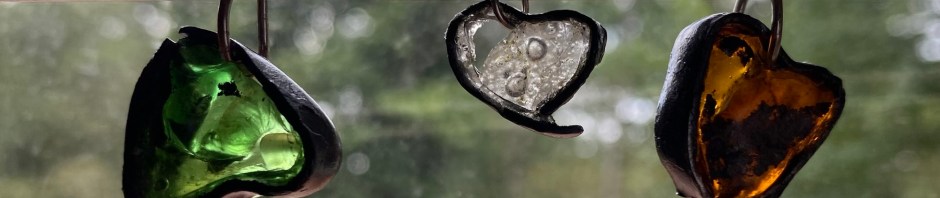
I’ve been working lately on incorporating beach glass into the things I make with my blacksmithing forge. There’s a whole other story about where the metal comes from and why I feel called to transform it into garden tools and crosses, but that’s for another time. The thing about the beach glass is that it has been shattered and scattered, rolled around, scoured and scrubbed, thrown up finally by the waves to settle among the rest of the silica sand.
Mostly, the elements have done the work to break it down; sometimes I help the process along a little further with a light tap of the hammer to help the pieces fit the mould I have in mind for them.
Then, the whole thing goes into the fire. Under the heat of the forge, the broken and disparate, divided fragments of glass melt and fuse and become one with one another, one body, as it were, of art and beauty — if everything goes right.
I came to bring fire to the earth, said Jesus, and how I wish it were already kindled.
Amen. Come, Lord Jesus.
Jeremiah 23:23-29, Luke 12:49-56
[1] Each of these sayings comes from one of a few original sources; the quotations in this homily are all gleaned from the collection contained in The Desert Fathers, by Helen Waddell (Vintage, 1998); this from page 115
[2] The Desert Fathers, 107
[3] The Desert Fathers,103
[4] The Desert Fathers, 149


 over the water