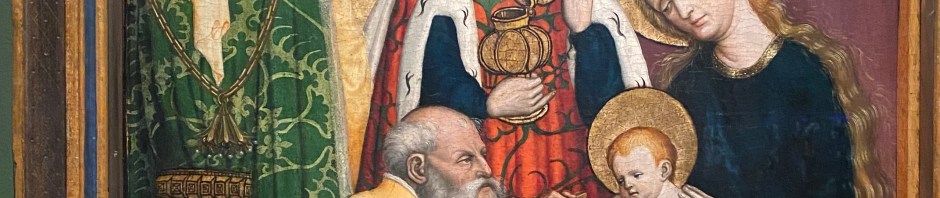
I have probably said this before, but the Gospel story of the visitation of the Magi to the manger of the Christ never mentions three kings, nor their names, nor their camels. It does not specify their country or countries of origin. The traditions of Melchior, Caspar, and Balthazar, kings of such places as India, Persia, and Ethiopia, with which many of us were raised are just that: later traditions, from perhaps five hundred years and more after the events they describe, that attempt to give colour to a scene that is already iridescent with the glory of God.
It is noticeable, too, that other churches in other parts of the world did not adopt the same details: some nominate twelve magi; others give different names to the same three kings, relating to time, place, or revelation.[i]
There is nothing wrong with applying our God-given imagination to God’s revelation, nor to exploring it in art and story, wondering how it might speak to us today. At least, I hope not because I do it all the time. I do wonder, though, why we feel the need so often to defend our embellishments: the kings, the names, the little details, as though they were the point of the story, rather than going back to the source of our revelation, our epiphany, and finding the Christ child there.
In the scripture that we have received, wise ones from the east, magi, travelled to Judea because they had perceived through a sign in the heavens that a new king had been born. We don’t know how many of them there were, nor how large their entourage. They were well-connected and noticeable enough to be introduced to the court of Herod, who was frightened by their portents. The Herod family history was full of palace intrigues, usurpations, and the theft of thrones, so Herod had some reason to be concerned at the announcement of a new king born for God’s people.
The scribes of the people, the wise ones whose revelation came not from the stars but from the diligent and faithful, prayerful study of scripture told the secret assembly that Bethlehem was clearly indicated as the birthplace of the Messiah. So it was that the magi continued their journey informed by God’s word and by the natural revelation of God’s movements within the world, until they came to the place where the child lay with his mother, and word and star stood still together, and all worshipped the Christ child.
This is the centrepiece of the story: that God’s revelation, through God’s word to God’s people throughout the ages, came together with the natural revelation that God as Creator has made known to all people with a heart to hear and see it, so that Jews and Gentiles alike and together might come and know that Christ has been born, not only king of the Jews but saviour of the world, Jesus; that God has come for all people, not only a chosen few, and that the love of God shines out for everyone.
And that God makes that love known by any means possible.
I think that the reason that I thought about our traditions and our embellishments and our insistences on details that we can’t really defend is that as we come to this new year, we know that we face a lot of campaigning, that we will be fed a steady diet of information and partial information, outrage and disinformation, that it will be difficult at times to know what is solid and what has been manipulated to produce the traditional stories that we want to hear. We have all heard of confirmation bias: we want to believe what we have always believed, and we want that to be the truth, never mind if it divides us one from another.
And so it is worth, from time to time and regularly, coming back to the centre, to the child and the manger, to the cross and the empty tomb, to remember that Jesus is the way, and the truth, and our life. To examine the words of scripture and the revelation of God’s love in the world: the patterns of mercy and the economy of grace. To remember that it is where the love of God is revealed in all of its humility and all of its wonder that we find the Christ, God among us, Emmanuel. One might think that whatever does not fit that story is not worth following.
In order to stay on that track, on the trail of truth, we can take some lessons from the unnamed and uncounted wise ones, the magi, who consulted with the heavens, using all of the knowledge and wisdom they could. It was Galileo who declared that, “I do not think it necessary to believe that the same God who gave us our senses, our speech, our intellect, would have put aside the use of these, to teach us instead such things as with their help we could find out for ourselves.”[ii] Galileo, whose proofs of the movements of the planets were considered heresy in his time; yet who knew that God meets us in our world, in our senses and our reason, and helps us to understand our place in creation, and in relation to our Creator.
The magi also consulted the community of faith. First, they came to Jerusalem, and asked all around town where the Messiah was to be born. In humility they did not pretend that their revelation was the beginning and end of that knowledge, but they applied to those they knew to be in close relationship with God and with the scriptures. Galileo, again, writing that, “Holy Scripture and Nature are both emanations from the divine word: the former dictated by the Holy Spirit, the latter the observant executrix of God’s commands.”[iii] In turning to the scribes of the scriptures, the magi were seeking the source material for their star. When Herod summoned them, then, they followed his direction, but with discretion; when God told them not to return to Herod, they left for home by another road.
Full circle, then: they examined the ways in which God had already revealed Godself to them; they consulted with the community of faith; they examined within that community the words of scripture; they listened always for the whisper of God in their dreams, so as not to stray too far, nor be seduced by the false friendship of Herod. They worshipped the Christ.
It isn’t bad advice for a Christian life in the midst of a noisy world: listen for God, expect to find God in our daily lives and experience; consult closely with the community of faith; study the scriptures; pray without ceasing; listen for the whispers of God in the night; do not be seduced by the trappings of power, but remember the Christ child, humble and full of glory, God among us, always.
[i] https://www.stcatherinercc.org/single-post/2020/01/01/where-do-we-get-the-names-of-the-three-magi
[ii] As quoted in Dava Sobel, Galileo’s Daughter: A Drama of Science, Faith and Love (Fourth Estate, 1999), 65
[iii] Ibid, 64


 over the water