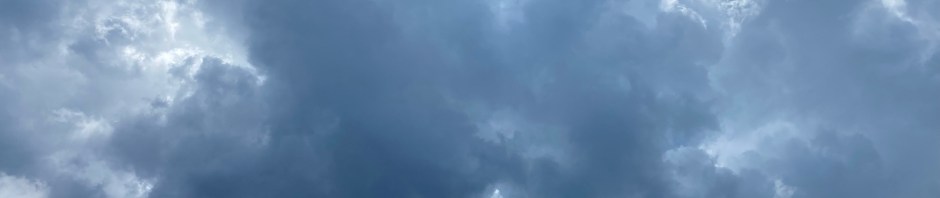
Did you see the sun this morning? It was as pale and flat and solid as a full moon. Still, I didn’t dare watch it for too long, in case the misty clouds should suddenly part and its full brightness shine through. It did seem fitting, though, to go with this morning’s Gospel. And there is something fitting about beginning our church year with the end of the world. The first Sunday of Advent, a new beginning, and what do we read but the apocalypse recorded by Mark. I am reminded of an old saying of my mother’s: “Is that a threat or a promise?”
In part, perhaps it is a warning: that Christianity is not a meagre undertaking. I was going to say “not for the faint of heart”, but of course it is for the fearful and the feeble as much as for the strong and the brave, maybe even more so; it specializes in lost sheep. But it is no small thing, to wait eagerly anticipating not only the infant in the manger but the man on the cross; not only the resurrection, but the trials that precede it; not only epiphany, but betrayal and heartbreak, too.
And it is a promise, too, that all of this, all of it brings to birth God’s new creation, God’s completion of the creation in which we yearn and labour for the time being. “Heaven and earth will pass away,” Jesus says, “but my words will not pass away,” proclaims the very Word of God. In other words, “I am with you, to the end of the ages,” and beyond. As surely as day follows night, and springtime emerges from winter, and the green shoots unfurl toward the sun, so sure is the constancy of God’s presence with us, God’s love toward us.
When Jesus told his disciples this tale of apocalypse and destruction, they were already in the midst of it. Overrun by successive empires, beaten down and about to witness worse, in the destruction of their Temple, the disciples and all of the peoples of Galilee and Judea wondered how much they could bear before the reign of God might break in and save them. Perhaps, like us, they turned to the prophet Isaiah, who confesses that we have sinned, we have transgressed, we are living with our own iniquities; and who appeals to God who has created us to rescue us from all that we have miscreated.
We know all too well the harm that we have wrought, miscreated with our weapons and with our well-intentioned or unintentioned technology. We have made it so that the world can be effectively ended with the push of a few buttons’ worth of code. We have made it so that worlds are ended regularly within our homes and families, where deadly weapons share space with cribs and swaddling clothes. Little apocalypses abound in every corner of the earth, some making more news than others. We have made it so that we wonder how long we can rely on the seasons to come in their turn, so far have we perverted the planet and its climate from the natural order of creation with our consumption. We wonder, in a whisper, is this really, now, the end of the world?
In the apocalypse that Jesus describes, the sun, moon, and stars are shaken out of their usual routine and function by the opening of heaven. But this is not a catastrophe, a failure of the light; rather, the created order and its finite light is overwhelmed and outshone by the inbreaking of the glory of God. Angels stream from the clouds like rays of a sun seventy-seven times brighter than the one we have known. They permeate the ends of the earth, the most hidden places, seeking out those whom God loves, to gather them, to save them from all of the afflictions that our iniquities have inflicted upon this creation. This apocalypse is not a threat but a promise. The visitation of God can never be anything less.
When Jesus advises his disciples to keep awake, to stay alert for this reordering of all that is and all that will be, it is not a threat, but a promise that however long it seems to be taking, however close the edge they might seem to have come, Christ is still coming. Emmanuel, God with us, is on the way, just as spring follows winter, and sometimes more than once in a season in Cleveland. It is an encouragement not to give up.
Not to give up on our stewardship of creation, because it is God’s creation, and God’s gift to us. Not to give up on the way of love, because it is the only way to walk in the footsteps of Jesus. Not to give up on mercy, because God’s mercy endures forever. Heaven and earth may pass away, but Gods’ mercy endures forever. Not to give up hope, even when it seems as though the end of the world is upon us. Because in Advent while we are waiting for the birth of the Christ child and the coming of the Messiah, he is already with us. And he has promised that will not change, though the stars fall from the sky; from the beginning through whatever ends, he is with us, the Word of God that will not pass away, but renews God’s promises season by season, constant and ever new, like the leaves unfurling on the shoots that even now wait beneath the earth for the warmth that comes when the world turns.
The readings for the First Sunday of Advent include Mark 13:24-37


 over the water